Bakekujira and Japan’s Whale Cults

Mizuki_Shigeru_Bakekujira

Translated and Sourced from Mizuki Shigeru’s Mujyara, Kaii Yokai Densho Database, Japanese Wikipedia, and Other Sources

Legends of a Great White Whale usually bring to mind Moby Dick, but the white of this whale is the color of its bones. For bones are all you can see of the Bakekujira—a massive, skeletal baleen whale that appeared and disappeared under mysterious circumstances once of the coast of Japan. Is it a monster? Is it a ghost? Is it a god? No one really knows for sure.

What Does Bakekujira (化鯨) Mean?

Bakekujira’s name is the same as many magical animals in Japanese folklore, with a difference of nuance. For most bake- creatures (bakeneko, bakenezumi, etc … ) the kanji 化 (bake; change) refers to a transformation, the ability to shift from one form to another. In Bakekujira—化 (bake; change) +鯨 (kujira; whale)—bake does not refer to a transformation. It just sounds scary and bizarre. This is one instance where translating bakekujira as “ghost whale” or “goblin whale” instead of “transforming whale” would be perfectly appropriate.

Inland Whaling2 Ukiyoe

The Tale of the Bakekujira

One rainy night, something massive and white appeared off the coast of Okino Island, Shimane prefecture. Fishermen from the village watched it get closer and closer, and finally decided to take a rowboat out and see what it was. From its size, they knew it must be some sort of whale, but no one had seen a whale like that before. As they rowed out their boat, they saw the waters of the ocean glimmer with thousands upon thousands of fish, the likes of which they had never seen.

As they neared the white whale, one of the fisherman threw his harpoon and it passed through the mass of white unnoticed. Their vision obscured by the pounding rain, the fishermen finally got a good look at the monster—it was the skeleton of a great baleen whale, without an ounce of skin nor meat on it. But it was moving and alive.

The men were terrified, even more so because the ocean was writhing with unknown fish, and the skies were filled with strange birds. In the distance they saw an island that hadn’t been there before, as if they had rowed into some mysterious country. Then suddenly the vision ended, and the massive bakekujira—for that is what they called it—retreated back to the open sea as quickly as it had come.

When the fishermen went back to shore, they speculated that it might have been the ghost of a whale killed in a hunt or some strange god. Whatever it was, the bakekujira was never seen again.

The History of the Bakekujira

That’s it. There is that one story of the one appearance of the bakekujira, and that is the sum total of knowledge on the boney beastie. Anything else you read about the bakekujira is pretty much just made up to try and fill in the gaps.

In fact, for being so well-known in the modern world, the bakekujira is a limited and obscure yokai. It wasn’t important enough to be added to Toriyama Sekien’s numerous Edo-period yokai collections; there aren’t any ukiyo-e prints or kaidan collections including the bakekujira—at least not that I could find when I was researching for this article. In fact, the first mention I could find of the bakekujira was from Mizuki Shigeru, whose cool character design seems largely (solely?) responsible for the bakekujira being known today.

But Japan does have a long history of whale gods and venerated bones, to which the bakekujira fits in nicely. So allow me to segue to another aspect of Japanese folklore—the Whale Cults of Japan.

Hyochakushin – The Drifting Ashore God

Whale God Ukiyoe

In pre-seafaring Japan—before Samurai William brought the secret of keels and ocean-going vessels—fishermen were limited to the coastal waters their small ships could take them too. They eked out a subsistence living harvesting what was in reach. But every now and then, the oceans would deliver a bounty beyond imagination.

Whales would sometimes come inland, or beach themselves on the shore. Fishermen hunted these whales in a practice called Passive Whaling, using harpoons to kill the whale that was trapped in the shallows. This was a rare and auspicious event—a single whale provided vast amounts of meat and resources for the village, and seemed like a gift from the gods. And the whale itself was only a piece of the bounty. Whales often came in following larges schools of fish, so their arrival meant an abundance of sea life beyond the leviathan itself. The arrival of a whale could save a village teetering on the edge of starvation and ruin. It was mana from the oceans.

Passive Whaling Ukiyoe

Like modern Cargo Cults, the villagers could not understand from where or why the whale came in to shore. They only knew that a whale meant wealth and rare full stomachs. Whales were considered to be embodied deities (神体; shintai), and whale religions sprang up in coastal villages, called Hyochakushin (漂着神; Drifting Ashore God) or Yorikami Shinkyo (寄り神信仰; The Religion of the Visiting Kami).

The Whale and Ebisu

These original whale cults were primitive. The people praying generally had one request—send more whales. But in time they evolved. Like many religions, the Whale Cults in Japan were built on a portion of respect and gratitude and a portion of fear. Because whaling—even Passive Whaling—was a dangerous operation, some whale religions also saw in whales the ability to be malevolent gods, and prayed to appease their spirits and assuage their wrath. Bad storms of poor catches could mean an angry whale god, and nobody wanted that.

In time, these whale religions merged with another, more popular deity, the god of abundance Ebisu. Whales were first thought to be emissaries of Ebisu, and then became considered to be an incarnation of Ebisu himself. Because whales were thought to have the power to control fish, fishermen began carrying images of the god Ebisu as a whale to give them the same fish-controlling powers.

Kujira Jinjya – Whale Shrines

120713_1102

When you have feasted on the body of a god, it only makes sense to give the leftovers a proper burial. After stripping the body of everything useful, villagers buried the whale carcass in mounds called Kujira Tsuga (鯨塚; whale mounds). Kujira Tsuga were capped with monuments of some sort, varying from carved stone tablets to pagodas to small wooden or rock shrines. Often these Kujira Tsuga were created in memory of some particularly bountiful harvest, and annual festivals where held like the Daihyo Tsuifuku (大漁追福; Big Catch Memorial Service). Or people prayed to the Kujira Tsuga for Kaijyo Anzen Kito (海上安全祈祷; Prayers to Ensure Safety at Sea).

Places where passive whaling was more prevalent also had Kujira Haka (鯨墓; whale graveyards) and Kujira Ishibumi (鯨碑; whale stone monuments). There are about 100 known whale graveyards throughout Japan.

Many Kujira Tsuga have their own legends and myths. In Miyagi prefecture, Kesenmema city, Karakuwa town, a legend is told of a ship foundering in the storm that was approached by two massive, white whales. The two whales swam to either side of the ship and steadied it, guiding it into port before sailing away. From that day forward, the citizens of Karakuwa down abandoned their ancient custom of whale eating.

The legend is attached to the MIsaki Shrine in Karakuwa, but the connection is not exactly accurate. Misaki Shrine is an old Kujira Tsuga, raised over a whale corpse and topped with a stone monument expressing gratitude for the whale’s death.

In Ehime prefecture, Seiyo city, Akehama town there are three known Kujira Tsuga, one of which is high up in the mountains. The shrine is ancient, and overlooks the ocean. It now sits along the national highway route making it much more accessible. Hauling up that carcass must have been quite the event.

On June 21st, 1837 (Tenpo 8th), a massive whale came to shore directly underneath this shrine. This was during the Great Tenpo Famine, and the whale saved the entire area from starvation. The villagers gave the whale a posthumous Buddhist name, meaning roughly “The Great Whale Scholar of the Universe who Brings Health.” That was extremely rare at the time, as posthumous Buddhist names was an honor reserved for great lords. The shrine is still honored by the villagers today

Whalebone Tori Gates

Whalebone Tori Japan

By the Edo period, Japan had become a seafaring nation and created a whaling industry and culture. Whaling Associations established and maintained official Whale Shrines in coastal areas, many of which still exist today. Whale shrines were also built in Taiwan when it was under Japanese rule, usually dedicated to Ebisu.

The most dramatic of these have Whalebone Tori gates—the picturesque post-and-lintel design that signifies the presence of a kami spirit.. The oldest Whalebone Tori is in Wakayama prefecture, Taijicho town, called the Arch of Ebisu. Ihara Saikaku mentions this Tori in his book Nippon Eitaigura (日本永代蔵; Japan’s Warehouse of Eternity; 1688). The tori is probably much older, however. The newest whalebone tori is in Nagasaki, Shinkamigostocho town at the Kaido Jinjya (Shrine of the Sea). Dedicated in 1973, it was built by the Japan Whaling Association.

Nirai Kanai

In an odd and unrelated Okinawan legend, a whale dressed in a kimono was said to have brought the secrets of rice cultivation to Japan. You can read more about this in my article on Nirai Kanai.

The Curse of the Bakekujira

Island Whale Ukiyoe

There are two odd footnotes to the story of the bakekujira, that don’t really fit in anywhere else so I am sticking them on here at the end.

In the 1950s, manga artist Mizuki Shigeru was working on a kamishibai story about the bakekujira, and also eating a lot of whale meat. He suddenly came down with a terrible fever, that only stopped when he quit working on the story. He calls this the “Curse of the Bakekujira.”

In 1983, an intact whale skeleton was spotted floating off the shores of Anamizu, Ishikawa prefecture. The press jumped on the story naming it a “real-life bakekujira.”

Translator’s Note:

This article was done at the request of comic book writer Brandon Seifert, who does the incredibly cool folklore/horror comic Witch Doctor, as well as other things. If you are a folklore fan, I highly recommend his work. And look for the bakekujira to possibly pop up his boney head in one of Seifert’s upcoming comics!

Further Reading:

For more tales of ocean-going yokai, check out:

Umibozu – The Sea Monk

Funa Yurei

Nirai Kanai

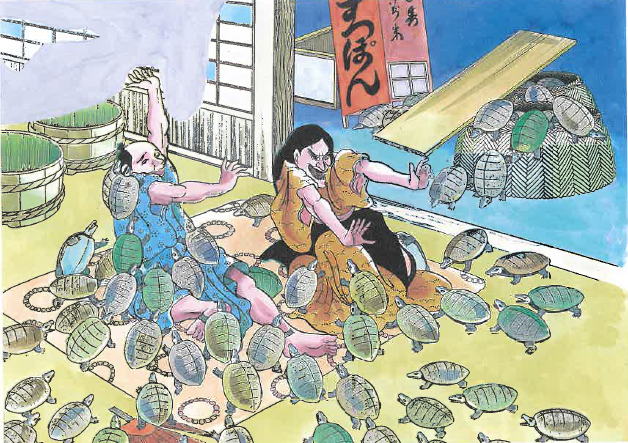
The Appearance of the Spirit Turtle

Tesso – The Iron Rat

Mizuki_Shigeru_Tesso_Iron_Rat

Translated and Sourced from Mizuki Shigeru’s Mujyara, Kaii Yokai Densho Database, Japanese Wikipedia, and Other Sources

In Japanese folklore, if you make a promise you had better keep it—even if you are the Emperor of Japan. Otherwise, the person you betrayed might hold it against you and transform into a giant rat with iron claws and teeth and kill your first-born son. That is the story of the Emperor Shirakawa, his son Prince Taruhito, and the Abbot of Miidera temple Raigo—better known as Tesso, the Iron Rat; or more simply as Raigo the Rat.

What Does Tesso Mean?

The kanji for Tesso is about as straight-forward as you can get. 鉄 (te; iron) +鼠 (sso; rat). The name Tesso was given to this yokai by artist Toriyama Sekien in his yokai collection Gazu Hyakki Yako (画図百鬼夜行; The Illustrated Night Parade of a Hundred Demons,), although the character is much older.

SekienTesso

Toriyama’s Text: The Abbot Raigo transformed into a monsterous rat.

Tesso is different from many yokai in that he is a singular character. There is only one Tesso. Until Toriyama came up with the much cooler name for his collection, Tesso was known as Raigo Nezumi (頼豪鼠), meaning Raigo the Rat.

The Story of Raigo the Rat

The tale begins with the Emperor Shirakawa, who was desperate for an heir to his throne. He enlisted the aid of the Abbot of Miidera temple, a powerful Buddhist monk named Raigo. Emperor Shirakawa promised Raigo vast rewards if he could use his spiritual powers to give the Emperor a son. Accepting the offer, Raigo threw himself into meditation and prayer and magic. Soon enough a son was born to Emperor Shirakawa, the Prince Taruhito.

Yoshitoshi_The_Priest_Raigo_of_Mii_Temple

Raigo went to the Emperor for his promised reward, and asked only for the funds to build an ordainment platform at his temple of Miidera. The Emperor was too happy to oblige, until temple politics interfered.

Miidera had a rival temple, the powerful Enraku-ji in Mt. Hiei in Kyoto. The monks of Enraku-ji were not normal, peaceful monks, but a terrible army of militant warriors feared across all Japan. It was said the Emperor could influence all on Earth except three things—the blowing of the wind, the rolling of dice in a cup, and the monks of Enraku-ji. Even though they were both of the Tendai sect of Buddhism, Miidera and Enraku-ji has split into different factions after the death of their founder. Enraku-ji was not about to allow new Tendai monks to be ordained at Miidera, a privilege they reserved for themselves.

The Emperor had no choice but to break his promise to Raigo. He asked if there was anything else he could give, but Raigo was adamant. So adamant, in fact, that he went on a hunger strike and died after 100 days, cursing the Emperor with his final breath. At the house of his death, a figure in white was said to have appeared beside the cradle of the 4-year old Prince Taruhito, who died soon afterward. What Raigo had given, Raigo had taken away.

What happened next was strange—up until now this is the usual ghost story with Raigo returning as a yurei. But the tale does not end there. Raigo used black magic to ensure he was reborn after death as a dread yokai. He twisted his body into the form of a giant rat as large as a man, with a body as strong as stone and with claws and teeth or iron.

The newly-named Raigo the Rat invaded Enraku-ji with an army of rats, devouring their rare and valuable Buddhist scriptures, and even eating statues of the of the Buddha himself. This reign of rat-terror when on until a shrine was built to appease Raigo, transforming him from a deadly emissary of vengeance into a protecting kami spirit. Because that’s how evil spirits roll in Heian-period Japanese folklore.

Raigo the Onryo

Old texts describe Raigo as an onryo, the name for the grudge-bearing spirit popular in Japanese horror films. Raigo wouldn’t be seen as an onryo nowadays—his transformation into a rat makes him more of a monster than a ghost. But in the Heian period the word onryo had a more specific meaning, being something with a grudge against the Emperor of member of the Imperial family. And that label suits Raigo just fine.

Raigo and the Heike Monogatari

The story of Raigo comes from the Heike Monogatari (平家物語; Tale of the Heike) an epic poem from the Heian period that tells of the Heike/Taira wars that split Japan as two factions struggled for the throne. The Heike Monogatari is often called Japan’s version of The Odyssey, freely mixing historical fact with the supernatural and mythological.

Because the Heike Monogatari comes from an oral storytelling tradition, there are multiple versions of it with variations of the story of Raigo the Rat. In one of the older versions—the Engyo Hon (延慶本; Book of the Engyo Period), the story ends with the death of Prince Taruhito. In later versions Raigo gets more and more monstrous. The 48-volume Genpei Seisuiki version has Raigo attacking Enraku-ji with his army of rats, and in the 14th century historical epic Taiheiki (太平記; Record of the Great Peace) Raigo is described as having a body of stone and claws and teeth of iron. This Raigo ate not only the sacred texts of Enrakuji, but also their statue of Buddha.

Other Tales of Raigo

Raigo the Rat was a popular enough character that other writers continued the story after the Heike Monogatari. For example, a collection of Tanka poems from Otsu city, Shiga prefecture called Kyoka Hyakumonogatari (狂歌百物語; A Hundred Stories of Satirical Poems) featured the poem Raigo of Miidera and retold the story from the Heike Monogatari.

During the Edo period, author Gyokutei Bakin wrote the story Raigo Ajari Kaisoden (寺門伝記補録; The Tale of the Abbot Raigo who Transformed into a Monsterous Rat), illustrated by famous ukiyo-e artist Katsushika Hokusai.

Raigo_Ajari_Kaisoden

Gyokutei puts Raigo into a different historical narrative, telling the story of Shimizu Yoshitaka (also known as Minamoto no Yoshitaka), the orphaned son of Minamoto no Yoshihara. Yoshitaka was on a pilgrimage of holy sites when he had a vision of the Raigo, who told Yoshitaka he would teach him the secrets of black magic and help him amass an army to take vengeance against his father’s killers. All Yoshitaka has to do is write an official request for help, and place it before Raigo’s shrine along with a donation.

Yoshitaka does as requested (of course), and soon finds himself in possession of Raigo’s shape-changing ability and mastery over rats. As an additional twist, Yoshitaka is hunted by Nekoma Mitsuzane (who’s name ironically begins with the kanji for “cat” in a traditional cat-and-mouse game). In one scene, Nekoma finds Yoshitaka and is about to kill him when a massive rat leaps to Yoshitaka’s defense. In another scene, Nekoma is torturing Yoshitaka’s mother-in-law and Yoshitaka leads and army of rats to her defense, saving the day.

Hundreds of years later, Raigo still has a hold on the popular imagination. Modern author Kyogoku Natsuhiko used the story of Raigo as the basis for his mystery novel “Tesso no Ori” (鉄鼠の檻; The Cage of the Tesso).

The Historical Raigo

Although the tale of Raigo the Rat is fictional, most of the key players are historically verified. Shrine records show Raigo was the Abbot of Miidera, and at one time petitioned Emperor Shirakawa for funds to build an ordination platform—a petition that was denied. There is little doubt that rival temple Enraku-ji played some hand in the denial. At the time, Enraku-ji’s power was absolute.

The only person not involved in the affair was Prince Taruhito. Records put the young Prince’s death in 1077, while Raigo himself died in 1084. This contradicts the facts of the legend.

Hokusai_Tesso_Monster_Rat

Rats, of course, were an actual source of fear to the fragile book collections of temples across all of Japan. So it is no wonder that a double-punch of an angry spirit and a scroll-eating rat was a natural mixture for Kaidan.

Tesso Shrines

There are a couple of supposed shrines to Raigo, each claiming to be THE shrine that ended Raigo’s scroll-devouring revenge.

In Hyoshi Taisha, in the Sakamoto district of Otsu city, Shiga prefecture, there is a shrine called the Shrine of the Rat that some connect to Raigo. Shrine records, however, say that the shrine is dedicated to the Rat God of the Chinese Zodiac and not to Raigo.

Tesso Shrine of the Rat

Miidera shrine has the most obvious connection, and has a small monument and shrine dedicated to Raigo also called the Shrine of the Rat. This shrine faces directly at Mt. Hiei in Kyoto and is said to be placed in defiance of Enraku-ji’s role in Raigo’s curse.

However, Mt. Hiei has their own shrine—the Shrine of the Cat—that looks directly at Miidera. Some suspect the two shrines are connected by an older legend of a monk who summoned a giant cat to destroy a giant rat that was menacing the area.

In truth, probably both of these Shrines of the Rat were re-dedicated to suit interests in the story. Like Relics in Catholic churches, a shrine or artifact connected to a popular legend can mean tasty tourist dollars and neither Buddhist temples nor Shinto shrines never let the facts get in the way of a good story. Especially one that attracted tourists.

Translator’s Note:

This was translated for Mike Mignola, who picked out Tesso from a copy of Mizuki Shigeru’s Mujyara that I showed him at Emerald City Comic Con. Mignola liked the illustration of Tesso, and I am only too happy to give him the story behind the image.

Plus, I did a lot of cats last year. It is only fair that at least one rat gets to appear as well.

Gotokoneko – The Trivet Cat

Gotokoneko_Mizuki_Shigeru

Translated and Sourced from Mizuki Shigeru’s Mujyara and Japanese Wikipedia

If you wake up on a cold morning to see a fire mysteriously roaring in what should be a cold fireplace, don’t be afraid. It just means the gotokoneko has been by, stoking up the hearth into a nice, satisfying, roaring blaze. Just the kind this magical cat enjoys.

Gotokoneko the Fire Builder

A type of nekomata, the gotokoneko has the split-tail and advanced age of all its kind. But the difference from average nekomata is the gotokoneko’s love of fire. Most animals—magical or otherwise—are naturally terrified of fire. They enjoy the warmth, but fear the flames. The gotokoneko is not only not afraid of fire, but is often found stoking up the fire in a cold hearth, using a hifuki-dake, a bamboo blowing tube, to coax flames from the coals.

The gotokoneko is not the only cat-yokai associated with fire—the kasha is a flame-wrapped cat demon who drags corpses to hell. Kasha and some bakeneko are said to be able to transform into hi-no-tama fireballs. Even the eyes of ordinary cats are said to be able to capture fire within them, sparkling in the dark. But of all the various cat demons and magical cats only the gotokoneko will actually sit down at a hearth and busy itself with the process of making a fire.

What is a Gotoko?

In traditional Japanese homes, trivets (gotoko) were often found near the sunken hearth. Hot utensils from the fire — like tea kettles or pots and pan — were set on trivets so as not to char the tatami mats. As the name implies, the gotokoneko wears a trivet on his head like a hat.

Trivet

In his book Mujyara, Mizuki Shigeru points out that nobody knows why the gotokoneko wears a trivet on its head. It just does.

The History of the Gotokoneko

The gotokoneko first known appearance is in Tomi Mitsunobu’s Muromachi-period yokai collection Hyakki Yagyo Emaki (百鬼夜行絵巻; Illustrated Scroll of the Night Parade of 100 Demons). There is no description of the yokai, just a background figure of a cat marching in the Night Parade with a trivet on its head. It is thought that later artists copies this trivet-wearing cat and developed a mythology to go along with it.

The gotokoneko next appeared in Toriyama Seiken’s Edo-period Hyakki Tsurezure Bukuro (百器徒然袋, A Bag of 100 Tedious Objects). Toriyama made a pun in the title of this collection, replacing the kanji –ki (鬼; demon) with the homophone –ki (器; objects). Sure enough, most of the yokai in this collection are either tsukumogami—a type of yokai that is an ordinary object come to life—or are associated with some object like the gotokoneko with the trivet on its head.

And Toriyama was nowhere near finished with his puns.

The Five Virtues

SekienGotoku-neko

Toriyama wrote on his illustration:

“As the man who danced the Dance of the Seven Virtues forgot two of them, perhaps you will also forget this cat or think it just a dream.”

He makes both an allusion and a pun. Because the term “gotoko” refers to the trivet, but it also can mean “The Five Virtues. “ This is a reference to an old story by Shinano no Zenji Yukinaga.

In the story, a man is supposed to dance the Dance of the Seven Virtues—embodying all of the manly virtues required to be a warrior –before the Tang Emperor of China. Unfortunately, the man has forgotten two of the virtues. He figures if he can’t remember them, no one else will either, and announces his “Dance of the Five Virtues” that he then performs magnificently.

So Toriyama is making a pun, drawing a link between the object gotoko and the Five Virtues gotoko. This leads to the gotokoneko sometimes being translated into English as the “Five Virtues Cat,” but that is not correct. Aside from the homophone of the name, the gotokoneko is clearly not an embodiment of manly virtues, but is at home in front of a hearth, blowing his bamboo tube to stroke the flames, and wearing a trivet on its head.

Translator’s Note:

Another magical cat story! And just when I think I know them all, I find a new one to write about. The gotokoneko is a pretty rare beast—I don’t think he shows up much outside of Toriyama and Mizuki Shigeru. But I could be wrong.

The kanji for gotokoneko is exactly the pun Toriyama created. Go (五; Five) + to (徳; Virtues) + Neko (猫; cat). It is rare in Japanese for homophones to share the same kanji, but that is exactly the case here. However, the “trivet” version of the word is far more common than the “Five Virtues” version.

Further Reading

For more magical cat stories, check out

Nekomata – The Split Tailed Cat

Bakeneko – The Changing Cat

Kasha – The Corpse-eating Fire Demon

Bakeneko Yujo – The Bakeneko Prostitutes of Edo

Iriomote Oyamaneko – The Iriomote Great Mountain Cat

The Cat’s Grave

Bakeneko Yujo – The Bakeneko Prostitutes of Edo

Sourced and Translated from Japanese Wikipedia and Other Sources

After enjoying the delights of one of the famed courtesans of the Yoshiwara pleasure district, a young samurai settles into his futon to sleep off his illicit encounter. But in the middle of the night he suddenly awakens, and sees his beautiful companion hunched over a rotting fishbone, stripping the flesh away with her teeth. The dim lantern-light casts an inhuman, cat-like shadown on the wall. The samurai shudders with the knowledge that he has passed the night with no human being, but one of the dreaded bakeneko prostitutes of Edo.

The bakeneko prostitutes were a common urban legend / folklore during the Edo period. Stories of them appeared in kiboshi illustrated storybooks, sharenbon accounts of the pleasure districts, kabuki plays, and in ukiyo-e woodblock prints.

Most stories follow the same basic pattern—a customer of one of the beautiful courtesans spends a night in pleasure, then curls up to sleep. He is awoken in the middle of the night to see the woman dimly outlined, either with the head of a cat or casting a cat-like shadow, while gorging herself on fish or other sea food popular with cats.

Most of the stories stop there, but darker legends continue with the yokai prostitute then turning to slake her hunger on some human meat, provided by the customer of course.

The Bakeneko Serving Maid of Shinagawa

The bakeneko prostitute legend is thought to have begun as a rumor—or urban legend if you like—of a bakeneko working as a meshimori onna, a type of low-rent waitress/maid/prostitute, at the Ise Inn in the Shinagawa-juku area of Edo, one of the fifty-three stations of the Tōkaidō sea highway.

The gossip spread as gossip does, and soon enough people were writing about it with a fervor. In 1775, “The Courage of Genji at the Sumo Tournament” has a scene with a bakeneko prostitute scattering fish all over the room with her mouth. This scene was adapted into an ukiyo-e woodblock print, with what looks to be a human arm. Whether this is part of her costume or her meal is left up to the imagination of the viewer.

The legend appeared in rapid succession slightly re-told in several books. In 1776 it appeared in Urikotoba (The Words of Seller), and in 1798 in Haratsuzumi (Belly-drumming), which has the bakeneko prostitute chomping on shrimp. In 1796, one of the scarier legends from the book Koame Shuame Miko Matsukasu (Anticipation of Things Seen in the Rain) tells of the customer peeping in on his companion to see her in cat-form gnawing on a human arm.

The stories were often told as true accounts, as traveler’s tales of wanderers who stayed at the inn and survived an encounter with the supernatural creature.

The Bakeneko Prostitutes of Edo

Interpretations of the story changed over time, and spread away from Shinagawa to the Yoshiwara pleasure districts of Edo. More rumors of bakeneko prostitutes spread, but instead of a creature of horror they attracted fascination—customers went in search of any ladies of the night rumored to be bakeneko in disguise. Artists sold prints of samurai walking with their bakeneko mistress happily in tow, not at all bothering to disguise her cat head.

Ever the clever businesswomen, the courtesans of Yoshiwara were quick to capitalize on this new fad. Many adopted names that ended with –no, such as kono – because that was reminiscent of the name of the famed serving wench of Ise inn. Women kept cats as pets, and plied their companions for expensive fish and seafood treats, anything to play up the image and create the mystique that their companion for the night was something more than human.

Truth Behind the Legend?

Like with many yokai, there have been attempts to rationalize the story of the bakeneko prostitutes with actual history. The most popular account is the most simple—it was considered bad manners for courtesans to eat in front of their customers. The women were there for the man’s pleasure, and so while men could feast and drink all night, their women had to suppress their own hunger. Once the customer was snoozing, I’m sure many a clever woman took advantage of the time to snatch some leftover nibbles from whatever had been on the menu. And the hunched over posture, trying to hide the illicit snacks, could have appeared as a cat to a tired, drunken man awakening in the middle of the night.

Neko or Neko?

A further connection between cats and sex lies in the word neko. Cat in Japanese is neko, using the kanj i猫. But you can also use the kanji 寝子 (ne ; sleeping + ko; young girl) to draw an obvious allusion to the delights of the Yoshiwara.

Modern Cat Girls

An obvious connection can be drawn between the bakeneko prostitutes of Edo and the modern cat-girl phenomenon. Japanese comics, animation, and video games are filled with cat-eared and cat-tailed girls who can transform into cats like a true bakeneko. And real-life girls even buy nekomimi “cat ears” to wear as accessories. What people think of as a modern fad actually has deep historical roots.

Japanese men have been attracted to cat-creaztures for hundreds of years. And it isn’t likely to go away anytime soon.

Translator’s Note

I found this legend while I was doing research for my bakeneko article, and I promised I would give a deeper account of it someday. So here it is! This legend shows how deeply people believed in the reality of yokai and the supernatural during the Edo period. Many took the rumors at face value, and spent good money for the chance to spend the night with what they believed to be a supernatural creature.

Further reading:

Read more yokai magical animal tales on hyakumonogatari.com:

Bakeneko – The Changing Cats

Kasha – The Corpse-Eating Cat Demon

Nekomata – The Split-Tailed Cat

The Cat’s Grave

The Tanuki and the White Snake

The Appearance of the Spirit Turtle

Baku – The Dream Eater

Translated from Mizuki Shigeru’s Mujara and Japanese Wikipedia

When a child in Japan wakes shaking from a nightmare, she knows what to do. Hugging her face in her pillow, she whispers three times “Baku-san, come eat my dream. Baku-san, come eat my dream. Baku-san, come eat my dream.” If her request is granted, the monstrous baku will come into her room and suck the bad dream away. But the baku cannot be summoned without caution. A too-hungry baku might not be satiated with a single dream, and might suck away her hopes and ambitions along with it, leaving her hollow.

What is a Baku?

Baku are classic chimera; the body of a bear, the nose of an elephant, the feet of a tiger, the tail of an ox, and the eyes of a rhinoceros. One legend says that when the gods were finished creating the animals, they took all of the odds and ends lying around and put them together to make the baku.

According to Japanese legend, baku are the eaters of bad dreams. They are a talismanic figure, that people pray to at night to come and suck away nightmares so that they may never be seen again. But there is a darker side to the baku; some say that baku eat all dreams, not only nightmares. This includes dreams of aspiration, dreams of your future, and dreams of hope.

Is the Baku Real?

While they are wildly stylized, baku resemble the Asian tapir. And in fact, in Japanese they share the same name and kanji (獏). The baku is not alone in this; the word kirin is not only Japanese for giraffe but also a mythical Chinese monster.

Which came first—the legend or the animal—is hidden in the past, with no solid agreement on either side. Many say that the two are unconnected, and that the similar appearance is pure coincidence, with the animal being named after the legend. Some say a wayward sailor drifted to Malaysia, and came back with stories of a massive creature that was transformed by legend.

Either way, the legend is old in his book “Ancient Chinese Gods and Beasts,” Kyoto University professor Hayashi Minao points to ancient bronze ware and other artifacts inscribed with images of the mythical baku. He postulated that some creature like the Asian tapir might have existed in China at sometime, but has since gone extinct.

Baku are often confused with another Chinese legendary animal, the hakutaku (called a bai ze in Chinese). In fact, at Gobyakukan-ji temple in Tokyo, there is a statue called the Baku King, which was originally a statue of a hakutaku.

Is the Baku a Yokai?

A complicated question, that depends on how broad your definition of a yokai is. It isn’t a yokai in the sense of fantasy creatures like the nure onago or bakeneko. It is more of a sacred animal, more associated with gods than monsters. Mizuki Shigeru uses the broadest possible definition of yokai, meaning anything mysterious from Bigfoot to rains of frogs, by which the baku definitely qualifies.

The History and Legends of the Baku

Like many folkloric creatures, baku have changed over the centuries. In the oldest Chinese legends, baku were hunted for their pelts. It was said that using a blanket made from a baku was a talisman against illness and the malice of evil spirits. Due to a lack of available baku pelts, this eventually changed to where putting an image of a baku over the bed would afford you equal protection. During the Tang dynasty( 618 – 907), folding screens decorated with baku were a popular item.

Somehow, the legend of the baku was transmitted to Japan, where the beast became associated with the dream eating that it is best known for today. The Tang period book Torokuten (Six Stories of the Tang dynasty) also tells of a sacred animal called a bakuki that eats dreams, and it is likely that the two were merged into a single legend.

The baku legend as a dream-eater has stayed consistent since adopted by Japan. There have been various ways of summoning the baku. In Fukushima it is said that if, after awaking from a bad dream, you say “I give this dream to the baku,” then that dream will never trouble you again. In other prefectures, you repeat “Baku-san, come eat my dream” three times in a row to summon to baku to come and eat your nightmares.

During the Muromachi period (1337 to 1573) in Japan, it became popular for people on their death bed to hold an image of a baku as a talisman against evil spirits. They also became associated with the fantastical Treasure Galley, which often had a baku painted on its sails. During the Edo period (1603 to 1868), pillows were sold in the shape of baku, said to protect the sleeper from bad dreams.


Baku in Modern Japan

While many yokai and legendary creatures have faded until they live only in the memory of academics and comic artists, baku are still a popular figure in modern Japan. The baku appears in many modern animation and comic books, although in appearance they look more and more like authentic tapir, and less and less like the folkloric chimera.

Previous Older Entries

Copyright notification

All translations and other writing on this website were created by Zack Davisson and are copyright to him.

Copyright notification

In accessing these web pages, you agree that any downloading of content is for personal, non-commercial reference only.

No part of this web site may be reproduced or transmitted in any form or by any means, electronic, mechanical, photocopying, recording or otherwise, without prior permission of Zack Davisson.

Copyright notification

For rights clearance please contact Zack at:

zack.davisson (at) gmail.com

Thank you.

Follow

Get every new post delivered to your Inbox.

Join 286 other followers

%d bloggers like this: