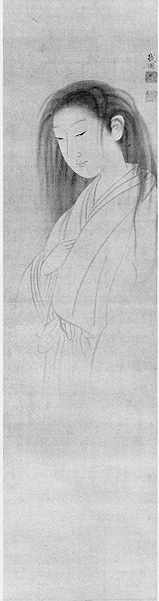
Tsurara Onna – The Icicle Woman

Mizuki_Shigeru_Tsurara_Onnna

Translated and Sourced from Mizuki Shigeru’s Mujyara, Kaii Yokai Densho Database, Japanese Wikipedia, and Other Sources

Is Japan’s Icicle Woman naughty or nice? Loving or lethal? If the stories are to be believed, Japan’s answer to Pygmalion can swing both ways. So a warning to men—if you fashion a woman out of an icicle, even when you pour your entire heart into it, don’t be surprised if she turns out cold-blooded.

What Does Tsurara Onna Mean?

Another yokai with a straight-forward name, tsurara onna’s name is written asつらら (tsurara; icicle) + 女 (onna; woman). Strangely enough, she almost never uses the kanji for tsurara (氷柱), always using the hiragana instead. The only reason I can think of for this is that kanji was once considered masculine for names, and hiragana feminine. It’s a possibility, but that’s all it is.

There are two regional variations on Tsurara Onna, using local dialect for the word “icicle.” One is Shigama Nyobo (シガマ女房; Icicle Wife) from Western Aomori prefecture, and the other is Kanekori Musume  (カネコリ娘; Icicle Daughter) from Gifu prefecture.

What are Tsurara Onna?

All Tsurara Onna stories start out the same—a lonely man gazes out of his window in winter, and marvels at the beauty of an icicle hanging from his eaves. As he stares deeply into its crystal structure, he wishes he could meet a woman as beautiful as the icicle to ease the pains of his loneliness. Like magic (for it is indeed magic) a woman fitting that description shows up the very next day.

The woman appears at the man’s door, seeking refuge from a massive, sudden snow storm. The man lets the beautiful woman in, and they fall in love. The woman decides never to leave, and the two become husband and wife. (In old Japan, no ceremony was necessary for this; as soon as a couple decided they were married, then they were married).

Life is good—for a while. The man’s new wife is attentive and loving and everything he hoped for. But then things go wrong, because there is rarely a Happily Ever After in Japanese folklore, and never when you are dealing with snow monsters.

Tsurara Onna tales fork at this point, into one of two endings. The ending you get depends largely on the region of Japan you live in.

Story #1 – The Sweet Woman Undone by Her Husband’s Love

The man is overjoyed at his new wife, but worried too. He cannot help but notice that his bride never uses the bath, even on the most chilly of nights. The poor man is worried about his wife’s health—surely she will take sick if she does not warm herself in the bath? Not to mention cleanliness. Time after time, he entreats her to use the bath. They are married now, he assures her, and she shouldn’t feel shy or ashamed.

The woman demurs, but eventually she can no longer refuse her husband. After he prepares a warming bath for her, the man busies himself about the house so she can enjoy her soak. Hours pass, and the man becomes worried about her. Perhaps she has fallen asleep? He goes into the back to check on her, and finds the tub empty, with only frozen shards of shattered icicles laying around the perimeter of the bath. These too slowly melt away …

This version of the tale is most often found in the Tohoku region, including Aomori and Nigata prefectures. There are some further variations:

Yamagata Prefecture – The woman does not go to the bath, but into the kitchen to heat up some hot sake for her husband. After a long wait, he goes to the kitchen to find the shattered icicle shards.

Akita Prefecture – This version has a husband and wife taking care of a young woman traveler instead of a new bride; but the results are the same. Against her wishes, into the bath the young traveler goes.

Story #2 – The Frozen Dagger of Hate

Her, the husband does not coax his wife into the bath, or ask her to retrieve hot sake for him. Instead they pass the winter in bliss. But as spring comes and the temperature warms, the man notices his wife getting anxious. One day he wakes up to find her gone, the door of their house standing open and the last of the winter winds blowing through.

The man is heartbroken, but assumes his wife has left him after using him for shelter though the winter. He moves on with his life, and meets a new woman and falls in love. Come summer, he moves his new wife into his house. They pass the months happily until winter comes again.

When the world again freezes over, the man notices a particularly large icicle forming from the eaves of his house. Fascinated by it, he goes outside for a better look. There he sees his former wife, livid that she has been replaced.

Inside the house, the new wife hears her husband shriek in agony. She rushes outside and finds him dead, a large icicle piercing his head through his eyeball.

This angrier version of the Tsurara Onna tale is found mostly in Nigata prefecture.

Translator’s Note:

The second in a series on snow monsters for December, the Tsurara Onna is a type of story found all over the world. A man bringing a woman to life from an inanimate object is a typical folklore story, the archetype of which is the Greek story of Pygmalion. With the second version of Tsurara Onna, I also can’t help but think of a sexier, angrier version of Frosty the Snowman—especially how she has to leave in the spring and return in the winter.

The Tsurara Onna also falls into the “magical wife” category so often found in Japanese folklore. These come in a myriad of variety, but always with the same simple plot. An unmarried man suddenly meets a wonderful woman, and they are married. They can stay happy forever so long as the husband obeys a single rule (for example, “Don’t look in a box,” or “Don’t tell anyone your story,” or “Don’t make me take a bath.”). The rule is inevitably broken, the wife leaves—with or without vengeance—and the man is left alone again, knowing that he could have had a happy life if he just would have obeyed the stupid rule.

Further Reading:

For more tales of snow monsters and magical wives, check out:

Oshiroi Baba – The White Face Powder Hag

Kitsune no Yomeiri – The Fox Wedding

The Yurei Child

Oshiroi Baba – The Face Powder Hag

Mizuki_Shigeru_Oshiroibaba

Translated and Sourced from Mizuki Shigeru’s Mujyara, Konjyaku Hyakki Shui, and Japanese Wikipedia

Weather-beaten, sake-bearing snow lady or servant to the Goddess of Cosmetics? It all depends on who ask when you are dealing with Oshiroi Baba – The Face Powder Hag.

What Does Oshiroi Baba Mean?

Oshiroi Baba uses the kanji 白粉 (oshiroi; white face powder) + 婆 (baba; old woman, hag). The word oshiroi specifically refers to the white face powder used by geisha and maiko.

Her name is pretty straight forward, and leans towards the Goddess of Cosmetics definition of this yokai.

What Does Oshiroi Baba Look Like?

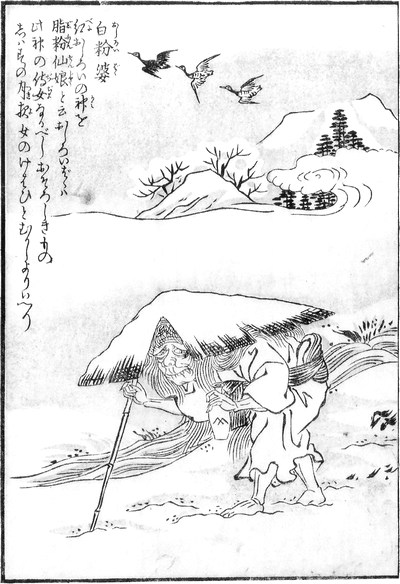
No matter which definition of Oshiroi Baba you prefer, she always looks the same. An ancient woman with a back severely bent by age, she leans on a bamboo cane. She wears a ragged kimono and a massive, straw umbrella hat covered in heavy snow. In her hand is a bottle of sake, usually a classic ceramic tokkuri. Her face is covered in oshiroi powder, often slathered on without delicacy or care.

By some accounts she drags a mirror behind her, which clangs and rattles in her wake. The mirror, however, is almost always heard but not seen. Few depictions of the Oshiroi Baba include this detail.

Servant to The Goddess of Cosmetics

SekienOshiroi-baba

Oshiroi Baba appears in Toriyama Sekien’s Konjyaku Hyakki Shui (今昔百鬼拾遺; Supplement to The Hundred Demons from the Present and the Past). Toriyama wrote:

“Legend tells of a Goddess of Crimson Cosmetics named Shifun Senjo (脂粉仙娘). Her servant is the possibly Oshiroi Baba, who comes on moonlit nights in the twelfth month as she has since long ago.”

The source for Toriyama’s picture and story are not known. In fact, even this so-called “Goddess of Crimson Cosmetics” Shifun Senjo appears nowhere other than Toriyama’s prescription. Draw what conclusions from that as you may.

The Sake-Bearing Snow Hag

Another legend of the Oshiroi Baba supposedly comes from the Noto Peninsula in Ishikawa prefecture. The story tells of an old yokai woman who comes out during heavy snow storms bringing hot sake to those in need—like some alcohol-bearing Santa Claus.

This story comes from folklorist Fujiwara Morihiko’s book Zusetsu Minzokugaku Zensho(図説民俗学全集; Complete Illustrated Work of Folklore). Fujiwara describes the Oshiroi Baba as analogous to the Yuki Onna. However, there is no supporting evidence to Fujiwara’s claims, and subsequent folklorists have been unable to find any such legends from the Noto Peninsula or elsewhere.

The Oshiroi Baba of Hasedera Temple

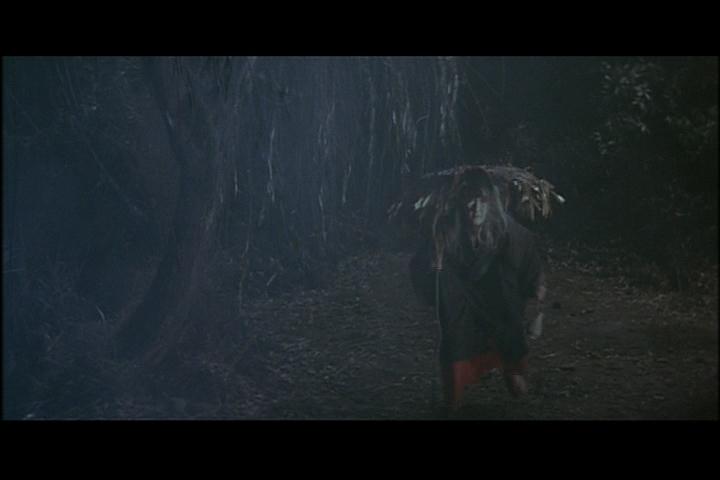
Oshiroi Baba HyakumonogatariOshiroi Baba from the film Yokai Hyakumonogatari. Image found on this site.

A further story of the Oshiroi Baba comes from Hasedera Temple in Nara prefecture. It has been sourced back to the Muromachi period, and has little in common with other legends.

In the 6th year of Tembun (1537), Abbot Koshin of Hasedera Temple had an idea to help the war-torn state of the nation. He would assemble artistic monks from across the country to paint an image of the Goddess Kannon—an image on a sheet of paper as large as the Hondo main temple itself.

Unfortunately, the army of the Ashikaga shogunate came into town at the same time, and requisitioned all of the provisions that were supposed to go to feeding the artist-monks. With the food all going to the soldiers, the monks were starving and were unable to complete their painting. They pleaded and prayed to Kannon to give them the means to finish their great work.

The next day, a young monk spotted an unknown young woman washing rice down at the local well. She pulled rice from her bucket, washed and ground it on a stone, then set it into a plate to dry. The strange thing was, her bucket never seemed to empty. So long as she left a single grain behind, the bucket would magically refill with rice. Soon there was enough rice to feed the entire Temple.

The young monk was amazed, and felt this woman must be an emissary of Kannon, if not Kannon herself. But as she was bent over her work, he could not see her face. And the young monk desperately wanted to see her face. He came up with a plan and lobbed a small stone at her back. As she looked up, he saw her face glowed with a holy light. Her skin was snow white, and looked as if she were made of oshiroi powder. And in spite of the young appearance of her body, her face was deeply lined as if she felt all of the worries of the monks of the world.

Fortified by this miracle, the artist monks were able to finish their portrait. In gratitude, they enshrined the Oishiroi Baba and built a temple in her honor. This temple can still be seen on the grounds of Hasedera Temple today.

Translator’s Note:

My theme for December is snow monsters, so of course the first one I pick isn’t really a snow monster! Well, I suppose it all depends on which legend you prefer. There is very little background on this yokai, and most agree that it was invented by Toriyama Sekein and that others have attempted to fill in the blanks ever since. Why he would draw an old woman in the snow, then make her the servant of some mysterious Goddess of Cosmetics, is a mystery. Not to mention the fact that she is clearly carrying a sake bottle and not some sort of cosmetics palette … ah well, no one every accused Toriyama of making sense.

Personally, I like the sake-bearing snow yokai who bounds up like some sort of magical St. Bernard dog or Santa Claus and pours hot sake down the throats of those in need. I think it suits the image best.  But then I also love the story of Hasedera Temple, as that was a temple I spent quite a bit of time at when I was a JET in Nara prefecture. I heard the story of the rice when I was there, but never connected it with the Oshiroi Baba until now.

When Food Attacks – 6 Types of Food Yokai From Japan

Japan’s native Yokai monsters can be almost anything—haunted trees, magical cats, transformed rats, or vengeful ghosts of slaughtered warriors. Or they can be food. Maybe animals who are sick of being overeaten. Or mysterious bugs that get into your system and infect you like a disease.

I put this series together for American Thanksgiving, to showcase some of Japan’s more bizarre yokai and as a cautionary tale for those tempted to over-indulge in their favorite foods. After all, eating a few soft-shelled turtles or savoring some salted horse meat is perfectly natural and fine. But consuming it by the hundreds invites ghostly revenge.

Click Each Title to Read the Full Story of Each Yokai

6. Sazae Oni – The Turban Shell Demon

Mizuki_Shigeru_Sazae_Oni

Sazae are a delicacy in Japan. The official English translation is “turban shell,” but they are more like a type of sea snail. And they are delicious. This tale of the Sazae Oni is something that would probably never associate with a sea snail—a shape-shifting supernatural seductress who boards and beds a ship full of men, then robs them of something very previous indeed.

5. Oseichu – The Mimicking Roundworm

Mizuki_Shigeru_Oseichu

This yokai disease starts as a small bump on your stomach, but soon enlarges into an angry red boil. The one day, the boil explodes into a giant mouth that speaks in your own voice and demands to be fed. This insatiable mouth will eat everything in the house unless it is stopped, slowly starving its host to death.

4. Suppon no Yurei – The Turtle Ghost

Mizuki_Shigeru_Suppon_no_Yurei

Being a connoisseur can be a good thing, but being a glutton is another thing all together. This is a tale of three friends who loved the taste of turtle flesh, and went from restaurant to restaurant like Edo period foodies eating all of the turtles they could. One night they spotted a new restaurant, but the chef has a little surprise in store for them.

3. Suppon on Onryo – The Vengeful Ghosts of the Turtles

Mizuki_Shigeru_Suppon_no_Onryo

Another tale of too many turtles. This one from a husband and wife who owned a popular turtle restaurant and who slaughtered and served up turtles by the hundreds. One day, the turtles decided enough was enough, and turned the tables. Illustrated Japan’s most famous artist, Katsushika Hokusai.

2. Shio no Choji – Salty Choji

Mizuki_Shigeru_Salty_Choji

Choji was a man who loved salted horse meat. And he loved it a lot. He owned a herd of 300 horse, and ate them down to the last one. When he was about to eat on his final horse—an old, beaten down old thing without an ounce of edible meat on him—his gluttony was finally undone. Choji was treated to an excruciating feast.

1. Nebutori – The Sleeping Fatty

Mizuki_Shigeru_Nebutori

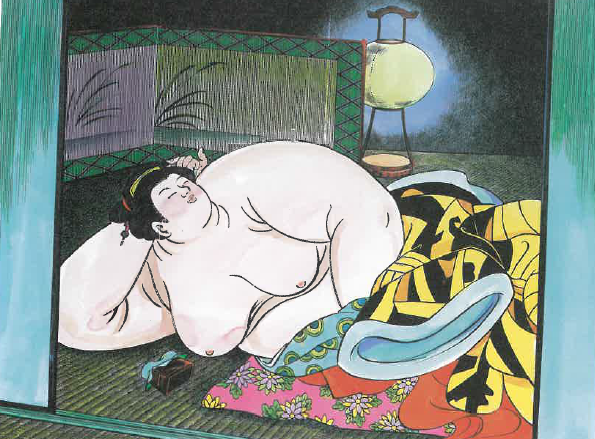
A classic story—a man goes out drinking one night and brings home a slender, sexy woman. After a night of passion, they fall asleep exhausted. The next morning the man is shocked to find out that he is not in bed with a beautiful woman, but a giant mound of flesh the size of four woman. Somehow, over the night, he bedmate caught the yokai disease nebutori-the sleeping fatty.

Next Newer Entries

Copyright notification

All translations and other writing on this website were created by Zack Davisson and are copyright to him.

Copyright notification

In accessing these web pages, you agree that any downloading of content is for personal, non-commercial reference only.

No part of this web site may be reproduced or transmitted in any form or by any means, electronic, mechanical, photocopying, recording or otherwise, without prior permission of Zack Davisson.

Copyright notification

For rights clearance please contact Zack at:

zack.davisson (at) gmail.com

Thank you.