Tenjoname – The Ceiling Licker

Tenjoname_Mizuki_Shigeru

Translated and Sourced from Mizuki Shigeru’s Mujyara, Japanese Wikipedia, and Kaii Yokai Densho Database.

Some yokai are scary, some are funny, and some are just … weird. The tenjoname—that bizarre, late-night licker of ceilings—is one of the few yokai that fits all three categories at once.

What Does Tenjoname Mean?

You can’t get much more straightforward than tenjoname. Its name combines 天井 (tenjo; ceiling) + 嘗 (name; lick) to make天井嘗—tenjoname, the ceiling licker.

What Does a Tenjoname Do?

Again, you can’t get much more straightforward than tenjoname—the ceiling licker licks ceilings. That’s pretty much it. It comes out of the darkness on cold, winter nights, and laps away at any accumulated frost or dirt or spider webs clinging to the rafters. You know the next day if you have had a visit from the tenjoname by the dark streaks it leaves behind, evidence of its long, red tongue being drug along the ceiling.

Oh, and there is the small consequence that if you catch sight of a tenjoname while it is doing its business, you die.

Of course, that minor detail doesn’t appear in every legend. But if you are tucked away in bed at night and hear something crawling along the ceiling—or maybe the sound of a long, slurping tongue—it’s probably for the best not to sneak a peek and risk death. Keep your eyes shut tight.

The Origin of the Tenjoname
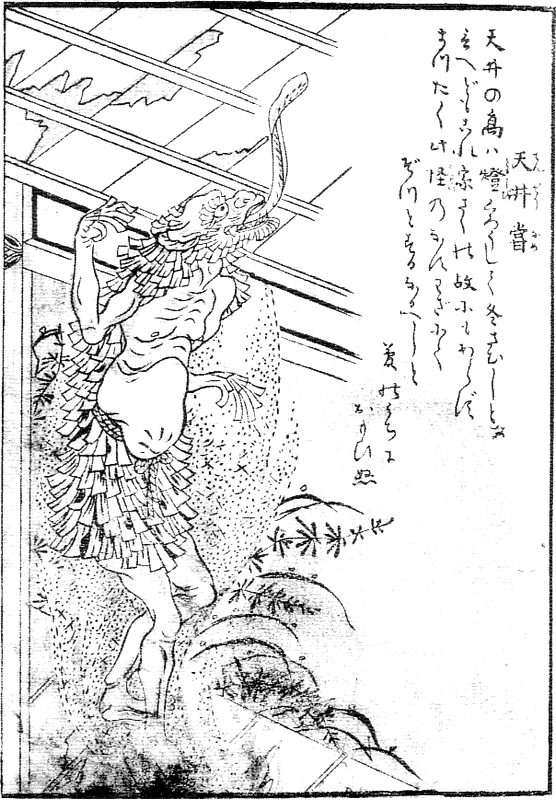
SekienTenjoname

Like many yokai, the tenjoname is the invention of artist and yokai-maker Toriyama Sekien. Tenjoname first appeared in Toriyama’s yokai encyclopedia Gazu Hyakki Tsurezure Bukuro (画図百器徒然袋; The Illustrated Bag of One Hundred Random Demons).

Toriyama wrote on his illustration:

“The heights of the ceiling devour the lamplight when the winter in cold. This is not by design. You will shiver in fear if you catch a glimpse of the this strange apparition, and know that it is no dream.”

The Gazu Hyakki Tsurezure Bukuro is famous for its literary allusions, and connection to things in everyday life. For the tenjoname, Toriyama was inspired by a poem from the book Tsurezuregusa (徒然草; Essays in Idleness). The poem comes from the 55th verse of the book, and says:

“In the cold of winter, tall ceilings swallow the lantern light.”

Like many Japanese poems, these lines are meant to evoke an image and emotional response from readers at the time. It deals with a subject most Japanese people would be familiar with. Japanese houses from the period were built with tall, towering ceilings. This was useful in the summer, and helped open up the house to dissipate the fierce tropical heat and humidity of the Japanese summer.

What was a blessing in summer was a curse in winter. The charcoal hibachi and fish oil lanterns were not powerful enough to reach the high ceilings, and so in the winter they became a mysterious domain of frost and shadows.

Yokai in the Boundaries

Ceilings are also boundaries, and in Japanese folklore yokai are known to haunt boundaries. Like fairylore of many countries, yokai exist in the in-between places—in the twilight between light and darkness, on the surface of the ocean that breaks the water world and the dry, or even in the ceiling that separates the inside from the outside.

From ancient times the ceiling was a gathering place for magical creatures, and many kaidan tell of a menagerie of yurei and yokai dangling from the rafters and hiding in the high corners of houses. Toriyama read the poem in Tsurezuregusa, thought of old stories of monsters on the ceilings, and imagined a yokai that scuttled around in the darkness of cold, winter nights.

The Design of the Tenjoname

Tenjoname_Night_Parade_of_100_Demons

For his visual interpretation of the tenjoname, Toriyama looked to the famous Muromachi period picture scroll the Hyakki Yagyo Emaki (百鬼夜行絵巻; Night Parade of 100 Demons Picture Scroll). At the time the scroll—and others like it—were designed, the yokai depicted had no name or story. Most of them were just interesting visual designs on the part of the artists, who thought no more of their individual traits than Hieronymus Bosch thought of his demons in his hell portraits. They were just weird designs.

Toriyama took a particular yokai running around with its tongue out staring and the ceiling and decided that was his tenjoname. Strangely enough that particular yokai inspired other yokai as well. A different version of the Hyakki Yagyo Emaki has the word “Isogashi” (meaning “busy” or “frantic” in Japanese) written next to it, and so the Isogashi became another yokai that was constantly running around knocking things over. An almost identical yokai to the tenjoname, called the tenjosagari or “ceiling descender,” comes down from the ceiling and licks the sleepers below instead of the ceiling.

Tenjoname in Showa and Beyond

Just as Toriyama built off of the Tsurezuregusa, many other writers added to the legend of the tenjoname over the years. Fujisawa Morihiko’s 1929 book Yokai Gadan Zenshu
(妖怪画談全集; Complete Discussions of Yokai) added the detail of stains being left behind on the ceiling as evidence of the tenjoname’s visit.

Yamamura Shizuka and Yamada Norio’s 1974 book Yokai Majin Shorei no Sekai (妖怪魔神精霊の世界; The Worlds of Ghosts, Evil Monsters, and Yokai) tells the story of a tenjoname haunting a castle in Tatebayashi Castle, part of the Tatebayashi Domain (Modern day Gunma prefecture) The cobwebs of the castle would be mysteriously licked clean, with the tell-tale slime trail of the tenjoname’s tongue being left behind. The source of this story is unknown, however, and first appears in Yamamura and Yamada’s book.

During the Showa period, the story of the tenjoname leveled-up, adding the terrifying component that seeing the face of the tenjoname would kill you. That has been come an important part of the modern mythos, and has scared many a young Japanese child into into not looking up at their ceilings at night for fear of seeing its frightful face.

Translator’s Note:

This is another yokai that appears in my translation of Mizuki Shigeru’s Showa 1926-1939: A History of Japan. As a young boy, Nonnonba shows Mizuki Shigeru the frost that has accumulated on the ceiling and warns him of the tenjoname that will come at night to lick it off.

Additional Reading:

For more yokai from Showa: A History of Japan, check out:

Nezumi Otoko – Rat Man

Hidarugami – The Hungry Gods

Sazae Oni – The Turban Shell Demon

Kitsune on Yomeiri – The Fox Wedding

Betobeto San – The Footsteps Yokai

Betobeto-San – The Footsteps Yokai

Mizuki Shigeru Betobeto San

Translated and Sourced from Mizuki Shigeru’s Mujyara, Japanese Wikipedia, and Kaii Yokai Densho Database

When you are walking down a lonely mountain road at night, and you hear footsteps behind you, don’t be alarmed. You have probably attracted the attention of that amiable yokai Betobeto-san. If you aren’t in the mood for yokai company, just step to one side of the road and say “Oh please, Betobeto-san—you first.” With that said, Betobeto-san will walk on by.

What Does Betobeto-San Mean?

The word “beto beto” (べとべと) has a few different meanings in Japanese. Japanese loves homophones, and we usually have the kanji to give us a clue as to the meaning. Not here though—beto beto is written in hiragana so we have to do a little deductive reasoning.

One of the meanings of beto beto—and the most common—is “sticky.” This is what you will find in most dictionaries, and has lead to some mistranslations of Betobeto-san as “Mr. Sticky.”

However, another meaning refers to an onomatopoeia of the sound of footsteps (Beto beto beto … ). This makes more sense given the nature of Betobeto-san, and a more accurate translation would be “Mr. Footsteps.”

(Although even the “Mr.” part is up in the air. The Japanese honorific “–san” (さん) has no gender bias, so Betobeto-san could easily be “Ms. Footsteps” or something gender-neutral like “The Honorable Footsteps.” None of those makes for a good translation though so I stick with Betobeto-san.)

What is Betobeto-san?

Betobeto San Station

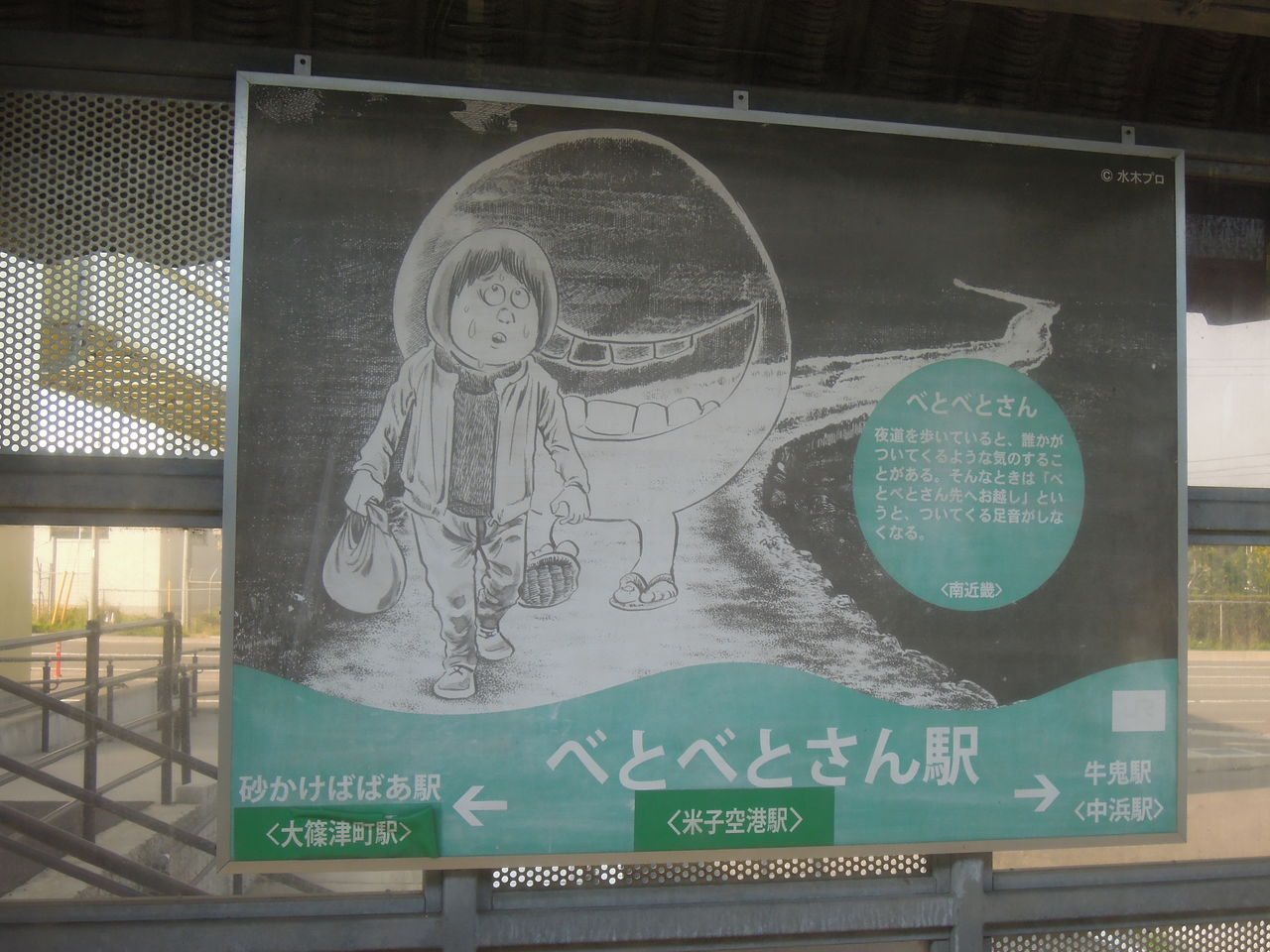
For most of its existence, Betobeto-san was a purely aural yokai. It embodied as the sound of someone following you down a dark street at night. The sound beto beto beto … brings to mind wooden clogs on hard streets, although Betobeto-san can be found wandering both city and country roads. Legends of Betobeto-san come mostly from Uda gun in Nara prefecture, and from Shizuoka prefecture, where Betobeto-san only travels mountain roads.

There are similar legends across all of Japan, usually with some slight variation. In Sakai gun, Fukui prefecture the yokai is called the “Bisha ga Tsuku” (びしゃがつく; The Following Bisha). The main difference is that the Bisha ga Tsuku only comes out in winter, where you can hear the sounds “bisha bisha” as someone walks behind you, crunching on the snow.

In any case, and whatever the name, Betobeto-san is not a dangerous yokai, and means no harm to anyone. If you hear the sound behind you, you step to the side of the road and invite it to pass by you. If you are in Nara prefecture, the phrase is “Betobeto-san, Osakini Okoshi” (お先にお越し; “Please Betobeto-san, you go first.”) In Shizuoka prefecture the more casual “Osakini Dozo” (お先にどうぞ; “Go right ahead.”) works just as well. With that formality observed, Betobeto-san will accept the invitation and walk by, looking for someone new to follow behind.

The Refusing Betobeto-San

There is one story of Betobeto-san not accepting the invitation. A man carrying a lantern was walking down a dark street when he heard the unmistakable sounds of Betobeto-san behind him. Knowing his yokai lore, he stepped aside and said “After you, Betobeto-san.” To his surprise, he heard an answer from behind: “I can’t go ahead. It’s too dark.” The man then offered Betobeto-san his lantern, and was even more surprised to hear a “Thank you” in reply, and to watch his lantern go bobbing down the street in front of him, held by invisible hands.

The man made it back to his house in the dark, and found his lantern returned the following morning.

Mizuki Shigeru and Betobeto-san

Betobeto-san is one of the yokai Mizuki Shigeru encountered as a young boy. His caretaker and friend Nonnonba taught him the chant that lets the Betobeto-san walk by.

SH350002

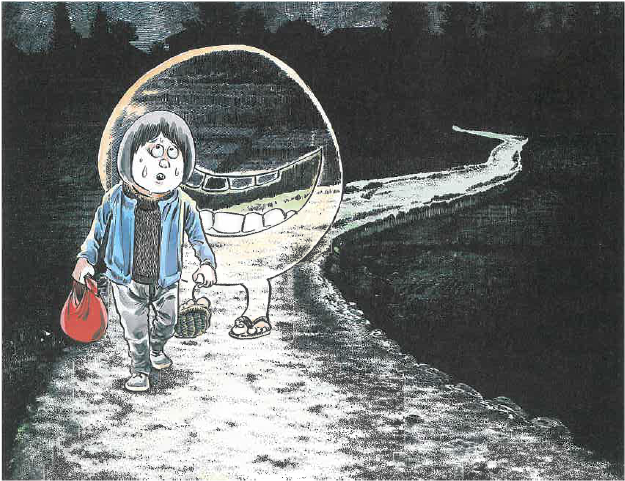
When he was older, Mizuki Shigeru included Betobeto-san in his comics, and he was the first one to give the yokai a physical appearance. In all prior accounts, Betobeto-san was nothing more than the sound of footsteps. Mizuki imagined with the footsteps might be attached to, and the round yokai with the large friendly smile is what he came up with.

Before Mizuki Shigeru’s comics, Betobeto-san was an obscure, unknown yokai not included in any of the major yokai encyclopedias or collections. Now, the Honorable Footsteps is one of Japan’s most popular yokai and ranked in 5th place in a “What’s Your Favorite Yokai?” survey held across Japan. In Sakaiminato city (Mizuki Shigeru’s birthplace) there is a train station named “Betobeto-san,” and Betobeto-san was one of the few yokai to show up in the popular TV drama Gegege no Nyobo that told the story of Mizuki Shigeru’s wife.

OLYMPUS DIGITAL CAMERA

Much of Betobeto-san’s fame and popularity is attributed to Mizuki’s design. The large, friendly smiling mouth made the yokai an instant favorite of children. Tourists to Sakaiminato like to pose next to the Betobeto-san statue and try and imitate its mouth, and leave coins in its mouth for good luck. It just goes to show that, even in the case of yokai, a good character design can be more memorable than a good story.

Translator’s Note:

Betobeto-san is another yokai that makes an appearance in my translation of Mizuki Shigeru’s Showa 1926-1939: A History of Japan, as well as in another Mizuki Shigeru comic published in English, NonNonBa.

Further Reading:

For more yokai from Showa: A History of Japan, check out:

Nezumi Otoko – Rat Man

Kitsune no Yomeiri – The Fox Wedding

Sazae Oni – The Sazae Demon

Hidarugami – The Hunger Gods

Tanuki no Kintama – Tanuki’s Giant Balls

Mizuki_Shigeru_Tanuki_Big_Balls

Translated and Sourced from Mizuki Shigeru’s Mujyara, Japanese Wikipedia, Japan Times, OnMark Productions, and Kaii Yokai Densho Database

To learn more about Japanese Ghosts, check out my book Yurei: The Japanese Ghost

Who’s got big balls? Tanuki have big balls! Anyone who has seen Studio Ghibli’s Pom Poko (Heisei Tanuki Gassen Pom Poko) knows that tanukis’ nut sacks are capable of amazing magical feats—from being stretched out into giant tarpaulins to transforming into magical treasure ships. And the Japanese people aren’t shy about their love for tanukis’ giant balls; images of well-endowed tanuki can be seen all over Japan, from ubiquitous statues in from of shops and restaurants to bank commercials to anime to … pretty much anything.

Pom Poko Tanuki Balls Parachute

What Does Tanuki no Kintama Mean?

Tanuki (狸) gets mistranslated into English as all sorts of things, mostly badger or raccoon or the neologism “raccoon dog.” None of these really fit. Badgers (穴熊; anaguma) and raccoons (洗熊; araiguma) have their own Japanese names. “Raccoon dog” doesn’t really mean anything, so I personally just like sticking with the Japanese name—tanuki works better than anything else.

Now those giant balls …

Utagawa Giant Tanuki Balls

The common Japanese word for testicles is kintama (金玉), which translates literally as “golden” (金; kin) + “balls” (玉; tama). In Japan, large testicles (or a large scrotum, to be precise. It’s the nut sack, not what’s in it that matters.) are a symbol of wealth and prosperity, not sexual prowess. An alternate name, kinbukuro (金袋; money bags), makes the connection even stronger. Even more so when you consider that tanuki scrotums were once sewn into wallets and carried as literal “money bags.”

And while kintama might just be slang, in the tanuki’s case these “golden balls” have a historical precedence.

Traits of the Tanuki

Utagagwa Tanuki Balls Raincoats

As yokai, tanuki are known to have several magical powers and interesting traits. They are henge, shape-shifters, with abilities on par with and sometimes even exceeding those of kitsune (foxes), the most powerful of Japan’s magical animals. Tanuki are also famous for their belly drums (See the Belly Beating of the Tanuki) and their love of sake, food, and generally being the lazy, loafing tricksters of Japanese folklore. And their giant balls.

But they weren’t always like this. The familiar tanuki that we know today—with the prodigious belly, straw rain hat, sake bottle, and pendulous testacles—is a relatively modern invention. It actually comes from the 20th century.

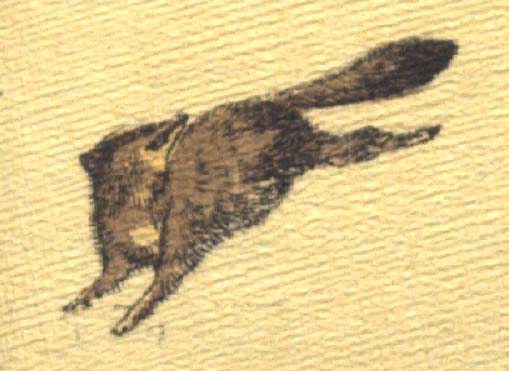
Early depictions of tanuki show a realistic animal. Japanese tests are almost completely mum on tanuki for most of history. There is mention of the mujina (狢), a mythical animal associated with the tanuki in some areas, from around the 8th century.

nichibunken tanuki

Tanuki appeared in early encyclopedia starting from the 1600s, like the 1666 Kinmōzui ( 訓蒙図彙; Collected Illustrations to Instruct the Unenlightened) by Nakamura Tekisai (中村惕斎). These early works are only collections of animals, and rarely mention tanukis’ supernatural powers. One of the earliest mentions of a tanuki as a magical creature comes from the Wakan Sansai-zue (和漢三才図会; Illustrated Sino-Japanese Encyclopedia) compiled by Terajima Ryōan (寺島良安), a doctor from Osaka. The tanuki entry does not go into detail, but states that “like a kitsune (fox), an old tanuki will often transform into a yokai.”

Tanuki_Encyclopedia

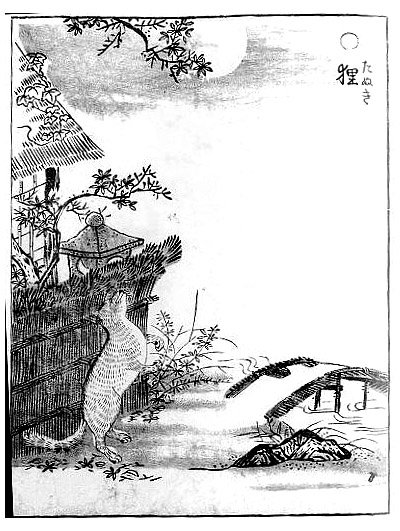
Toriyama Sekien (鳥山石燕) included tanuki in his 1776 Gazu Hyakkiyakō (画図百鬼夜行; Illustrated Night Parade of 100 Demons), but again this tanuki looks like a regular animal.

SekienTanuki

The depiction of tanukis evolved slowly, with new stories adding new elements and transforming them slowing from the realistic animals to the cartoonish figured seen all over Japan today. The big round stomach and accompanying belly-drumming didn’t become attacked to tanuki lore until the 18th century. Several stories of tanukis’ belly-drumming appear around this time, although their famous nut sacks are still regular size. They didn’t develop elephantitis until later.

Tanuki Belly Drum

The reason for the appearance is gold.

Gold Nut Sack Pounding

Utagawa Tanuki Balls

Owaka Shigeo traced the origins of tanukis’ magical scrotums in his book about Japanese metal working, Hagane no Chishiki (鋼の知識; Knowledge about Steel). He claims the myths began from goldsmiths and metalworkers in Kanazawa prefecture. In order to turn malleable gold into delicate gold leaf, they would wrap the gold in animal skin and pound it into thin sheets. They discovered that a certain part of a certain animal was the best for the business.

In biological terms, tanuki scrotums are rather large. This is an evolutionary trait to help the randy males succeed in the fierce competition for mates. And from a metalworking perspective, tanuki scrotums were both soft and strong enough that they could take the heavy pounding and stretch out to extraordinary size. It was said that, using a tanuki scrotum, even a small piece of gold could be stretched out into an 8-tatami mat big sheet of gold leaf. (Some said a 1000-tatami mat sheet, but that seems excessive.)

Utagawa Tanuki Balls Fishing

Because of this, tanuki scrotums became known for their ability to “stretch” money and make it go further. Savvy marketers started telling tales of the magical properties of tanuki scrotums, selling them as good luck charms and wallets telling buyers that the scrotums would “expand their wealth” in the same way they stretched nuggets of gold into massive sheets.

This association between wealth and tanuki testicles continues to this day. In modern times, Tanuki are said to embody “Eight Virtues,” with their large scrotums signifying luck with money.

Ukiyo-e Artists and Tanuki Balls

Utagawa Tanuki Balls Daruma

Once the myth of tanuki and their magical, giant balls hit the cities, the imagination of Edo period artists went wild. It really was too good of an idea, and made much too interesting of a motif, so artists expanded on the “stretching scrotum” idea. Suddenly, tanuki were using their nut sacks as weapons, sail boats, swimming pools, fishing nets, umbrellas … there was no limit. All of the great artists of the ukiyo-e period got in on the fun, out doing each other with even more outrageous pictures of tanukis’ magical scrotums.

Utagawa Kuniyoshi did a particularly cool set of tanuki testicle prints that you can see here.

Utagawa Tanuki Balls Archery

It was thanks to ukiyo-e artists that the idea of tanuki and their magical, giant balls became a permanent part of Japan’s folklore and popular culture. In fact, I think it shows that the addition was more of an artistic one than a storytelling one—there are many Edo period stories about tanuki, but most of them focus on either shape-shifting or belly-drumming. I have read few tanuki tales where their scrotums play a significant element to the story.

tanuki_balls punch

All the Rest

The rest of the tanukis’ outfit—the straw hat, sake jug, and pay slip—didn’t show up until even more recently. The iconic image of the tanuki that we know and love today is really a product of the Taisho era (1912-1926), when more and more shops started using tanuki for advertising or as statues out in front of their shops.

Translator’s Note:

This article was largely sourced through the amazing website OnMark Productions. Anyone who wants to know everything about tanuki (and other aspects of folkloric and Buddhist Japan) should make that site their destination. I got most of my information from there, and only used additional sources to confirm and add a bit of flavor to the article.

Further Reading:

For more tales of tanuki, check out:

The Belly-Beating of the Tanuki

The Tanuki Song

The Tanuki and the White Snake

The Writing of the Tanuki

Kori no Tatakai – The Fox-Tanuki Battles

What Does Ayakashi Mean in English?

Mizuki Shigeru Ayakashi

Translated and sourced from Mizuki Shigeru’s Mujyara, Japanese Wikipedia, Kaii Yokai Densho Database Japanese Performing Arts Resource Center, and Other Sources

A sea serpent so massive it takes three days to pass by in a boat? Mysterious lights floating by the beach? A generic term for ghost stories? Ayakashi is one of the most complicated and convoluted terms in all of Japanese folklore. There is no easy answer to this simple question.

What Does Ayakashi Mean?

Usually when investigating a yokai I like to start with deciphering the kanji that make up the name. That is your first, best clue as to what the monster or phenomenon is. But ayakashi is written either in hiragana (あやかし) or katakana (アヤカシ), neither of which give any hints as to the meaning. There is an alternate and specific spelling of ayakashi that does use kanji, and we will look into that later.

In its most basic usage, ayakashi is a general term for yokai that appear above the surface of the water, and can be translated as “strange phenomenon of the sea.” That fact that this is the surface of the water is important—yokai tend to appear at boundaries, places where one thing becomes another thing. So ayakashi are yokai that haunt the boundary between the ocean and the air, instead of sea monsters swimming in the dark depths.

There are many yokai that have been called ayakashi over the years. Here are a few of them:

Ayakashi no Kaika – The Strange Lights of Ayakashi

Seiban_Kaidan_Jikki_Kumobi

In Nagasaki, the term ayakashi refers to strange lights that dance above the surface of the water, and are found mostly on the beaches in twilight.

These lights are different from the typical Japanese kaika (怪火; strange lights), in that the floating fires are said to contain what looks to be small children running around inside of them. This phenomenon is particularly associated with Tsushima city, Nagasaki.

Some of these ayakashi no kaika also appear out on the water, where it is said they can suddenly take on the appearance of massive rocks or landmasses that appear out of nowhere. The goal of this transformation is to panic ships, forcing them to change course and run aground or sink. But the irony is, if the brave captain sails right through the mirage, they vanish leaving everyone unharmed.

Funa Yurei – The Boat Ghosts

Funayurei

See Funa Yurei – The Boat Ghosts

In Yamaguchi and Saga prefectures ayakashi refers to funa yurei, a group of yurei who drowned at sea and now try to sink boats to increase their numbers. Funa yubrei are known to float up to the surface of the water appearing first as kaika, then transforming into figures when they reach the surface. They will demand a hishaku—a bamboo spoon—from any boat they encounter, and if given one they will swiftly fill the boat with water and drag the crew down to the depths.

A wise captain always carried a hishaku with holes drilled in it when sailing in funa yurei infested waters. Giving this spoon to the funa yurei means that they cannot sink your boat.

Several other areas in Western Japan use the term ayakashi to describe ghosts of those drowned at sea, who try to sink boats and drown swimmers either for revenge or to swell their ranks. A good example of this is the Shudan Borei.

The Woman of the Well

This story of the ayakashi appears only once, in the Edo period Kaidanshu Kaidanro no Sue (怪談老の杖; A Cane for an Old Man of Kaidan).

In Taidozaki, in the Chosei district of Chiba prefecture, a group of sailors put to show in order to re-stock their fresh water holds. As they pulled into the beach, a beautiful woman came walking by carrying a large bucket. She said the bucket was filled with fresh water that she had drawn from a nearby well, and that she would be only too happy to share it with the sailors.

Hearing this, the Captain said “There’s no well nearby. I’ve heard similar stories of thirsty sailors beguiled by a beautiful woman offering them water, never to be seen again. That woman is an ayakashi!” He ordered the boat swiftly back to the sea. As the men pulled their oars, the woman came running towards the ship in a rage, and leapt into the ocean biting the hull of the ship and holding on tight. The quick-thinking Captain beat her off with one of the oars, and the ship sailed away unharmed.

Remoras

Spearfish_remora

A real-life animal associated with the term ayakashi are remoras, the leach-like fish with sucker bellies that fasten themselves onto sharks and other ocean-going objects in order to get a free ride and some free food.

According to folk belief, if remoras fasten themselves to the underside of your boat, you will become stuck in the water and unable to move. In this case, remoras are called ayakashi.

Ikuchi – The Oily Sea Serpent

Sekien Ayakashi

By far the most famous depiction of ayakashi is the massive sea serpent Ikuchi. The association comes from Toriyama Seiken (鳥山石燕), and his entry for ayakashi in his Konjyaku Hyakki Shui (今昔百鬼拾遺; A Collection of 100 Ghosts from Times Past)

Toriyama wrote:

“When boats sail the seas of Western Japan, they encounter a beast so large it takes 2-3 days just to sail past. The body of the beast drips oil, but if the sailors work together to clear the boat of the oil no harm will come to them. If they don’t, they will sink.“

The Ikuchi is a legendary monster from Ibaraki prefecture, that was written about in Edo period Kaidanshu like Tsumura Soan (津村正恭)’s Tankai (譚海; Sea Ballads) and Negishi Shizumori (根岸 鎮衛)’s Mimibukuro (耳袋; Ear Bag). The Ikuchi is described as eel-like and massively long, several kilometers at least. It was not inherently dangerous, but would become tangled up with ships accidently. Crews had to work often for days to get their ship free of the Ikuchi. The most dangerous part was the oil that seeped from the monster’s body. The crew had to diligently clean up all the oil, or the ship would sink.

Why Toriyama called his depiction of the Ikuchi “ayakashi” isn’t known. Perhaps he didn’t know the monster’s true name, or perhaps he was using the general term for sea monsters instead of the specific name of Ikuchi. But for whatever reason, such is Toriyama’s influence that Ayakashi has come to describe the Ikuchi in most modern depictions.

Other Depictions

The word ayakashi has been put on almost every variation of sea monster you can think of. The 1918 book Dozoku to Densetsu (土俗と伝説; Local Customs and Legends) describes the ayakashi like this:

“The ayakashi is a mystery of the sea. They haunt boats on the open waters. Their appearance is like an enormous octopus. It will wrap itself around a boat, and only let go when gold coins are given to it.”

The 1923 book Tabi to Densetsu (旅と伝説; Travels and Legends) says this about ayakashi:

“While traveling the open sea at night, you will see lights in the distance. A ship approaches, mysteriously traveling against the wind. The ship is blazing, covered in lanterns of every shape and size, and suddenly overtakes your vessel. Or sometimes it disappears all together, and reappears next to you. The boat is filled with the souls of those who drowned at sea, and they want to add to their number. If they get close enough, they will fling an iron basket filled with fire onto your ship, killing all on board.”

Another Edo period kaidanshu offers this description:

“When the winds blow from the West, the dead travel on the waves. With lanterns hanging from the prow, you can make out the site of a woman clad in a white kimono, standing in the prow of a small ship. This is the ayakashi.”

There are many, many more. Most of the stories are slightly similar—describing either some kind of great sea monster, or a boat full of drowning victims out for revenge—but few of them are exactly the same. This is probably what cause folklorists and storytellers to throw up their hands and say “Fine! Ayakashi just means all sea weirdness. That covers everything, right?”

Not quite …

Ayakashi and the Masks of Noh

Noh Mask Reiayakashijpg

While no one agrees on exactly what kind of ocean phenomenon ayakashi is, they are all at least agreed that it is SOME kind of ocean phenomenon. Except for Noh theater.

Many of Japan’s arts have a specialized vocabulary that is used nowhere else (try going to a sushi restaurant in Japan and asking for some “purple” and you will see what I mean.) As you know (ha ha!) Noh theater uses masks. All of the masks have names, and the name for a male mask of a ghost or violent god is called ayakashi.

Noh uses a specialized kanji, 怪士 meaning strange (怪; ayaka – ) + warrior (士; shi). These masks come in variation, like the chigusa ayakashi which is fleshy and more human-like, or the shin no ayakashi with protruding eyes and bulging blood vessels. The most terrifying is the rei no ayakashi, a skeletonesque face with a white pallor and sunken eyes. The ayakashi masks were designed around the Muromachi period and where used interchangeably for many ghostly roles, but by the Edo period each mask had been assigned a specific role.

Because of the masks of Noh, and Ayakashi no Mono (怪士のもの) can refer to a ghost story of Noh, where one of the ayakashi masks are used. And that is where the confusion comes in, from using the term “ayakashi” as a general word for yokai or “ghost story.” It is … but ONLY in Noh theater.

Ayakashi: Samurai Horror Tales

ayakashis samurai horror tales

And that brings us to where most Westerners have heard the term ayakashi, in the anime Ayakashi: Samurai Horror Tales. While this is a brilliant series, you will notice that nowhere is there a sea creature of any kind, neither monster nor boat full of lantern-bearing yurei.

That is because the series is named after the Noh usage of ayakashi, which gives it a mysterious, nostalgic feel (and is also a bit misleading, as the stories in Ayakashi: Samurai Horror Tales come from Kabuki theater and not Noh. But that’s marketing for you … )

Translator’s Note

This started out with me answering a reader’s question on the difference between yokai, ayakashi, and mononoke. It soon became apparent that there was far too much information for a simple answer, and blossomed into this article.

And I still didn’t answer the question! Sorry! But at least you will have a better understanding of what ayakashi means!

Further Reading:

For other informative posts about yokai and such, check out:

What Does Yokai Mean in English?

How Do You Say Ghost in Japanese?

A Brief History of Yokai

Funa Yurei

Umibozu – The Sea Monk

Bakekujira and Japan’s Whale Cults

Kori no Tatakai – Kitsune/Tanuki Battles

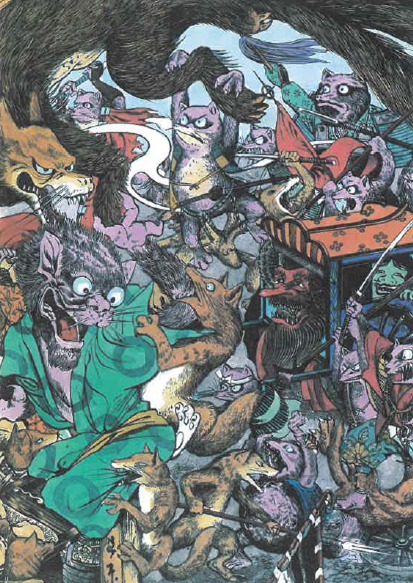
Mizuki_Shigeru_Kitsune_Tanuki_Battle

Translated and Sourced from Mizuki Shigeru’s Mujyara, The Fox and the Badger in Japanese Folklore, Japanese Wikipedia, and OnMarkProductions.

Kitsune (foxes) and tanuki share much in common. They are the only two animals in Japanese folklore that are naturally magical—they don’t need to live a certain number of years to manifest their powers. Their stories both come from similar source legends in China, and dogs are their bitter enemies. Like many tribes who share so much in common, they are also rivals.

And while they rarely (if ever) engage in knock-down, drag-out fights, confrontations between kitsune and tanuki do happen occasionally. Usually they are magical showdowns of shape-changing ability, in the most classic “demonstration of magical powers” –style combat. Kitsune vastly overpower tanuki in these contests, but tanuki are much better tricksters. And in these cases, the mischief of the tanuki beats the pure evil of the kitsune.

What does Kori no Tatakai mean?

Put the kanji for tanuki (狸) with the kanji for kitsune (狐) together and you get the word kori (狐狸). In ancient times, kitsune and tanuki were considered to be a single group, and the word kori was used in a association with both of them. It appears as far back as 702 CE, in Section VII of the Zokutō Ritsu (賊盗律; Laws Concerning Robbers) which warned against the practice of using smoke to force “kori” (tanuki and kitsune) out of their dens in graveyards.

(And because Japanese is an extra-confusing language, through the kanji for dog in the middle of kori and the word transforms into kokkori (狐犬狸; Fox, Dog, Tanuki) and refers to the Japanese name for a Ouija Board,)

Much simpler is the term no tatakai (の闘い) with just means “battle of.”

Danzaburō Danuki and the Tanuki of Sado Island

Kyosai_Dosan-tanuki

Most Kori no Tatakai involved Danzaburo Danuki and his defense of the tanuki kingdom on Sado Island from invasion by kitsune. Danzaburo Danuki is a legendary figure, possibly based on a real person who lived on Sado Island in the 1650s. Danzaburo (the human) is said to have brought the tanuki to Sado Island as a dealer in meats and pelts. He released several tanuki cubs that soon populated the island. Or at least that was his cover—legends grew that said that Danzaburo was not a human at all, but a powerful bakedanuki (化け狸; transforming tanuki) smuggling his tanuki clan to the island to create a tanuki paradise free from the foxes and dogs that plagued them.

There are many stories of Danzaburo Danuki on Sado Island. He is somewhat of a folk hero. In by Kyokutei Baki’s Enseki Zasshi (燕石雑志 ; ) Danzaburo was said to recover lost treasure from hidden valleys and homes abandoned to fire and war, then loaaned his wealth to the poor island fishermen. This is unusual for a tanuki figure, who deal in illusion and trickery. The money Danzaburo Danuki leant was real gold and didn’t turn into useless leaves like is so many other tanuki tales. He wasn’t entirely pure though—when the fishermen stopped paying him back he stopped loaning out.

But by far the most famous Danzaburo Danuki tales are how he defended Sado Island from the Kitsune.

Danzaburo vs Kitsune – Round 1

Danzaburo Danuki was preparing to take his boat across to Sado Island one day, when he saw a kitsune waiting on the shore. The kitsune said he was looking for a new home for his clan, and wondered if Danzaburo might give him a ride across in his boat—the kitsune could not swim and had no money for passage. Danzaburo agreed, but asked that the kitsune transform himself into a vest so that it would be lest suspicious when he arrived at the far side.

The kitsune agreed that this was a good plan, and transformed himself into a vest that Danzaburo pulled on. Pulling the oar, Danzaburo whistled to himself quietly making his way across the stretch of ocean to Sado Island. When they were about half-way across, Danzaburo calmly slipped off the vest and dropped it into the ocean, leaving the kitsune to drown.

Danzaburo vs Kitsune – Round 2

Danzaburo Danuki met a powerful kitsune near Futatsu Iwa on Sado Island. Danzaburo was not about to allow a kitsune to set foot on Sado Island, and challenged him to a duel—a show of transforming powers. Danzaburo boasted “You may be hot stuff back home but your powers are nothing compared to mine. I don’t just turn from one thing into another. I can transform myself into an entire Daimyo’s procession!”

The kitsune—confident that no mere tanuki could out-transform him—accepted the challenge and settled back to watch Danzaburo make a fool out of himself. “Go ahead,” the kitsune smirked, “show me what you can do.”

In an instant, Danzaburo had disappeared. The kitsune was startled for a moment, but he was even more surprised when a Daimyo’s procession appeared, complete with armored warriors and bearers carrying a heavy palanquin.

“Unbelievable!” He did it!” The kitsune couldn’t believe that such a magical feat and been transformed, and leapt up on top of the palanquin to test the solidness of the illusion.

Unfortunately for the kitsune, Danzaburo was a better boaster and liar than a transformer. He timed his trick perfectly to disappear right when the very real Daimyo’s procession would come along the path. The soldiers, seeing a fox leap on the palanquin and appear to attack their Lord, grabbed it by the scruff of its neck and chopped its head off with one swift blow.

More Kitsune/Taunki Battles

According to Mizuki Shigeru’s Mujyara, the kitsune tried many times to invade Sado Island over the years, but where always beaten back by Danzaburo and his clan. That’s why to this day, there are no foxes on Sado Island—all though there are lots and lots of tanuki.

Flying_Dragon_Tanuki_vs_White_Fox

Another legendary Kitsune/Tanuki battle appeared in the kamishibai theater. Attributed to Musashi Jūnin (武蔵住人), Flying-Dragon Tanuki vs Nine-Tailed White Fox ran for the 21-installments. The story told of the villainous Nine-Tailed White Fox spiriting off the beautiful maiden Hagino, and the Flying-Dragon Tanuki’s battle to rescue her.

Translator’s Note:

This was translated for Katriel Page, who knows way more about kitsune than I do. A big thanks to Mark Schumacher and his OnMarkProductions site, which any fan of Japanese folklore should already have bookmarked.

Further Reading:

For more tanuki and kitsune tales, check out:

The Tanuki and the White Snake

The Belly-Beating of the Tanuki

Previous Older Entries Next Newer Entries

Copyright notification

All translations and other writing on this website were created by Zack Davisson and are copyright to him.

Copyright notification

In accessing these web pages, you agree that any downloading of content is for personal, non-commercial reference only.

No part of this web site may be reproduced or transmitted in any form or by any means, electronic, mechanical, photocopying, recording or otherwise, without prior permission of Zack Davisson.

Copyright notification

For rights clearance please contact Zack at:

zack.davisson (at) gmail.com

Thank you.