Happy 92nd Birthday Shigeru Mizuki!!!

Shigeru Mizuki Birthday Cake

Shigeru Mizuki is 92 years old today. (A day early, I know. But March 8th falls a day earlier in Japan.) On his last birthday, he was already hailed as the world’s oldest working comic book artist. He still holds that title—just another year older.

Mizuki Shigeru Drawing

And yes, I do mean “working” comic book artist. Last year in December he announced his new comic, Watashi no Hibi (My Everyday). He also launched a new book this February touting his love of life and hamburgers and junk food called If You Go Ahead and Eat, You’ll Be Happy – The Daily Life of the Mizuki Brothers. In a recent interview, when asked if he had any doubts about taking on new work at his advanced age, Mizuki thought about it for only a brief second and replied:
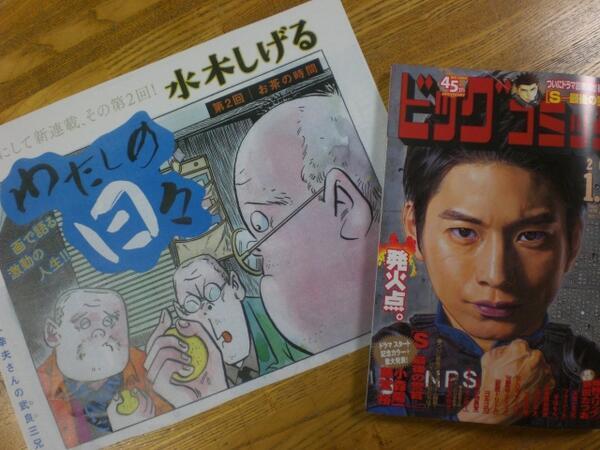
Shigeru Mizuki My Everyday

“That’s something I really can’t understand. Why doubt yourself? It feels so much better to be proud—to have confidence.

I’m 91 years old, but I’m not finished yet. I’m still bursting with dreams.”

That’s beautiful.

Shigeru Mizuki Go Ahead And Eat

There is no word I can think of that encapsulates Japan feels about Shigeru Mizuki other than “beloved.” He is, to the country, a sort of living Buddha; an embodiment of joy and happiness and imagination. In 2010 he was officially recognized by the Japanese government as a Person of Cultural Merit. In 2012, a TV show called Gegege no Nyobo portrayed the romantic story of how he met his wife through an arranged marriage and how they fell in love anyways.
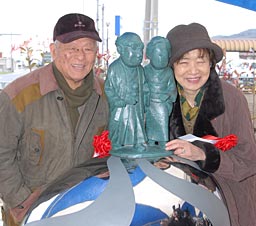
Mizuki and Wife Statue

Like Osamu Tezuka and Hayao Miyazaki, he is one of those rare individuals who shapes the fantasy dreams of an entire country. (I might even say that while Tezuka shaped Japan’s dreams of the future, Mizuki shapes its dreams of the past. And Miyazaki its present.) The only conceivable American equivalent I could conceive of might be Walt Disney when he was a living man and not a corporation. Or JRR Tolkien, if he were less academic. Or Willy Wonka if he were real.

“Come with me and you’ll see, a world of pure imagination … “

We love Shigeru Mizuki!

Mizuki is an artist and a scholar whose work transcends genre and medium. He was born March 8th, 1922 in a small fishing town in Tottori prefecture called Sakaiminato. From a young age he was recognized as an artistic prodigy. His work was published in local newspapers and magazines, and he had his first solo exhibition while he was still in Elementary school.
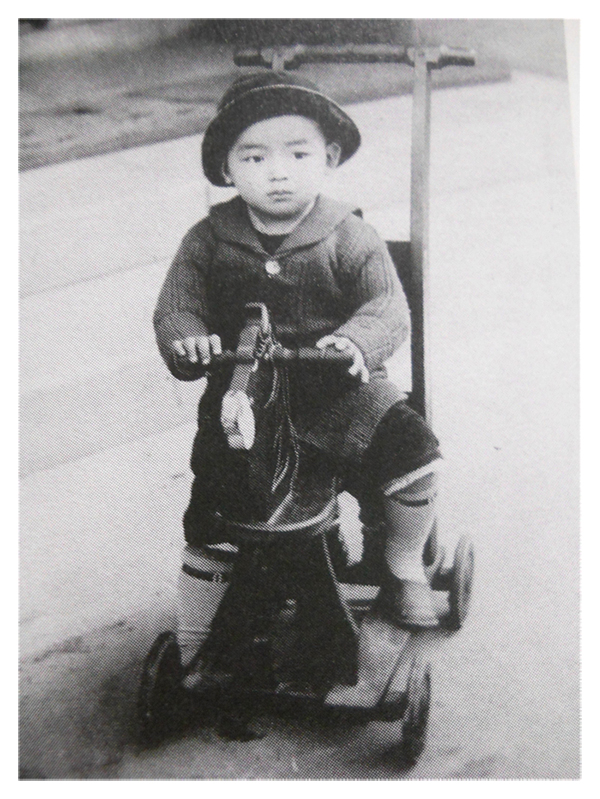
3years

His career as a comic artist began when he returned home from WWII, his drawing arm lost to an Australian bomb while he was in a hospital suffering from malaria. (For more, see Mizuki Shigeru in Rabaul) Mizuki relearned how to draw with his left arm, and began a brief career as a kamishibai artist making paintings for the paper theater popular at the time.

Young Mizuki Shigeru Student

Soldier Shigeru Mizuki

He transitioned into the fledgling manga market, mostly copying Western superhero comics in his own versions of Superman and Plastic Man.  And he dabbled in Western horror comics along the way. (See Mizuki Shigeru and American Horror Comics)

Shigeru Mizuki Rocketman

He didn’t have his first hit until he was in his 40s, with his horror comics Akuma-kun and Hakaba Kitaro, which later transformed into Gegege no Kitaro (published in English simply as Kitaro.) In the 1960s Mizuki helped pioneer the concept of gekiga or art manga, in the magazine Garo, transitioning comic books from children to adult readers.

cover

In his 60s, bored with the daily grind of manga he embarked on a new career as a world folklorist. He began to seriously study the monster and folklore culture he was so fascinated with, and created a series of encyclopedias that cataloged both Japan and the world’s folklore. His work was recognized for his scholarly nature and he was invited as a member of The Japanese Society of Cultural Anthropology.

Mizuki Shigeru in Rapaul

In the late 1980s, during Japan’s infamous “Bubble Era,” he was disgusted with the government of Japan attempting to cover up their wartime atrocities, and the children of Japan ignorant of their own past. Never one to play it safe, Mizuki responded with powerful works like Onward Towards Our Noble Deaths and the epic Showa: A History of Japan. He continues to fight against right-wing militarism and government mind control, in favor of what Thomas Jefferson called The Pursuit of Happiness. Like himself, he prefers a world “bursting with dreams.”

Mizuki_Shigeru_Showa_Book

One of the things I love so much about Shigeru Mizuki the person is that—for all his legendary status—he remains very human. He is not aloof and imperious like Hayao Miyazaki. Mizuki Shigeru posts pictures of himself chowing down on fast foods. He picks his nose. He is very much a man who inhabits a human body, and isn’t ashamed of it, and he doesn’t distance himself. But he loves life and attacks it with gusto.
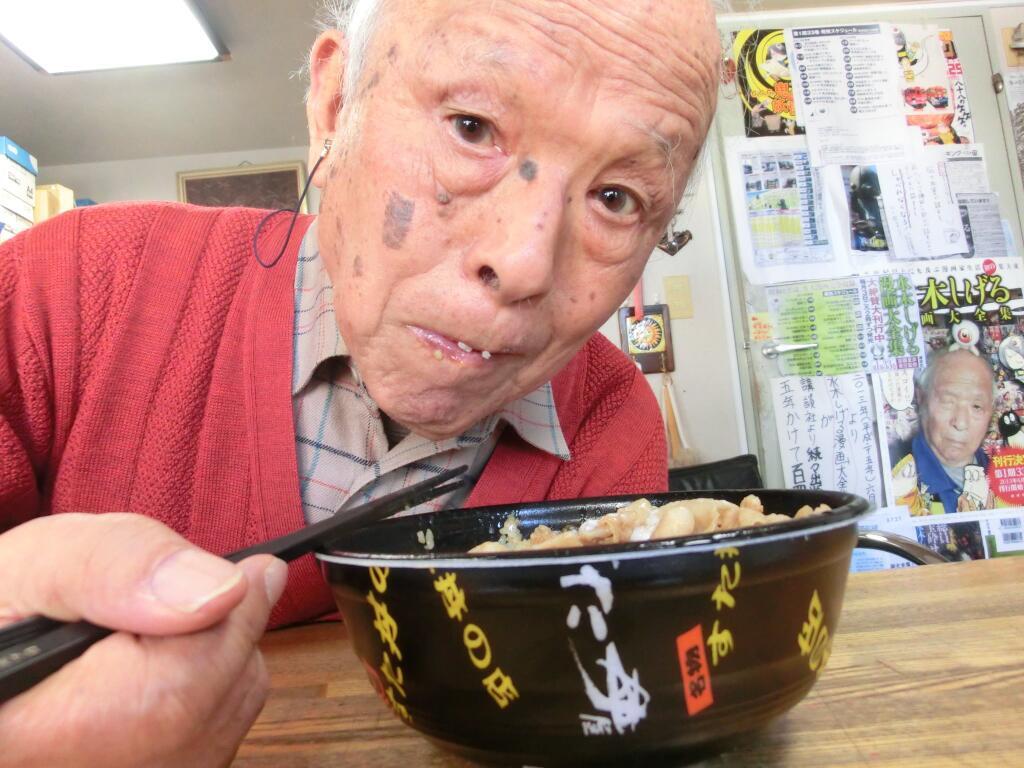
Shigeru Mizuki Instant Ramen

It is my great privilege and pleasure to translate some of Mizuki Shigeru’s works and make them available for the English speaking world. That is a wider world than you would think. Many more people world-wide speak English than Japanese—even as a second language—and I have gotten emails from people as far away from Brazil excited to be reading Mizuki’s works for the first time.

I’ve been a fan of Mizuki’s works since I discovered them in Japan more than a decade ago, and I honestly thought they would never get English translations. They were just too weird; too … “Japanese” for lack of a better word. But now they are here, and with more to come. I am especially glad that the Western world discovered Mizuki Shigeru while he is still alive. Too often we wait until someone is dead to properly honor them.

Shigeru Mizuki Hamburger

And every time I see Mizuki Shigeru’s grinning face, I hear the whisper of Yoda coming somewhere in the background.

“When 900 years old you are, look as good you will not.”

Damn straight. Dream on, beautiful dreamer.

Mizuki Shigeru 91 Birthday

Further Reading:

At long last, Shigeru Mizuki’s fine works are available in English. Do yourself a favor and read them all!

Yūrei: The Japanese Ghost

yurei-amazon-cover

I am proud to announce that my book Yūrei: The Japanese Ghost is finally available for preorder! This book is the culmination of more than eight years of research, including work done for my MA thesis for the University of Sheffield. It is a deep dive into the history, folklore, religion, and culture behind Japanese ghosts—yūrei.

Windy_Japanese_Ghost

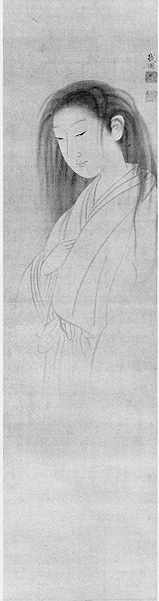
In other words, if you have ever wondered about the pale girl in the white kimono with the long black hair, dripping water—this will give you all the answers.

Click to preorder Yurei: The Japanese Ghost

What’s it about?

Unsurprisingly, Yūrei: The Japanese Ghost is about everything to do with yūrei. The book begins with Maruyama Ōkyo and his famous painting, The Ghost of Oyuki. Then we dive into the Edo period kaidan boom that set the stage for Ōkyo’s painting, and examine the influence of kabuki on yūrei and why they look the way they do. Next Lafcadio Hearn takes the stage with his Rule of the Dead, and we take a tour of the Japanese afterlife and the World Over There. We learn why Heian period Japanese aristocrats worried so much about their final thought, and hired zenchishiki to mid-wife them to death. Next we meet the San O-Yūrei—the Three Great Yūrei of Japan; Oiwa, Otsuyu, and Okiku. Then it is Obon, Japan’s festival of the dead, and finally we meet the warrior ghosts of Japan in noh theater and hear some Tales of Moonlight and Rain.

Yurei_Chapter_List

I modeled the book after Carl Sagan’s Cosmos, telling the stories of the people and history behind the various yūrei legends as well as the yūrei themselves. We will meet the painter Maruyama Ōkyo, the kabuki playwright Tsuruya Nanboku IV, the Confucian scholar Hayashi Razan who invented the word kaidan, and the Buddhist priest Asai Ryōi who wrote one of the most famous Japanese ghost stories of all time, Botan Dōrō, called The Tale of the Peony Lantern. The book intertwines these stories with the story of the yūrei, showing how the concepts developed over time and how Japan changed to encompass new beliefs in the supernatural.

Are there Japanese ghost stories in Yūrei: The Japanese Ghost?

Of course! Although that is not the main focus. I like to say it is a book about Japanese ghost stories not a book of Japanese ghost stories. So this is far more than just a collection of tales. But you will get lots of my translations in here.

Ghost_of_Oyuki_Closeup

Are there pictures in Yūrei: The Japanese Ghost?

Absolutely! We are still working on the details for this, but I plan to pack the book with as many yūrei-e as I can!

Japanese_Ghost_Closeup

Will the book look cool?

Oh yes! The book itself is going to be amazing. My publisher, Chin Music Press, specializes in making cool physical books. They believe the best way to compete in the modern digital market is the make the physical book stand on its own as a piece of book art. Clothbound with an embossed cover— Yūrei: The Japanese Ghost is going to look tremendous on your book shelf.

Yurei_Galley_Copies


Please Preorder!!!

Yurei Amazon Cover

And now my pitch! If you are planning to buy my book at all I encourage you to preorder it. You’ll never have a better price on the book than right now, and you will have time to save  before you actually have to pay! Plus you will be doing me a huge favor.

In the modern publishing world, preorders are king. The amount of preorders indicates interest to publishers and retailers. Retailers use preorder numbers to determine how much they will order and market the book. The publisher uses retailer orders to determine how large the print run will be.

This is especially true of a first-time author such as myself. I’ve been translating and writing for free here on hyakumonogatari.com for more than six years. If you have been enjoying reading the site I would appreciate your support for my book! And I know you will love it!

Click to preorder Yurei: The Japanese Ghost


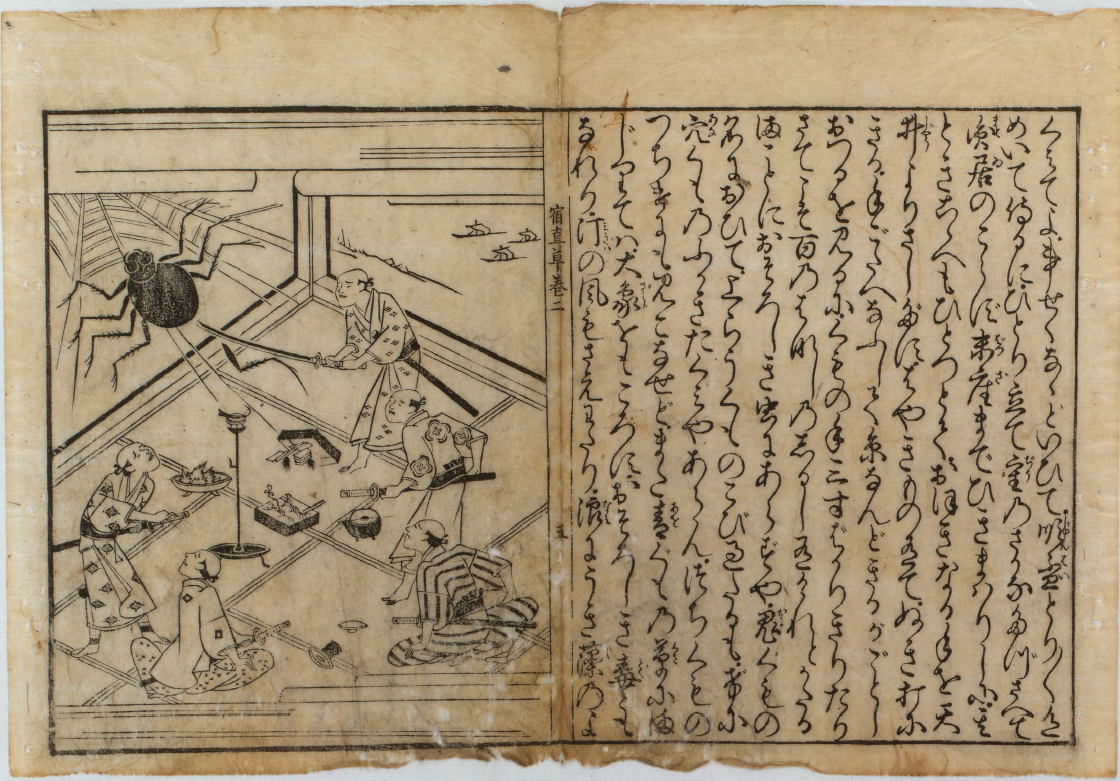
On Cutting a Spider’s Leg During a Game of Hyakumonogatari Kaidankai

Tonoigusa_Hyakumonogatari_Spider

Translated from Tonoigusa

The brave young men had gathered together for a single purpose. “Tonight, we will exchange 100 stories and see if the legends are true; see if something terrifying awaits us at the end.”

They were ardent tellers of tales. As the night passed, they soon arrived at the closing of the ninety-ninth weird story. The room was thick with anticipation.

“Let us not be impatient.” said one of the men. “A drink and some food together before the final tale is told.” All in agreement, they produced lacquered boxes packed tight with delicacies. These were shared between the intimate gathering. They sat in a circle, enjoying the brief respite.

Without warning, a great hand appeared on the ceiling. It appeared to stretch wide, reaching its fingers out in a colossal grasp.

The frightened men were bowled over at the sight, except for a single stalwart who sprang to action. With a flick of his wrist, his sword flew from its sheath and struck at the hand. However, much to everyone’s surprise instead of a giant finger the sword sliced off a spider’s leg, about three inches in length. One of the men chuckled, “I guess this was a true Test of Courage after all.”

As to the spider, it appeared to be of the variety known as the orb-spinning spider. It would flatter it too much to call it a Joro spider (joroguma). Its color was not right to call it an earth spider (tsuchigumo). But it was no common pit spider either (anagumo). After all, in its web it had killed a giant weevil, so it must have a dreadful poison.

But its color was blue/green, like the kind of insect that could disappear between blades of grass. Perhaps it was a sea spider, blown here by an ocean breeze that carried it far from its home, floating in the air as if on the waves. It is pitiable; this spider carried so far from its home, trying to make do in its new environment, spinning a web on unknown surfaces. We should admire its perseverance. It was only sitting there, sleeping in the summer heat, never asking for the intrusion of these storytellers. And here was its fine works undone.

Our own fine works are made of individual threads that can be pulled apart. We can be killed on the street walking home, joining Yorimitsu in the spirit realms. Or maybe tomorrow will come. It is not for us to decide.

Tonoigusa Hyakumonogatari Spider

Translator’s Note:

This story comes from the 1660 kaidan-shu Tonoigusa by Ogita Ansei. It is one of the earliest known accounts of the game Hyakumonogatari Kaidankai.

I’ve read numerous accounts of this story, but had never read it myself until recently. I was surprised to find the epilog about the spider, as it is not included in most translations.

Further Reading:

For more spider tales and tales of Hyakumonogatari Kaidankai, check out:

The Web of the Water Spider

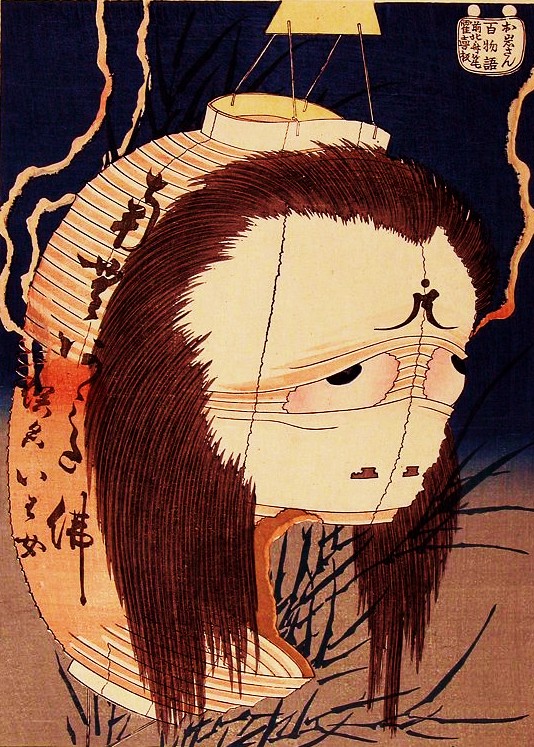
Aoandon – The Blue Lantern Ghost

What is Hyakumonogatari?

Yurei FAQ – Five Facts About Japanese Ghosts

Hokushū Shunkōsai Ghost of Oiwa

To learn much more about Japanese Ghosts, check out my book Yurei: The Japanese Ghost

Yurei—Japanese Ghosts—follow certain rules; obey certain laws. They have a specific appearance and purpose. These rules supply authenticity, making them culturally relevant and recognizable. Also, these rules make them more horrifying than the constantly changing Western ghost, which can be played for laughs, romance, or fear at any given moment.

Each aspect of a yurei is bound by centuries of culture and tradition. There is a “why” behind everything, and the story of the individual aspects of the yurei can be as fascinating as the yurei stories themselves.

Click the title of each to be taken to the full story.

5. How Do You Say Ghost in Japanese?

yurei

A country as obsessed with ghosts as Japan is obviously going to have more than a single word. Just as in English, there are several words meaning “ghost,” but each with a different usage and feel.

4. What is the White Kimono Japanese Ghosts Wear?

dead body

Black hair. White face. White kimono. Whisper the word Japanese ghost to anyone, and that is the image that will appear in their head. For Americans, the image generally comes from Japanese horror films where white-kimonoed girls crawl from TV sets or rise from wells. But to Japanese people, the costume of a white kimono has a more somber feel. Most likely over their lives they will wrap more than one loved one in the traditional burial garment called a kyokatabira.

3. What is the Triangle Headband Japanese Ghosts Wear?

yureisankakuboshi

What are those odd, triangle-shaped hats or headbands worn by some Japanese ghosts? That is a difficult question to answer because, while there are several opinions, nobody really knows.

2. Why do Japanese Ghosts Not Have Feet?

Yurei_Japanese_Ghost

The gentle drops of falling rain. A lonely willow tree standing near a graveyard. And a Japanese ghost, called a yurei, waiting below. This is our image of a yurei, and when we imagine this picture of the yurei, it has no feet.

1. What’s the Difference Between Yurei and Yokai?

Yokai_or_Yurei

What is a yokai? What is a mononoke? What is a bakemono? Are yurei also yokai? These seemingly basic questions have no precise answers. Almost everyone has their own ideas, and they seldom agree with each other. Because folklore isn’t a science.

Mizuki Shigeru and American Horror Comics

Kitaro_and_Four_Color_Fear

When you think of influences on Japanese comic book legend Mizuki Shigeru, names like Basil Wolverton, Bob Powell, and Warren Kremmer don’t usually spring to mind. After all, those artists drew for 1950s American horror comics like Tomb of Terror and Crypt of Horror. They hardly seem like source material for a young man thousands of miles across the ocean. Where would he find them? And if he did find them, how could he read them?

But the influence is obvious. Mizuki Shigeru’s early work has the same shadowy gloom, the same lines and dramatic poses. This is especially true in Mizuki’s comic Hakuba Kitaro (Graveyard Kitaro), his darker, more horrific version of his famous character Kitaro before it was lightened and made more child-friendly at the publisher’s request. The opening story in Hakuba Kitaro—called Kitaro no Tanjobi or Kitaro’s Birthday—in particular looks and feels like a 1950s EC comic. If it weren’t for the Japanese lettering and some of the faces, Kitaro no Tanjobi could easily have risen from Tales from the Crypt or Vault of Horrors.

Mizuki has never been shy about these influences. He is widely read, and was fascinated with American and European authors and philosophers. He borrowed freely for his comics, adapting obscure horror authors like W. F. Harvey, whose 1928 story The Beast with Five Fingers was transformed into the Kitaro adventure The Hand. (See Kitaro and the Beast with Five Fingers.)

In his historical/auto-biographical comic Showa: A History of Japan Mizuki describes how American comics came into his hands. In the post-war period, Mizuki’s father had a position working with the occupation government. Mizuki’s father spoke English and even worked as an English teacher, which made him a valuable bridge between the occupiers and the native Japanese. Mizuki’s father knew his son was struggling, trying to break into the fledgling kashihon rental-comic market after his former kamishibai (paper theater) business had vanished. He brought home the various comic books left behind by American GIs and civilians working in the occupational government, and gave them to his son to use as reference material and inspiration for his own comics.

It is pretty obvious which American comic inspired Mizuki’s first hit with the kashihon rental-comic market. Although he called his version Rocketman, Mizuki made no attempt to disguise the character’s origin, and didn’t even bother to alter the famous “S”-shield on the chest into an “R”—which would have been more appropriate for “Rocketman.” Mizuki may have taken the look of Superman directly from the comic, but he told it with his own sense of whimsy and style. It almost looks like he is imitating the Fleisher Brothers’ Popeye cartoons instead of Superman, as Rocketman flexes a muscle in the shape of an atomic bomb’s mushroom cloud to show off just how mighty he is.

Shigeru Mizuki RocketmanSo the influence was always there. But it wasn’t until the publication of Fantagraphics’ Four Color Fear: Forgotten Horror Comics of the 1950s that it became clear just how much of an influence there was. (Or at least until a copy of that book found its way into the hands of Natsume Fusanosuke who wrote the initial blog that inspired this post.
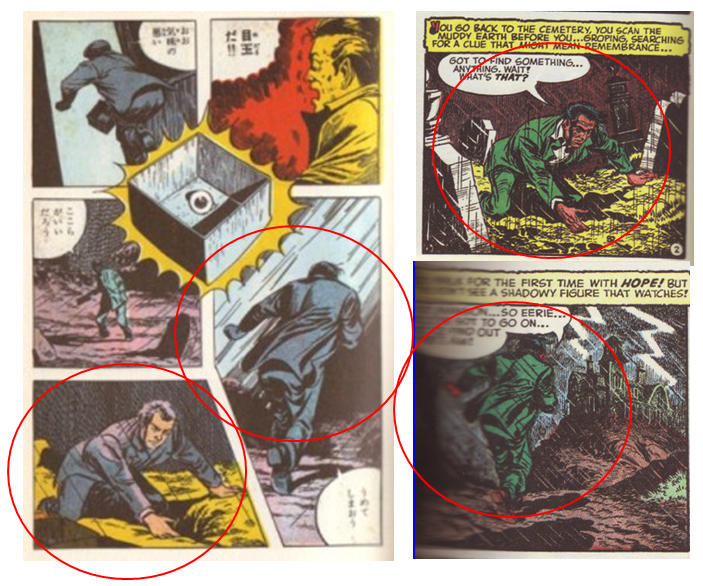
In the time-honored tradition of comic artists, it looks like Mizuki Shigeru may have had his own “swipe file” of poses and characters that came straight from American comic book artists.

Shigeru_Mizuki_EC_Comics_1

These first images come from the 1959 kashihon comic Yokaiden by Mizuki Shigeru. There can be no mistake that Mizuki took several of the poses and faces directly from Warren Kremmer’s 1953 comic Amnesia. The poses are identical, even though they are being used for different story elements.

Shigeru_Mizuki_EC_Comics_2

The biggest surprise—and “Ah ha!” moment—comes when looking at Kitaro’s father. The mummy in these pictures is Kitaro’s father, before he liquefies and renders into the famous version of Medama Oyaji that we all know and love. I always thought this was a weird design for Mizuki. Mummies aren’t exactly prominent in Japanese folklore and horror, and it never really made sense that Mizuki would chose a shambling mummy to represent the last of the Yurei Zoku, the Ghost Tribe, that once ruled over the earth.

Shigeru_Mizuki_EC_Comics_Kitaros_FatherBut here, in Bob Powell’s 1951 comic Servants of the Tomb we see the origin and inspiration of Kitaro’s father. This one isn’t a direct swipe like the others, but it is obvious that Mizuki Shigeru saw this comic and thought enough of the monster to use it for the brief appearance of Kitaro’s father as a whole creature. Finally, the design makes sense.

Bob Powell and Warren Kremmer are in good company. Mizuki Shigeru also collects early European prints by artists like Albrecht Dürer, and uses them for inspiration. I have seen several posts by Mizuki where he shows the original, and his version next to it. He also copies the work of Japanese masters like Toriyama Sekein and Katsushika Hokusai for his Yokai Encyclopedias and print series, and uses famous photographs and historical works of art to ground his series like Showa: A History of Japan.

As Natsume mentions in his article, there are probably more of these swipes from early comics to be discovered by someone with the patience and means to find them. Natsume further speculates that, if American GIs carried American comics with them to Japan and inspired a young Mizuki Shigeru, perhaps they brought them to Europe and influenced a certain young man who would come to be known as the artist Moebius.

Who knows? But American comic art traveled far, and the American GIs served as unknowing Johnny Appleseeds, leaving behind their discarded bits of Americana and pop culture that got absorbed and assimilated into something else, something that has become a foundational element of Japanese culture.

Further Reading:

For more about Mizuki Shigeru, check out:

Mizuki Shigeru in Rabaul

6 Types of Japanese Yokai From Showa

Countdown to Mizuki Shigeru’s Showa 1926-1939: A History of Japan

Mizuki Shigeru’s French Fry Heaven

Happy 91st Birthday Mizuki Shigeru!

Previous Older Entries Next Newer Entries

Copyright notification

All translations and other writing on this website were created by Zack Davisson and are copyright to him.

Copyright notification

In accessing these web pages, you agree that any downloading of content is for personal, non-commercial reference only.

No part of this web site may be reproduced or transmitted in any form or by any means, electronic, mechanical, photocopying, recording or otherwise, without prior permission of Zack Davisson.

Copyright notification

For rights clearance please contact Zack at:

zack.davisson (at) gmail.com

Thank you.