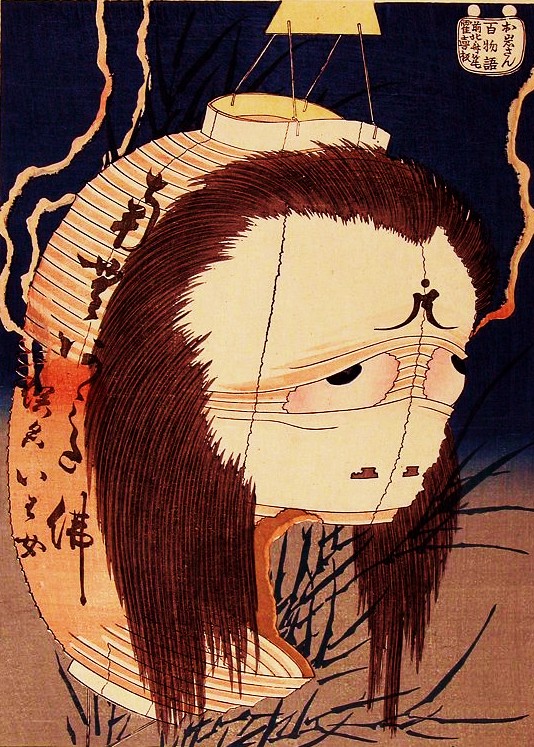
How Do You Say Ghost in Japanese?

To learn much more about Japanese Ghosts, check out my book Yurei: The Japanese Ghost

A question I am commonly asked is, “What is the Japanese word for ghost?”  However, what seems a simple question is actually complicated.

Ghost. Spirit. Specter. Wraith. Revenant. Several words in the English language describe souls of the dead who have not moved on to the afterlife. Many of these come from other languages; like ghost, which has its probable roots in the pre-Germanic word ghoizdoz, meaning fury or anger; or spirit from the Latin spiritus meaning breath.  Then there are more direct loan words, such as the Dutch spōk (spook), or the French phantom, or the Scottish wraith.  Each word can mean “ghost,” but each word carries a different nuance or flavor.

Some words are even more specific. Poltergeist combines the German words poltern meaning to rumble or to make noise and geist meaning spirit or ghost.  Put the two words together and you have a very specific entity that cannot be mistaken for some other type of ghost.  A poltergeist is only ever a poltergeist.

A country as obsessed with ghosts as Japan is obviously going to have more than a single word.  Just as in English, there are several words meaning “ghost,” but each with a different usage and feel.

All(most) all Japanese words for ghost use some variation on the kanji .  霊 can be read as either –rei or –ryō (or tama, or mitama, or –ki — no one ever said Japanese was easy).  Whatever the pronunciation, 霊 always retains the rough meaning of spirit.

Here is a list and definition of all the Japanese words for ghost that I know.  I am sure the list must be incomplete:

___________________________________

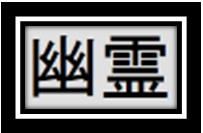
幽霊 – yūrei – 幽 (dim) +霊 (spirit) – Probably the most common Japanese word for ghost, yūrei translates pretty happily as dim
spirit.  This seems like an obvious explanation – ghosts are see-through, after all – but the word has a further connection.  One of the words of the land of the dead in Japanese is 霊の世界 Yū no Seikai – The Dim Land.

亡霊 – bōrei – 亡 (departed) +霊 (spirit) – Bōrei is the Gothic term for ghost in Japanese, meaning ruined or departed spirit.  This is the word with the most literary overtones. Probably the best example is Japanese translations of Shakespeare where the ghost of Hamlet’s father is called Hamlet no Bōrei.

心霊 – shinrei – 心 (heart) +霊 (spirit) – Shinrei is the term preferred by spiritualists in Japan, and carries a more mystical feel.

精霊 – seirei/shōryō – 精 (vitality) +霊 (spirit) – This combination of kanji has religious connotations.  When pronounced, seirei, it is most likely talking about Western ghosts. When pronounced shōryō it has Buddhist connotations.

聖霊 – seirei – 聖 (holy) +霊 (spirit) – The same pronunciation as seirei above, but changing the kanji makes the word for the Holy Ghost of Christianity.

死霊 – shiryō – 死 (dead) +霊 (spirit) – Because it has the kanji for “death” right there in the front, shiryō is a little bit scarier term for a ghost in Japanese.

生霊 – ikiryō – 生 (living) +霊 (spirit) – Ikiryō is a specific term for a person who releases their ghost-energy while still alive.  It is a rare manifestation, seen mainly in The Tale of Genji.

怨霊 – onryō – 怨 (grudge) +霊 (spirit) – A popular figure in J-Horror flicks, onryō are ghosts who died with some lingering grudge, and seek revenge against those who wronged them.

騒霊 –sōrei – 騒 (disruptive) +霊 (spirit) – This is a rarely-used term for poltergeist, meaning ghosts who just rattle the chandeliers and move chairs around.  In modern Japan, most people would just use the loan-word poltergeist.

祖霊 – sorei – 祖 (ancestor) +霊 (spirit) – Similar pronunciation as above, but with a long vowel and and a drastically different kanji.  Sorei are ancestor spirits who protect the living, and are deeply honored.

神霊 – shinrei – 神 (shrine) +霊 (spirit) – Another rarely used term, this refers to the spirits of Shinto shrines.

悪霊 – akuryō – 悪 (bad) +霊 (spirit) – This is a somewhat loaded term that mean’s simply “bad spirit.”  It carries a more Western feel to it, and could be applied to devils as well as ghosts. Definitely bad news.

浮かばれない霊 – Ukabarenairei- 浮かばれない(cannot rest in peace) + 霊 (spirit).  Essentially, the Restless Dead. Often used for those who died in isolated places, like mountains, whose bodies were not properly cared for.

英霊 – eirei – 英 (heroic) +霊 (spirit) – Spirits of the war dead/heroes.

幽鬼 – yuki – 幽 (dim) + 鬼 (ki) – Demon spirit.  A seldom-used term for evil ghosts.

亡者 – mojya – 亡 (dead) + 者 (person) – Dead person. An older, seldom-used term for ghosts.

お化け/化け物  – obake/bakemono  お化け (changing) +  物 (thing) – The terms refer not specifically to yūrei but translate in usage to something closer to supernatural creature.  Obake and bakemono use the kanji 化 (bakeru) which carries the meaning of to adopt a disguise or change form, with the implication of changing for the worse.

The Ghost of Oyuki

For more about the origins of Japanese Ghosts, you can purchase Zack Davisson’s limited edition yomihon chapbook The Ghost of Oyuki from Chin Music Press.

The Ghost of Oyuki Chapbook

Further Reading:

Check out other yurei tales from hyakumonogatari.com:

What Does Yokai Mean in English?

What is the Triangle Headband Japanese Ghosts Wear?

Goryo Shinko – The Religion of Ghosts

Why do Japanese Ghosts Not Have Feet?

The Yurei Child

Goryo Shinko – The Religion of Ghosts
Translated and Adapted from Mishu Shukyo Shisosho

To learn much more about Japanese Ghosts, check out my book Yurei: The Japanese Ghost

From ancient times, the Japanese attributed natural disasters and plagues to the handiwork of onryo, grudge-bearing spirits of the dead who had died by violence or some other unnatural circumstance.  In order to transform these onryo from horrors into benign deities that would use their powers for the peace and prosperity, the Japanese created Goryo Shinko, the Religion of Ghosts.

About the Spirit

Spirits or souls separating from their bodies at death is a common belief across the world.  Japan is no exception.    From as far back as the distant history of the Jomon period, the Japanese have built their spiritual beliefs on ghosts and the grave.   The unleashed soul, called mitama or tameshi in Japanese, could cause an array of misfortunes.   Of particular danger were the spirits of those who died due to political intrigue, or who were defeated in war.  These spirits inflicted their revenge upon their still-living enemies.   During the Heian period, folk beliefs and rituals dealing with the wrathful dead formalized into a religion.

From Onryo to Goryo

During times of national instability, when political strife and battle dominated the country, the threat of onryo loomed large.  Any who died amidst the chaos were capable of sustaining a powerful hatred.   And this hatred was unfocused.  Onryo did not limit their revenge to those whom had wronged them in life.  The method of an onryo’s revenge; plague, fire and earthquake, did not allow for such precise targeting.

The Heian period is full of examples of these wrathful ghosts, onryo, mostly high-born and privileged in life. Fujiwara Hirotsugu, Prince Sawara, and Prince Osabe were all considered to have transformed into onryo their deaths.   To calm their raging spirits, they were posthumously raised in court rank and title, then enshrined as kami in Shinto shrines.  These rituals, it was said, transformed them from destroyers into protectors of after Japan.

This, in essence, is Goryo Shinko; the transformation of wrathful ghosts into protective entities via ritual and entitlement.  During the Heian period this religion was so pervasive there was even a ceremony in the Imperial Court welcoming new spirits into the ranks of protective spirits. According to official documents, the first such ceremony confirming goryo was on May 20th in 863CE (The 5th year of the Jyogan Era), held in Shinsenen. (From the Nihon Sandai Jitsuroku).

Examples of Goryo Shinko survive to modern Japan.  Kyoto has two ancient temples that remain devoted to Goryo Shinko: the Upper and Lower Goryo Shrines.  The Upper Goryo Shrine enshrines the Hassho Goryo (The Goryo of the Eight Districts): Emperor Sudo (Prince Sawara, son of Emperor Konin), Emperess Inoenai (Wife of Emperor Konin), Prince Osabe (Son of Emperor Konin), Fujiwara Daibunin (Fujiwara Yoshiko, mother of Prince Iyoshin), Tachibana Daibu (Tachibana Hayanari), Budaifu (Bunya Miyatamaru), the diety Honoikatzu (Sugawara Michizane), and Kibi Daijin (Kibi Makibi).  Also enshrined are Prince Shoshin, the Government Inspectors for China (Fujiwara Nakanai and Fujiwara Hirotsugu), the Emperor Sotoku, Fujiwara Yorinaga (known as the Badman of Uji), Emperor Antoku, Emperor Jyuntoku and Emperor Tsuchimikado.

While Goryo Shinko is identified with the Heian period, and the earliest records of Goryo Shinko date to this time, there is speculation that the religion was based on older traditions. Looking at purely historical records, the first known account of an onryo was Fujiwara Hirotsugu, written about in Genbo’s military history “Shoku-Nihongi”
(“The Continued Chronicles of Japan”). But there are other opinions.

In his book “Kakushita Jyujika” (“The Hidden Cross”), author Umehara Takeshi makes the unlikely (and wholly unsupported) claim that the Buddhist Prince Shotoku Taishi was an early onryo.  Another author, Yaegashi Naohiki, sees evidence of onryo activity in the decline of the heads of the Soga clan (Soga Emishi and Soga Iruke).  Another candidate for pre-Heian period onryo is put forward by Ootsu Miko, who identifies Tada Kazuomi in her books “Fusouryakuki” (“An Record of the Approximation of the Lands East of China”) and “Yakushiengi” (“The Omen of Yakushi Temple”).  Ootsu says that the true causes of historical events can be placed on karma coming back to us from future lives.   Each of these writers have some grounds for argument in their individual accounts.

Another more likely candidate is put forth by Terasaki Yasuhiro, who wrote in “Jinbutsu Sousho” (“A Library of Humanity”) that the death by small pox of four children of the Fujiwara clan was cause by the onryo of Nagaya Ookimi.  However, this still sets Goryo Shinko in the Heian period, as Nagaya Ookimi was a contemporary of Fujiwara Hirotsugu, and both of their stories were featured in Heian period compilations like “Shoku Nihongi.”  Timewise, there isn’t much difference between the two, and whether Ookimi or Hirotsugu were first, there is scant hard evidence of onryo from any period before the Heian and Nara periods.

Based not on evidence, but purely on philosophical terms, the author the author Izawa Motohiro, in his book “Gyakusetsu no Nihonshi” (“An Alternate Explanation of Japanese History”), writes that the dangerous nature of improperly worshiped ghosts is native to Japan.  It runs contrary to the influences of the ancestor cult from China.
While Izawa confirms that the Heian period is the beginning for formalized worship, he names the earlier collection of folkbeliefs Pre-Onryo Shinko.  Iwaza also uses Nagaya Ookimi and the deaths of the four Fujiwara children as an example, showing that belief in onryo existed prior to the formalized religion of the Heian period.  Izawa further advocates that Goryo Shinko should properly be called Japanese Onryo Shinko.  In truth, Izawa’s theories almost perfectly reflect statements made previously by author Umehara Takeshi.

There are many theories, but few actual articles written on ancient onryo.  One of the most basic descriptions was made by the monk Jien, who wrote that an onryo was only as powerful as its reason for appearing.  Once the spirit’s claims had been settled, it would be appeased and cease to trouble the world.  Jien’s description remains accurate, and this basic description has carried through from ancient times through Japan’s middle ages and beyond.

Goryo Shinko declined with the advent of Buddhism in Japan, during the Wars of the Northern and Southern Courts.  Buddhism’s rituals and beliefs gradually supplanted the Shinto beliefs of the Heian period, although they never vanished entirely.  In shrines such as Yanbekimiyori (Warei Jinja) and Sakura-sotzuro (Sougorei-do), goryo
were regularly enshrined and worshiped.  And even with the dominant influence of Buddhism, in the “Taiheiki” (“Record of the Taihei Clan”) the violence fo the War of the Northern and Southern Courts was said to be influenced by onryo.  The power of the dead was still blamed for the many great social upheavals in Japan.   The Genpei Gassen, were said to be caused by the onryo of Sutokuin, and still more onryo-derived conflicts are recorded in the “Hogen Monogatari” and the “Heike Monogatari.”

Why do Japanese Ghosts Not Have Feet?

Yurei_Japanese_Ghost

Translated from Sore de Honto?

To learn much more about Japanese Ghosts, check out my book Yurei: The Japanese Ghost

The gentle drops of falling rain. A lonely willow tree standing near a graveyard. And a Japanese ghost, called a yurei, waiting below.  This is our image of a yurei, and when we imagine this picture of the yurei, it has no feet.

The uniform image of a yurei has come from the Middle Ages to the modern day.  But in the earlier days, at a time when people were mortally afraid of the power of spirits, yurei actually had feet.

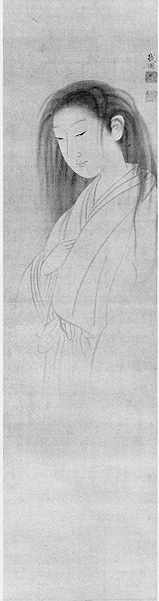
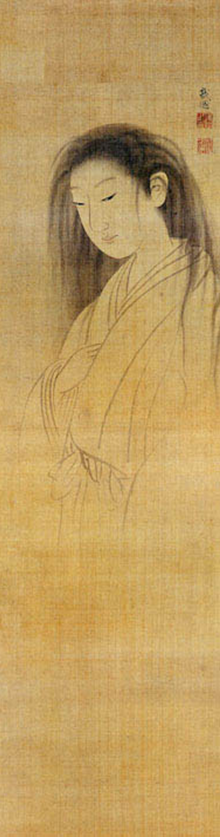
The image of a footless yurei, known as the ashi ga nai yurei, became established in the Edo period by kaidan tales like “Yotsuya Kaidan” and “Bancho Sarayashiki.”  But even before these kaidan, the footless yurei had gained popularity in the works of artist Maryuama Okyo. (1733-1795).   His paintings were so overwhelmingly popular that they influenced the designs of the kabuki stage, until Okyo’s image of the yurei became the accepted form of Japanese ghosts.

Maruyama_Okyo_The_Ghost_of_Oyuki

But why did he paint his yurei without feet?  There are several proposed explanations.  One says that his images were drawn in dim light, that only illuminated the top half of the person leaving the legs and feet in darkness.   Keio University professor Ikeda Yasaburo proposed the theory in his book “Nihon no Yurei” that Okyo was inspired by the haze of incense smoke rising into the sky, and drew his yurei as if they were half composed of this smoke.  Another theory looks at the long robes of Bunraku puppet theater which hide the feet of female puppets.  Kabuki theater took inspiration from Bunraku, and it is possible that the hidden feet of the puppets was adopted into live theater.  It is most likely that from one or more of these explanations comes the popular image of the footless Japanese ghost.

…and yet, it cannot be said that all yurei are footless. You can often hear the sounds of ghostly footsteps in traditional kaidan stories.  In the popular kaidan Botan Doro the arrival of the yurei Otsuyu is announced by the karan, koron of her wooden geta sandles.  And in Noh theater, many of the ghostly characters sport magnificent footware.

Further Reading:

To read more about Japanese ghosts, check out:

The Ghost of Oyuki

How Do You Say Ghost in Japanese?

Do Kappa Really Exist?

Translated from Sore de Honto?

Of all the bakemono and yokai in Japan, the kappa is the best-known.  Depending on the area, they might be known as “gataro” or “kawako” or “gawappa.”   This just shows how wide-spread they are.  As for appearance, the most stereotypical kappa can be recognized by the indented bowl on his head and by webbed hands and feet.

There are many people who claim to have seen this kind of kappa.  But if you research exactly what people describe, it seems like what they are actually seeing is an otter.

Otters come from the mink family, and have a large tail.  They can use this tail for support to stand straight up on the river banks.  When they do this, they are almost exactly the same size as a human child.

An otter’s skull is soft, and can be flattened out at the top.  Just imagine coming upon an otter in the dim evening light, standing upright on a river bank.  Water running off its fur,  the head flattened out and eyes moving around restlessly, standing at the same height as a human child.  Don’t you think it might look just like a kappa?

In the Edo period, if you examine all of the different portraits of kappa, you can see the influence of the otter’s shape.  For example, the picture called “Suiko, scroll #20” is obviously a mix between an otter and a turtle.

The distribution of otters in Japan and stories of kappa coincide, from Hokkaido down to Amami island.  But nowadays, otters are almost extinct in Japan.  I wonder if the legend of the kappa will fade along with them?

Secrets of the Yokai II

Translated from Mizuki Shigeru’s Yokai Daihyakka

How are Yokai born?

It is said that the vast majority of Yokai are born from the emotions of human, especially the powerful emotions of fear, yearning or hate.

But there are other ways for a Yokai to come into being:

1. From the violence of natural disasters such as floods, earthquakes, windstorms or volcanic eruptions.

2.  From the fear of dying accompanying disease and dire poverty.

3. From fear of animals, especially the terror humans feel at the prospect of being eaten by some beast.

4. From plants with lifespans that outstrip humans, like cedar and pine trees.  It was thought that these trees would live forever, and there was a desire of humans to believe in something that had power over death, something indestructible.

5. From human belief in superstitions and stories, or the teachings of religions.  There are things that scientific knowledge cannot explain, and it is there that Yokai are born.

Further Reading:

For more information about yokai and their meaning, check out:

What Does Yokai Mean in English?

A Brief History of Yokai

Secrets of the Yokai – Types of Yokai

Previous Older Entries Next Newer Entries

Copyright notification

All translations and other writing on this website were created by Zack Davisson and are copyright to him.

Copyright notification

In accessing these web pages, you agree that any downloading of content is for personal, non-commercial reference only.

No part of this web site may be reproduced or transmitted in any form or by any means, electronic, mechanical, photocopying, recording or otherwise, without prior permission of Zack Davisson.

Copyright notification

For rights clearance please contact Zack at:

zack.davisson (at) gmail.com

Thank you.