Mizuki Shigeru’s Showa 1926-1939: A History of Japan

Mizuki_Shigeru_Showa_Cover

So, I haven’t had as much time to work on new translations for Hyakumonogatari.com, and I can finally tell you why. I have been working on translating Drawn & Quarterly’s new Mizuki Shigeru comic Showa 1926-1939: A History of Japan.

This is an epic, monolithic comic that combines the best of Mizuki Shigeru—his yokai comics, his autobiographical comics, and his war comics. It is a history of the Showa period (1926-1989), covering both his personal story growing up during the period, as well as the heady back story of politics, finance, and culture that transformed Japan from the promising flower of Taisho Democracy into the monster of WWII and back to the Economic Miracle that reconstructed the nation.

The entire series is narrated by Nezumi Otoko, and features sporadic appearances by other yokai. It’s the kind of comic you could never see in the U.S.—I like to think of it as “What if Carl Barks had written Howard Zinn’s A People’s History of the United States but done it as a comic book using Donald Duck as the narrator?” The depth of history is incredible. I had some knowledge of the Japanese side of WWII, but when translating this I found that many of my long-held beliefs were entirely incorrect. It also puts into perspective all of the dealings that are still going on in Asia today. Or as my wife said when she read the comic—“I finally understand why China hates Japan so much.”

It’s an amazing comic and I feel honored to bring it an English-speaking audience. The comic was originally an 8-volume series in Japan, but Drawn and Quarterly is combining two volumes into one book, so it will be a 4-volume set in total.

You can pre-order the comic here:

Showa 1926-1939: A History of Japan

When I am finished with the translation, I do some more translations for Hyakumonogatari.  I am planning to do a series on the yokai featured in Showa, so you can look forward to that!

Oh, and if there are any Twitter folks on here, I am also translating Mizuki Shigeru’s official Twitter posts (@mizukipro) so you can follow me @zackdavisson and see what Mizuki Shigeru has to say!

Happy 91st Birthday Mizuki Shigeru!

Born March 8th, 1922, today is the 91st birthday of the man who brought yokai back to Japan, and created the comics that have entertained and educated succeeding generations of people.

Happy birthday Sensei!!!

Mizuki Shigeru 91 Birthday

Takaonna – The Tall Woman

Translated from Mizuki Shigeru’s Mujyara and Japanese Wikipedia

The takaonna (tall woman) is a yokai with an interesting hobby. If she is walking along, and sees a two-story brothel, she stretches the bottom half of her body so she can peek in on men enjoying the delights inside. It’s said that the takaonna was a homely woman who could never attract male companionship, changed into a yokai by her own desire.

Takaonna were first illustrated by Toriyama Seiken in his The Illustrated Night Parade of a Hundred Demons (Gazu Hyakki Yagyo ). He drew a picture and a name, but with no story or explanation for the stretching yokai.

Folklorist Fujisawa Morihiko first recorded the story of the ugly woman peeking into brothel windows in his book Complete Discussions of Yokai (Yokai Gadan Zenshu), although he speculates that the local legends of the takaonna probably came from people seeing Toriyama’s illustration, then imagining a story to go along with it. Novelist Yamada Norio furthered the legend of the takaonna in his book Travels in the Weird Tales of Tohoku (Tohoku Kaidan no Tabi). Yamada tells of a woman consumed by jealousy and lust but too ugly to get a man, who then transforms into the takaonna and menaces anyone enjoying the pleasures of the flesh that she was denied.

There is a possible (but obscure) connection to a more horrible creature from Wakayama prefecture, a female demon called the takanyobo (tall wife).

It is said that the takanyobo was once the wife of Kijishi, a woodcutter of Kizaku village. She was a strong woman who would go and cut wood with him in the forest. He thought he was a lucky man to have such a wife, but she was actually a yokai. Kijishi was a successful woodcutter, and he always kept a servant. But the servant wouldn’t stay long. Over a year, Kijishi went through 30 servants. It was only when his own baby also disappeared that Kijishi discovered the truth at last—his yokai wife had eaten them all.

Kijishi confronted his wife and threw her into a well. He thought to let her die down there, but to Kijishi’s surprise she stretched the bottom half of her body right to the top of the well, then clambered out and made her escape into the night.

Translator’s Note:

The kanji for the tall woman is exactly what it says 高 (taka; tall) + 女(onna; woman). She is most likely an original creation of Toriyama Seiken, who apparently wasn’t feeling very creative because he didn’t give her a story. Fortunately the people of the Edo period filled in for him, and came up with a nice little urban legend based on his image.

I think the connections are obvious between the takaonna and the later kuchisake onna (split-mouth woman). Both yokai are urban legends more than folklore, both are hideously ugly women, and both have a grudge against the beautiful people they can never be, and the love (or sex) they can never share.

Further Reading

For more female yokai stories, you should read:

Bakeneko Yujo – The Bakeneko Prostitutes of Edo
Nure Onago – The Soaked Woman
The Long-Tongued Old Woman

Baku – The Dream Eater

Translated from Mizuki Shigeru’s Mujara and Japanese Wikipedia

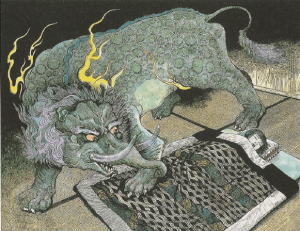
When a child in Japan wakes shaking from a nightmare, she knows what to do. Hugging her face in her pillow, she whispers three times “Baku-san, come eat my dream. Baku-san, come eat my dream. Baku-san, come eat my dream.” If her request is granted, the monstrous baku will come into her room and suck the bad dream away. But the baku cannot be summoned without caution. A too-hungry baku might not be satiated with a single dream, and might suck away her hopes and ambitions along with it, leaving her hollow.

What is a Baku?

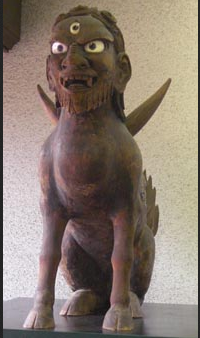
Baku are classic chimera; the body of a bear, the nose of an elephant, the feet of a tiger, the tail of an ox, and the eyes of a rhinoceros. One legend says that when the gods were finished creating the animals, they took all of the odds and ends lying around and put them together to make the baku.

According to Japanese legend, baku are the eaters of bad dreams. They are a talismanic figure, that people pray to at night to come and suck away nightmares so that they may never be seen again. But there is a darker side to the baku; some say that baku eat all dreams, not only nightmares. This includes dreams of aspiration, dreams of your future, and dreams of hope.

Is the Baku Real?

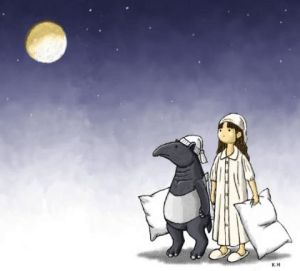
While they are wildly stylized, baku resemble the Asian tapir. And in fact, in Japanese they share the same name and kanji (獏). The baku is not alone in this; the word kirin is not only Japanese for giraffe but also a mythical Chinese monster.

Which came first—the legend or the animal—is hidden in the past, with no solid agreement on either side. Many say that the two are unconnected, and that the similar appearance is pure coincidence, with the animal being named after the legend. Some say a wayward sailor drifted to Malaysia, and came back with stories of a massive creature that was transformed by legend.

Either way, the legend is old in his book “Ancient Chinese Gods and Beasts,” Kyoto University professor Hayashi Minao points to ancient bronze ware and other artifacts inscribed with images of the mythical baku. He postulated that some creature like the Asian tapir might have existed in China at sometime, but has since gone extinct.

Baku are often confused with another Chinese legendary animal, the hakutaku (called a bai ze in Chinese). In fact, at Gobyakukan-ji temple in Tokyo, there is a statue called the Baku King, which was originally a statue of a hakutaku.
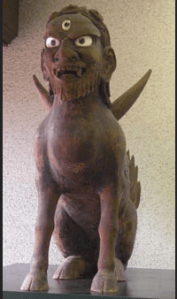
Is the Baku a Yokai?

A complicated question, that depends on how broad your definition of a yokai is. It isn’t a yokai in the sense of fantasy creatures like the nure onago or bakeneko. It is more of a sacred animal, more associated with gods than monsters. Mizuki Shigeru uses the broadest possible definition of yokai, meaning anything mysterious from Bigfoot to rains of frogs, by which the baku definitely qualifies.

The History and Legends of the Baku
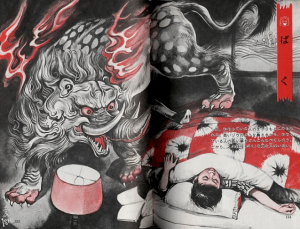
Like many folkloric creatures, baku have changed over the centuries. In the oldest Chinese legends, baku were hunted for their pelts. It was said that using a blanket made from a baku was a talisman against illness and the malice of evil spirits. Due to a lack of available baku pelts, this eventually changed to where putting an image of a baku over the bed would afford you equal protection. During the Tang dynasty( 618 – 907), folding screens decorated with baku were a popular item.

Somehow, the legend of the baku was transmitted to Japan, where the beast became associated with the dream eating that it is best known for today. The Tang period book Torokuten (Six Stories of the Tang dynasty) also tells of a sacred animal called a bakuki that eats dreams, and it is likely that the two were merged into a single legend.

The baku legend as a dream-eater has stayed consistent since adopted by Japan. There have been various ways of summoning the baku. In Fukushima it is said that if, after awaking from a bad dream, you say “I give this dream to the baku,” then that dream will never trouble you again. In other prefectures, you repeat “Baku-san, come eat my dream” three times in a row to summon to baku to come and eat your nightmares.

During the Muromachi period (1337 to 1573) in Japan, it became popular for people on their death bed to hold an image of a baku as a talisman against evil spirits. They also became associated with the fantastical Treasure Galley, which often had a baku painted on its sails. During the Edo period (1603 to 1868), pillows were sold in the shape of baku, said to protect the sleeper from bad dreams.


Baku in Modern Japan

While many yokai and legendary creatures have faded until they live only in the memory of academics and comic artists, baku are still a popular figure in modern Japan. The baku appears in many modern animation and comic books, although in appearance they look more and more like authentic tapir, and less and less like the folkloric chimera.
Shudan Borei – A Group of Ghosts


shudan borei

To learn much more about Japanese Ghosts, check out my book Yurei: The Japanese Ghost

Translated from Mizuki Shigeru’s Mujara

On July 28th, Showa 30th (1955), in a heartbreaking incident 36 junior high school girls drowned on a beach in Mie prefecture. Of the nine girls who survived the incident, five had the same story to tell.

The girls were all playing and swimming in the calm waters, enjoying the gentle lapping of the waves. Without warning, the water seemed to gather together, and a dark mass rose from the surface of the ocean. The mass took the shape of people in WWII air-raid hoods, dark in color, soaking wet and pouring water from every surface. As the mass rose, the figures become more defined, dressed in old-fashioned women’s work pants. There were hundreds of them.

The girls tried to get away, but the water seemed to be sucked up towards the dark figures, dragging the girls towards them. One of the girls who survived said she felt a hand grab her leg and try and pull her under the water. She was able to break the hands grasp and make her way to the shore, but her friends were not so lucky.

Afterwards, students who were on the beach and not in the water confirmed the story and all of its details. They saw the ghosts rising and dragging the girls under the water.

After investigating the incident, it was discovered that exactly ten years before the incident, U.S. aircraft had firebombed that area, killing around 250 people. The bodies were not cremated, but were piled without ceremony into a mass grave on that beach. In this way one tragedy became two tragedies, as the ghosts of the war dead rose up again.

Translator Note:

The kanji for this is集団 (shudan, meaning “group” or “gathering”) and亡霊 (borei, which is a somewhat Gothic term for “ghost”).

This story is based on a actual event, called the Kyohaku Junior High School Drowning Incident (橋北中学校水難事件) in Japanese. The school had gone to the beach as their annual excursion, and as swimming practice for the girls. At the time, swimming had been added to the official school curriculum, but as the school had no pool swimming practice was held in the nearby, usually calm ocean.

The school principle and teachers were arrested and charged with negligence—the school was short-handed and had not brought along the required number of adult observers, and parents claimed their children were not yet strong enough swimmers to be unsupervised in the ocean. Ultimately, they were found not-guilty and cleared of charges. The girls’ deaths were ruled a mysterious, unfortunate accident. A pool was quickly built for the school, and the students no longer practice swimming in the ocean.

Observers reported a sudden swelling of the waves and a rise in the water level that drowned the girls. Of the nine surviving girls, five reported a sensation of pulling on their legs, as if the sand was sucking down on their feet, holding them down while the water rose. Several also reported seeing the dark shape of women in air-raid hoods rising from the water.

In 1956, the Ise Newspaper reported on the story of the war dead buried on the beach, noting that most of the dead had been refugees and were thus buried without name or ceremony. In 1963, one of the girls published an article in a Joshi Jishin magazine (Women’s Own Stories) called “How I survived an Encounter with a Ghost” that further spread the supernatural origin of the drowning.

Several scientific explanations have been offered for the sudden swelling of the water based on the geographical features of the beach, along the supernatural one. It is clear Mizuki Shigeru prefers the supernatural explanation.

The beach remains off-limits for swimmers. A year after the incident, a shrine was raised on the location, and a statue called the Goddess of Protecting Swimmers in the Ocean was placed on the beach as a memorial.

Further Reading:

For more tales of haunted oceans, read:

Umi Bozu – The Sea Monk

Funa Yurei – The Boat Ghosts

Nure Onnago – The Soaked Woman

Previous Older Entries Next Newer Entries

Copyright notification

All translations and other writing on this website were created by Zack Davisson and are copyright to him.

Copyright notification

In accessing these web pages, you agree that any downloading of content is for personal, non-commercial reference only.

No part of this web site may be reproduced or transmitted in any form or by any means, electronic, mechanical, photocopying, recording or otherwise, without prior permission of Zack Davisson.

Copyright notification

For rights clearance please contact Zack at:

zack.davisson (at) gmail.com

Thank you.