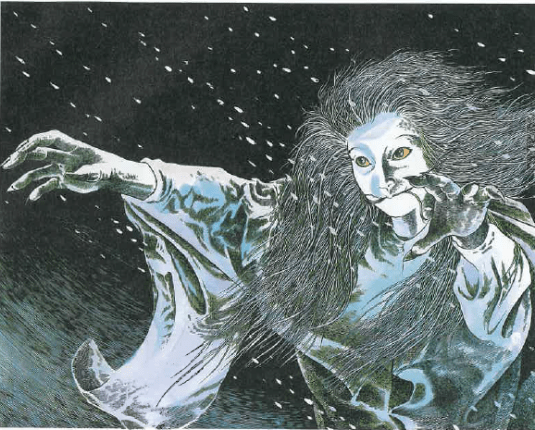
7 Types of Yokai – Japan’s Snow Monsters

Mizuki Shigeru Snow Monsters of Japan

To learn much more about Japanese Ghosts, check out my book Yurei: The Japanese Ghost

In the frozen north of the Japan, the snow piles deep and high and brings monsters. Whether riding on the avalanche, or coming in the guise of a beautiful young woman or a little lost boy, or hoping on one leg, Japan’s snow yokai are as varied and miraculous as any in folklore. Some are dangerous. Some are famous. Some are sad. Some are spectacular.

Japan’s snow monsters are like the snow itself; they bring comfort, solace, and beauty, but only for awhile. For spring comes, and snow melts, and all things must pass—good or bad.

Click Each Title to Read the Full Story of Each Yokai.

7. Yuki Jiji – The Old Man of the Snow

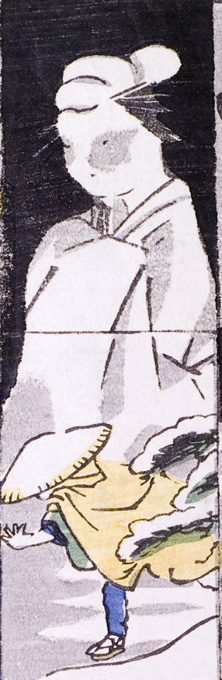
Mizuki_Shigeru_Yuki_Jiji

An old man who rides the avalanche, or an ancient God of Snow? The Yuki Jiji is a mysterious, powerful figure in Japanese folklore.

6. Yuki Onba and Yukinko – The Snow Mother and the Snow Child

Suuhi_Yuki-onna

Anytime a solitary woman approaches you and asks you to hold her baby for a few seconds, you are in trouble. This wintery variation on the Ubume legend delivers its own chills.

5. Yuki Warashi / Yukinbo – The Snow Babies

Mizuki Shigeru Yukinbo

One is cute and sweet—the answer to a childless couples prayers—and the other is a bizarre creature out of your nightmares.

4. Yukinba/Yukifuriba – The Snow Hags

Bakemono_Yuki-baba

Nothing ambiguous here. The Yukinba and Yukifuriba are terrifying creatures out for blood. The most horrifying of Japan’s snow yokai.

3. Tsurara Onna – The Icicle Woman

Mizuki_Shigeru_Tsurara_Onnna

Does she come to love you, or eat you? The Tsurara Onna goes both ways, and you are never sure just which one is going to come to your door.

2. Oshiroi Baba – The Face Powder Hag

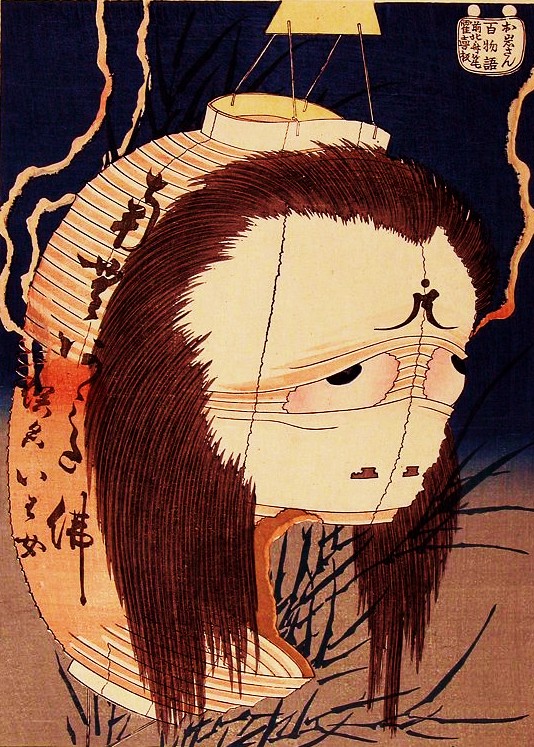
Mizuki_Shigeru_Oshiroibaba

Another oddity of Japanese folklore—is the Oshiroi Baba a dangerous snow hag, or some long-forgotten Goddess of Cosmetics?

1. Yuki Onna – The Snow Woman

Mizuki_Shigeru_Yuki_Onna

By far the most famous of Japan’s snow monsters, the Yuki Onna is an enigma. There are thousands of stories about her, with thousands of variations. Which one is true?

Yuki Jiji – The Old Man of the Snow

Mizuki_Shigeru_Yuki_Jiji

Translated and Sourced from Mizuki Shigeru’s Mujyara, Kaii Yokai Densho Database, Japanese Wikipedia, and Other Sources

In the village of Hishiyama in Nigata prefecture, there is at least one avalanche every year. The snow always comes tumbling down at night, and with it comes the Yuki Jiji—the Old Man of the Snow.

What Does Yuki Jiji Mean?

No mysteries here. His name uses the kanji 雪 (yuki; snow) + 爺 (jiji; old man).

Yuki Jiji and the Avalanche

This story comes from Hishiyama in Nigata prefecture.

Every year in March, the snow comes tumbling down from the mountains in an avalanche. They only come at night, and they always herald the arrival of the Yuki Jiji. He is said to be an old man as white as the snow; white skin, white hair, dressed in a white kimono and bearing a white hei—a staff with plaited paper streamers used in Shinto ceremonies. The Yuki Jiji rides the avalanche, comfortably seated on it as it tumbles down the mountain slopes. Depending on how far the avalanche travels, the Yuki Jiji brings either a good harvest or a poor one.

Yuki Jiji of the Mountains

Yoshitoshi_The_Skulls

There hints of other stories about the Yuki Jiji, that he is a male component of the Yuki Onna—an old man who haunts the snow-covered forests and attacks travelers, or causes them to be lost. Some of these legends paint the Yuki Jiji as a person who froze to death in the mountains, and was reborn as a yokai. These legends are rare, however.

Translator’s Note:

The last of my snow monster series for December, and my last post of the year as I enjoy the Holidays! The Yuki Jiji is one of those yokai with only a single legend—the opposite of his sister the Yuki Onna!

Yuki no Kami

The Yuki Jiji is thought to be an ancient mountain god, properly termed a kami. The presence of his hei, a magical staff used in Shinto rituals, marks him as sacred—as does his connection to the harvest. But whatever cult worshiped him long, long ago he is now a member of the yokai pantheon.

This was a fun and interesting series to work on. I hit almost all the snow monsters, with the sole exception of the Yuki Nyudo (雪入道), a one-legged hopper that is identical to the Yukinbo except an old man instead of a young boy. Sadly, there isn’t much else to say about the Yuki Nyodo. So there is his entry!

Further Reading:

For more snow yokai, check out:

Yuki Onna – The Snow Woman

Yuki Onba and Yukinko – The Snow Mother and Snow Child

Yuki Warashi / Yukinbo – The Snow Babies

Yukinba / Oyukifuriba – The Snow Hags

Tsurara Onna – The Icicle Woman

Oshiroi Baba – The White Face Powder Hag

Yuki Onna – The Snow Woman

Mizuki_Shigeru_Yuki_Onna

Translated and Sourced from Mizuki Shigeru’s Mujyara, Kaii Yokai Densho Database, Kwaidan, Japanese Wikipedia, and Other Sources

The Yuki Onna is one of Japan’s most well-known and yet unknown yokai. There is no single story of the Yuki Onna. From dread snow vampire of the mountains to a loving bride and mother, she has played many roles over the centuries; worn many costumes. She is ephemeral as a windblown mist of snow, and as impossible to hold.

What Does Yuki Onna Mean?

The only easy thing about the Yuki Onna is her name. It is as straight-forward as her icy companion, the Tsurara Onna – The Icicle Woman. Yuki Onna uses the kanji 雪 (yuki; snow) + 女 (onna; woman) to mean Snow Woman.

OK, I lied. Her name isn’t easy. Yuki Onna is only one of her names. Anywhere there is ice and snow in Japan you will find legends of the Yuki Onna, often called by some regional variation.

Here are a few of her many names:

  • 雪乳母 – Yuki Onba – Snow Nursing Mother
  • 雪娘 – Yuki Musume – Snow Daughter
  • 雪女子 – Yuki Onago – Snow Young Woman
  • 雪女郎 – Yuki Joro – Snow Hooker
  • 雪姉 – Yuki Anesa – Snow Older Sister
  • 雪女房 – Yuki Nyobo – Snow Wife

Basically, any variation of “Snow” + “Name used for a Woman” can be found in use somewhere. Some of these different names have different stories and characteristics, and it is often difficult to tell what is a unique yokai (Like the Yuki Onba and Yukinko) and what is just a variation of the Yuki Onna. Almost all tales of female snow monsters are also told as Yuki Onna stories.

What Do Yuki Onna Look Like?

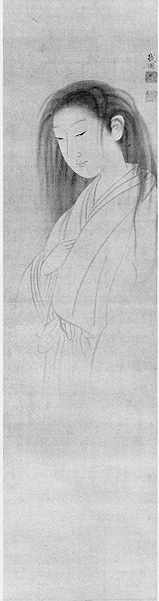
Suuhi_Yuki-onna

Whatever you call her, the Yuki Onna changes little in appearance. She resembles a classic yurei, with snow-white skin and a white kimono. The kimono is usually described as a thin, summer kimono that is far too light for the cold weather. In many stories, the kimono is pale enough to be translucent, with the garment exposing her white skin underneath.

The biggest variations in her appearance are her age and her hair. In most tales, the Yuki Onna is a preternaturally beautiful young woman, with dark black hair offsetting the whiteness of her skin and kimono. However in her first known appearance—in Sogi Shokoku Monogatari (宗祇諸国物語; Sogi’s Tales of Many Lands)—she is described as having white hair that matches the rest of her bone white appearance.

Other stories of the Yuki Onna further confuse her with yurei. She is said to leave no footprints when she treads on the snow, and this can lead to stories of a footless Yuki Onna, mimicking the footless yurei.

When and Where Do Yuki Onna Appear?
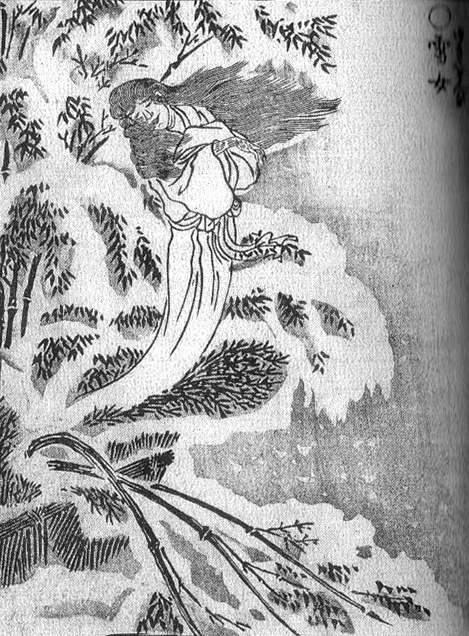
SekienYukionna

Not surprisingly, most Yuki Onna tales come from Tohoku, and Japan’s frozen north. They hail mostly from Aomori, Iwate, Miyagi, and Yamagata, as well as Nagano and Nigata. However, they are not restricted to those areas. Yuki Onna appear as far south as Ehime, Tottori, Fukui, Gifu, Nara, and Toyama prefectures. There are few prefectures in Japan without at least one Yuki Onna story—except maybe Okinawa (and, strangely enough, Hokkaido).

As to when they appear—there are different stories.

In Aomori and Iwate prefectures, Yuki Onna appear during Koshogatsu (小正月). Meaning “Little New Years,” Koshogatsu takes place on January 15th and was the traditional end of New Year’s festivities. Nishitsugaru District in Aomori prefecture is even more specific—the Yuki Onna arrives on New Year’s Day and leaves on the 1st of February.

The link between these dates and the Yuki Onna is obscure. Some say that in ancient times the Yuki Onna was worshiped as a Toshigami (歳神), a special deity that appeared on specific days and brought either good or bad fortune for the coming year. The link with February is interesting, corresponding with the Gaelic festival of Imbolc. She may have been Aomori’s Punxsutawney Phil, either ending winter or extending it with her presence. Some think she may have been a servant to the Mountain God (山神), playing the role of Miko or Shrine Maiden and bringing blessings of fertility and a good harvest.

Others say that the Yuki Onna appears only during full moons with new-fallen snow. Mothers in Ehime prefecture are warned not to let their children out to play on such nights. Still others say they arrive and disappear with blizzards. And at least one story says the Yuki Onna appears on the cusp of spring, to bid a temporary farewell to winter.

Yuki Onna from Sogi Shokoku Monogatari – The First Yuki Onna
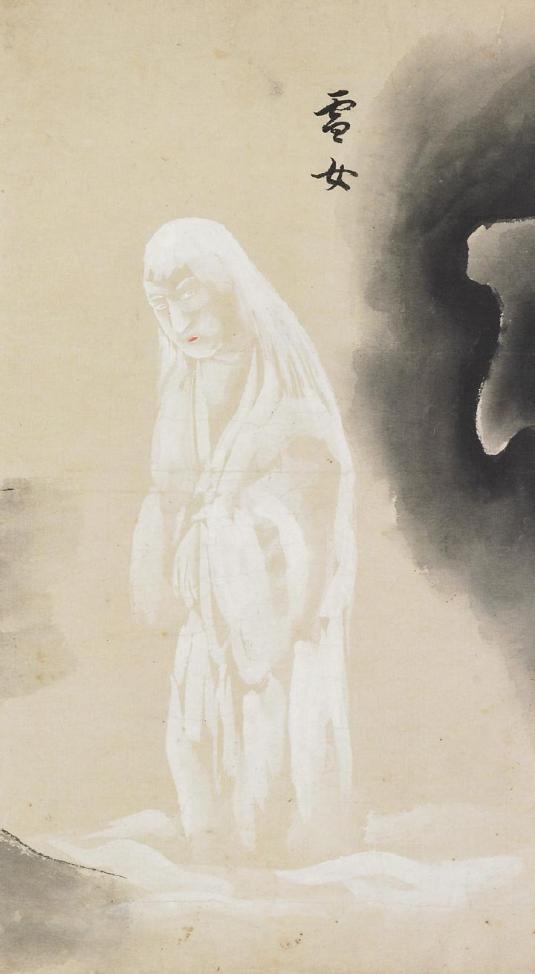
White Yuki Onna

Although she is thought to be an ancient legend, the first known written account of the Yuki Onna comes from the Muromachi period (1333 – 1573). The monk Sogi wrote of his travels in Echigo province (modern day Nigata prefecture) and his encounter with a Yuki Onna.

Sogi writes that he went out of his house one snowy morning and saw a beautiful and unusual woman standing in his frozen garden. She was huge; almost 10 feet tall, with skin whiter than any human being. Although her face was young and beautiful, her hair was stark white and hung loosely about her shoulders. Her kimono was white to the point of being translucent, and was made of some magical gossamer fabric that clung to the woman’s body.

Sogi attempted to speak to her, but she vanished into the snow. Discussing the vision later with a friend native to the region, Sogi was told that she was the Spirit of Snow (雪の精霊; yuki no seirei) who normally appeared during heavy snowfall. It was rare for her to appear at the cusp of spring.

Other Yuki Onna Tales

There are more stories and variations of the Yuki Onna than it would be possible to tell—you could easily fill a book with them. Many are so different from each other it seems they are talking about completely different yokai. Some are different yokai. Tales of the Yuki Nyobo – The Snow Wife are identical to the Tsurara Onna – The Icicle Woman. The Yuki Onba and her child the Yukinko are different enough that I split them into their own entry. And there are more—thousands more.

Here are a few:

Yuki Onna – The Water Beggar
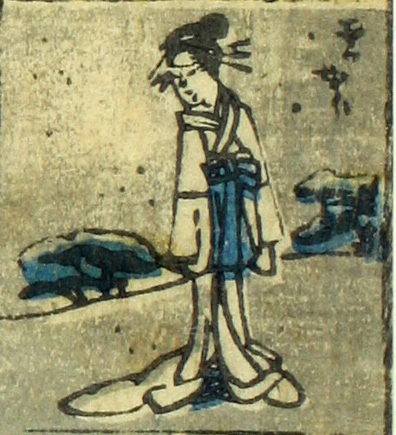
Yuki Joryo

From Tottori prefecture:

The Yuki Onna travels on the wind, and appears on days with a light snowfall. She walks through the town swinging a white Gohei wand, and shouting “Please give me water—hot or cold!” to anyone she meets. If you give the Yuki Onna cold water, she swells in size. If you give her hot water, she melts and disappears.

Yuki Onna – The Moon Princess
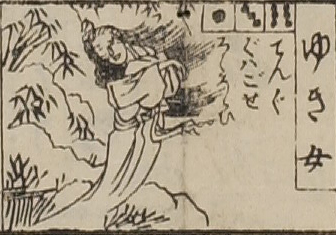
Yuki Onna Small

From Yamagata prefecture:

The Yuki Onna was once a princess of the lunar world, and lived on the Moon. Her life was full of luxury and indulgence—and extremely boring. She became fascinated looking at the world below, and so she snuck out one night and fell down to Earth, traveling on the snow. However, coming down was easier than going back up, and she became stuck on the Earth. On snowy nights of the full moon, she appears, pining for her old home.

Yuki Onna – The Snow Vampire

Yuki Onna Tall

From Aomori, Nigata, and Miyagi prefectures:

The Yuki Onna is a terrible yokai, that haunts the snowy forests looking to feed. She lives by sucking seiki (精気), the vital energy of the human body. She extracts the seiki by first freezing her victims to death, then sucking their souls out through their mouths. This type of Yuki Onna is particularly nasty in Nigata, where it is said she particularly prefers the seiki of children.

Yuki Onna – The Talking Snow Woman

From Ibaraki, Fukushima, Akita, and Fukui prefectures:

This Yuki Onna has a peculiar trait—she needs to engage her victims in conversation in order to attack. When she meets someone on a dark and snowy night, she will call out to them. If the person answers her greeting, she attacks.

Unless you are from Fukushima or Ibaraki prefecture; in those case the Yuki Onna only attacks those who ignore her. And her method of killing is specific. Anyone who ignores her she grabs and throws into a nearby ravine. (A similar yokai in Fukui is called the Koshimusume (越娘), the Cross-Over Daughter.)

The Five Battledores of the Yuki Onna – A Tale of Ghostly Revenge
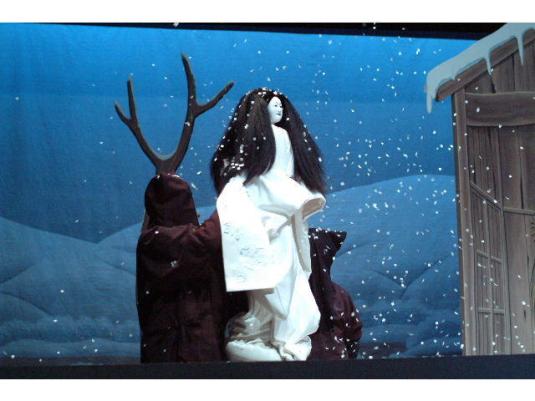
Bunraku Yuki OnnaPicture found here.

Some accounts say that the Yuki Onna is not a Spirit of Snow, but the ghost of a woman seeking revenge. This mainly comes from Chikamatsu Monzaemon’s bunraku puppet play Yuki Onna Gomai Hakoita (雪女五枚羽子板; The Five Battledores of the Yuki Onna). In Chikamatsu’s play, the Yuki Onna is the ghost of a woman who was deceived, lead into the forest, and murdered. She manifests as the Yuki Onna in order to get her revenge.

Variations of this theme—combining the bewitching beauty of the Yuki Onna with slaughter and revenge—can be found throughout Yuki Onna county, and have been confirmed in Aomori, Yamagata, Akita, Iwate, Fukushima, Nigata, Nagano, Wakayama, and Ehima prefectures.

Lafcadio Hearn’s Yuki Onna (1905)

Kwaidanposterjapanese

But the version of the Yuki Onna that most people know—either in Japan or elsewhere—comes from Lafcadio Hearn’s book Kwaidan. His kindler, gentler—and more romantic—Yuki Onna has become the template for Yuki Onna and superseded all others. Odds are in modern times if someone speaks of the Yuki Onna 99% of the time it will be Hearn’s version.

****

Two woodcutters—a father and son—were trapped in the forest when a sudden blizzard arose. They took shelter in an abandoned cabin, huddling in their clothes to sleep next to a meager fire. In the middle of the night, the son awoke when the door banged open and an ethereally beautiful woman came in from the blizzard. The woman crept over the father and blew her breath on him, then sucked up his living essence. As she turned to do the same to the son, she paused. Captivated by his youth and beauty, the Yuki Onna said she would let him live, but only on the condition that he never speak of this night.

The following winter, the young man was standing in his doorway when a beautiful woman traveler came walking by. The man offered her refuge from the elements, and the woman accepted. They quickly fell in love, and the woman never made it to her destination. She stayed on, married the young man, and they lived happily for years. They even had several children.

One night, when the kids where happily playing, the man looked up at his wife and a memory surfaced that he hadn’t thought about in years. When his wife asked him what was the matter, he told her of his encounter with the snow spirit years ago, wondering if it had all been a dream. The smile fell from his wife’s face, as she revealed herself to be that very same Yuki Onna.

She was livid that her husband had broken her promise, and would have killed him there were it not for the children. As it was she left instantly, leaving the husband behind with regret and sorrow.

****

No one knows exactly where Hearn got this version of the Yuki Onna tale. People have searched for years to find the original, but without success. According the Hearn’s preface, it was taught to him by a local man. Researchers have tracked that down to a potential candidate, a father and daughter who worked as servants in Hearn’s house in Tokyo. The daughters name was Ohana, and the father was Shuya, and they came from the Oume district of Toyko. That area has some similar folktales, which make Ohana and Shuya good candidates.

However, it is almost certain Hearn embellished whatever tale he was told. Hearn almost never faithfully recorded stories, and always worked them into something he thought was better. So there is no way of knowing what portions are original, and what are additions.

It doesn’t really matter though—ever since Hearn published his version, it completely dominated all other versions of the Yuki Onna. No more Moon Princesses or Water Beggars. With Hearn’s story there was a marked shift to a different kind of Yuki Onna story, one that blended romance and loss and melancholy.

Translator’s Note:

Another snow monster for December! This is the big one. I have been wanting to do Yuki Onna for a long time now, but was always intimidated by the sheer amount of information and variations. Even as one of my longest articles I don’t think I did the subject justice. There are many more Yuki Onna stories that can be told; although to be fair, many of them are just variations of existing yokai stories re-cast with the Yuki Onna.

I’m especially fond of the Yuki Onna became my wife’s name is Miyuki, which translates as “Beautiful Snow.” For as long as I have known her I have teased her about being a Yuki Onna in disguise. Which doesn’t really work because she hates the cold and is completely a beach girl, not a snow bunny.

There is at least on attempt to make sense of the ubiquitous nature of the Yuki Onna in Japan. Some researchers have said that the Yuki Onna may have actually existed in the form of mental illness. The intense cold of winter combined with suffocating fever could lead people to stumble outside dressed in only light summer kimonos. People who stumbled upon their hapless wanderers invented stories, and over time these stories became legends.

Further Reading:

For more winter yokai stories, check out:

Tsurara Onna –The Icicle Woman

Yuki Onba and Yukinko – The Snow Mother and Snow Child

Yuki Warashi / Yukinbo – The Snow Babies

Yukinba / Yukifuriba – The Snow Hags

Oshiroi Baba – The White Face Powder Hag

Yuki Warashi / Yukinbo – The Snow Babies

Mizuki Shigeru Yukinbo

Translated and Sourced from Mizuki Shigeru’s Mujyara, Japanese Wikipedia, and Other Sources

Snow and ice have a certain magic to them. You can craft them into whatever shape you want, from snow men to snow wives to snow babies. And—legend tells us—if you wish hard enough, they just might come to life. But snow is fickle. To an elderly childless couple, it might bring joy and comfort—but only for a little while. Spring comes and snow melts and takes the beauty and magic with it. That is the lesson of the story of the Yuki Warashi.

The Yukinbo, however. tells an entirely different kind of story …

What Do Yuki Warashi and Yukinbo Mean?

Both of these snow babies’ names mean roughly the same thing, just using different kanji

  • 雪童子 – Yuki Warashi – Combines雪 (yuki; snow) + 童子 (warashi; small child). Sharp-eared readers will recognize this as using the same kanji as the good luck house spirit Zashiki Warashi.
  • 雪坊 – Yukinbo – Combines雪 (yuki; snow) + 坊 (bo; priest). Note that by itself “bo” is a slang term for young boys, like the diminutive “Bo-chan.” Of the two names, only the Yukinbo specifies a gender.

What Do They Look Like?

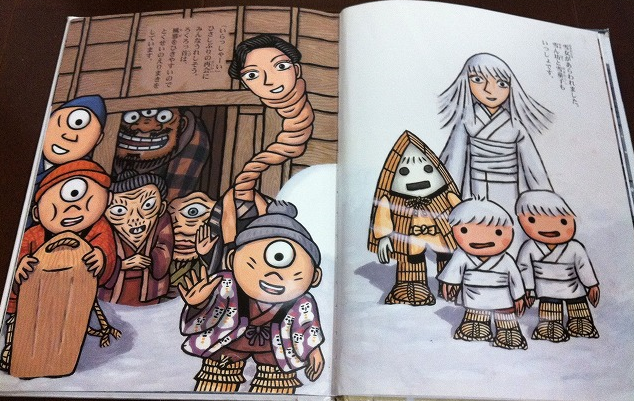
Images of the Yuki Warashi and Yunkinbo are exceedingly rare. When they do appear, they look like cute, red-cheeked children clad in the traditional straw-peaked snow jackets. Their jackets have a hood that comes up to a point so that the snow can’t accumulate. The hood ties under the chin, and there are armholes that give freedom of movement.

Yuki_Warashi_Childrens_Book

From the children’s book お化けの冬ごもり (Obake no Fuyu Gomori)

In some Yuki Warashi depictions their face is blank and featureless like a doll. This comes less from folklore and stories and more from folk art. Wooden sculptures of children dressed in this ancient costume are popular. In fact, people in snowy regions still dress their children in these costumes for pictures. After all, they are awfully cute. But not every child in a straw snow coat is snow baby.

Definitely not a Yukinbo, unless they are hopping on one leg …

Yuki Warashi – The Good Little Snow Child

This is a legend from Nigata prefecture.

Long ago there was an old, childless couple. They were very lonely, and wished desperately for a child. One snowy day, in order to distract themselves from their desolation, they went out into the new fallen snow and sculpted a snow child. Pleased with their creation, they went back inside.

That night there was a fierce blizzard. There was a knock and the door, and when they answered it the couple were shocked to see a bright, young child leap into their house. They were too overjoyed to question their good fortune, and welcomed the child into their hearts. They loved their snow baby, and vowed to raise it with affection.

The new family passed a wonderful winter together, but as spring neared the couple noticed that their child got slimmer and slimmer. They were terribly worried, and woke up one morning to find their child gone completely. Their hearts were broken, but there was nothing they could do.

Time passed, and soon it was winter again. On yet another storming snowy night, there was a knock at the door and the couple’s happy snow baby came bounding home again, fat and happy and red-cheeked. The couple realized that this was the spirit of the child they sculpted out of snow, could only stay with them through the winter.

This pattern repeated itself for many years, until one day the snow baby came no more. They never saw their child again. But the couple was content with what happiness the kami allotted them, and forever cherished the sweet memories of their snow baby.

Yukinbo – The One-Legged Snow Boy

The Yukinbo comes from Wakayama prefecture, and is essentially a personification of a natural phenomenon.

As anyone who lives in a snowy climate—or participates in winter sports—knows, the snow around trees and plants melts faster than elsewhere. We call these “tree wells” when skiing, and falling into a tree well can be a dangerous proposition. You sink into the semi-melted snow and can have a hard time tunneling back out.

Strangely, there is no real known scientific explanation for this. Oh, there are theories to be sure, most amounting to internal heat generated by the plants. But there is no absolute answer (At least not according to Susan Pell, director of science at the Brooklyn Botanic Garden.)

But the people of Wakayama didn’t need science. They knew tree wells were cause by a one-legged yokai called the Yukinbo who came out in the morning and hopped circles around trees.

Translator’s Note:

More snow monsters for December! Although they aren’t really related, I decided to combine the Yuki Warashi and Yukinbo into a single entry. Mainly because they are both obscure, without much detail to their stories and descriptions. Also because of a lack of pictures. I wasn’t able to find a single picture of a Yukinbo. Neither of them appear in my volumes of Mizuki Shigeru’s Mujyara, except as footnotes to other yokai, nor do they appear in Toriyama’s catalogs of any other yokai resource. But they are cool legends, so I decided to add them to the series.

Yukinbo and Kitaro

The Yukinbo in particular gave me some trouble. As a one-legged snow monster he shares and almost identical story to the Yukinba and Yuki Nyudo. I considered sticking them all together, but eventually went with age/gender instead of number of limbs. The Yukiba went with the Yukifuriba, and the Yuki Nyudo will go with the Yukifuri Bozu (If I have time to get around the them!)

Related Stories:

For more December yokai chills, check out:

Tsurara Onna – The Icicle Woman

Yukiba/Yukifuriba – The Snow Hags

Oshiroi Baba – The Wife Face Powder Hag

Tsurara Onna – The Icicle Woman

Mizuki_Shigeru_Tsurara_Onnna

Translated and Sourced from Mizuki Shigeru’s Mujyara, Kaii Yokai Densho Database, Japanese Wikipedia, and Other Sources

Is Japan’s Icicle Woman naughty or nice? Loving or lethal? If the stories are to be believed, Japan’s answer to Pygmalion can swing both ways. So a warning to men—if you fashion a woman out of an icicle, even when you pour your entire heart into it, don’t be surprised if she turns out cold-blooded.

What Does Tsurara Onna Mean?

Another yokai with a straight-forward name, tsurara onna’s name is written asつらら (tsurara; icicle) + 女 (onna; woman). Strangely enough, she almost never uses the kanji for tsurara (氷柱), always using the hiragana instead. The only reason I can think of for this is that kanji was once considered masculine for names, and hiragana feminine. It’s a possibility, but that’s all it is.

There are two regional variations on Tsurara Onna, using local dialect for the word “icicle.” One is Shigama Nyobo (シガマ女房; Icicle Wife) from Western Aomori prefecture, and the other is Kanekori Musume  (カネコリ娘; Icicle Daughter) from Gifu prefecture.

What are Tsurara Onna?

All Tsurara Onna stories start out the same—a lonely man gazes out of his window in winter, and marvels at the beauty of an icicle hanging from his eaves. As he stares deeply into its crystal structure, he wishes he could meet a woman as beautiful as the icicle to ease the pains of his loneliness. Like magic (for it is indeed magic) a woman fitting that description shows up the very next day.

The woman appears at the man’s door, seeking refuge from a massive, sudden snow storm. The man lets the beautiful woman in, and they fall in love. The woman decides never to leave, and the two become husband and wife. (In old Japan, no ceremony was necessary for this; as soon as a couple decided they were married, then they were married).

Life is good—for a while. The man’s new wife is attentive and loving and everything he hoped for. But then things go wrong, because there is rarely a Happily Ever After in Japanese folklore, and never when you are dealing with snow monsters.

Tsurara Onna tales fork at this point, into one of two endings. The ending you get depends largely on the region of Japan you live in.

Story #1 – The Sweet Woman Undone by Her Husband’s Love

The man is overjoyed at his new wife, but worried too. He cannot help but notice that his bride never uses the bath, even on the most chilly of nights. The poor man is worried about his wife’s health—surely she will take sick if she does not warm herself in the bath? Not to mention cleanliness. Time after time, he entreats her to use the bath. They are married now, he assures her, and she shouldn’t feel shy or ashamed.

The woman demurs, but eventually she can no longer refuse her husband. After he prepares a warming bath for her, the man busies himself about the house so she can enjoy her soak. Hours pass, and the man becomes worried about her. Perhaps she has fallen asleep? He goes into the back to check on her, and finds the tub empty, with only frozen shards of shattered icicles laying around the perimeter of the bath. These too slowly melt away …

This version of the tale is most often found in the Tohoku region, including Aomori and Nigata prefectures. There are some further variations:

Yamagata Prefecture – The woman does not go to the bath, but into the kitchen to heat up some hot sake for her husband. After a long wait, he goes to the kitchen to find the shattered icicle shards.

Akita Prefecture – This version has a husband and wife taking care of a young woman traveler instead of a new bride; but the results are the same. Against her wishes, into the bath the young traveler goes.

Story #2 – The Frozen Dagger of Hate

Her, the husband does not coax his wife into the bath, or ask her to retrieve hot sake for him. Instead they pass the winter in bliss. But as spring comes and the temperature warms, the man notices his wife getting anxious. One day he wakes up to find her gone, the door of their house standing open and the last of the winter winds blowing through.

The man is heartbroken, but assumes his wife has left him after using him for shelter though the winter. He moves on with his life, and meets a new woman and falls in love. Come summer, he moves his new wife into his house. They pass the months happily until winter comes again.

When the world again freezes over, the man notices a particularly large icicle forming from the eaves of his house. Fascinated by it, he goes outside for a better look. There he sees his former wife, livid that she has been replaced.

Inside the house, the new wife hears her husband shriek in agony. She rushes outside and finds him dead, a large icicle piercing his head through his eyeball.

This angrier version of the Tsurara Onna tale is found mostly in Nigata prefecture.

Translator’s Note:

The second in a series on snow monsters for December, the Tsurara Onna is a type of story found all over the world. A man bringing a woman to life from an inanimate object is a typical folklore story, the archetype of which is the Greek story of Pygmalion. With the second version of Tsurara Onna, I also can’t help but think of a sexier, angrier version of Frosty the Snowman—especially how she has to leave in the spring and return in the winter.

The Tsurara Onna also falls into the “magical wife” category so often found in Japanese folklore. These come in a myriad of variety, but always with the same simple plot. An unmarried man suddenly meets a wonderful woman, and they are married. They can stay happy forever so long as the husband obeys a single rule (for example, “Don’t look in a box,” or “Don’t tell anyone your story,” or “Don’t make me take a bath.”). The rule is inevitably broken, the wife leaves—with or without vengeance—and the man is left alone again, knowing that he could have had a happy life if he just would have obeyed the stupid rule.

Further Reading:

For more tales of snow monsters and magical wives, check out:

Oshiroi Baba – The White Face Powder Hag

Kitsune no Yomeiri – The Fox Wedding

The Yurei Child

Previous Older Entries Next Newer Entries

Copyright notification

All translations and other writing on this website were created by Zack Davisson and are copyright to him.

Copyright notification

In accessing these web pages, you agree that any downloading of content is for personal, non-commercial reference only.

No part of this web site may be reproduced or transmitted in any form or by any means, electronic, mechanical, photocopying, recording or otherwise, without prior permission of Zack Davisson.

Copyright notification

For rights clearance please contact Zack at:

zack.davisson (at) gmail.com

Thank you.