Shio no Choji – Salty Choji

Mizuki_Shigeru_Salty_Choji

Translated and Sourced from Mizuki Shigeru’s Mujyara, Ehon Hyakumonogatari, and Japanese Wikipedia

In Kaga province (modern day Ishikawa prefecture), there lived a wealthy man known as “Salty Choji” who kept 300 head of horses. Now, these horses weren’t for riding. This man had a taste for horse flesh, and would slaughter his horses like cattle then pickle them in salt or preserve them in miso paste to get them tasting just right. Every night he tucked into a pile of salty horse meat with gusto.

Such was the man’s appetite that Choji ate his way through 299 of his own horses, until all that was left was an ancient animal that wasn’t good for labor or food. One night Choji just couldn’t stand it any longer, and he shot the old beast anyways, then slathered it in salt and ate it down in a gluttonous frenzy. That night, however, the tables turned against Choji—the spirit of the old horse came to him in a dream and bit him on his neck.

From that night on, whenever the clock stuck the hour of the time when Choji had killed the old horse, its spirit appeared and entered Choji’s body. But this wasn’t your normal possession; the horse forced his way through Choji’s mouth, and crawled straight through to his stomach. The pain was intense, and Choji felt every inch of the massive horse stretching his innards and intestinal tract. As he lay in agony night after night, Choji bitterly regretted all of his evil deeds and his ravenous appetites that lead him to this fate. But his regrets did him no good. For it was too late.

Choji summoned every manner of doctor and exorcist to aid him in his suffering. They tried everything they could but without effect. No amount of medicine or prayers for reprieve could lessen his agony. Choji’s torment continued for 100 days until at last he died. It was said his corpse was broken and shattered, like an overburdened packhorse.

Translator’s Note:

Another tale of overeating for November, and the American Thanksgiving holiday. There are a few more to come in their series! This story comes from the Edo period kaidan-shu Ehon Hyakumonogatari (絵本百物語; Picture Book of 100 Stories).

ShunsenShionoChoji

The tale of Salty Choji isn’t as strange as it seems. Although rare nowadays, horse is a standard part of Japanese cuisine, mostly eaten raw and sliced as the sashimi called basashi. I have eaten it many times. It’s delicious! So the shock of the story isn’t really what Choji was eating, but how much of it. All things in moderation is the moral of the story. That and Choji forgetting an important fact of Japanese folklore—the older an animal is, the more likely it is to have developed supernatural powers. Salty Choji should have left that old horse alone, and just gone shopping for some new ones.

The story of Shio no Choji (Salty Choji) inspired a story for the anime series Kyogoku Natsuhiko Kosetsu Hyaku Monogatari (京極夏彦 巷説百物語; Natsuhiko Kyogohe ku’s Hundred Stories), most commonly known in English as Requiem From the Darkness. I say “inspired by” instead of “adapted from” because the version of Salty Choji found in the series is VERY different from the original folktale. There is cannibalism involved, and fratricide, and all sorts of things that never appear in the simple story of Shio no Choji who could couldn’t control his appetite.

Requiem_From_The_Darkness_cover

Further Reading:

For more tales of hungry yokai and yokai food, check out:

Oseichu – The Mimicking Roundworm

Jinmenju – The Human Face Tree

Oseichu – The Mimicking Roundworm

Mizuki_Shigeru_Oseichu

Translated and Sourced from Mizuki Shigeru’s Mujyara, Japanese Wikipedia, and Kaii Yokai Densho Database

It starts with a high fever and some stomach pains, and ends with a giant mouth poking out of your own stomach, speaking in your own voice demanding food and drink. It’s bad enough getting sick, but you don’t want to catch a yokai disease. Especially you don’t want to get infected by an oseichu, a mimicking roundworm.

What Does Oseichu Mean?

Oseichu is made up of three kanji – 応 (O; affirmative, agreements ) + 声 (sei; voice) + 虫 (chu; worm, bug). The three kanji translate roughly into “Voice Mimicking Bug,” all though the word “bug” refers more to the infectious disease type than the insect type.

The term osei (応声) is really only used in relation to this yokai. In fact, sometimes the “chu” is dropped altogether and it is just called an osei.

The Oseichu of Chusaburo

This is a story from the 16th year of Genroku (1703 CE). The laborer Shichizaemon lived with his family in Tokyo. One day, his son Chusaburo was struck down with a terrible fever and pain in his stomach. The illness continued, and after a few days they could see a boil growing form the son’s belly. The boil kept growing larger and spreading until it resembled a massive, human mouth. Everyone in the family was shocked when the boil finally opened its mouth, and began speaking in Chusaburo’s own voice. The voice began demanding food, and anything shoved into the giant mouth soon disappeared. The mouth was never satisfied and demanded more and more food, while Natsaburo was slowly starving to death, deprived of sustenance.

Shichizaemon tried every medicine he could find, and summoned exorcists and sorcerers of all type to help the misfortune of his child, but to no avail.

At his wit’s end on how to help his son, Shichizaemon sent for the famous doctor Kan Gensai. The renowned physician took one look at Chusaburo and declared that he was infected with an Oseichu. Dr. Gensai whipped up a special blend of six medicines, and fed them directly into the extra mouth protruding from Chusaburo’s belly. After the first day, the mouth ceased to speak and the boil reduced in size. By the second day, Chusaburo expelled a giant worm from his anus—33 centimeters long. The worm looked like a lizard, with an arrow shaped head and long body. It tried to run away, but everyone in the room immediately set upon it and beat it to death.

With the Oseichu expunged, Chusaburo made a complete recovery.

Yokai Diseases and Mysterious Bugs

The oseichu is thought to have come to Japan from China, where there are similar stories based off of real-life parasitic worms like roundworms. Oseichu is a good example of how yokai can be many things, from giant, one-eyed monsters down to strange, infectious diseases. Oseichu are not a type of monster, but are considered a type of kibyo (奇病; Strange Illness) brought on by kaichu (怪虫; Mysterious Bugs). It is easy to see how roundworms can become yokai. A sudden fever and feeling of hunger, finishing with a large worm being expelled from the anus—that must have been terrifying to those who weren’t aware of what was happening.

The oseichu is found in three Edo period collections; the Shin Chomonju (新著聞集; New Collection of Famous Tales), the Shiojiri (塩尻; Salt’s End), and the Kanden jihitsu (閑田次筆; Continued Tales of a Fallow Field).

Both the Shin Chomonju and Shiojiri tell tales similar to The Oseichu of Chusaburo, with only slight variation. Shin Chomonju sets the story in Tokyo, while Shiojiri says the mysterious illness occurred in the Abura no Koji district of Kyoto. Shiojiri also says the medicine took 10 days instead of 2.

The Kanden Jihitsu tells a similar, but different story. In the 3rd year of Genbun (1738) , a side show manager running a Misemono (Seeing Things) show in Tamba province (modern day Kyoto) heard a rumor about a woman infected by an oseichu. He immediately went to her house to attempt to recruit her for the show, and was stunned to find an authentic case of the disease. An unmistakable voice came from the woman’s belly. The woman’s husband was ashamed of her condition, however, and would not allow her to be displayed. The disappointed side show manager went home empty handed.

Translator’s Note:

It’s November, and that means Thanksgiving Day in the US! And Thanksgiving Day means eating so much your stomach hurts afterwards, and that got me thinking about Oseichu.

Oseichu is an odd yokai. It doesn’t appear very often in yokai collections. I would like to that’s because it is gross, but yokai have never let being gross bother them! This one is clearly a supernatural version of a natural disease/parasite – the roundworm. Something I hope I never have to experience in real life!

Further Reading:

For more bizarre yokai, check out:

Jinmenju – The Human Faced Tree

Inen – The Possessing Ghost

Kejoro – The Hair Hooker


6 Types of Japanese Yokai From Showa

Mizuki_Shigeru_Showa_Book

In Showa period Japan belief in yokai was waning but could still be found, especially in the countryside and rural provinces. Mizuki Shigeru—Japan’s most honored and beloved author of yokai manga and the person directly responsible for yokai still being known in Japan today—has several first-hand encounters with yokai in his life. He detailed several of these encounters in his comic series Showa 1926-1939: A History of Japan

Being primarily a history series and not a yokai series like Kitaro, Showa 1926-1939: A History of Japan doesn’t come with a Yokai Glossary except as included in the extensive notes section in the back. As the translator of the comic, I also put together this collection of articles on all of the yokai that appear.

Here they are, in no particular order. Click on the links to go to the individual articles and learn more about these amazing yokai!

6. Nezumi Otoko – Rat Man

Nezumi Otoko

A Mizuki Shigeru original, Nezumi Otoko is the Donald Duck to Kitaro’s Mickey Mouse. A scoundrel and reprobate who does everything wrong, he is also Mizuki Shigeru’s favorite character. As Mizuki himself says, without Nezumi Otoko he has no story.

Nezumi Otoko is the narrator of Showa 1926-1939: A History of Japan, popping in occasionally to share some facts and to get the narrative moving to where it needs to go. He delivers some of the most profound dialog of the comic as well.

5. Hidarugami – The Hungry Gods

Hidarugami Mizuki Shigeru

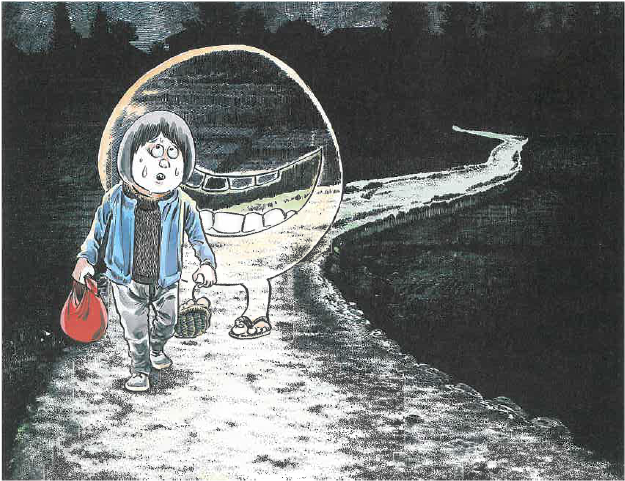
As a boy Mizuki Shigeru encountered the Hidarugami out for a walk in the woods. These spirits of those who died of hunger can cause the living to suffer the pains of starvation. A terrible, terrible ghost.

Mizuki’s encounter with the Hidarugami as a young boy is quite poignant, considering how hunger would become such a defining point for the entire nation of Japan in the decades to come.

4. Sazae Oni – The Turban Shell Demon

Mizuki_Shigeru_Sazae_Oni

The Sazae Oni only pops up briefly in Showa 1926-1939: A History of Japan, when Mizuki Shigeru’s mentor treats young Shigeru to his first taste of the sea snail sazae and warns him of the dangers of the Sazae Oni.

This shape-shifting Sazae Oni is one of the most bizarre in Japan’s yokai menagerie. I’m not sure who first saw this hard-shelled sea snail and imagined a seductive woman.

3. Kitsune no Yomeiri – The Fox Wedding

Mizuki_Shigeru_Kitsune_no_Yomeiri

The phenomenon that convinces a young Mizuki Shigeru that yokai are real. One night, his friend and mentor NonNonBa tells a young Shigeru about the foxes in the mountains and how they hold their marriage ceremonies.

When Shigeru hears the foxes in the mountains, he knows NonNonBa is telling the truth, and that yokai are real!

2. Betobeto San – The Footsteps Yokai

Mizuki Shigeru Betobeto San

One of the least dangerous monsters in Japanese folklore, Betobeto San is the sound of footsteps walking behind you late at night. One evening Mizuki Shigeru and his brother have an encounter with Betobeto San, and the wise NonNonBa tells them what to do.

1. Tenjoname – The Ceiling Licker

Tenjoname_Mizuki_Shigeru

Another yokai story from NonNonBa, who tells the young Mizuki Shigeru about the monstrous Tenjoname who comes in the dark of the night and … licks the ceiling. OK, so that’s not very scary, and other authors have had to improve on the legend of the Tenjoname over the years.

Countdown to Mizuki Shigeru’s Showa 1926-1939: A History of Japan

Mizuki_Shigeru_Showa_Cover

The long wait is almost over! Mizuki Shigeru’s Showa 1926-1939: A History of Japan arrives in stores November 11th!!!

I hope everyone is as excited as I am. I guarantee this is one of the most incredible comics you are likely to read this year. I can’t honestly think of anything that it compares to. It’s the kind of comic you could never see in the U.S.—I like to say it is “What if Carl Barks had written Howard Zinn’s A People’s History of the United States but done it as a comic book using Donald Duck as the narrator?” Or maybe if Pixar decided their next feature film should be Buzz and Woody from Toy Story leading a detailed narrative on the US’s involvement in the Middle East, and exactly how 9/11 happened and what the worldwide repercussions were. Then juxtapose that with a quaint story of growing up in the Middle East during that time. It sounds weird, I know. But trust me. It’s awesome.

Mizuki_Shigeru_Showa_Book

Showa is both epic and intimate. It tells the story of any entire country—multiple countries, actually—all the while being a deeply personal tale of young Mizuki Shigeru and his unusual life. It is a cautionary tale, showing how countries can slide from fair, democratic nations to warmongering monsters in only a few decades. It’s also nostalgic, funny, and downright bizarre at times. If you have read Mizuki Shigeru’s other comics like NonNonBa and the Eisner-winning Onward Towards Our Noble Deaths you will recognize some of the scenes—these are the accounts that Mizuki Shigeru fictionalized for those two comics, told here in all their often harsh reality.

The book itself is just beautiful. I spent months of my life with Showa—translating it, then working with the fine editors at Drawn and Quarterly to fact-check and tighten the translation down until it was perfect—and I was still blown away when I got the physical volume. It is huge. An absolute brick. Almost twice the size of NonNonBa and Onward Towards Our Noble Deaths. And I love the oversized edition. The original Japanese edition that I translated from is nowhere near as nice—or as huge—as this English-language edition. And engrossing to read. Once through is not going to be enough. You are getting your money’s worth with this comic.

Mizuki Shigeru Drawn and Quarterly Library

Here’s a preview of Showa 1926-1939: A History of Japan from Drawn and Quarterly

http://www.drawnandquarterly.com/imagesPreview/a514204cdae83d.pdf

Preorder!

There is still time to preorder Showa 1926-1939: A History of Japan and to guarantee you get a copy. You can preorder it here (Showa 1926-1939: A History of Japan) from amazon, or support your local comic shop by picking up a copy there.

Then Preorder Showa: 1939-1944: A History of Japan!!!

Mizuki Shigeru Showa History of Japan 1939 1944

There are eight volumes in total to this series as originally released in Japan, being released in English in these massive 2-volume editions. The next volume is available for preorder right now on amazon. If you plan on getting a copy at all, I recommend preordering it. Not only do you get the best price you are likely to get, but the publishing industry cares a lot about preorders and a strong preorder will convince stories to get behind the book

You can preorder Showa 1396-1939: A History of Japan here (Showa 1939-1944: A History of Japan) from amazon.

Garei – The Picture Ghost

Mizuki_Shigeru_Garei

To learn more about Japanese Ghosts, check out my book Yurei: The Japanese Ghost

Translated from Mizuki Shigeru’s Mujyara, Ochiguri Monogatari, and Other Sources

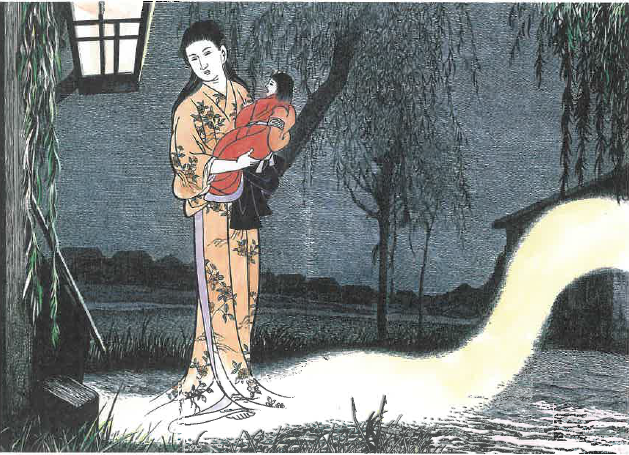
Long ago, there was a dilapidated folding screen with the portrait of a woman holding her child. The screen was the property of the Kanju-ji temple in Kyoto, where it was kept buried away in a storehouse. One day, a request came from a retainer of the samurai Honamiden to borrow the screen. Thinking it was nothing more than a worthless nuisance, the temple was only too happy to comply with the request. The priests sent Honamiden the screen with all due haste.

Even though the screen was old and neglected, the painting was beautiful and Honamiden proudly put it on display in his house. That very night, reports started coming in of a mysterious woman who appeared in the vicinity of Honamiden’s manor. She was beautiful, and was reported to be carrying a small child. The unknown woman appeared every single night and wandered the grounds of the manor. Finally, one of Honamiden’s servants followed the woman. He watched her as she entered the house, and gasped as she suddenly disappeared while standing in front of the ancient painting.

Upon hearing this, Honamiden returned the screen to Kanju-ji as quickly as possible, mentioning nothing of the mysterious woman or the incident. A beautiful picture was one thing, but he did not need to attract strange spirits.

Now, that same mysterious woman began to appear around the Kanju-ji temple. Suspecting the painting was the origin of this apparition, a clever servant placed a piece of paper over the head of the woman in the painting. Sure enough, that evening when the ghostly woman was seen her head was covered by a piece of paper.

Kanju-ji assembled some artists to investigate the painting, and they all agreed it was the work of the artist Tosa Mitsuoki—and an important work at that. Because Tosa was dead, there was no way of knowing the story behind the woman in the painting, but they all agreed that it was a shame that such a valuable painting was allowed to degenerate to such poor condition. Hearing that, Kanju-ji paid to have the screen restored to its former condition and properly displayed.

From that time onward, the mysterious woman never appeared again.

Translator’s Note:

Winding down on my Halloween yurei posts! Although the last two haven’t exactly been yurei, but spirits of a different sort …

This story comes from Fujiwara Ietaka’s Ochiguri Monogatari (落栗物語; Tales of Fallen Chestnuts), thought to be written sometime in the 1820s. Ietaka’s book is a loose collection of random bits and pieces, observations of daily life of the time and stories overheard. Obviously, the Garei falls into the latter category.

The connection between art and ghosts is an old one, going back at least to The Ghost of Oyuki and probably even further. The story of the Garei builds on the idea that certain works of art and craftsmanship are able to be infused with some of the soul of the artist and take on a life of their own. The story serves as a cautionary tale with a definite moral—treat works of art with respect, or they will come out and haunt you.

(Speaking of which, this can almost be seen as an inspiration to films like Ringu, with the ghost emerging from the painting instead of Sadako emerging from the TV. Of course, the Garei from this story wasn’t quite so vengeful as Sadako; she just wanted her picture to be appreciated and treated nicely. )

Yokai researcher Oda Kokki identifies the Garei as a type of Tsukumogami , a belief in Japan that household objects can gain life after 100 years. I’m not personally sure I agree with that, as the painting in this story is not yet 100 years old. And Tusumogami tend to be everyday objects that are handled and used daily, slowly gaining life as human’s infuse them will small pieces of their motive energy over the century. Garei-type stories tend to be more about the power of the artist, how certain artists attain such skill that they are able to infuse their works with souls. A similar story has an artist painting such realistic portraits of Hell that they become actual portals to the netherworlds. Sounds like an episode of Twilight Zone, doesn’t it?

Oh, and by the way: Mizuki Shigeru ends his retelling of the Garei with a further warning—you better be nice to his comic books or he will make sure that all of the monsters he puts in there will come out to get you!

Further Reading:

For more stories of yurei and art, check out:

The Ghost of Oyuki

Hokusai’s Manga Yurei

More Hokusai Manga Yurei

Yurei-zu: A Portrait of a Yurei

A Portrait of an Ubume

Previous Older Entries Next Newer Entries

Copyright notification

All translations and other writing on this website were created by Zack Davisson and are copyright to him.

Copyright notification

In accessing these web pages, you agree that any downloading of content is for personal, non-commercial reference only.

No part of this web site may be reproduced or transmitted in any form or by any means, electronic, mechanical, photocopying, recording or otherwise, without prior permission of Zack Davisson.

Copyright notification

For rights clearance please contact Zack at:

zack.davisson (at) gmail.com

Thank you.