Baku – The Dream Eater

Translated from Mizuki Shigeru’s Mujara and Japanese Wikipedia

When a child in Japan wakes shaking from a nightmare, she knows what to do. Hugging her face in her pillow, she whispers three times “Baku-san, come eat my dream. Baku-san, come eat my dream. Baku-san, come eat my dream.” If her request is granted, the monstrous baku will come into her room and suck the bad dream away. But the baku cannot be summoned without caution. A too-hungry baku might not be satiated with a single dream, and might suck away her hopes and ambitions along with it, leaving her hollow.

What is a Baku?

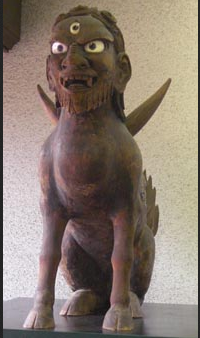
Baku are classic chimera; the body of a bear, the nose of an elephant, the feet of a tiger, the tail of an ox, and the eyes of a rhinoceros. One legend says that when the gods were finished creating the animals, they took all of the odds and ends lying around and put them together to make the baku.

According to Japanese legend, baku are the eaters of bad dreams. They are a talismanic figure, that people pray to at night to come and suck away nightmares so that they may never be seen again. But there is a darker side to the baku; some say that baku eat all dreams, not only nightmares. This includes dreams of aspiration, dreams of your future, and dreams of hope.

Is the Baku Real?

While they are wildly stylized, baku resemble the Asian tapir. And in fact, in Japanese they share the same name and kanji (獏). The baku is not alone in this; the word kirin is not only Japanese for giraffe but also a mythical Chinese monster.

Which came first—the legend or the animal—is hidden in the past, with no solid agreement on either side. Many say that the two are unconnected, and that the similar appearance is pure coincidence, with the animal being named after the legend. Some say a wayward sailor drifted to Malaysia, and came back with stories of a massive creature that was transformed by legend.

Either way, the legend is old in his book “Ancient Chinese Gods and Beasts,” Kyoto University professor Hayashi Minao points to ancient bronze ware and other artifacts inscribed with images of the mythical baku. He postulated that some creature like the Asian tapir might have existed in China at sometime, but has since gone extinct.

Baku are often confused with another Chinese legendary animal, the hakutaku (called a bai ze in Chinese). In fact, at Gobyakukan-ji temple in Tokyo, there is a statue called the Baku King, which was originally a statue of a hakutaku.
Is the Baku a Yokai?

A complicated question, that depends on how broad your definition of a yokai is. It isn’t a yokai in the sense of fantasy creatures like the nure onago or bakeneko. It is more of a sacred animal, more associated with gods than monsters. Mizuki Shigeru uses the broadest possible definition of yokai, meaning anything mysterious from Bigfoot to rains of frogs, by which the baku definitely qualifies.

The History and Legends of the Baku

Like many folkloric creatures, baku have changed over the centuries. In the oldest Chinese legends, baku were hunted for their pelts. It was said that using a blanket made from a baku was a talisman against illness and the malice of evil spirits. Due to a lack of available baku pelts, this eventually changed to where putting an image of a baku over the bed would afford you equal protection. During the Tang dynasty( 618 – 907), folding screens decorated with baku were a popular item.

Somehow, the legend of the baku was transmitted to Japan, where the beast became associated with the dream eating that it is best known for today. The Tang period book Torokuten (Six Stories of the Tang dynasty) also tells of a sacred animal called a bakuki that eats dreams, and it is likely that the two were merged into a single legend.

The baku legend as a dream-eater has stayed consistent since adopted by Japan. There have been various ways of summoning the baku. In Fukushima it is said that if, after awaking from a bad dream, you say “I give this dream to the baku,” then that dream will never trouble you again. In other prefectures, you repeat “Baku-san, come eat my dream” three times in a row to summon to baku to come and eat your nightmares.

During the Muromachi period (1337 to 1573) in Japan, it became popular for people on their death bed to hold an image of a baku as a talisman against evil spirits. They also became associated with the fantastical Treasure Galley, which often had a baku painted on its sails. During the Edo period (1603 to 1868), pillows were sold in the shape of baku, said to protect the sleeper from bad dreams.


Baku in Modern Japan

While many yokai and legendary creatures have faded until they live only in the memory of academics and comic artists, baku are still a popular figure in modern Japan. The baku appears in many modern animation and comic books, although in appearance they look more and more like authentic tapir, and less and less like the folkloric chimera.

Nure Onago – The Soaked Woman

Translated from Mizuki Shigeru’s Mujara

In Tsushima in Nagasaki prefecture, when the rain falls at night, the bakemono known as the Nure Onago appears. The Nure Onago can appear near any body of water, from a small pond to the ocean. Her entire body is drenched, and she is soaked from the top of her head to the tips of her toes.

The Nure Onago can be found in several parts of Japan. In Nuwa in Ehime prefecture, it is said that you can see her hair stretched out and floating on the surface of the ocean, and it is from there that she appears. In the Uwa district, the Nure Onago doesn’t come from the ocean, but it is said that she appears from a soaking wet mop of hair.

The Nure Onago always has a wicked smile, and laughs hideously. If by chance you hear her and, thinking she is just a regular woman amused at something, should laugh along with her, then she will attack you swiftly and without mercy.

In Kagoshima prefecture, in the cape of Tajiri where the famous festival for the god Ebisu is held, there is a similar yokai. They call her the Iso Onna (Beach Woman), and like the Nure Onago she is soaked head to foot. The Iso Onna appears anywhere there is sand, either on the actual beach or inland if there is sand. The main different between the Nure Onna and the Isa Onna is the lower half of their bodies. The Isa Onna is said to have no lower half, but instead is formed like a snake below the waist. Both the Iso Onna and the Nure Onago are types of the yokai called Nure Onna.

Most depictions of the Nure Onago show her as being nothing different than a regular human woman, dripping wet. The Nure Onago is a relative of the Hari Onna (Needle Woman) from western Japan.

Translator’s Note

Mizuki Shigeru’s depiction of the Nure Onago is quite different than most portrayals.  Mizuki’s description is more in tune with the name Nure Onna 濡女子 which means literally “Wet Woman-child” or “Soaked Woman-child.” The related Nure Onna is traditionally drawn as a snake with the head of a woman.  She is also sometimes described as carrying a small child (odd considering the lack of arms) which then turns out to be a bundle of leaves.  This story is taken directly from the Ubume legends.

Further Reading:

Read more yokai tales on hyakumonogatari.com

Inen – The Possessing Japanese Ghost

Funa Yurei

Enju no Jashin – The Evil God in the Pagoda Tree

The Appearance of the Spirit Turtle

Translated from Edo Tokyo Kaii Hyakumonogatari

In the 2nd year of Koka (1845), there was a turtle who was worshiped in Lake Shinobazu, in Ueno. This turtle was different from normal turtles. Its shell was white, and had faint markings on it that could be read as kanji characters. Its neck, legs, and arms were unusually thick. The turtle was originally from the great lake of Nagai in Settsu, and had been brought to Lake Shinobazu by virtuous local men who had purchased the turtle in Osaka then brought it home and dedicated it to the goddess Benzaten.

White turtles have a history of sacredness. There is a legend from India of a one-eyed white turtle who listened intently to the sermons of the Buddha Shakuson. China speaks of a white turtle who descended from Heaven and brought with it peace and tranquility. And in Japan the white turtle is revered as a symbol of peace. The appearance of a white turtle is thought necessary to ensure a peaceful Imperial reign.

To see a white turtle was said to result in an unending spring of good fortune. A long life for you, prosperity for your descendents, and freedom from illness were all said to be blessings conferred by the white turtle. There are many other legends where turtles appear as omens or signs.

In the 16th year of Meiji (1883), May 10th , the Iroha newspaper published the story of a “straw-raincoat wearing turtle.” Whether it was called a straw-raincoat wearing turtle, or a spirit turtle, or even a God turtle, the appearance of an unusual turtle was an auspicious sign during a change in Imperial eras.

The particular turtle was sighted by Yamada Miyakawa, in Mie prefecture. In that same place the turtle was purchased by the merchant Tahata Shudo, acting under the guarantee of Nakagawa Chubei of Nippon-bashi ward. Nakagawa had previously engaged the sake dealer Yorozuya Taijiro to aquire a turtle, and Tahata and Yorozuya took 1,000 yen of Nakagawa’s money to go and buy the straw-raincoat wearing turtle and to bring it back with them. They were able to make the purchase, and with the guidance and advice of a local museum, brought back the previous turtle with great care.

Kiyomizu Seifu of the Iroha newspaper saw the straw-raincoat wearing turtle on its trip back to be enshrined, and drew a picture of it. From the area of its shoulders, blue hair streamed like fine silk thread. It looked exactly as if the turtle were wearing a straw-raincoat. The turtle was not much different from normal turtles other than its hair, which needed to be combed every day with great care to prevent tangles and to prevent the hair from pulling out.

Translators Note: The straw-raincoat wearing turtle in this story is called a minogame (蓑亀; 蓑=Straw Raincoat  亀=Turtle) in Japanese.  Minogame are an actual phenomenom, where pond plants root and grow on the back of turtle shells.

The Snake’s Curse

Translated from Edo Tokyo Kaii Hyakumonogatari

In North Toyoshima, in the town of Oji, a dealer in hardware named Kumatani Harumachi had a house where five people died in the month of March.  In fear of a similar fate, the house had stood empty ever since.

But on August 2nd, the house of Harumachi’s younger brother, Tamura Sanmachi, was destroyed in a landslide after heaving flooding brought some seaside cliffs tumbling down.  Sanmachi and his wife Aki moved into the abandoned house of his older brother. From the very first night, Aki was besieged with terrible nightmares. It was more than she could handle, and eventually Aki and her husband moved again and had the cursed house torn down.

The curse was said to have begun some two or three years earlier, when Harumachi was working in his back yard.  He had decided to remove a saikachi tree, and when he cut it down he saw five snakes pouring out of a hollow in the tree.  Even with his wife pleading him to stop, Harumachi swung his hatchet at the snakes and cut off all five of their heads, the flung their bodies into the Keshin river to be washed away.

That same hatchet was later used to murder Harumachi and his entire family, and the neighborhood began to whisper about the snake’s curse.

There are many similar legends about the curses of snakes.  It was reported in a newspaper that a child was hurt by a snake in Tachimori village while gathering dry grass for horses.  In response the village got together and worked to drive all of the snakes from the village, but that night the villagers were tortured by dreams of great masses of snakes crawling over their bodies.  The nerves of even the toughest man were severely shaken, and several people went mad.

The Writing of Tanuki

Translated from Edo Tokyo Kaii Hyakumonogatari

In Bushu, Tanma-gun, in the village of Bunkokuji, the village headman Heigo was once visited by a tanuki who had disguised itself as a Buddhist monk.  The tankuki claimed to be a monk from the Murasaki Otoku temple in Kyoto, and was under a vow of silence so could only communicate by written notes.

Bunkokuji was just a small, countryside village and the headman was honored to have such a holy guest, one who was so diligent in walking the eight-fold path of the Buddha.  He invited the monk to stay with him and be fed as a guest.

Now, the handwriting of this monk was most peculiar.  He freely mixed the styles of artful Chinese calligraphy and machine-printed Japanese with some strange flourishes that Heigo had never seen before.  There were many grammatical mistakes as well, and Heigo thought it looked like the sort of thing that a tanuki would write.

By the morning, the monk had disappeared, and outside his house Heigo found the body of a tanuki who had been torn apart by local dogs.  His suspicious were confirmed.

There are many such stories of tanuki writings that have been passed down through the years.

Previous Older Entries Next Newer Entries

Copyright notification

All translations and other writing on this website were created by Zack Davisson and are copyright to him.

Copyright notification

In accessing these web pages, you agree that any downloading of content is for personal, non-commercial reference only.

No part of this web site may be reproduced or transmitted in any form or by any means, electronic, mechanical, photocopying, recording or otherwise, without prior permission of Zack Davisson.

Copyright notification

For rights clearance please contact Zack at:

zack.davisson (at) gmail.com

Thank you.