The Yurei Rock of the Cemetery

Translated from Nihon no Yurei Banashi

Long ago, in a village deep in the mountains, there was a large hexagonal rock.  The rock was cut in two diagonally, starting from the top.  It looked exactly as if it had been cut by a sword. Everyone in the village called it the yurei rock.  The reason behind this name is the story to follow.

When we say “long ago,” in this instance we mean about a hundred years ago.  At that time, the monk at the village temple would gather the young men of the village together after dusk to teach them reading and writing. 

Amongst these young men, there was a boy named Horiishi Kage

One night, as he always did, Kage went home from the lessons alone.  It was a lonely village road.

The path home took Kage by the village cemetery.  Illuminated by the moonlight, Kage saw a beautiful young woman in an elegant kimono making mysterious gestures before the graves. 

“Eh?  What is she doing?”

Kage stopped in his tracks, and stared at the young woman.  She didn’t seem to notice Kage, and with a flick of her wrist threw a small stone into a hole that she had dug near a grave.

“Listen to this!  Here what I am asking of you!”

What she was doing was an old style of prayer, where you dug a small hole in the dirt and flung in a small stone.  If it was done well and with true intention, it was said that your prayer would succeed.

Kage has been standing and watching this the whole time.  He watched until the very end then silently slipped away.   But the next night when walking home, he saw the young woman perform the same ceremony, and she did it again the next night, and the next night again.

Kage wondered about the mystery, and decided to ask the young woman what she was doing.

“Miss, why do you do this night after night?”

She answered:

“You are Horiishi Kage.  I know that you come here every night to watch me.  To tell the truth, I have been praying night after night that you would someday speak to me.”

“Eh? That I would speak to you….?”

“Yes.  That was my prayer.  And now it has come true.  Come this way. There are many things I wish to talk to you about.

With that said, the young woman stood up and walked into the darkness.  Kage was intrigued by the mysterious beauty, and so he followed her.

As the young woman walked in front of him, Kage noticed that she glowed with a pale light.

“Ah, this is no ordinary girl.  Indeed.  Meeting her in a cemetery this way…she must be a yurei.”

Thinking this, Kage began to shiver with fear.  So afraid, so afraid was Kage that he felt that this must be a dream.  In a trembling weak voice, he said to her:

“My lady, I…I must be going home now.”

Just as he said that, the young woman turned to face him.  She was still beautiful, but her face was pale, drained of all color, she stared at him with glowing eyes.

“Ah!”

Overcome with fear, Kage drew his sword from his sheath and in a panic screamed loudly and slashed blindly at the young woman. 

“Whoosh!”  “Whoosh!”  “Whoosh!”

In the darkness, the sound of the slashing sword rent the air.

After slicing wildly with his sword, Kage returned to his senses and fled home without looking back.

The next day, Kage snuck back to the cemetary where he had met the young woman. But instead of her slashed body, as has he had feared, he found nothing.  Instead, he saw the hexagonal rock that had always been there, only now it had been cleaved as if by a slashing sword.

When he thought he had been cutting the young woman, in truth he had cut the rock.  From that time on, whenever the villagers saw the rock they said:

“Ah…that is the yurei rock.”

“It’s true. That rock is cursed by some young woman.  That is the yurei rock.”

From that time, more than a hundred years have passed.  But the villages never forgot the story of the yurei rock.

But there was once a rich man who was building a magnificent garden.  He found what he felt was the perfect rock to place in his garden, but when he tried to move the rock, it split in two.

“No problem!  I will just fix the rock back together!”

He summoned a local stone cutter, who used his skills to put the rock back together, where it was placed in the garden.

“Good…good…this is a fine garden for me.”

The rich man went and enjoyed his garden every day. But one evening a young woman who was a servant in his household came rushing up to him, her face pale.

“My lord!  Your rock…your rock…it is glowing with some terrible light!”

She was shaking with fear.  It was then that the rich man remembered that he had found that perfect stone in a cemetery.

“I seem to remember that rock was had some sort of old scary story about it…they called it the yurei rock or something…with a rock like that in my garden, who knows what will happen!!  I had better return it to the cemetery where I found it!”

Without delay, the rich man had the rock returned to the cemetery.  He then had the local temple monk hold services for the lingering spirit.

This is a folktale from Fukushima prefecture.  At sometime the yurei became connected to that rock.  There is a similar story in Gifu prefecture as well.
The Smoking Husband

Translated from Konjaku Monogatari

A man from Yamato province had a daughter, who was in love with a skillful flute-player from Kawauchi province.  The two were married, and they lived together for two years that were full of love and happiness.

Sadly, the husband was struck by a sudden illness and died.

The woman was overcome with sadness, and would do nothing but cry and mourn her husband.  Other men came to her earnestly and with good intentions, but she would not even distain to look at them, and filled her life only with memories of her dead husband.

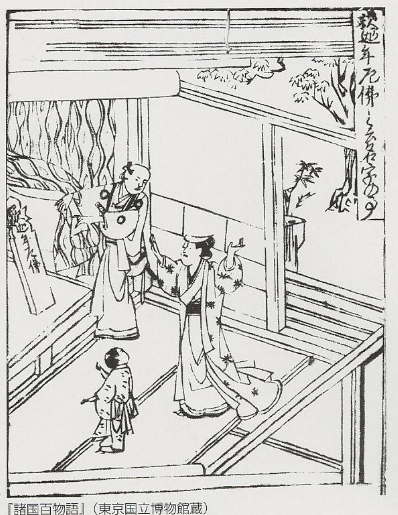
Three years passed in this way, until one summer night when the woman lay crying at home, she thought she heard faint strains of the flute music her husband once played.  Listening closely, she heard a voice from the next room, saying “Please open this door and let me in.”  There was no mistake.  It was her husband’s voice.

The woman peeked through a gap in the boards of the door, and saw her dead husband standing there.  He was playing a song that he had composed for her long ago.

He looked exactly as he had when he was still alive, and when seeing him the woman was chilled to the bone and overcome with fear.  She looked closer, and saw smoke escaping from the folds of his hakama trousers that covered his kimono, even where they were bound by a cord.  When the husband spoke, more smoke came from his mouth.

“What is this?  You were so sad and weeping and longing for me that I could get no rest!  But now that I have come back to see you, you sit there shivering in fear?  If that is the kind of greeting I get then I will just go back.  For this I withstood the scorching heat of Hell?”

And with that said, the man disappeared.

The Black Hair

Translated from Konjaku Monogatari

There was a samurai living in poverty in the capitol, who was suddenly summoned to the service of a Lord of a distant land.  The samurai eagerly accepted the offer, but abandoned his wife of many years in favor of taking another woman he desired along with him.

When his responsibilities to the Lord had finished, the samurai returned to the capitol and found himself longing for his old wife.  He went that night to the old house where they had once lived.  It was midnight, and the full autumn moon bathed the home in light.  The gate was open, and the samurai entered his old dwelling only to find his much-missed wife sitting silently by herself.

She showed neither anger nor resentment towards her husband for his ill-use of her, but instead offered him greetings and welcomed him back after his long time away.

The samurai, overcome with emotion, swore to his wife that they would live together from now on and never be parted.  Pleased by the happiness this brought to his wife’s face, the samurai embraced her and they held each other until sleep took them.

The samurai was woken in the morning by the bright morning sun that battered the house more harshly than had the previous autumn moon.  He looked about himself, and found that instead of embracing his wife he was holding a dry corpse, nothing but bits of flesh clinging to bone wrapped in long black hair.

He leapt to his feet and rushed into the neighbors house;

“What happened to the woman who lived next door?”

“Her?  She was abandoned by her husband long ago, and died of an illness brought on by her sorrow. It was just this summer that she died. Because there was no one to care for her or give her a funeral, her body lays still where she died.”

The Speaking Skull

Translated from Nihon no Yurei Banashi

The Man who materialized before the Temple Gate

This is a tale that comes from about 1300 AD.   There was a temple in Nara prefecture called Kanko-ji, where lived a monk named Doutou.  Doutou had come from Koma province (modern day of northern Chosen peninsula), and was a very tender-hearted and compassionate person.  He noted one day that travelers had difficulty crossing the Uji river due to lack of a bridge, and so he supplied the funds from his personal savings to build a bridge for everyone’s use.  Acts such as this earned Doutou the respect and honor of everyone who knew him.

One day, Doutou was walking through the valley of Mt. Nara with his disciple Manryo.  Quite by accident while glancing on the wayside, he saw a skull that had tumbled down from somewhere.  The skull seemed to have had a hard time, being covered in mud and looking like it had been kicked around by travelers on the road. There was very little meat left clinging to the bone, and then only in small places.  Doutou felt very sorry for the poor skull, and turned around to talk to his disciple Manryo.

“Look at this poor skull, of nobody knows who.  People have been picking on it even when it is dead.  In order to protect it from this shameless behavior, the least we can do is place it in some tree away from trampling feet.”

As his mastered commanded, Manryo took the skull high up into a tree away from where it would be seen, and covered it with some branches to keep it hidden.

This happened on the evening of the closing of the year.

Soon after, a man appeared before the gates of Kanko-ji, asking to be shown inside.

“I have humbly come down from the mountains, with a request to see the one they call Manryo with my own eyes.  Could you please bring me before him?”

The man was infallibly polite in his greeting and manners, so the young man tending the gate guided him to Manryo.

Though Manryo had never seen the man before, his face had an odd familiarity about it.  This is what the man said:

“I am a man who is deeply indebted to you.  You have done me a tremendous service, and now I would like to return your generosity.  Although I have brought nothing with me now, I beg of you to return with me to my home so that I may properly repay you.”

For his part, Manryo did not understand at all.  However, because the petitioner had come with such heartfelt enthusiasm, he felt that the man must be telling the truth.

“How could I deny such a request from one so earnest?  I will come with you to your home.”

There was nothing for Manryo to do except for to accompany the man out of the temple gates.

A crime revealed

When he arrived at the man’s house, Manryo was presented with a dazzling feast.

“Please, please…take only your favorites, and lots of them!  Please!”

While saying this, the man began to enthusiastically gorge himself.  Manryo still wondered what he had done to deserve such rich rewards, but when he asked the man how exactly he had been of service, the man was quick to shut Manryo up by shoving delicious delicacies at him.  There seemed to be no end to the offered morsels.

Manryo, still a young man and given to worldly pleasures, was unable to resist.

“Alright, I will hear the reason later.  For now, I will simply enjoy the proffered feast!”

With that decided, Manryo dug into the food with as much enthusiasm as his mysterious companion.  Never in his life had he tasted such delicious foods, and he was eager to try them all.  Between the two of them, empty plates piled up like a mountain.

Eventually, enthusiasm gave way to physics as Manryo could stuff no more food into his eager body.  Thinking to relax, he was startled as he saw the man’s face suddenly turn a violent shade.

“Honored Manryo!  My brother who murdered me has just arrived!  There is no time to hesitate.  We must flee from here!  Come with me!”

Hearing this, Manryo was shocked out of his pleasant repose.

“What? What exactly are you saying?”

His voice trembling, the man answered.

“Many years ago my brother and I had a business together. From that business I was able to save 30 kin of gold (about 18 kilograms).  My brother himself saved nothing, and thought it easier to kill me one night and steal my 30 kin of gold.  For the longest time my body rotted in the forest, until nothing was left of me but my skull.  People walking along the road who saw me would only kick my skull out of the way like an inconvenience. It was terrible. But then, beyond all hope you came along and lifted me up from the dirt and saved me from my fate.”

“I thought about how I could possibly repay such a kindness, and so I came to your temple this evening to invite you to my house for this feast.”

To say that Manryo was surprised by this confession would be a gross understatement.  But even in his panic and confusion he realized that being caught in this house by the murderous brother was undesirable, and so he jumped to his feet.  But he was too slow in trying to escape, and he heard the door creak open and someone enter the house.

The shock was too much for him, and Manryo froze in fright.

The person at the door, however, was not the feared brother but instead the brother’s son accompanied by their mother.  She saw Manryo standing rigidly in her living room and shouted in fear.

“Ahhh!!! A monk! Why are you here inside my house!”

Manryo let the story he had just heard poor out in every detail.  He turned back to look over his shoulder and get confirmation from the man who had led him to this house, only to see nothing.

The mother listened to Manryo’s story with as much shock as Manryo had.  It was nothing like what she had heard before.   The mother was very angry towards her son who had killed his younger brother.  She looked down at the brother’s son and told him in her strictest voice.

“Your father is a terrible person!  You must pray for the spirit of your murdered uncle, and apologize for your father’s crime!”

The young boy did as he was directed, and removed his father from his heart to be replaced by honored instead his uncle who had been good and kind.

This story comes from the “Nihon Ryoiki,” Japan’s oldest collection of folktales and legends. That folktale collection was written in the 13th year of Konin (822 AD), and is mostly a collection didactic tales for teaching Buddhism.

The Yurei Child

Translated from Edo Tokyo Kaii Hyakumonogatari

In Edo, in the vicinity of Nipponbashi (modern day Tokyo), there was an important shopkeeper named Kenhei.  Every year Kenhei would make a trip to Kyoto to buy stock for his store, always buying from the same seller, a widow women living with her daughter.  This daughter had stolen the heart of Kenhei, and she had no plans to give it back.  So, with the consent of the mother, they were pledged.

In the following days Kenhei said:

“I am a man of Edo, and so it is my wish to move our family to Edo where we can live out our days in ease.  I will return first and make the necessary preparations, then come and collect you.  What do you think?”

The daughter was pleased, and answered:

“I know that we have not yet the money to move, so we will wait for you here in Kyoto.  By the time you come again next year, we will be ready to go and live with you in Edo.”

With this pledge, Kenhei returned happily to Edo.  But on the trip back, he became terribly ill and unable to work.   The daughter was unaware of this and waited patiently for Kenhei to come and collect her and bring her to Edo to live together.  When the promised day came and went, she thought she had been betrayed and was overcome by sadness.  Such was her grief that she died.

Kenhei, still in Edo, believed that the daughter was waiting for him in Kyoto.  Just as he was wondering what she was doing now, he heard a voice:

“Is this the residence of Kenhei?”

Kenhei was overcome with happiness.

“What are you doing here in Edo?  This is fantastic!”

They both wept profusely.  But the daughter was bitter with her accusations at Kenhei for not keeping his promise.

Kenhei explained to her about his illness and why he had been unable to keep his promise.  At length he soothed her anger and brought her into his house, where she was introduced as his wife.

When the daughter said:

“And now we must bring my mother to Edo as well.”

Kenhei replied:

“Sadly, I still lack the money and she must wait another two or three years.”

During that time, the daughter, now Kenhei’s wife, became pregnant and gave birth to a boy as round as a ball.

When the boy was three years old, Kenhei went as promised to Kyoto to bring back the mother.  He went to their familiar house where the old widow was pleased to see him again.

She cried while saying:

“Well, well.  This is an unexpected reunion!  It has been three years since my daughter died while waiting for you to come and collect here.  Since she passed away I have had no one to rely on.  I have just lived an empty life here by myself, without compassion or sympathy of others, and here suddenly from Edo is that man who I thought had abandoned us long ago!”

Kenhei was shocked by this:

“What is it you are saying?  You daughter came to my house three years ago, and even now our three year old child is in our house.  Your grandson!”

With this the mother went into the back room where the family altar was kept, removed the mortuary tablet of her daughter.

“Your love for my daughter must have been so great as to call her back so she could live with you for those three years.”

Pulling it from her breast pocket, the mother showed the mortuary tablet to Kenhei.  The daughter’s name was written clearly on it in brush, along with the name of the blessed Buddha.    Kenhei broke down in tears, and after performing the proper funerary rights he brought the mother home with him to live together in Edo.

The child born to Kenhei and his ghostly bride grew up, and he became admired for his great wisdom and gentility by everyone in the province.

Previous Older Entries Next Newer Entries

Copyright notification

All translations and other writing on this website were created by Zack Davisson and are copyright to him.

Copyright notification

In accessing these web pages, you agree that any downloading of content is for personal, non-commercial reference only.

No part of this web site may be reproduced or transmitted in any form or by any means, electronic, mechanical, photocopying, recording or otherwise, without prior permission of Zack Davisson.

Copyright notification

For rights clearance please contact Zack at:

zack.davisson (at) gmail.com

Thank you.