Shichinin Dōgyō – The Seven Pilgrims

Translated from Mizuki Shigeru’s Mujara

This is a legend from Kagawa prefecture, and is one of several legends about someone out for a walk who runs into a mysterious band on the road, and dies as a result.

The Seven Pilgrims cannot be seen under normal circumstances. According to legend, only those with the ability to wiggle their ears can see them unaided. Everyone else has to look beneath the legs of a cow in order to make the invisible visible. Cows in particular are said to be sensitive to the presence of the Seven Pilgrims. If a farmer is out walking with his cows, and they come to a sudden stop at a crossroads, the wise farmer bends down and peeks from between his cows’ legs until he is sure the coast is clear. But, if he sees seven dark pilgrims walking single file … then his time has come.

Along with the Seven Pilgrims, Kagawa prefecture also has the legend of the Seven Boys. This is essentially the same story as the Seven Pilgrims, substituting a group of wandering young boys. The Seven Boys are also encountered on crossroads, and because of this the Nakatado District of Kagawa is spotted with long-abandoned crossroads where no human dares to walk.

The Seven Pilgrims and the Seven Children are most likely the same entity. Whether they look like weary travelers or small children, in truth, no one knows. No one has ever survived an encounter.

In Kochi prefecture, there is a similar legend of the Seven Misaki . They say that people who drown in the ocean are chained together in gangs of seven. The number is always seven, and there is a hierarchy. In order to gain their freedom and go on to the afterlife, the Seven Misaki need a new member in the form of a drowning victim. Then, the ghost in the front gets to heaven, while the rest of the members move up a rank. And the Seven Misaki feel no need to wait for an accidental drowning. They will kill if they can, to gain new members and free themselves from their torment.

So powerful is this bond that not even invoking the Nembutsu (prayer to the Ahmida Buddha) can help the Seven Misaki. Far better to save your prayers for yourself, and hope that they don’t come to you one night, looking for someone to step into the back row.

Translator’s Note

As I have said before, Japanese folklore runs the gambit from funny, to strange, to terrifying. After doing Eyeball Butt, I was in the mood for a monster that was honestly scary. Well, except for looking between a cow’s legs … that’s just weird.

One of the interesting things about the Seven Pilgrims is they show the fine line between yurei and yokai in Japanese folklore. The pilgrims are referred to either as “shiryo” (dead spirits) or “borei” (departed spirits), but they don’t follow the normal rules and tropes of Japanese ghosts. Generally, Japanese ghosts require some purpose or reason to manifest, whereas the Seven Pilgrims act as if they are under a curse. Unless their reason is more mysterious than we know.

The kanji used for the Seven Pilgrims is 七人同行, which translates literally as “Seven Fellow Travelers,” although in this case “travelers” implies “walkers of the path” which is a reference to Buddhist pilgrims. Their alternate form, the Seven Boys is 七人童子, or Shichinen Doshi. Based on that term, they don’t necessarily have to be boys—you could say the Seven Little Kids—but that is the most common usage.

The terrifying Seven Misaki uses katakana for the name (七人ミサキ). Misaki refers to a classification of Shinto spirits that are sort of “subordinate gods” to the main kami. Kitsune that serve the deity Inari are a type of misaki, for example.

Further Reading:

For most ghostly tales on hyakumonogatari.com, check out:

Shōrōkaze – The Ghost Wind

The Gratitude-Expressing Yurei

How Do You Say Ghost in Japanese?

The Yurei Child

Ubume-zu – Portrait of an Ubume

Translated from Mikzuki Shigeru’s Yokai Zukan

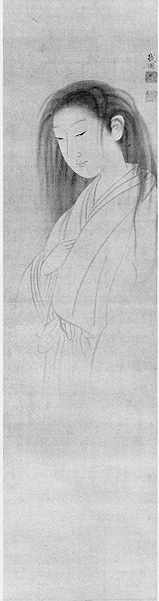
Here we have yet another yurei portrait, but this one gives an impression of sadness instead of fear. The title of this piece is ubume (姑獲鳥), which makes a reference to a Chinese yokai that took the form of a bird. This yokai entered Japanese folklore as the spirit of a woman who had given birth, and stories are told of a ghostly woman who wanders through town carrying her child in her arms.

This image of the ubume (産女) is the one drawn by Sawaki Sushi in Hyakaizukan (百怪図巻; “The Illustrated Volume of a Hundred Demons”) and by Sekien in Gazu Hyakki Yagyō (画図百鬼夜行; “The Illustrated Night Parade of a Hundred Demons”). Kyosai’s painting is of the same genus. In fact, Kyosai’s painting is so similar to that of another artist, Kano Tosen’s work “Umesachi,” that it could almost be considered a reproduction.

The ubume’s clothing and hair are swept back by the wind. She covers her face with her sleeve. The whole scene is one of plaintive sorrow.

Further Reading:

Check out other yurei art from hyakumonogatari.com:

Yūrei-zu – A Portrait of a Yūrei, a Japanese Ghost

Two Tales of Ubume

Hokusai’s Manga Yurei

Translator’s Note

This is Mizuki Shigeru’s commentary on a famous painting by Meiji-era artist Kawanabe Kyosai (河鍋暁斎; 1831-1889). Known as the last great painter in the Japanese style, Kyosai was said to be the inheritor of Hokusai and the other great ukiyo-e masters, although he did not study under Hokusai.

This painting is of a traditional type of ghost known as ubume. Ubume can be written with two sets of kanji, either 姑獲鳥 or 産女. The more typical one is 産女, which translates as “birthing mother.” Ubume are said to be ghosts of women who died in childbirth, or died with their still living child in their womb who is then born from a dead mother. They wander the streets trying to buy sweets and to get care for their still living child. In still other legends their child is as dead as they are. The kanji Kyosai used to title his painting, 姑獲鳥 translates rather strangely as “bird-catching mother-in-law” and shows the Chinese origin of the name. As stated by Shigeru, the Chinese ubume can take on a bird shape.

Kyosai probably used this archaic kanji to give an allure of mystery to his work, and to show his knowledge of Chinese.

Yūrei-zu – A Portrait of a Yūrei, a Japanese Ghost

Translated from Mikzuki Shigeru’s Yokai Zukan

To learn much more about Japanese Ghosts, check out my book Yurei: The Japanese Ghost

The moon hangs in the sky like the blade of a sickle, giving off a dim glow. A ghostly air permeates the scene, and from a thicket of bamboo emerges the form of a single yurei.

An emaciated body wrapped in a kyokatabira, the traditional white burial kimono, this figure is the very epitome of a yurei. Our eyes are instantly drawn to the clenched teeth from which dangles a pale, severed head. Held tightly by the hair, the yurei shows no sign of allowing its precious bounty to drop, and its expression challenges anyone to make it try. And while the eyes of the dead, severed head are closed, the eyes of the yurei look as if they could pop out of their eye sockets at any moment. An unearthly light surrounds the yurei and its head. The scene is blood curdling.

The head is painted in vivid colors, but we do not know its story. There must have been some terrible curse, some tragic event, to produce such a terrifying circumstance.

Although there are other paintings along similar themes, in this work the artist Kawanabe Kyosai has emphasized the horror, the eerie nature of the image. Kyosai is known as a master of yurei paintings, and surely this is one of his masterpieces.

Translator’s Note

This is Mizuki Shigeru’s commentary on a famous painting by Meiji-era artist Kawanabe Kyosai (河鍋暁斎; 1831-1889). Known as the last great painter in the Japanese style, Kyosai was said to be the inheritor of Hokusai and the other great ukiyo-e masters, although he did not study under Hokusai.

This painting, titled simply Yurei-zu (幽霊図), meaning “Picture of a Yurei,” is india ink on silk and was painted in 1870 – The 3rd year of the Meiji period. The painting is currently housed in the Fukuoka City Museum.

The story of this particular painting is not known, and indeed there may be no story. Kyosai painted a few portraits of yurei carrying severed heads. The reason for this is usually related to a story from Kyosai’s youth. As a nine-year old boy, he found a severed head by the side of a river, and brought it home to study and play with it like some discovered toy. When his parents found the head and ordered Kyosai to throw it back in the river, he did so only after he drew the head from every angle, fully studying his gruesome find.

Further Reading:

Check out other yurei art from hyakumonogatari.com:

Hokusai’s Manga Yurei

More Hokusai Manga Yurei

Shōrōkaze – The Ghost Wind

Translated from Mizuki Shigeru’s Mujara

In Goto city in Nagasaki, on the morning of the 15th day of the Obon festival of the dead, it was said that an evil wind blew. Anyone who felt the caress of this evil wind would fall sick and collapse. This day also happened to be the traditional day for visiting the graves of ancestors. It was believed that the souls of the unworshiped dead flew on the winds.

Since olden times, the people of Japan believed in and feared the unworshiped dead, called muenbotoke ( 無縁仏). Farmers blamed everything from droughts, to strong winds, to infestations of insects on these unhappy spirits. And so, during the Obon festival of the dead, along with the usual offerings of rice and sake to the ancestor spirits of the family, they would try to calm the spirits of the muenbotoke and the Buddhist hungry ghosts, so that they would not lay their curse on any living person. But some of these spirits would not be calmed, and so on the morning of Obon these vengeful souls would take flight on the wind and become the shōrōkaze.

It was not just evil spirits that used the wind to travel. The kami spirits of Shinto were also known to flow with the winds. For example, in the middle of March the wind from the East was called the kami-kudashi, and in the beginning of October when the kami gathered in Izumo for their annual meeting it was said that they traveled from all corners of Japan on the wind. And of course, the most famous of all is the kami-kaze, the God Wind that saved Japan. But of these all, only the shōrōkaze is counted amongst the yokai.

Translator’s Note:

The Shōrōkaze uses the kanji 精霊 (shōrō – ghost) + 風 (kaze – wind). 精霊 as a term for ghosts is interesting in that it has two different pronunciations, each with different connotations. The most common reading of 精霊 is seirei, and means ghosts or spirits in the Western tradition. When proncounced shōrō, as it is here, the word carries Buddhist meanings. So it is appropriate that the shōrōkaze is associated with Obon, the festival of the dead.

Further Reading:

Check out other yurei tales from hyakumonogatari.com:

How Do You Say Ghost in Japanese?

Goryo Shinko – The Religion of Ghosts

The Gratitude-Expressing Yurei

Enju no Jashin – The Evil God in the Pagoda Tree

Translated from Mizuki Shigeru’s Mujyara

Long ago in Koshu (Modern day Yamanashi prefecture), on the base of Mt. Minobu, there was a dark forest where great trees lined up in a row. Inside the forest was an ancient Japanese Pagoda Tree. The tree was worshiped as a spirit, and a shrine had been built near the tree. However, anyone who passed by that tree after sundown had to leave an offering of silver and gold, or fine clothing, or anything of monetary value. Those who ignored this custom would suffer a terrifying curse. Now, I say that the tree was a spirit, but those in the town called it the mori no jyashin, the Evil God of the Forest.

At one time, a poor but hardworking farmer heard that his mother was dreadfully ill. He fled back home to see her, but the quickest path to her house took him right in front of the tree, and he had nothing to leave as an offering. There was nothing to be done, and as the famer rushed by the tree he prayed to the evil god, making a promise that he would come back later with an appeasement. But from the tree an empty suit of armor appeared and followed the man. The farmer dropped to the ground, bowing his head against the ground and begging the evil god for forgiveness. Appearing to accept the promise, the armor disappeared.

The following day, because the farmer terribly poor, he could only muster 500 mon in coins for an offering. Apparently this amount did not please the evil god, who cast the farmer into a giant pot and set him to fire preparing to make a dinner of him. The farmer prayed most solemnly for his life, and his prayers were heard. The son of the diety Fudo Myo appeared, and dispensed with the evil god. Not only that, all of the money and goods that had been paid to the evil god by the village was returned.

Although the villagers called the entity in the tree a spirit, I think it is more likely that some kind of yokai had settled down there.

Translator’s Note:

The name of this story is Enju no Jashin (槐の邪神). The enjyu tree is a species called Sophora japonica, and is known in English as either the Japanese Pagoda Tree or the Chinese Scholar.

Further Reading:

Check out other magical tree tales from hyakumonogatari.com:

Ochiba Naki Shii – The Chinkapin Tree of Unfallen Leaves

Previous Older Entries Next Newer Entries

Copyright notification

All translations and other writing on this website were created by Zack Davisson and are copyright to him.

Copyright notification

In accessing these web pages, you agree that any downloading of content is for personal, non-commercial reference only.

No part of this web site may be reproduced or transmitted in any form or by any means, electronic, mechanical, photocopying, recording or otherwise, without prior permission of Zack Davisson.

Copyright notification

For rights clearance please contact Zack at:

zack.davisson (at) gmail.com

Thank you.