Kyōkotsu – The Crazy Bones Yōkai

Kyokotsu Mizuki Shigeru
Translated and adapted from Hyakiyako Kaitai Shisho and other sources

Be careful when you pull up a bucket of water from an ancient, abandoned well. You might get more than you bargained for if a kyokotsu 狂骨—which translates literally as “crazy bones”—springs up from the bucket like a Jack-in-the-Box to deliver its curse.

Clad in a white burial kimono, kyokotsu almost look like a classical yurei but they lack the black/white contrast due to shocks of white hair that spring from its bleached-white skull. Kyokotsu appear as little more than bones wrapped in a shroud, springing from a well.

The yokai is best-known from Toriyama Sekien’s Edo-period yokai print-book “Konjyaku Hyaku Kishui” or  “Supplement to the Hundred Demons of the Past.” Author Kyogoku Natsuhiko also recent featured a kyokotsu in his book “Dream of the Kyokotsu.”

Sekien’s original woodblock print was accompanied by this text:

“Kyokotsu rise from the bones in the well. It is said that whosoever commits the horrendous act of abandoning august bones will find it impossible to abandon the horrendous wrath that follows.”
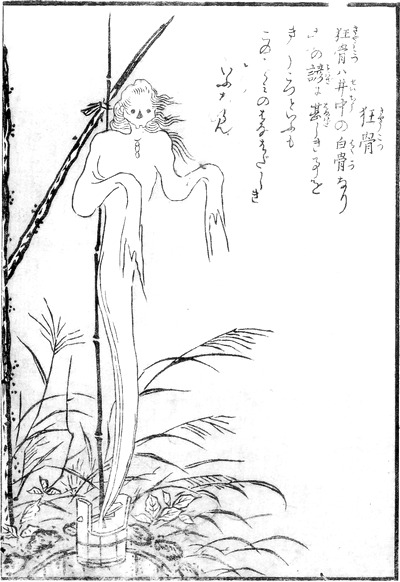
Sekien’s text seems to explain that kyokotsu appear from a well in response to some wrongdoing and bearing a terrible grudge. Seiken also claimed that the regional-dialect term “kyokotsu,” meaning “violent” or “furious,” is an allusion to this yokai. However, while such a term does exist, specifically in Tsuki-gun in Kanagawa prefecture, there is no concrete evidence linking either the term or Seiken’s picture to an older folktale.

It is much more likely that the opposite occurred, that Seiken heard the term “kyokotsu” and decided to invent a yurei to match—much like if an English-language author decided to create a monster called “Lazy Bones” after the pre-existing term. To get the image for his yokai, Seiken was probably just playing on works, combining the local term “kyokotsu” (crazy bones) with “gyokotsu,” which means bones from which all of the meat has fallen off. He might also have been influenced by the words “keikotsu” or “sokotsu” which can mean drifter or wander, but also can be phrased as “someone from the bottom.” It seems likely that Seiken was influenced both by these words and by the old belief of an inexhaustible grudge that can come from the bottom of wells.

There are several Japanese folklore stories—involving both yokai and yurei—that involve the bottom of a well. In Japanese folklore, water was a channel to the world of the dead, and the bottoms of wells were directly connected. Wells also served as a convenient hiding place for murders committed in the dark of the night, and the superstitious believed that any such-disposed of corpse was capable of a powerful curse. Those who died from falling in wells, by accident, suicide, or murder, were thought to transform into shiryo and haunt the well. The spirit connects to the well itself, rather than where they were murdered, and their curse is likely to fall on anyone who used the well and not specifically targeted to the murderer.

A cursed set of bones is another typical trope in Japanese folklore and does not need to be connected to a well. In her book “Nozarashi Monogatari,” the literary scholar Sawada Mizuho wrote a similar story of a weather-beaten, abandoned skull that gets its revenge.

The biggest difference between the kyokotsu and typical Japanese folklore tales of skeletal ghosts is the element of disparity between the spirit form and the physical remains. In most stories, the spirit resembles a typical Japanese yurei—with a physical, full human body—even while the discovered remains are nothing more than a pile of rotting bones. The kyokotsu is rare in that Sekien drew the spirit in skeletal form as well. Because of this, kyokotsu is most often identified as a type of yokai, being a possessed skeleton, rather than a type of yurei, a Japanese ghost.

Translator’s Note:  The manga series “Bleach” has a character called Katen Kyōkotsu that uses the same kanji as this yokai, but seems to have no other relationship.

Inen – The Possessing Japanese Ghost

Translated from Mizuki Shigeru’s Mujyara

In Saisetan, located on Fukue island in the Goto archipelago of Nagasaki prefecture, there are legends of things that have the power to enter and possess humans. These things (ikiryo, shiryo, dobutsu-rei, kappa, and the curses of various deities of Shinto and Buddhism) are called inen. They cause various illnesses, changes in personality, and spiritual distress. There is also a type of shaman who can speak directly to the inen, interpreting their demands and negotiating the price that must be paid. These shamans are known as Honin.

At one time, there was the wife of a farmer who had a strange growth on the side of her body under her armpit. It was painful, and because of the tumor she couldn’t sleep at night. She went to the doctor and had the malignant growth removed several times, but it always grew back. Three times she was operated on, and with no success. She finally paid a call on a honin. The honin said “In your house there are many spirits. These are not the beneficial spirits of your ancestors. They are desperate things who want something from you. It is the spirits who have caused this growth on your body. Here is what you must do to appease them. Go home, make a great feast, and set it on your largest plate. Set the plate under a large tree near your house and leave it there, making the proper supplications to the spirits.”

It was long the tradition of the village that the once-prosperous farmer’s wife’s house was built on top of an ancient graveyard. The spirits interred there wanted the humans to honor them and hold regular memorial services, and they made their desires known by causing illnesses such as skin diseases, tumors, and even insanity.

You can read more details about inen in the book “Spiritual and Magical Powers” by Sasaki Miki.

Translator’s Note:

The word inen is written in katakana, and thus has no meaning other than being a name.

The Chrysanthemum Vow

Translated from Nihon no Yurei

Ueda Akinari’s “Ugetsu Monogatari” is a nine-story collection of tales of the mysterious and strange. It is a pedantic work, designed by the author largely as a display to flaunt his own body of knowledge. In the nine stories, Ueda wrote about the nature of yurei. Among them is the story “The Chrysanthemum Vow,” the gist of which goes like this:

In the country of Harima there was a post-town called Kako that stood as a relay station for official messages. Living there in honorable poverty and relative safety was an old mother and her son, who was named Hasebe Samon. One day Samon saw a visitor coming into town. The visitor was sick with a high fever and in obvious pain. Terrified of a contagious infection, the people of the tiny post-town gave the stranger a wide berth. Hasebe alone took pity on the stranger and brought him into his own home where he cleaned him and nursed him slowly back to health.

The visitor was from Shoue, in Izumo. His name was Akana Soemon. He had served as a mentor in strategy and tactics to the Lord of Toda, Enya Kamonnosuke , but one day when Akana was out delivering a message to Sasaki Ujitsuna of Oumi, a man named Amako Tsunehisa betrayed and attacked Lord Enya Kamonnosuke. Sadly, Akana’s patron died in the ensuing battle. Soemon pleaded with Ujitsuna to take up the sword and exact revenge on Amako, but aside from some pretty speeches Ujitsuna did nothing. The lack of action on the part of Ujitsuna was upsetting, so Akana decided to leave Oumi and return home to Izumo. But on the journey back he fell ill.

Akana was overwhelmed by the kindness he had been shown by Hasebe, and the two became sworn brothers. At the beginning of summer, Akana wished to stay with his new companion but he still needed to fulfill his original purpose and return to Izumo to check on his holdings. After that was taken care of, Akana promised to return to Hasebe’s house for a lengthy stay.

Akana promised to return to Kako before the season had a chance to change into fall. He set the day at September 9th, the day of the Chrysanthemum Festival. Akana gave his most solemn vow to Hasebe that the festival would not pass without his return. That said, Akana set out for Izumo.

In time, the promised day arrived, September 9th. From the very earliest light of morning, Hasebe Samon busily prepared for his dear friend’s return, and when preparation was done he waited patiently. Noon came and went with no sign of Akana. Soon it was evening, and even as the sun was sinking into the West Akana did not arrive. After waiting well into the night, Hasebe told his mother that she should retire, and that he would continue his vigil alone. It never occurred to Hasebe that Akana would not fulfill his vow.

Waiting still, as he looked beyond the door of his house, Hasebe saw the faint glow of the Milky Way above, and the dim illumination of the setting Moon. In the distance, he heard the sound of ocean waves breaking, and he could clearly hear the barking of the family dog. The fading moonlight outlined dark silhouettes of the mountains. As he stood in the doorway without any intention of entering, Hasebe watched the night scene.

Just then, from out of the silhouettes of the mountain, Hasebe saw the shape of a person begin to appear. The figure did not walk, but floated as if carried on the wind. Although it seemed impossible, when Hasebe looked closely he saw the shape of his friend Akana Soemon. Exactly as promised, Akana Soemon had kept his vow and come on September 9th, the day of the Chrysanthemum Festival.

But the Akana Soemon that arrived was not the man of this world that Hasebe had been expecting. Only Akana’s spirit had appeared.

Akana’s shade told his story to Hasebe. Once in Izumo, Amako Tsunehisa had Akana placed under house arrest and kept him there, making it impossible for Akana to keep his vow and arrive for the Chrysanthemum Festival. Akana had pondered this for awhile. He reasoned that even if it was impossible for his physical body to make the journey of a thousand ri to see his friend, his spirit alone would have no problem traveling that great distance. And so with his own hand and his own sword, Akana freed his spirit and traveled on the wind in order to keep his promise. Once Akana told this story to Hasebe, his spectral form vanished and Hasebe was alone once again.

After expressing the extreme fidelity of these two friends, Ueda Akinari notes that you should not become attached to frivolous people, or wrap your fate with those who will not pay in kind.

The Chrysanthemum Vow can be seen as a template for this kind of yurei story. If we compare it to other Tokuhon-shu stories popular with Edo period readers, we see the similarities. It stands to reason that the yurei of Akana Soemon came to visit Hasebe Samon, and did not just blindly return to the house where he had stayed. If Hasebe had been elsewhere, then Akana would have found him there and appeared before him. This element of ghosts is one of the unique points of Japanese yurei.

In other words, Japanese yurei have a specific goal in mind, a purpose. If they are seeking a person, they will find them no matter where they go or where they hide. There are some exceptions, most notably the story in my first chapter (Translated as The Scared Yurei) where I tell the story of a ghost of Ginza who wished to get revenge on the person who killed her, but, being still afraid of the murderess even in death, deigned to appear at the kindly old lady’s home next door. But this kind of story is rare, and ignores the rules of Japanese yurei.

Translator’s Note: Those familiar with Lafcadio Hearn will probably reconize his version of this story, recorded as Of a Promise Kept in A Japanese Miscellany.  This is a shortened, less poetic version of the tale told just as a recap for the book Nihon no Yurei.  The story originally appeared in Ueda Akinari’s Ugetsu Monogatari.

More Hokusai Manga Yurei

Here are three more yurei from Hokusai’s 15-volulme Manga series.

Iga no Tsubone– Volume 05

Iga no Tsubone serves double-duty as an actual historical person as well as a folkloric figure. She was the wife of Kusunoki Masanori, an Imperial serving in the court-in-exile for the Emperor Go-Diago.

The story goes that Sasaki no Kiyotaka was an unsuccessful advisor to Emperor Go-Daigo. Sasaki advised the Emperor to attack Ashikaga Takauji’s armies, despite the weakness of the Imperial position. The result was disaster, and Sasaki was ordered to commit seppuku, ritual suicide, as atonement.

Sasaki’s yurei returned to haunt the Imperial court-in-exile after his death, appearing in the form of a tengu. ( It is not uncommon for members of the Imperial court to return after death as tengu instead of normal yurei.) The ghost of Sasaki no Kiyotaka tormented the court-in-exile, until finally the lady Iga no Tsubone confronted it in the palace gardens, and persuaded it to leave.

The scene of Iga no Tsubone confronting the yurei of Sasaki no Kiyotaka was a very popular one and appeared in many ukiyo-e woodblock prints of the Edo period. The artist Yoshitoshi Tsukioka included this scene of Iga no Tsubone in both his “One Hundred View of the Moon” and his triptych “Famous Women of Japan.”

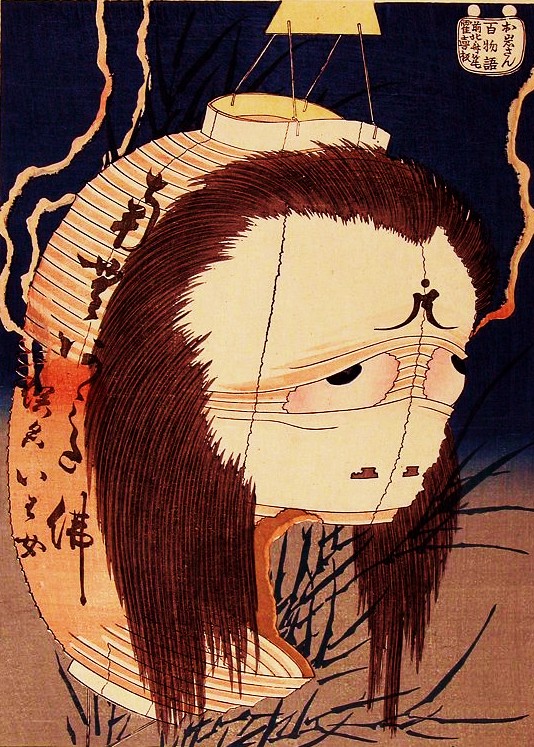
Oiwa and the Buddhist Monk Yuten – Volume 10

By far the most famous ghost story of Japan, and the most famous ghost in Japan, this is a scene of Oiwa from the kabuki play Tokaido Yotsuya Kaidan. Oiwa was a woman cursed from birth with being ugly. Despairing of any happiness, she was finally married and had a baby with a poor ronin named Iemon, who eked out a living as an umbrella maker. Iemon somehow won the heart of the beautiful daughter of a well-off neighbor, and realized that the only thing standing in his way was his wife and child. He secured a vial of poison that he gave to Oiwa, which didn’t kill her but only caused her eye to droop and her hair to fall out. Disturbed, Iemon finally outright killed Oiwa and her baby. Oiwa returned to haunt Iemon and his new bride and family until she got her revenge.

This image of Oiwa from the Yostuya Kaidan is highly unusual, in that the vast majority of pictures of Oiwa (and there are hundreds, if not thousands) have her facing off against her husband Iemon. Instead, in this scene she is confronting the Buddhist monk Yuten. In some versions of the story, it was this monk who supplied the poison to Iemon.

Hokusai has another, much more famous print of Oiwa from his Hyakumonogatari series. That image is the famous scene of Oiwa’s face appearing from a lantern to confront Iemon.

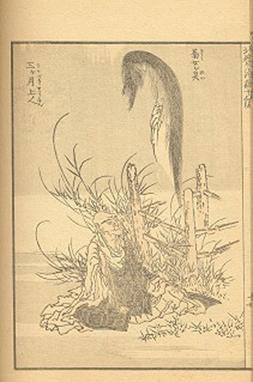
Okiku and the Buddhist Monk Mikazuki Jyounin – Volume 10

Another of Japan’s most famous ghosts, the story of Okiku and the Nine Plates is usually told as the Bancho Sarayashiki. In the tale, Okiku is an innocent maid who breaks one of the ten plates that are the heirloom of the family she works for. In his wrath, the master of the house has Okiku thrown down a well where she dies. Every night, her ghost rises from the well and goes to the house to count the plates, shrieking horrifically when she gets to number nine.

The story of Okiku has as many variations as there are old wells in Japan, each claiming to be the original. This picture is based on a version where a monk hid nearby when Okiku rose to count the plates. As she counted the plates, and reached the final ninth plate, the monk shouted “ten,”and Okiku, satisfied that she had finally finished her count, dissipated to the afterlife.

Like Oiwa and Iga no Tsubone, there are several ukiyo-e woodblock print versions of the Okiku story.

Poverty-stricken Yube and the Oil Seller

Translated from Nihon no Yurei Banashi

Drinking Oil

Long ago in a village in Banshu (Modern day Hyogo Prefecture), there was a man named Yube. So stricken with dire poverty was Yube that he had nothing to eat and nowhere to live.  In desperation, Yube went to the home of a wealthy dealer in oil and bowed his head on the floor and begged to borrow some money.   The Oil Seller loaned Yube the money, and set the conditions for repayment.   But when the promised day to repay the loan came, Yube’s circumstances had not improved and he had not the ability to return the money.

Yube begged the Oil Seller:

“Please, my lord. Just give me another six months to pay back the loan.”

After listening to Yube beg and plead and beg some more, the Oil Seller finally relented and gave Yube six more months.  But he enforced a harsh term for the additional time.

“All right, if you want more time so badly, then prove it!  Right here, before me, drink five cups of oil.  If you can’t do that, then you had better be able to pay me back this minute.”

Yube was shocked at the demand.  But as he lacked the money to repay the loan, there was nothing he could do but set down to drink the oil. The Oil Seller made sure the cups were filled full to the brim, and watched as Yube sucked down every last drop of the thick oil.   First one, then two, until finally all five cups were drained.   Just as Yube finished the last of the oil, he doubled over with in excruciating pain.   First his stomach ached, and then his chest tightened terribly.  Yube began to sway back and forth, howling in agony, before he dropped to the floor dead.

The Burning Grave

The news of the Oil Seller’s deed spread quickly through the town, and it wasn’t long before it was overheard by the local magistrate.   The magistrate hurried at once to the Oil Seller’s home, and began a thorough investigation into the matter.   When he learned enough to know that the rumors were true, he fixed a stern eye on the Oil Seller.

“Well now. You have killed a man, and no mistake.  To tell the truth, there is enough here for me to send you to the executioner to be beheaded. But I would save you that much.  Instead, you will cover the entire cost of Yube’s funeral, and see to it that his family never suffers for money again.   If you can’t promise me that, then I will see your head posted on the town gates.”

The magistrate said this with such conviction in his voice that the Oil Seller trembled in fear. The Oil Seller quickly agreed to the terms, and wasted no time in making the arrangements to give Yube a fine funeral.   When the day came, the Oil Seller laid flowers on Yube’s freshly-cut headstone and then bent down to light the lanterns next to the grave while the people of the village silent watched and prayed.

When the match was touched to the lanterns, something shocking happened.  The five cups of oil that Yube had drunk had seeped from his body into the surrounding soil, and the grave burst into flames, rising up into a fireball.  The villagers shouted in surprise.

“Ahhh!  It is a hi no tama (fireball)!  This is Yube’s curse, and he has turned into a hi no tama!  We have to get out of here!”

Everyone fled from the grave running as if their lives depended on it.   As for the Oil Seller, he would never live another comfortable day in his life; he flesh grew pale and his entire body was overcome with shaking. He ran faster than anyone.

Just as everyone fled the grave, another mysterious thing happened.  The hi no tama blinked out as quickly as it had appeared; Yube’s oily body was burned up.   That is to say, all of the oil in Yube’s body had burned up. Yube himself was left clean and pure again.  When the last of the fires disappeared, Yube’s body down in the grave let out a huge gasp as air rushed back into his lungs.

“Huh?  Where am I?  What am I doing down here?”

With the oil purged from his body, Yube had come back to life and began to dig himself out of his own grave.   Pulling himself clear, he began to walk through town, heading back to his house.

When Yube came walking through town he came on a huge, noisy bunch of men were gathered in the street.   They were making a tremendous ruckus, some shouting with joy and some with anger.

“Hey there!  What are you all doing?”

Yube tried to push his way into the crowd to get a look at what was going on.  Just then, someone noticed him.  Yube caused quite a fright,
as he was still dressed in his white burial kimono that he had been wearing at his funeral.

“Ahhhhh!!!  It is a yurei!!!”

At the site of Yube in his white kimono, the courage of the men fled from them, and soon all the men were fleeing along with it.   Yube looked at the ground where the men had been gathered, and was surprised to see that the streets were littered with money. For sure this wild crowd had gathered for illegal gambling, and they had all left their cash behind when they went running from Yube.

“Ho!  This will certainly provide for my needs!”

Yube gathered all the stray money from the streets, and carried it off to his house.  But if he expected a welcome home greeting, he was sorely disappointed.  To see their dead relative, whose funeral they had been to today, suddenly show up at their doorstep was too much of a shock for Yube’s family.

“Ahhh!  It is a yurei!  Yube must be lost and unable to make his way to the world over there!”

With that they slammed the door shut and held it tight.   No matter how many times Yube knocked and pleaded to be let in, they wouldn’t listen and just yelled at him to go away.   There was nothing for Yube to do, so sadly he left his house and wandered to a near-by temple.   There, he poured out his story to a sympathetic monk who listened patiently. The monk then returned with Yube to his house, and explained Yube’s return to life to the family, who finally let Yube come inside.  They called down everyone in the house to hear Yube’s tale, and after that went out into the streets of the village where everyone celebrated Yube’s return.

With all the money Yube collected from the gambling den, he was now the richest man in the village. He paid off his dept to the terrified Oil Seller, and proceeded to live happily ever after.

This is a very unusual yurei story.  Not only does the dead man return to life, but he also becomes rich and lives a happy life.  This kind of story is mainly told in the Kansai area of Japan.

Previous Older Entries Next Newer Entries

Copyright notification

All translations and other writing on this website were created by Zack Davisson and are copyright to him.

Copyright notification

In accessing these web pages, you agree that any downloading of content is for personal, non-commercial reference only.

No part of this web site may be reproduced or transmitted in any form or by any means, electronic, mechanical, photocopying, recording or otherwise, without prior permission of Zack Davisson.

Copyright notification

For rights clearance please contact Zack at:

zack.davisson (at) gmail.com

Thank you.