The Dead Wife Who Didn’t Leave

Translated from Nihon no Yurei Banashi

The Voice of the Dead Wife

Long ago, deep in the mountains of Shikoku, a husband and wife lived happily alone far away from the nearest village in a small house. In the autumn of one year, the wife of that happy couple fell suddenly ill and was confined to bed.

But, because the couple lived so very far away from the nearest doctor in the village, they had no medicine. The wife’s fever grew hotter every day, and the husband could do nothing but cool down her body with cool water.

The wife’s condition worsened every day. The husband never left his wife’s side, and tended to her every moment of every day. One day, seeing the pain on his wife’s face, the husband sought to comfort her agony.

“My love, we are the type of couple who can never be separated. No matter what happens, please say that you will never leave my side.”

“I am so happy you to hear you say that, my husband, because that is my feelings exactly.  As it always has been, no matter what may occur in the future, I will never leave you.”

“Then let us make a promise,” the husband said, “no matter who is the first to die,  we will not bury that person in a grave.”

“That is for the best,” answered the wife, “I know that I have not much life left in this body. Do not break the promise you make to me know.  Do not put my body in a grave, but leave me here as I am so that I may always be by your side.”

With that said, the woman relaxed with a peaceful look on her face, and exhaled her last breath.  As he had promised, the husband didn’t bury her, but left her as she had died, inside the house, lying in bed.

In this way, seven days passed.  Nothing of note happened during those seven days,  and the husband went about his business as usual.  But on the night of the seventh day…

“Let’s go outside, shall we?”

The husband heard these words in a thin voice, but from where they came he could not say.

“Eh?  Who said that? There is no one else here…”

The husband turned his eyes towards the mysterious voice, and saw nothing but the dead body of his wife.

“That’s strange…but there is no way I heard her voice!  I must be imagining things.”

But even as he thought this, he didn’t really believe it.  So he turned to his wife’s body and said:

“You say you want to go outside, but where do you want to go?”

Even so, he was shocked to get an answer:

“Yes, I am bored just lying here all day.  The moon must be beautiful tonight.  Let us go out and view it.”

“Its fine to say that,” the husband replied, still unsettled, “but you are dead.”

With that, the wife spoke no more.

Let’s Go Outside, Shall We?

After that, two or three days passed uneventfully.  But on the evening of the fourth day, a traveling salesman lost his way passing over the mountains while making his way towards the village.  Seeing the couple’s remote cottage, he knocked on the door.

“Hello?  Would you be so kind as to let me stay just this night?  I have lost my way, and find myself in trouble.”

“That is a tight spot,” said the husband, “but come in and make yourself at home.”

With that said, the traveling salesman went into the cottage.  But the husband still had some errands to run outside, and said:

“Excuse me, but I must go out for a bit.  Please wait for me here.”

The traveling salesman had been hoping for some company as well as a place to stay,  and was a bit downhearted when the husband left him alone.  Sitting in the cottage, he heard a small voice.

“Let’s go outside, shall we?”

The voice, however weak, was unmistakably a woman’s voice.  The traveling salesman thought it was strange, but answered:

“Where do you want to go?”

“The moon must be beautiful tonight.  Let us go outside to view it.”

“Indeed it must be beautiful.  All right then, let us go outside.”

Just has he answered, a woman appeared wrapped in a long white kimono.  She stood before him wavering, as if blowing in a breeze. And she said:

“Well then, shall we go?”

and she reached out a stark white hand to him.  The traveling salesman looked closer at her and saw that she had no feet.

“Ah!  A yurei!”

The traveling salesman was astonished and stepped back two or three feet.  But he was no weakling, lacking in courage.  Indeed he was a robust and brave man.  He muttered to himself:

“OK now…this yurei must want to whisk me off to the land of the dead.  Well she will not find such easy prey.”

With that, he sprang at the woman, grabbed her by the throat and threw her from the house. He stepped to the door to await her challenge, but there was nothing before his eyes. The woman had vanished.

After a bit, the husband returned from his errand.

The traveling salesman flew into his story of the mysterious encounter.

“That was a strange thing indeed!  Hah!  But maybe it was just the fog playing tricks on me after all!”

But instead of being entertained, the husband was furious:

“What have you done?  I show you a little sympathy, let you stay at my home, and you throw my wife out the door? Then you go out with her!  If you want to stay in my cottage, go find my wife and bring her back!”

The chastised travelling salesman slowly plodded out the door, and began his task of wandering the dark forest looking for the yurei he had so roughly handled.  But even with the bright light of the moon to guide him, the wife was never seen again.

This story is sometimes told about a fleeing soldier running from the Heike wars. The legend comes from Shikoku, from Mt. Iya, and for a yurei story has very few variations.  It has the nature of a love story, and is a tale of compassion.

Why do Japanese Ghosts Not Have Feet?

Yurei_Japanese_Ghost

Translated from Sore de Honto?

To learn much more about Japanese Ghosts, check out my book Yurei: The Japanese Ghost

The gentle drops of falling rain. A lonely willow tree standing near a graveyard. And a Japanese ghost, called a yurei, waiting below.  This is our image of a yurei, and when we imagine this picture of the yurei, it has no feet.

The uniform image of a yurei has come from the Middle Ages to the modern day.  But in the earlier days, at a time when people were mortally afraid of the power of spirits, yurei actually had feet.

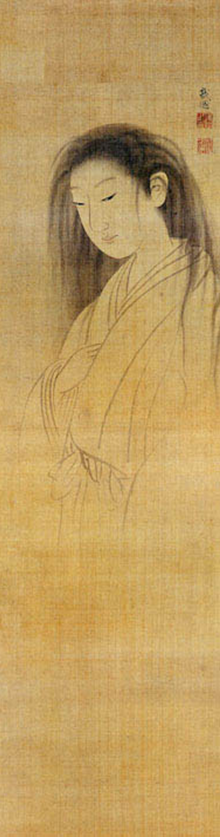
The image of a footless yurei, known as the ashi ga nai yurei, became established in the Edo period by kaidan tales like “Yotsuya Kaidan” and “Bancho Sarayashiki.”  But even before these kaidan, the footless yurei had gained popularity in the works of artist Maryuama Okyo. (1733-1795).   His paintings were so overwhelmingly popular that they influenced the designs of the kabuki stage, until Okyo’s image of the yurei became the accepted form of Japanese ghosts.

Maruyama_Okyo_The_Ghost_of_Oyuki

But why did he paint his yurei without feet?  There are several proposed explanations.  One says that his images were drawn in dim light, that only illuminated the top half of the person leaving the legs and feet in darkness.   Keio University professor Ikeda Yasaburo proposed the theory in his book “Nihon no Yurei” that Okyo was inspired by the haze of incense smoke rising into the sky, and drew his yurei as if they were half composed of this smoke.  Another theory looks at the long robes of Bunraku puppet theater which hide the feet of female puppets.  Kabuki theater took inspiration from Bunraku, and it is possible that the hidden feet of the puppets was adopted into live theater.  It is most likely that from one or more of these explanations comes the popular image of the footless Japanese ghost.

…and yet, it cannot be said that all yurei are footless. You can often hear the sounds of ghostly footsteps in traditional kaidan stories.  In the popular kaidan Botan Doro the arrival of the yurei Otsuyu is announced by the karan, koron of her wooden geta sandles.  And in Noh theater, many of the ghostly characters sport magnificent footware.

Further Reading:

To read more about Japanese ghosts, check out:

The Ghost of Oyuki

How Do You Say Ghost in Japanese?

Two Tales of Ubume

Translated from Nihon no Yurei

The name Tsukiji nowadays brings to mind a bustling fish market in Tokyo, but it was not always so.  In the olden days, the area known as Tsukiji was packed with temples, mostly belonging to the Honkan-ji temple complex. .  The area was also covered in cemeteries.

Along the banks of the Sumida River that flows near Tsukiji, there were also stands selling fresh fish and the sweet sake for children known as amazake.  In one story, late every night a woman clutching a child would come to a certain amazake dealer to buy the sweet sake from him, which she would then give to her child to drink.  The sake dealer, sensing something mysterious about this woman, followed her from his stall one night and watched her as she made her way towards the main hall of the temple, where she disappeared like a blown-out candle. When she vanished, the sake dealer could hear the cry of a baby coming from somewhere in the cemetery. Tracking the sound to a freshly-dug grave, the sake dealer enlisted the help of some others to dig up the grave,   and when opening the coffin discovered a crying baby nestled in the arms of its mother’s corpse.  So it is said.

I heard this scary story many times when I was a child.  And of course, there are many variations of the same story.   Kaidan of the child-bearing yurei known as ubume are very old, and yet the story is still widely told in modern times.  The basic ingredients of the story have unaltered even as the legend has passed through the years.  The ubume legend first appeared in the 12th century kaidan collection called Konjyaku Monogatari, and it is that story I shall relate to you next.

The 17th scroll of the Konjyaku Monogatari is a kaidan scroll, full of ghost legends and monster stories.  This particular story is Number 43 from the 17th scroll; the Tale of the Bravery of Urabe Suetake.

Urabe Suetake was a retainer of that legendary figure Minamoto no Yorimitsu.   More than just a retainer, however, Suetake was one of the Shiten-nō, the Four Guardian Kings whose legend would grow to almost the same size as Yorimitsu’s himself.

One this occasion, Yorimitsu and his retainers had made camp near a river-crossing in the old province of Mino (modern day Gifu prefecture).  As was common at the time, the soldiers whiled away the night telling weird stories around the campfire, until one man mentioned that this very river crossing was supposed to be the home of an ubume.  The legend, it said what that a woman appeared holding a weeping child, and she would plead anyone attempting to ford the river to take the child from her and save its life.   Anyone foolish enough to accept the burden would find that child becoming heavier and heavier in their arms, until they were drug under the water and drowned.

After hearing this story, all of Yorimitsu’s men were far too frightened to cross the river, but Suetake just laughed and said that he didn’t believe in such nonsense.

“I shall cross the river myself.  Right now!” he shouted boldly.

Standing up and preparing to make his way towards the haunted river, he snatched up an arrow and said he would place it on the far bank as testament to his deed.

There were three men in the camp who decided that they would not be satisfied with the evidence of the arrow.  After all, he could just fire it across the river!  So after Suetake had left, the used the cover of the darkness to silently follow him and to bear witness to his deed.

When the arrived, Suetake had indeed crossed the river and placed the arrow, and was now mid-way through his return trip.  Suddenly, from the darkness they heard the voice of a young woman, and the unmistakable cry of a baby.  The woman appeared next to Suetake, and begged him to receive her baby and carry it safely across the river for her.  In spite of the danger, Suetake bravely received the child and started for the shore.  With each step, Suetake’s burden grew heavier, but with his great strength he persevered and it was soon obvious that he would reach his destination.

Behind him, the woman screamed in desperation, begging Suetake to return her child to her, but Suetake refused her cries and continued on until he reached the river shore.  From there, he headed back to camp with the baby still bundled in his arms.

When Suetake arrived in camp, he proudly opened the bundle to show the ubume’s child as evidence of his great deed.  Inside, however, there was no baby. Just a mass of wet leaves bundled together in the rough shape of a human child.

Nagarekanjyou – A Death Custom

Translated from Nihon no Yurei

There is a memorial custom called nagarekanjyou (流れ灌頂).   In a small river that runs next to one of the streets in town, four bamboo poles are stood upright in the river, and a red cloth is stretched between them.   Next to the cloth and poles a hishaku spoon is placed so that passer-bys can stop and ladle water over the cloth.

It is said that when the lettering on the cloth has washed away completely, and the colors have faded, that dead person’s soul is released and can float up to nirvana.  It is also said that it is dangerous to catch so much as a glimpse of a nagarekanjyou and not stop to ladle water.  This will enrage the waiting yurei who will then follow you home.

This custom is most often associated with women who died in childbirth.

Funa Yurei

Translated from Nihon no Obake Banashi

Long ago, it was said that when a boat put out to sea on New Year’s Eve it was sure to catch the eyes of funa yurei.

Funa yurei are said to be the souls of drowning victims.  Bitter and wrathful towards the living, they rise up from the bottom of the sea to attack boats.

One time, at Mizushimanada in the Seto Inland Sea (West of modern day Okayama prefecture) a lone boat crossed the water heavy with goods for the New Year’s festival.  Due to the nature of its cargo, the boat had no choice but to cross on New Year’s Eve and was now being tossed about by the white-capped waves.

“What, do you fear to go sailing on New Year’s Eve?  Are we boatmen to have our livelihoods ended out of fear of the funa yurei?  The sky may be black as ink without a star in sight, but the wind is favorable and if we hold our course steady we will at be back home before we even left!”

Cheering themselves up in this manner, the boatsmen continued along the pitch-black sea.  For a time, everything was good. Their sales were full of wind, and they were traveling so fast it was as if they were flying over the water.  But suddenly the skies opened up, and a hammering rain began to fall.

“Damn!  This is some pretty bad stuff coming down on us…”

The boatsmen didn’t stop their work for evne a moment, and kept the boat steady on as the violence of the rain increased.  Suddenly, the boat ground to a halt as if something had moved up behind it and grabbed itl  The wind fell to a dead calm.

“What just happened?  Where is our wind?”

Then, just as suddenly, they were blasted by a fierce breeze that seemed to have come straight from the heart of winter.

“Everyone!  Push us ahead!  Heave to those oars!”

To the shock of the boatsmen, the boat held its ground, frozen to the spot as if it had set down roots.

“Wha…what is that?”

From deep under the water, something was drifting up towards the boat.  It looked almost like floating balls of cotton.

“No!…it can’t be!”

The white shapes moved relentlessly upwards, increasing in size as they approached.  The boatsmen could see them now; wrapped in kimonos as white as snow, their hair floated wildly in the water.   From below there was a ghastly light illuminating their faces.  There was no doubt these were the dreaded funa yurei.

“Lend us a hishaku…lend us a spoon…”

Their ghostly hands stretched up from the waves, and their voices carried their bitter grudge toward the living.

It is known that, if you should find yourself in such a situation and overcome by fear you actually had over the hishaku spoon they are requesting, then you are as good as dead.  Before your eyes, the single hishaku spoon will split into multiple spoons, and arms beyond you ability to count will stretch out from the ocean.

“Ei ya!  Ei ya! Ei ya!”

Singing their loathsome song with voices filled with hate, the funa yurei will ladle water from their infinite spoons until you boat is swamped.  And if this is not enough to sink your boat, they will reach up and drag it to the bottom of the ocean.  How many hundred of ships have been sunk in this manner?

“No no no…not to you…we will never lend you a spoon!”

But these boatsmen, shivering so badly they could barely hold their oars, refused absolutely and pulled the water with all their strength. This did not discourage the funa yurei.   Slowly the boat moved slowly forward in the water, followed closely by the funa yurei.

“Go away!  Just go away!”

The boatmen took their oars and began to beat with all their might on the heads of the funa yurei.

“Lend us a hishaku…lend us a spoon…”

A funa yurei grabbed hold of one of the oars and pulled with such strength that one of the boatmen was dragged into the ocean.

“No!”

Letting go of the oar, he clambered up the side of the boat upsetting the lantern they had used to guide their way through the black night.   Sparks flew off of the lantern, and the funa yurei fled before the power of the flame.    With that, the boat that had been held almost still in the water suddenly broke free and sped along smoothly.

“Ahhh….thanks to that lantern…”

The boatmen pulled with all of their remaining strength for the shore.

The funa yurei are found not only in the Seto Inland Sea, but anywhere in the waters surrounding Japan.   Always they ask for the hishaku spoon.

Because of this, some boats carry a specially prepared hishaku spoon with holes drilled in it.  This way, when the pass over the spoon the funa yurei are unable to fill the boat with water and they can make their escape.

This legend comes from Okayama prefecture, from an Edo period book called “Kasshi Yawa.”   A fishing villiage in this area still sells specially made hishaku spoons with holes that are said to ward off the funa yurei.

Previous Older Entries Next Newer Entries

Copyright notification

All translations and other writing on this website were created by Zack Davisson and are copyright to him.

Copyright notification

In accessing these web pages, you agree that any downloading of content is for personal, non-commercial reference only.

No part of this web site may be reproduced or transmitted in any form or by any means, electronic, mechanical, photocopying, recording or otherwise, without prior permission of Zack Davisson.

Copyright notification

For rights clearance please contact Zack at:

zack.davisson (at) gmail.com

Thank you.