Takaonna – The Tall Woman

Translated from Mizuki Shigeru’s Mujyara and Japanese Wikipedia

The takaonna (tall woman) is a yokai with an interesting hobby. If she is walking along, and sees a two-story brothel, she stretches the bottom half of her body so she can peek in on men enjoying the delights inside. It’s said that the takaonna was a homely woman who could never attract male companionship, changed into a yokai by her own desire.

Takaonna were first illustrated by Toriyama Seiken in his The Illustrated Night Parade of a Hundred Demons (Gazu Hyakki Yagyo ). He drew a picture and a name, but with no story or explanation for the stretching yokai.

Folklorist Fujisawa Morihiko first recorded the story of the ugly woman peeking into brothel windows in his book Complete Discussions of Yokai (Yokai Gadan Zenshu), although he speculates that the local legends of the takaonna probably came from people seeing Toriyama’s illustration, then imagining a story to go along with it. Novelist Yamada Norio furthered the legend of the takaonna in his book Travels in the Weird Tales of Tohoku (Tohoku Kaidan no Tabi). Yamada tells of a woman consumed by jealousy and lust but too ugly to get a man, who then transforms into the takaonna and menaces anyone enjoying the pleasures of the flesh that she was denied.

There is a possible (but obscure) connection to a more horrible creature from Wakayama prefecture, a female demon called the takanyobo (tall wife).

It is said that the takanyobo was once the wife of Kijishi, a woodcutter of Kizaku village. She was a strong woman who would go and cut wood with him in the forest. He thought he was a lucky man to have such a wife, but she was actually a yokai. Kijishi was a successful woodcutter, and he always kept a servant. But the servant wouldn’t stay long. Over a year, Kijishi went through 30 servants. It was only when his own baby also disappeared that Kijishi discovered the truth at last—his yokai wife had eaten them all.

Kijishi confronted his wife and threw her into a well. He thought to let her die down there, but to Kijishi’s surprise she stretched the bottom half of her body right to the top of the well, then clambered out and made her escape into the night.

Translator’s Note:

The kanji for the tall woman is exactly what it says 高 (taka; tall) + 女(onna; woman). She is most likely an original creation of Toriyama Seiken, who apparently wasn’t feeling very creative because he didn’t give her a story. Fortunately the people of the Edo period filled in for him, and came up with a nice little urban legend based on his image.

I think the connections are obvious between the takaonna and the later kuchisake onna (split-mouth woman). Both yokai are urban legends more than folklore, both are hideously ugly women, and both have a grudge against the beautiful people they can never be, and the love (or sex) they can never share.

Further Reading

For more female yokai stories, you should read:

Bakeneko Yujo – The Bakeneko Prostitutes of Edo
Nure Onago – The Soaked Woman
The Long-Tongued Old Woman

What Does Yokai Mean in English?

To learn much more about Japanese Ghosts, check out my book Yurei: The Japanese Ghost

You probably think you already know what yokai means. And, you are probably wrong. Or at least, you are only partially correct. There is more to yokai than you think.

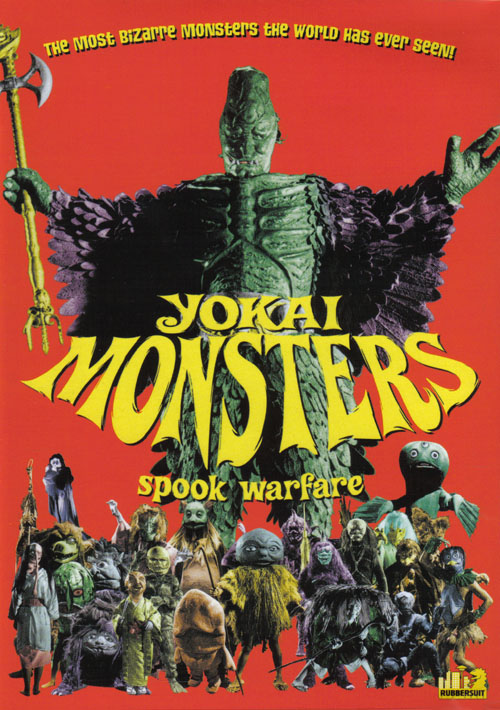
Thanks to movies like “The Great Yokai War,” and comics and books like “Nura: Rise of the Yokai Clanand “Yokai Attack!,” yokai as a word is slowly making its way into the English language. People are becoming aware of Japan’s legacy of magic and mystery. But, “yokai” is entering English with a meaning almost-but-not-quite the same as the Japanese meaning.

It is kind of like the word “manga”—in English, manga has come to mean “Japanese comics.” Exclusively. But in Japanese, manga just means … comics. All comics. Regardless of national origin. Iron Man? Manga. Mickey Mouse? Manga. Rex Morgan, M.D.? Manga. Tin Tin? Manga. And it doesn’t even specifically mean books (That would be “manga no hon.”) “Manga” can mean toys, movies, games … anything comic-related. It has a vast meaning beyond the limited scope of usage that we have given the word in English. I digress.

Of course, yokai can refer to Japan’s menagerie of monsters. All of the beasties and spirits—the baku, the kodama, the yuki onna, the kappa—all of these are yokai. I am as guilty as the next person for using yokai as a generic term for “Japanese monster.” It works. It fits. But that’s not the whole story.

Many other things are also yokai, things that are not creatures of any sort. Like the word manga, the Japanese usage of yokai has a much larger scope. It covers much more than just monsters.

(It is worth noting that “Nura: Rise of the Yokai Clan” isn’t called that in Japanese. The original title is “Nurarihyon no Mago” meaning “Nurarihyon’s Grandson.” The term “Yokai Clan” was tagged on to appeal to English readers.)

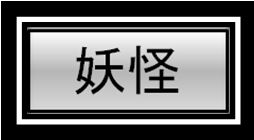
Breaking Down the Kanji – 妖怪

Like most Japanese words, the key to the meaning is in the kanji. So let’s start there.

Yokai uses two kanji;

  • (yo) which means “mysterious, bewitching, unearthly, weird.” It doesn’t really have a scary nuance to it, but more of the attraction to something beyond the normal. It can be used in words like yoka (妖花) meaning an ethereally beautiful flower, or ayashii (妖しい) meaning bewitching or charming.
  • (kai) which means “mystery, wonder, strange.” Kai has more of a sense of horror, or the bizarre. It is the same kanji used in kaidan (怪談) meaning “weird tales” and kaiki (怪奇) meaning “bizarre, strange, outrageous.”

Put those two together and you get yokai妖怪, with a direct translation along the lines of “something that is otherworldly and strange yet captivating and appealing.” But direct translation of kanji almost never gives the full picture.

So, What Does Yokai Really Mean?

I think a better translation would be “mysterious phenomena”—or even “Fortean phenomena” if that means anything to you. “Mysterious phenomena” is probably better.

Along with folkloric creatures, yokai can refer to things like strange weather, mysterious illnesses, optical illusions, weird fruit, etc … And yokai is not limited to Japan. In his Yokai Encyclopedias, comic artist/folklorist/genius Mizuki Shigeru covers things like the Moai statues on Easter Island, or bigfoot and the yeti, or vampires and ghouls, or rains of frogs. Yokai is a broad, sweeping term that can cover pretty much everything weird on Earth.

Here’s what Japanese Wikipedia has to say:

“Yokai as a term encompasses oni, obake, strange phenomenon, monsters, evil spirits of rivers and mountains, demons, goblins, apparitions, shape-changers, magic, ghosts, and mysterious occurrences. Yokai can either be legendary figures from Japanese folklore, or purely fictional creations with little or no history. There are many yokai that come from outside Japan, including strange creatures and phenomena from outer space. Anything that can not readily be understood or explained, anything mysterious and unconfirmed, can be a yokai.”

That great arbitrator of all things yokai, Mizuki Shigeru, further breaks down the word yokai into four separate categories:

  • Kaiju – 怪 (kai, mysterious) + 獣 (ju; beast), meaning “monster.” Most of Japan’s famous yokai are kaiju. Godzilla is a dai-kaiju, or “great monster.”
  • Choshizen – 超 (cho; super) + 自然 (shizen; natural), meaning the supernatural, including mysterious natural phenomena.
  • Henge – 変 (hen; strange) + 化(ge; to change, transform) , meaning shape-shifters like tanuki, foxes, and old cats.
  • Yurei -幽 (yu; dim) + 霊 (rei; spirit), meaning ghosts, and spirits of the dead.

So if you think in the classic biological classification model, then you would have something like this:

  • Bakeneko is a yokai > henge
  • Oiwa is a yokai > yurei
  • Bigfoot is a yokai > kaiju
  • Bermuda Triangle > yokai > choshizen

(Very) Brief History of the Word Yokai

Yokai is a pretty old world, pre-dating most of Japanese folkloric vocabulary. The oldest known use of “yokai” is from the 1st century text “Junshiden” (循史伝) where the author writes “The yokai was in the Imperial Court for a long time.” The term is used to describe a sense of unnatural anxiety and foreboding. It shows up again in 772, in “Shoku Nihongi” (続日本紀) where a ritual cleansing of the palace is recommended to “clear away the yokai.” It isn’t used in the sense of any particular bad creature, but just accumulated “bad juju” that might be clinging to the palace.

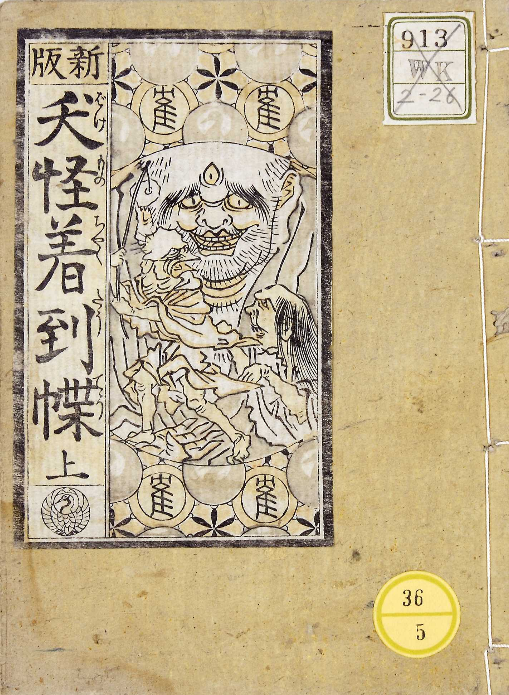
Yokai as a term for Japan’s folkloric beasts didn’t really appear until the Edo period, with the publication of “Yokai Chakutocho” (夭怪着到牒 ), a yokai bestiary of the kind still familiar today. Sharp-eyed readers ( or those who know Japanese) will see that a different set of kanji was used; 夭 (yo, calamity, disaster ) + 怪 (kai). That kanji has a much more distinct menacing feel to it.

Texts from the Edo period also distinguish between types of yokai, such as “strange natural phenomenon” or “strange living things.”  Also during the Edo period, when Japan began to have contact with other cultures, books began to be published of accounts of “Yokai of the West.”

Now you Know What Yokai Means!

Of course, this is the quick and dirty version.  Whole books can and have been written on yokai, on the history of yokai, on the evolution and social meaning, etc … At least now when you want to start diving into things like that, you will have a clearer understanding of what the word yokai actually means!

Further Reading:

Secrets of the Yokai  – Types of Yokai

Secrets of the Yokai II

How Do You Say Ghost in Japanese?

Translator’s Note:

I wrote this article mainly to clear up some misapprehensions.  More and more I see people refer to yokai as if it meant some sort of tribe of Japanese monsters.   And while that isn’t exactly incorrect, it is a simplification. So here is a little deeper dive for yokai fans.

Baku – The Dream Eater

Translated from Mizuki Shigeru’s Mujara and Japanese Wikipedia

When a child in Japan wakes shaking from a nightmare, she knows what to do. Hugging her face in her pillow, she whispers three times “Baku-san, come eat my dream. Baku-san, come eat my dream. Baku-san, come eat my dream.” If her request is granted, the monstrous baku will come into her room and suck the bad dream away. But the baku cannot be summoned without caution. A too-hungry baku might not be satiated with a single dream, and might suck away her hopes and ambitions along with it, leaving her hollow.

What is a Baku?

Baku are classic chimera; the body of a bear, the nose of an elephant, the feet of a tiger, the tail of an ox, and the eyes of a rhinoceros. One legend says that when the gods were finished creating the animals, they took all of the odds and ends lying around and put them together to make the baku.

According to Japanese legend, baku are the eaters of bad dreams. They are a talismanic figure, that people pray to at night to come and suck away nightmares so that they may never be seen again. But there is a darker side to the baku; some say that baku eat all dreams, not only nightmares. This includes dreams of aspiration, dreams of your future, and dreams of hope.

Is the Baku Real?

While they are wildly stylized, baku resemble the Asian tapir. And in fact, in Japanese they share the same name and kanji (獏). The baku is not alone in this; the word kirin is not only Japanese for giraffe but also a mythical Chinese monster.

Which came first—the legend or the animal—is hidden in the past, with no solid agreement on either side. Many say that the two are unconnected, and that the similar appearance is pure coincidence, with the animal being named after the legend. Some say a wayward sailor drifted to Malaysia, and came back with stories of a massive creature that was transformed by legend.

Either way, the legend is old in his book “Ancient Chinese Gods and Beasts,” Kyoto University professor Hayashi Minao points to ancient bronze ware and other artifacts inscribed with images of the mythical baku. He postulated that some creature like the Asian tapir might have existed in China at sometime, but has since gone extinct.

Baku are often confused with another Chinese legendary animal, the hakutaku (called a bai ze in Chinese). In fact, at Gobyakukan-ji temple in Tokyo, there is a statue called the Baku King, which was originally a statue of a hakutaku.

Is the Baku a Yokai?

A complicated question, that depends on how broad your definition of a yokai is. It isn’t a yokai in the sense of fantasy creatures like the nure onago or bakeneko. It is more of a sacred animal, more associated with gods than monsters. Mizuki Shigeru uses the broadest possible definition of yokai, meaning anything mysterious from Bigfoot to rains of frogs, by which the baku definitely qualifies.

The History and Legends of the Baku

Like many folkloric creatures, baku have changed over the centuries. In the oldest Chinese legends, baku were hunted for their pelts. It was said that using a blanket made from a baku was a talisman against illness and the malice of evil spirits. Due to a lack of available baku pelts, this eventually changed to where putting an image of a baku over the bed would afford you equal protection. During the Tang dynasty( 618 – 907), folding screens decorated with baku were a popular item.

Somehow, the legend of the baku was transmitted to Japan, where the beast became associated with the dream eating that it is best known for today. The Tang period book Torokuten (Six Stories of the Tang dynasty) also tells of a sacred animal called a bakuki that eats dreams, and it is likely that the two were merged into a single legend.

The baku legend as a dream-eater has stayed consistent since adopted by Japan. There have been various ways of summoning the baku. In Fukushima it is said that if, after awaking from a bad dream, you say “I give this dream to the baku,” then that dream will never trouble you again. In other prefectures, you repeat “Baku-san, come eat my dream” three times in a row to summon to baku to come and eat your nightmares.

During the Muromachi period (1337 to 1573) in Japan, it became popular for people on their death bed to hold an image of a baku as a talisman against evil spirits. They also became associated with the fantastical Treasure Galley, which often had a baku painted on its sails. During the Edo period (1603 to 1868), pillows were sold in the shape of baku, said to protect the sleeper from bad dreams.


Baku in Modern Japan

While many yokai and legendary creatures have faded until they live only in the memory of academics and comic artists, baku are still a popular figure in modern Japan. The baku appears in many modern animation and comic books, although in appearance they look more and more like authentic tapir, and less and less like the folkloric chimera.

Shirime – Eyeball Butt

Translated from Mizuki Shigeru’s Mujara

To learn much more about Japanese Ghosts, check out my book Yurei: The Japanese Ghost

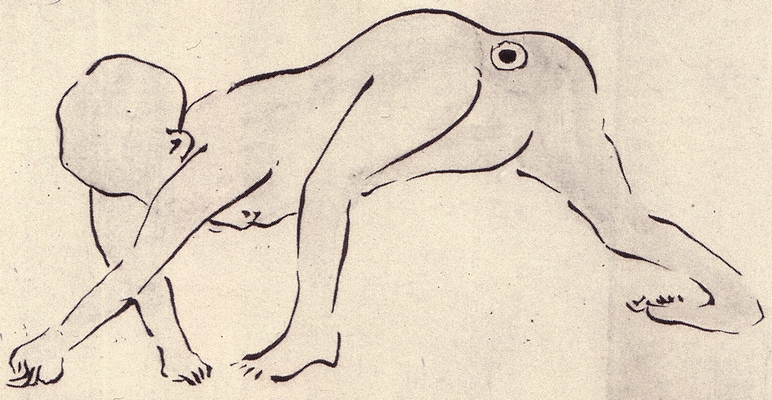
In old times, this was a yokai found on the roads leading to Kyoto. The legend goes that late at night, a samurai walking down the street when a man in a kimono stepped in to block his path and said “Excuse me … just a moment of your time … “ The samurai readied himself for an attack, and shouted back “What do you want?”

The man suddenly shed his kimono and stood stark naked. He then bent over and showed his ass to the samurai, which had a single, huge eye. When the eye opened, it shown with a bright light. The samurai screamed with fright and fled from the mysterious monster.

The poet and artist Buzon included the shirime in his collection “Buzon’s Yokai Picture Scroll” (蕪村妖怪絵巻), which is the only known source of the story. It is a variation of the nopperabo legend, and the shirime is considered to be a type of nopperabo.

Regular nopperabo surprise people by suddenly showing them a featureless face, smooth as an egg. The shimire species of nopperable can give a double surprise, first showing the featureless face then bending over and exposing the eyeball butt. The shirime doesn’t have any bad intentions or evil purpose. It just thinks it is fun to surprise people.

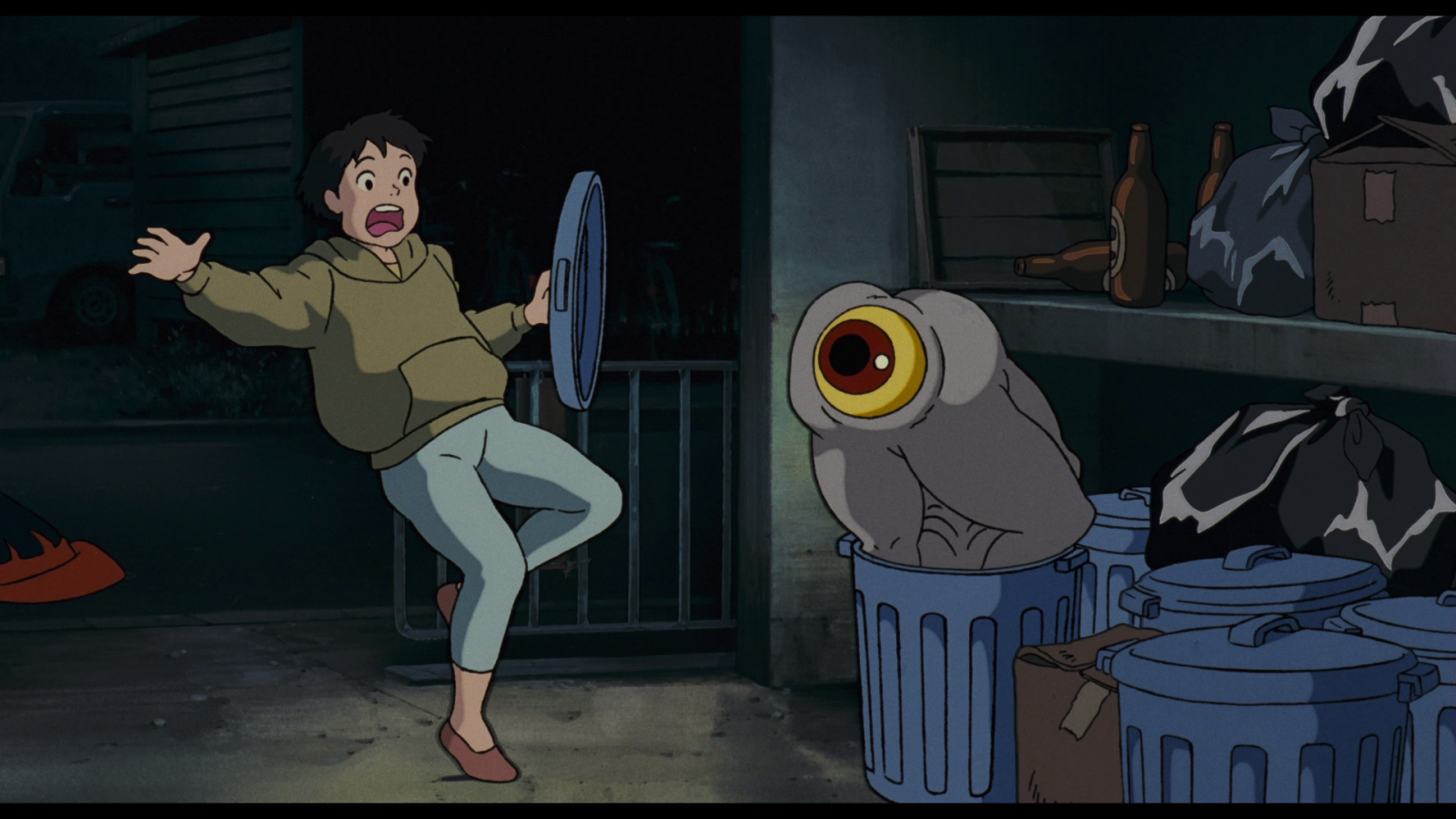
Shirime Pom Poko

Shrimime’s Cameo in Pom PokoTranslator’s Note:

The shirime’s name is pretty self-explanatory; 尻 (shiri – butt)目(me – eye). The term can also be used to mean to look down on someone, or to look askance at.

Like many of this type of yokai, there isn’t much more to the story than a mischievous creature that likes to startle people. Japan has a high tolerance for body humor and grotesqueness, and the shirime is a good example of this.

Further Reading:

Check out other butt-related tales from hyakumonogatari.com:

Kappa to Shirikodama – Kappa and the Small Anus Ball

Kodama – The Tree Spirit

Sourced and translated from Kaii Yokai Densho Database, Japanese Wikipedia, Yokai Jiten, Nihon Kokugo Dai-ten, and Other Sources

If a tree falls in the forest, and someone hears it, is that the plaintive cry of a kodama? Because that is what ancient, tree-worshipping Japanese people thought.

The Japanese have always known that some trees were special. For whatever reason—maybe because of an interestingly shaped trunk, or a sequence of knots resembling a human face, or just a certain sense of awe—some trees were identified as being the abodes of spirits. Depending on where you lived, these spirits went by many names. But the most common term, the one that is still used today, is kodama.

What does kodama mean?

Kodama is a very old belief, and a very old word. It was spoken long before Japan had a written language, and over the centuries there have been three different kanji used to write kodama.

The oldest, 古多万, is ambiguous to say the least. The word breaks down into 古 – (ko; old) – 多- (da; many) – 万 (ma; 10,000). Because ancient Japanese had no writing system, when the Chinese writing system was adopted kanji characters were often selected for sound rather than meaning. Unrelated symbols were jammed together to approximate the pronunciation of existing Japanese words. This is the most likely explanation for the use of 古多万.

But this combination is unsatisfying, and in later years 木魂 (木 ; ko; tree – 魂 ; dama; soul) was adopted as well as木魅(木 ; ko; tree – 魅 ; dama; soul), and now in modern times木霊 (木 ; ko; tree) – 霊 ; dama; spirit) tends to be used. There is little difference between木魂, 木魅, or 木霊, all being variations of the term “tree spirit.”

Another kanji used for kodama, 谺, also means echo. And if you read below you will find out why.

The Legends of Kodama
Mizuki_Shigeru_Kodama

Along with the kanji , what exactly a kodama is has changed over the centuries, from nature gods to goblin spirits.

In ancient times, kodama were said to be kami, nature dieties that dwelled in trees. Some believed that kodama were not linked to a single tree but could move nimbly through the forest, traveling freely from tree to tree.

Still others believed that kodama were rooted like the trees themselves, or in fact looked no different from other trees in the forest. Woe betide any unwary woodsman who took an axe to what looked like a regular tree, only to draw blood as he chopped into a kodama. A kodama’s curse was something to be feared.

But they were also a sound. Echoes that reverberated through mountains and valleys were said to be kodama. The sound of a tree crashing in the woods was also said to be the plaintive cry of a kodama. (In modern times this mountain echo is associated with the yokai yamabiko and not with kodama).

Whatever form they took, kodama were said to be possessed of supernatural power, that could either be a blessing or a curse. Kodama that were properly worshipped and honored would protect houses and villages. Kodama that were mistreated or disrespected brought down powerful curses.

The History of Kodama
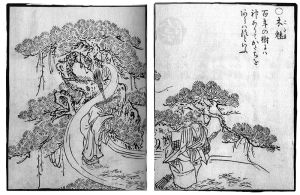
The first known mention of tree spirits is in Japan’s oldest known book, the Kojiki (Record of Thing’s Past) that talks about the tree god Wakunochi-no-kami, second born of the godling brood of Izanagi and Izanami.

The oldest, specific known use of the term kodama comes from the Heian period, in the book Wamuryorui Jyusho (和名類聚抄; Japanese Names for Things; written 931 – 938 CE). Wamuryorui Jyusho was a dictionary showing the appropriate kanji for Japanese words, and listed古多万 as the Japanese word for spirits of the trees. Another Heian era book, Genji Monogatari (源氏物語; The Tale of Genji), uses木魂 to describe kodama as sort of tree-dwelling goblin. Genji Monogatari also uses the phrase “either oni or kami or kitsune or kodama,” showing that these four spirits were thought to be separate entities.

Around the Edo period, kodama lost their rank as gods of the forest and were included as just one of Japan’s ubiquitous yokai. Kodama became humanized as well—there are stories of kodama falling in love with humans and taking human shape in order to marry their beloved.

Kodama Across Japan

In Aogashima, Izu Islands, people place small shrines at the base of cryptomeria (Japanese cedar) trees and still worship and pray to them. This is said to be the remainders of a nature-worshiping religion that once dominated.

In Mitsune village, in Hachijō-jima, they still have a festival every year giving thanks and respect to “kidama-san” or “kodama-san,” hoping for forgiveness and blessing when they cut down trees for the logging industry.

In Okinawa, they call the tree spirit kinushi. At night, if you hear the sound of a falling tree it is said to be the cry of a kinushi, and Okinawa’s tree-dwelling famous yokai kijimuna is thought to be a descendant of these ancient kinushi tree spirits.

Appearance of Kodama

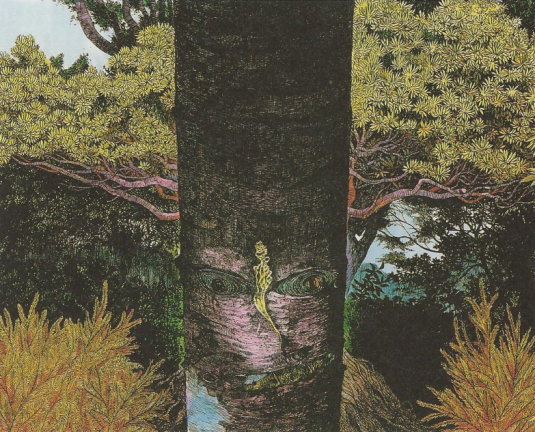
No one really agrees what kodama look like. In ancient legends they are either invisible or indistinguishable from regular trees. Toriyama Sekian, who has set the standard for the appearance of many creatures of Japanese folklore, drew kodama as an ancient man or woman standing near a tree in his famous Gazu Hyakki Yagyō (画図百鬼夜行; The Illustrated Night Parade of a Hundred Demons).

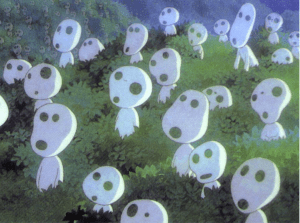
Miyazaki Hayao used kodama extensively in his film Mononoke Hime (Princess Mononoke) and illustrated kodama as dual-color bobble-heads. Modern interpretations are wildly various, showing kodama as human young and old, or small nature sprites borrowing from European pagan traditions, or just cute animated characters.

Clearly, they are open for interpretation.

Kodama: The Game
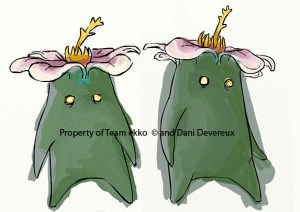
This version of kodama comes from a Kodama game being developed by Dan Tsukasa, that I am helping out with as “yokai advisor.”

Here is Dan’s blurb for the game:

——————————————————-
Kodama is a game set in Japan during the time of Yokai. A nameless Kodama journeys across Japan to find his fellow Kodama and return them to the forest in order to protect it from a powerful Yokai. During his travels Kodama must use his abilities as a tree spirit to overcome countless obstacles, using nothing but the elements around him, he must traverse dangerous swamps, caverns and even Jigoku itself in order to protect the Kodama Forest. Kodama is able to use the world around him to his advantage, using his unique tree spirit abilities he is able to float on a breeze, grow to reach new heights and perform other abilities only known to a Kodama.

Kodama is a puzzle platformer with a few unique twists & a never before seen system known as the ‘Mori System’, the game features over 30 unique Yokai, 12 different locations and a wealth of information concerning the featuring Yokai themselves.

If I had to describe the ‘feeling’ of Kodama in a few short words, I’d say it was more of a ‘stop, smell the roses and take in the magnificent view’ type of game.
——————————————————-

You can find out more about the very cook Kodama game (along with some stunning art) at the Kodama Devlog.

Translator’s Note:

Kodama is the latest in my magical tree series of translations. Kodama are slightly different from my previous translation Ki no Kami, in that they are mostly considered to be lower-level tree spirits that actual gods. The Ki no Kami come down from heaven to inhabit the trees, whereas the kodama are the spirits of the trees themselves. And then there are the moidon, which are awakened trees with a soul like any human.

Thanks to Miyazaki, kodama are well-known in Japan (unlike some of the obscure folklore on familiar to true yokai lovers), although most would associate kodama with the white bobble-head from Mononoke Hime.

Further Reading:

For more magical tree stories, check out:

Ki no Kami – The God in the Tree

Moidon – The Lords of the Forest

Jinmenju – The Human Face Tree

Enju no Jashin – The Evil God in the Pagoda Tree

Ochiba Naki Shii – The Chinkapin Tree of Unfallen Leaves

Previous Older Entries Next Newer Entries

Copyright notification

All translations and other writing on this website were created by Zack Davisson and are copyright to him.

Copyright notification

In accessing these web pages, you agree that any downloading of content is for personal, non-commercial reference only.

No part of this web site may be reproduced or transmitted in any form or by any means, electronic, mechanical, photocopying, recording or otherwise, without prior permission of Zack Davisson.

Copyright notification

For rights clearance please contact Zack at:

zack.davisson (at) gmail.com

Thank you.