The Ghost of Oyuki

Maruyama_Okyo_The_Ghost_of_Oyuki

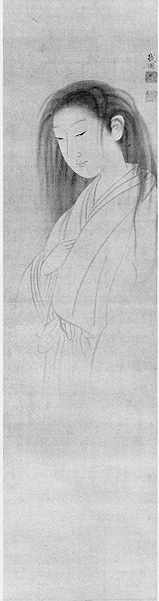
Maruyama Ōkyo opened his eyes from a fitful sleep and saw a dead woman. She was young. Beautiful. And pale. Unnaturally drained of color, her bloodless skin peeked from her loose, bone-white burial kimono. Her bleached appearance was contrasted only by the thin slits of her black eyes, and by the long, black hair that hung disheveled across her shoulders. She had no feet.

What is The Ghost of Oyuki?

The Ghost of Oyuki is without a doubt the most famous and influential Japanese ghost painting.  It is the template for the entire country’s idea of “what a ghost looks like.” The white-faced, black-haired girl in the white kimono has roots in tradition, but this image–particularly the lack of feet–comes from the brush of Maruyama Ōkyo.

Although the English title is The Ghost of Oyuki, the actual Japanese title is Yūreizu: Oyuki no Maboroshi (幽霊図(お雪の幻), which translates as Portrait of a Yurei: The Vision of Oyuki. According to a note on the scroll box, put there sometime by a former owner named Shimizu, the young artist had a mistress called Oyuki who worked as a geisha at the Tominaga geisha house in Ōtsu city in the province of Ōmi, modern-day Shiga prefecture.  Oyuki had died young, how or when the note does not say; and Ōkyo mourned her deeply.  Perhaps too deeply.

One night Maruyama awoke  and saw Oyuki hovering at the foot of his bed. She stayed there for a moment and disappeared. When she was gone, Maruyama sprang from his bed and painted Oyuki exactly has she had appeared before him.

Maruyama had a reputation as the ultimate naturalist painter—if he painted something, you could trust that he had seen it.  Because of his reputation, when Maruyama appeared with his painting and his story, the people of Japan had no doubt that this was what a yurei actually looked like. And they have been honoring that image ever since.

The Ghost of Oyuki Yomihon

The story of Maruyama Okyo and the Ghost of Oyuki is told in my yomihon chapbook The Ghost of Oyuki available from Chin Music Press.

The Ghost of Oyuki is not an actual book, but a piece of “book art” commissioned from Mercuria Press in Portland, OR to support my upcoming book Yurei: The Japanese Ghost. The Ghost of Oyuki is letterpress printed and handbound in the style of an Edo period yomihon, and was produced in a limited edition of 100.

You can buy The Ghost of Oyuki exclusively from Chin Music Press. It can be ordered here.

Further Reading:

For more Yurei-zu, check out:

Ubume-zu – Portrait of an Ubume

Yurei-zu: A Portrait of a Yurei, a Japanese Ghost

Hokusai’s Manga Yurei

More Hokusai Manga Yurei

Ijuu – The Strange Beast

Mizuki Shigeru Ijuu Strange Beast

Translated and Sourced from Mizuki Shigeru’s Mujyara, Kaii Yokai Densho Database, Japanese Wikipedia, and Other Sources

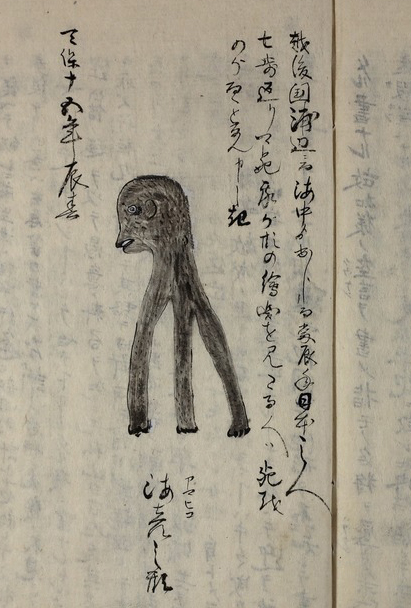
If you are wandering through the forests of Japan and happen across a beast that looks like a strange blend of monkey and bear, don’t be scared. Just offer to split your lunch with it and the creature will most likely repay you by carrying your heavy load. At least that’s the story of the Ijuu, the strange beast.

What Does Ijuu Mean?

Whoever named the Ijuu wasn’t feeling particularly imaginative. Ijuu has two kanji making up its name, 異 (I; strange, mysterious) + 獣 (Juu; beast, creature). The name translates literally as “strange beast.”

The Tale of the Ijuu

There is only one story of the Ijuu, and it comes from Suzuki Bokushi’s Edo period book Hokuetsuseppu (北越雪譜; Snow Stories of North Etsu Province, 1837).

Suzuki Bokushi Iju Strange Beast

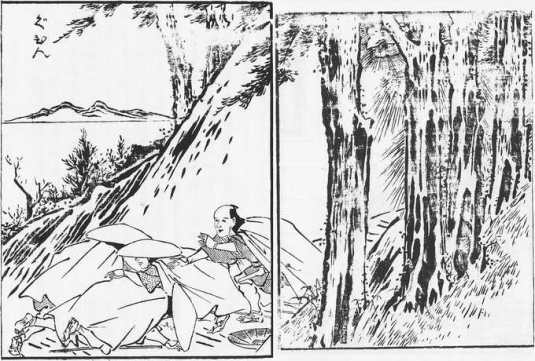
Long ago, in Echigo province (modern day Niigata prefecture), a porter named Takesuke was engaged in hauling a heavy load over a mountain pass to a faraway town. He had gone about 7 shaku (28 kilometers), when he became exhausted and hungry. Takesuke leaned his backpack against a tree, then sat down and rested against that same tree, unpacking his lunch and preparing to tuck in.

Before Takesuke could get a bite into his mouth, the thick bamboo of the forest was pushed aside, and an incredible monster stepped into sight. It was larger than a human, and looked like some mix between a monkey and a bear. It had long tufts of hair on its head, and fur covering its entire body.

Instead of panicking, the porter calmly looked at the strange beast. It looked hungry, Takesuke decided. He then casually split his lunch, offering the animal half. The creature was delighted, and accepted the food and ate it with vigor.

With the meal done, the strange beast leapt to its feel and shouldered Takesuke’s burden as if it weighted nothing at all. The porter walked ahead down the mountain trail, while the creature happily ambled along behind. When they got within sight of the porter’s definition, the creature took off the heavy backpack, set it down carefully, and scampered back into the forest.

It was never seen again.

Sakaiminato_Mizuki_Shigeru_Road_Ijyu_Statue_1

Translator’s Note:

Ijyuu is another one-shot yokai with only one appearance, and another translation for reader Michael Goldstein of Yokai Composed.

For as obscure and limited the Ijyuu is, it still got one of the coveted spots as a bronze statue on Mizuki Shigeru Road in Sakaiminato, Tottori prefecture.

Further Reading:

For more mysterious monsters, check out:

Shirime – Eyeball Butt

Onikuma – The Demon Bear

The Kappa of Mikawa-cho

Onikuma – Demon Bear

Onikuma Mizuki Shigeru

Translated and Sourced from Mizuki Shigeru’s Mujyara, Kaii Yokai Densho Database, Japanese Wikipedia, and Other Sources

What walks on its hind legs like a human, is covered in fur, and hauls off horses in the middle of the night to eat? If you answered Onikuma, the Demon Bear, then you are definitely up on your Japanese yokai.

What Does Onikuma mean?

The name onikuma is broken down into two kanji 鬼(oni; demon, ogre) + 熊(kuma; bear). It’s an unusual name for a yokai of this type—the vast majority of magical animal yokai use some variation of bake-, like the bakekujira, or bakeneko. I have no idea why this isn’t called a bakeguma, but it just goes to show that folklore doesn’t follow any rules. A monster bear comes tromping through your town, you get to name it whatever you please.

In this case the word “oni” doesn’t mean that this is a half-oni bear. It’s just used as a descriptive term, meaning this is one big, tough bear.

The Legend of the Onikuma

Shunsen Oniguma Ehon Monogatari

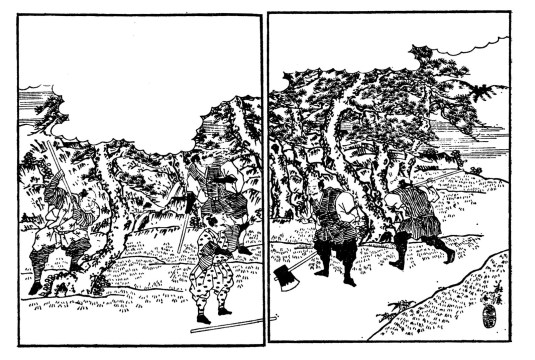
Onikuma come from Kiso province (modern day Nagano prefecture). They are a fairly obscure yokai, and one of the few known depictions of them is from the Ehon Hyakumonogatari (1841). Like almost all magical animal yokai, the onikuma is a bear that has lived an exceptionally long life and has transformed into a yokai.

Onikuma have no special powers other than walking on their hind legs like humans, and being exceptionally strong. Legends say an onikuma can move rocks that 10 men together can’t push. There are still some rocks in odd places around Nagano prefecture that are rumored to have been put there by onikuma, since they are far too large for a group of men to manage.

Their favorite food is horse. They are rarely seen, but sometimes sneak into villages at night to carry off horses by their forelegs, which they then devour in their caves.

Hunting the Onikuma

A legend says that a group of villagers once hunted and killed an onikuma. They were sick of their horses being carried off, and tracked the onikuma back to its cave lair. In preparation, they carved long spears from massive trees, and placed fresh meat as bait in front of the onikuma’s cave. When it came out for its supper, the villagers attacked with their long spears, killing it. They took the carcass back to their village where they stretched and tanned the hide. It was said to be big enough to cover the floor of an entire large room.

Henge or Kaiju?

In Hokkaido, instead of transformed animals the term “onikuma” is used for giant bears who have killed and eaten humans. In his book Mujyara, Mizuki Shigeru makes the case that perhaps the onikuma is not a henge-type transforming animal like bakeneko, but just a monstrous bear and should be considered a kaiju (monster) –type yokai.

Translator’s Note:

Onikuma comes by request for reader Michael Goldstein who runs the blog Yokai Composed. It’s one of those yokai where there really isn’t too much to tell—it’s a giant, horse-eating bear. There are quite a few yokai like that, where there is only one story and not much other folklore. Still, demon bears are always cool.

Further Reading:

For more magical animal tales, check out:

Bakeneko – The Changing Cat

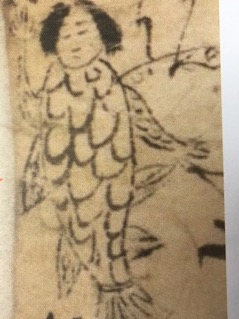
Bakekujira and Japan’s Whale Cults

Iriomote Oyamaneko – The Iriomote Great Mountain Cat

Yokai Chat at Obakeforums.com!

Obakemono_Forums

Once upon a time the Obakemono Project was the coolest place on the internet to chat with like-minded folks about yurei, yokai, and other Asian and world folklore monsters. Sadly, the owner lost interest in the site and didn’t designate any other Admins before abandoning it.  The site became overrun with SpamBots, and–while a few of us fought valiantly to keep the site clean–we lost.

Like a spunky band in a zombie show, eventually we had to give up our no-longer safe haven and strike out for something new.

After a few months of testing, fiddling, and building up our own walls and fortifications to ensure the SpamBot horde wouldn’t destroy our new home, we are proud to announce the new coolest place on the internet to chat with like-minded folks about–well, you know.

Welcome to Obake Forums !!!!

There you can hang out and chat yokai, post questions, get answers, give answers, and do all of that cool forum stuff with some of the leading English-language experts on yokai and Asian folklore. People like Matt Alt (Yokai Attack!: The Japanese Monster Survival Guide, Yurei Attack!: The Japanese Ghost Survival Guide), Mathew Meyer (The Night Parade of One Hundred Demons: a Field Guide to Japanese Yokai), and–humbly–myself, Zack Davisson (Showa 1926-1939: A History of Japan, Kitaro, upcoming Yurei: The Japanese Ghost).

Some come check it out. Register. And start chatting.


Mizuki Shigeru in Rabaul

Mizuki Shigeru in Rapaul

Translated and Sourced from Showa: A History of Japan, Remembering the war in New Guinea, and Other Sources

Mizuki Shigeru is Japan’s most famous living manga artist, and the greatest modern scholar and writer on Japanese folklore and yokai. But he wouldn’t be alive if it weren’t for a small tribe of Tolai villagers on Rabaul, on the island of New Guinea.

Mizuki Shigeru in WWII

During WWII, like many young men Mizuki Shigeru was drafted into the Army. As great an artist as Mizuki Shigeru is, he was a very poor soldier. And this is what probably saved his life. Because of his poor abilities as a soldier, he was initially assigned to a non-combat position in the bugle corp. But he hated playing the bugle, and in what he describes as one of the worst mistakes of his life, requested a transfer. He was sent to the front in Rabaul as a private in the 229th Infantry Regiment of the 38th Division.

Mizuki Shigeru Soldier

He was constantly being smacked around by his superior officers for slacking off, and being sent on guard duty as punishment. One night when he was stationed far away on guard duty, the Allies attacked and his entire unit was wiped out. Only Mizuki Shigeru survived. Alone and on the run, he had his first encounter with the natives of New Guinea. And it wasn’t a friendly encounter. He was attacked by villagers who most likely planned to turn him into the Allies.

After a harrowing escape, he made his way to a Japanese base, where he was treated as a deserter. Assigned to a unit for a Suicide Charge, his life was saved again by a terrifying case of malaria. While being treated, his hospital was bombed and he lost his arm.

Mizuki Shigeru and Topetoro

While he was recovering from malaria and his lost limb, Mizuki Shigeru would often go for walks, dodging Allied strafing attacks. One walk he found a Tolai village tribe. They were cooking dinner, and Mizuki was so hungry he just sat down and started eating with them.

Here’s how Mizuki described it himself in an interview.

“Villagers used to live in a nice spot on top of the hills. Australian [planes] did not attack their villages. I used to visit their villages quite often. But when I went to their place, [Allied] planes used to appear in the sky. Then the villagers told me to go back to my camp. In fact, when I was walking alone on the trail, I was often strafed by the planes. I was wondering why they shot at me. They said that even if only one man was walking, the pilot could see him. They shot at me even when I was alone. Then I tried to be careful not to attract their attention. But they did not shoot villagers. So Japanese were hiding in holes. The Japanese killed a village chieftain, so villagers did not like us. But personally, I made good friends with them. When I first visited a village, I saw an old woman and I smiled at her, and she smiled back. She welcomed me. But I think now that she just sympathized with me, because I had only one arm. Now I think she just wanted to give me some food or something. Her name was Ikarian. “

Mizuki continued visiting Ikarian and her children, the boy Topetoro and the girl Epupe. He loved their lifestyle, their connection with the spirits and nature, and most of all their Shin Shin dance rituals. With the Tolai people, he found the yokai paradise he always dreamed of.

Rapaul Shinshin Dance

The Tolai accepted Mizuki as one of their own. They called him “Paul,” after one of the names in the Bible left behind by Christian missionaries, and he referred to them as “The People of the Forest.” The Tolai saved his life, keeping him supplied with food to make his body strong during bouts of malaria that killed his fellow soldiers. Epupe in particular loved Mizuki, and even tried to interfere in one of the many beatings Mizuki received from his superior officers. “Paul is Number One!” she shouted angrily in her broken English, not realizing how lowly Mizuki actually was amongst his own people.

Mizuki Shigeru Rapaul Showa Shi

He relationship with the Tolai was so close he almost deserted at the end of the war to go and live with them. Ikarian, Topetoro, and Epupe made him a garden patch, and were planning to build him a house.

“I started visiting her village more often, and I became like a member of her family. They looked after me well. They gave me fruit, and when I was sick in bed with malaria, they came to see me in the camp. When the war finished, they told me to run away from the army and come to live in their village. They make gardens, and their gardens are ready for harvesting very quickly. They told me that they would make a garden for me and build a house for me. They said they would look after me. So they told me to live with them. Ikarian told me to escape from the army. They were so keen. As I used to go to their village many times and had seen their life style, which looked very easy, much easier than the life in Japan. I used to think that village life was nice. And they were so keen to persuade me to escape from the army. I thought that it was not a bad idea. I thought I would not have to work so much. I could stay in bed all the time. I seriously thought about leaving the army there.”

Mizuki Shigeru Rapaul Shinshin Dance 2

Mizuki seriously considered their offer, and consulted with an army surgeon.

“I talked with an army surgeon. I sought his advice, explaining about the villagers’ invitation. He was very surprised. He was too annoyed to answer my question, but told me that I should see my parents in Japan first; then I could decide what to do. I followed his advice and went back to Japan.”

Along with visiting his parents, the surgeon told Mizuki Shigeru that his arm was not properly healed. The battlefield amputation was flawed (actually performed by a dentist), and he would need to go to a proper hospital in Japan or he could die. Mizuki left his Tolai family with a promise to return in seven years and live out his life in New Guinea. But other things got in the way of his promise.

“But when I went back, Japan was so chaotic under the rule of MacArthur. I had no time to think about returning to Rabaul. I had to live in Japan.”

Mizuki didn’t keep his promise. Life in post-war Japan was hard, and success constantly eluded him. He spent months in a veteran’s hospital waiting for surgery for his arm, and tried his hand at many trades from black market rice dealer to fish monger. Returning to his true love—art—he got work as a kamishibai artist and later transitioned to comic books. After twenty years in Japan, and many failures, Mizuki achieved success as a manga artist.

When his life and finances were finally stable, Mizuki returned to Rabaul and found his old friend Topetoro. His Tolai family had always been waiting for him, and kept his garden and house exactly as promised. Mizuki’s return was a cause for celebration, and the Tolai again performed the Shin Shin dance for him that he so loved.

While Mizuki never did move to live amongst the Tolai, over the following years he would return many times. The boy Topetoro became his lifelong friend.

The Rabaul Comics

Mizuki Shigeru Topepo Rapaul

Mizuki Shigeru has always treasured his time among the Tolai, and written several comics about Rabaul. Some of these are war comics, like Onward Towards Our Noble Deaths, An Account of the War in Rabaul by Mizuki Shigeru (Mizuki Shigeru no Rabauru Senki), and the touching Account of War from Father to Daughter (Mizuki Shigeru no Musume ni Kataru Otosan no Senki) that he wrote for his daughter Etsuko.

A film version was made of his time during the war in Rabaul, called The Noble Death Witnessed by Kitaro (Kitaro Ga Mita Gyokusai).

Mizuki Shigeru Rapaul Movie

He honored his friendship with Topetoro with the comic Fifty Years with Topetoro (Topetoro Tono 50 Nen)and wrote an extensive account of his time on Rabaul—both during the war and after—in Showa: A History of Japan.

Artifacts of New Guinea

Mizuki Shigeru Rapaul Mask Collectionjpg

Mizuki Shigeru not only loved the people and lifestyle, he also loved the yokai of New Guinea. Over the years he compiled a vast collection of New Guinea masks, statues, and artifacts. He made recordings of the songs and dances of the Tolai, and displayed his collection in his home in what was called the Natural History Room by his family. When things were stressful at work, Mizuki would go into his room, play the sounds of New Guinea and drift away in his mind to life among the Tolai, and his friend Topetoro.

Many of Mizuki’s New Guinea artifacts are now displayed in the Mizuki Shigeru Memorial Museum in his hometown of Sakaiminato, Tottori.

In 2003, the people of New Guinea honored Mizuki Shigeru’s long relationship with the Tolai by inaugurating Mizuki Shigeru Road in Rabaul.

Preorder Showa: A History of Japan

You can read all about Mizuki Shigeru’s adventures on Rabaul and life amongst the Tolai—and much, much more—in Showa: A History of Japan.

The first volume is available for pre-order on amazon.com (and probably other places as well).

Showa 1926-1939: A History of Japan

Translator’s Note:

Mizuki Shigeru’s adventures amongst the Tolai was one of my favorite parts of translating Showa: A History of Japan. Mizuki’s time on Rabaul is both terrifying and touching, and I often found myself getting a bit weepy mid-translation because I was so caught up in the story. It’s pretty powerful.

I was inspired to write this when I found this picture of Mizuki in New Guinea on this blog— the first photograph of this time I have ever seen. Maybe the only one publically available. I looked around but couldn’t find any others. I wanted to post the picture, and figured I better write an article to give it context for those who haven’t yet read Showa: A History of Japan.

Previous Older Entries

Copyright notification

All translations and other writing on this website were created by Zack Davisson and are copyright to him.

Copyright notification

In accessing these web pages, you agree that any downloading of content is for personal, non-commercial reference only.

No part of this web site may be reproduced or transmitted in any form or by any means, electronic, mechanical, photocopying, recording or otherwise, without prior permission of Zack Davisson.

Copyright notification

For rights clearance please contact Zack at:

zack.davisson (at) gmail.com

Thank you.

Follow

Get every new post delivered to your Inbox.

Join 310 other followers

%d bloggers like this: