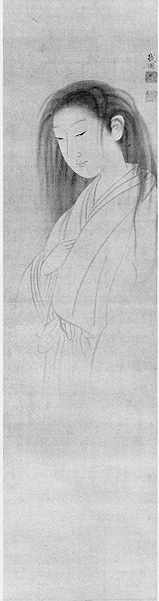
The Black Hair

Translated from Konjaku Monogatari

There was a samurai living in poverty in the capitol, who was suddenly summoned to the service of a Lord of a distant land.  The samurai eagerly accepted the offer, but abandoned his wife of many years in favor of taking another woman he desired along with him.

When his responsibilities to the Lord had finished, the samurai returned to the capitol and found himself longing for his old wife.  He went that night to the old house where they had once lived.  It was midnight, and the full autumn moon bathed the home in light.  The gate was open, and the samurai entered his old dwelling only to find his much-missed wife sitting silently by herself.

She showed neither anger nor resentment towards her husband for his ill-use of her, but instead offered him greetings and welcomed him back after his long time away.

The samurai, overcome with emotion, swore to his wife that they would live together from now on and never be parted.  Pleased by the happiness this brought to his wife’s face, the samurai embraced her and they held each other until sleep took them.

The samurai was woken in the morning by the bright morning sun that battered the house more harshly than had the previous autumn moon.  He looked about himself, and found that instead of embracing his wife he was holding a dry corpse, nothing but bits of flesh clinging to bone wrapped in long black hair.

He leapt to his feet and rushed into the neighbors house;

“What happened to the woman who lived next door?”

“Her?  She was abandoned by her husband long ago, and died of an illness brought on by her sorrow. It was just this summer that she died. Because there was no one to care for her or give her a funeral, her body lays still where she died.”

The Fudaraku Pure Land

Translated from Kitaro no Tengoku to Jigoku

Mt. Fudaraku is the home of the bodhisattva Kannon.  There also is found the beautiful garden known as the Fudaraku Pure Land.

The Fudaraku Pure Land can be reached by a small boat called the utsubo-bune.   That boat primarily departs from Kumano beach in Kishu province (modern-day Wakayama prefecture).   The utsubo-bune has no windows, and instead has three or four tori gates where windows would be.  Passengers bring fruits and nuts for the journey, and the utsubo-bune has pegs on which to hang them. 

The utsubo-bune goes with the North wind, and travels onward until it reaches the Fudaraku Pure Land.

The Root Country

Translated from Kitaro no Tengoku to Jigoku

There are many different legends about what is called the Root Country (Ne no Kuni), and no one really knows for sure what the original concept was. 

According to one story, the Root Country is the deepest part of an underground land, that is to say the roots of the Earth.  This gives it the name Root Country.   Another legend says that the Root Country is the source of all vegetables and all food harvested from the soil, and that is where the name comes from.

In the Kojiki, the Record of Ancient Matters, there is a myth that records the Emperor’s visit to the Root Country, where everything was much the same as the above-ground world including a great palace.  This palace was the home of Susanoo, one of the major deities of Shinto.

Nirai Kanai

Mizuki_Shigeru_Nirai_no_Kuni

Translated from Kitaro no Tengoku to Jigoku

What the mainland of Japan called the Distant Lands (Toko no Kuni) the people of the southern islands of Okinawa referred to as Nirai Kanai.  There are still many stories remaining of this land.

Probably the most numerous legends of Nirai Kanai are explanations of how rice farming began.  Sometimes an eagle, other times a hawk or a crane, took a grain of rice from Nirai Kanai and flew back to Japan.  In other versions it is a human who visited Nirai Kanai and brought the grain of rice back.  In one of the most unusual tales, it is a whale who brings the grain of rice from Nirai Kanai.

A long time ago, in Amami (Modern day Kagoshima prefecture) in a place called Omoto beach a massive 15-meter whale came swimming up.   Now this whale was wearing a kimono, and written on its flank was “From Nirai Kanai, to the parents of Omoto beach.”

The people of Omoto beach promptly cut into the whale’s flank, and found in his stomach the grain of rice.

The Distant Land

Translated from Kitaro no Tengoku to Jigoku

The oldest of Japan’s concepts of Heaven was known as the Distant Land (Tokoyo no Kuni), and was considered the land of the ancestor spirits.   It was a magical land where rice was abundant as well as other treasures, and no one ever grew old or died.

The ancestor spirits lived in the Distant Land in much the same way as they did in life.  They ate and drank, they slept and woke.  If asked exactly where this Distant Land lied, the location depended on the local beliefs.  Most traditionally, the Distant Land was on the far side of the ocean, in an unseen island.   Here on this island the ancestor spirits would swim and play about in boats, and sometimes travel back to Japan via the secret pathways of wells.

The ancestors in the Distant Land took the form of kami, and still looked over and occasionally helped their living relatives on Earth.

Previous Older Entries Next Newer Entries

Copyright notification

All translations and other writing on this website were created by Zack Davisson and are copyright to him.

Copyright notification

In accessing these web pages, you agree that any downloading of content is for personal, non-commercial reference only.

No part of this web site may be reproduced or transmitted in any form or by any means, electronic, mechanical, photocopying, recording or otherwise, without prior permission of Zack Davisson.

Copyright notification

For rights clearance please contact Zack at:

zack.davisson (at) gmail.com

Thank you.