Tesso – The Iron Rat

Mizuki_Shigeru_Tesso_Iron_Rat

Translated and Sourced from Mizuki Shigeru’s Mujyara, Kaii Yokai Densho Database, Japanese Wikipedia, and Other Sources

In Japanese folklore, if you make a promise you had better keep it—even if you are the Emperor of Japan. Otherwise, the person you betrayed might hold it against you and transform into a giant rat with iron claws and teeth and kill your first-born son. That is the story of the Emperor Shirakawa, his son Prince Taruhito, and the Abbot of Miidera temple Raigo—better known as Tesso, the Iron Rat; or more simply as Raigo the Rat.

What Does Tesso Mean?

The kanji for Tesso is about as straight-forward as you can get. 鉄 (te; iron) +鼠 (sso; rat). The name Tesso was given to this yokai by artist Toriyama Sekien in his yokai collection Gazu Hyakki Yako (画図百鬼夜行; The Illustrated Night Parade of a Hundred Demons,), although the character is much older.

SekienTesso

Toriyama’s Text: The Abbot Raigo transformed into a monsterous rat.

Tesso is different from many yokai in that he is a singular character. There is only one Tesso. Until Toriyama came up with the much cooler name for his collection, Tesso was known as Raigo Nezumi (頼豪鼠), meaning Raigo the Rat.

The Story of Raigo the Rat

The tale begins with the Emperor Shirakawa, who was desperate for an heir to his throne. He enlisted the aid of the Abbot of Miidera temple, a powerful Buddhist monk named Raigo. Emperor Shirakawa promised Raigo vast rewards if he could use his spiritual powers to give the Emperor a son. Accepting the offer, Raigo threw himself into meditation and prayer and magic. Soon enough a son was born to Emperor Shirakawa, the Prince Taruhito.

Yoshitoshi_The_Priest_Raigo_of_Mii_Temple

Raigo went to the Emperor for his promised reward, and asked only for the funds to build an ordainment platform at his temple of Miidera. The Emperor was too happy to oblige, until temple politics interfered.

Miidera had a rival temple, the powerful Enraku-ji in Mt. Hiei in Kyoto. The monks of Enraku-ji were not normal, peaceful monks, but a terrible army of militant warriors feared across all Japan. It was said the Emperor could influence all on Earth except three things—the blowing of the wind, the rolling of dice in a cup, and the monks of Enraku-ji. Even though they were both of the Tendai sect of Buddhism, Miidera and Enraku-ji has split into different factions after the death of their founder. Enraku-ji was not about to allow new Tendai monks to be ordained at Miidera, a privilege they reserved for themselves.

The Emperor had no choice but to break his promise to Raigo. He asked if there was anything else he could give, but Raigo was adamant. So adamant, in fact, that he went on a hunger strike and died after 100 days, cursing the Emperor with his final breath. At the house of his death, a figure in white was said to have appeared beside the cradle of the 4-year old Prince Taruhito, who died soon afterward. What Raigo had given, Raigo had taken away.

What happened next was strange—up until now this is the usual ghost story with Raigo returning as a yurei. But the tale does not end there. Raigo used black magic to ensure he was reborn after death as a dread yokai. He twisted his body into the form of a giant rat as large as a man, with a body as strong as stone and with claws and teeth or iron.

The newly-named Raigo the Rat invaded Enraku-ji with an army of rats, devouring their rare and valuable Buddhist scriptures, and even eating statues of the of the Buddha himself. This reign of rat-terror when on until a shrine was built to appease Raigo, transforming him from a deadly emissary of vengeance into a protecting kami spirit. Because that’s how evil spirits roll in Heian-period Japanese folklore.

Raigo the Onryo

Old texts describe Raigo as an onryo, the name for the grudge-bearing spirit popular in Japanese horror films. Raigo wouldn’t be seen as an onryo nowadays—his transformation into a rat makes him more of a monster than a ghost. But in the Heian period the word onryo had a more specific meaning, being something with a grudge against the Emperor of member of the Imperial family. And that label suits Raigo just fine.

Raigo and the Heike Monogatari

The story of Raigo comes from the Heike Monogatari (平家物語; Tale of the Heike) an epic poem from the Heian period that tells of the Heike/Taira wars that split Japan as two factions struggled for the throne. The Heike Monogatari is often called Japan’s version of The Odyssey, freely mixing historical fact with the supernatural and mythological.

Because the Heike Monogatari comes from an oral storytelling tradition, there are multiple versions of it with variations of the story of Raigo the Rat. In one of the older versions—the Engyo Hon (延慶本; Book of the Engyo Period), the story ends with the death of Prince Taruhito. In later versions Raigo gets more and more monstrous. The 48-volume Genpei Seisuiki version has Raigo attacking Enraku-ji with his army of rats, and in the 14th century historical epic Taiheiki (太平記; Record of the Great Peace) Raigo is described as having a body of stone and claws and teeth of iron. This Raigo ate not only the sacred texts of Enrakuji, but also their statue of Buddha.

Other Tales of Raigo

Raigo the Rat was a popular enough character that other writers continued the story after the Heike Monogatari. For example, a collection of Tanka poems from Otsu city, Shiga prefecture called Kyoka Hyakumonogatari (狂歌百物語; A Hundred Stories of Satirical Poems) featured the poem Raigo of Miidera and retold the story from the Heike Monogatari.

During the Edo period, author Gyokutei Bakin wrote the story Raigo Ajari Kaisoden (寺門伝記補録; The Tale of the Abbot Raigo who Transformed into a Monsterous Rat), illustrated by famous ukiyo-e artist Katsushika Hokusai.

Raigo_Ajari_Kaisoden

Gyokutei puts Raigo into a different historical narrative, telling the story of Shimizu Yoshitaka (also known as Minamoto no Yoshitaka), the orphaned son of Minamoto no Yoshihara. Yoshitaka was on a pilgrimage of holy sites when he had a vision of the Raigo, who told Yoshitaka he would teach him the secrets of black magic and help him amass an army to take vengeance against his father’s killers. All Yoshitaka has to do is write an official request for help, and place it before Raigo’s shrine along with a donation.

Yoshitaka does as requested (of course), and soon finds himself in possession of Raigo’s shape-changing ability and mastery over rats. As an additional twist, Yoshitaka is hunted by Nekoma Mitsuzane (who’s name ironically begins with the kanji for “cat” in a traditional cat-and-mouse game). In one scene, Nekoma finds Yoshitaka and is about to kill him when a massive rat leaps to Yoshitaka’s defense. In another scene, Nekoma is torturing Yoshitaka’s mother-in-law and Yoshitaka leads and army of rats to her defense, saving the day.

Hundreds of years later, Raigo still has a hold on the popular imagination. Modern author Kyogoku Natsuhiko used the story of Raigo as the basis for his mystery novel “Tesso no Ori” (鉄鼠の檻; The Cage of the Tesso).

The Historical Raigo

Although the tale of Raigo the Rat is fictional, most of the key players are historically verified. Shrine records show Raigo was the Abbot of Miidera, and at one time petitioned Emperor Shirakawa for funds to build an ordination platform—a petition that was denied. There is little doubt that rival temple Enraku-ji played some hand in the denial. At the time, Enraku-ji’s power was absolute.

The only person not involved in the affair was Prince Taruhito. Records put the young Prince’s death in 1077, while Raigo himself died in 1084. This contradicts the facts of the legend.

Hokusai_Tesso_Monster_Rat

Rats, of course, were an actual source of fear to the fragile book collections of temples across all of Japan. So it is no wonder that a double-punch of an angry spirit and a scroll-eating rat was a natural mixture for Kaidan.

Tesso Shrines

There are a couple of supposed shrines to Raigo, each claiming to be THE shrine that ended Raigo’s scroll-devouring revenge.

In Hyoshi Taisha, in the Sakamoto district of Otsu city, Shiga prefecture, there is a shrine called the Shrine of the Rat that some connect to Raigo. Shrine records, however, say that the shrine is dedicated to the Rat God of the Chinese Zodiac and not to Raigo.

Tesso Shrine of the Rat

Miidera shrine has the most obvious connection, and has a small monument and shrine dedicated to Raigo also called the Shrine of the Rat. This shrine faces directly at Mt. Hiei in Kyoto and is said to be placed in defiance of Enraku-ji’s role in Raigo’s curse.

However, Mt. Hiei has their own shrine—the Shrine of the Cat—that looks directly at Miidera. Some suspect the two shrines are connected by an older legend of a monk who summoned a giant cat to destroy a giant rat that was menacing the area.

In truth, probably both of these Shrines of the Rat were re-dedicated to suit interests in the story. Like Relics in Catholic churches, a shrine or artifact connected to a popular legend can mean tasty tourist dollars and neither Buddhist temples nor Shinto shrines never let the facts get in the way of a good story. Especially one that attracted tourists.

Translator’s Note:

This was translated for Mike Mignola, who picked out Tesso from a copy of Mizuki Shigeru’s Mujyara that I showed him at Emerald City Comic Con. Mignola liked the illustration of Tesso, and I am only too happy to give him the story behind the image.

Plus, I did a lot of cats last year. It is only fair that at least one rat gets to appear as well.

Mizuki Shigeru’s Showa 1926-1939: A History of Japan

Mizuki_Shigeru_Showa_Cover

So, I haven’t had as much time to work on new translations for Hyakumonogatari.com, and I can finally tell you why. I have been working on translating Drawn & Quarterly’s new Mizuki Shigeru comic Showa 1926-1939: A History of Japan.

This is an epic, monolithic comic that combines the best of Mizuki Shigeru—his yokai comics, his autobiographical comics, and his war comics. It is a history of the Showa period (1926-1989), covering both his personal story growing up during the period, as well as the heady back story of politics, finance, and culture that transformed Japan from the promising flower of Taisho Democracy into the monster of WWII and back to the Economic Miracle that reconstructed the nation.

The entire series is narrated by Nezumi Otoko, and features sporadic appearances by other yokai. It’s the kind of comic you could never see in the U.S.—I like to think of it as “What if Carl Barks had written Howard Zinn’s A People’s History of the United States but done it as a comic book using Donald Duck as the narrator?” The depth of history is incredible. I had some knowledge of the Japanese side of WWII, but when translating this I found that many of my long-held beliefs were entirely incorrect. It also puts into perspective all of the dealings that are still going on in Asia today. Or as my wife said when she read the comic—“I finally understand why China hates Japan so much.”

It’s an amazing comic and I feel honored to bring it an English-speaking audience. The comic was originally an 8-volume series in Japan, but Drawn and Quarterly is combining two volumes into one book, so it will be a 4-volume set in total.

You can pre-order the comic here:

Showa 1926-1939: A History of Japan

When I am finished with the translation, I do some more translations for Hyakumonogatari.  I am planning to do a series on the yokai featured in Showa, so you can look forward to that!

Oh, and if there are any Twitter folks on here, I am also translating Mizuki Shigeru’s official Twitter posts (@mizukipro) so you can follow me @zackdavisson and see what Mizuki Shigeru has to say!

Happy 91st Birthday Mizuki Shigeru!

Born March 8th, 1922, today is the 91st birthday of the man who brought yokai back to Japan, and created the comics that have entertained and educated succeeding generations of people.

Happy birthday Sensei!!!

Mizuki Shigeru 91 Birthday

A Brief History of Yokai

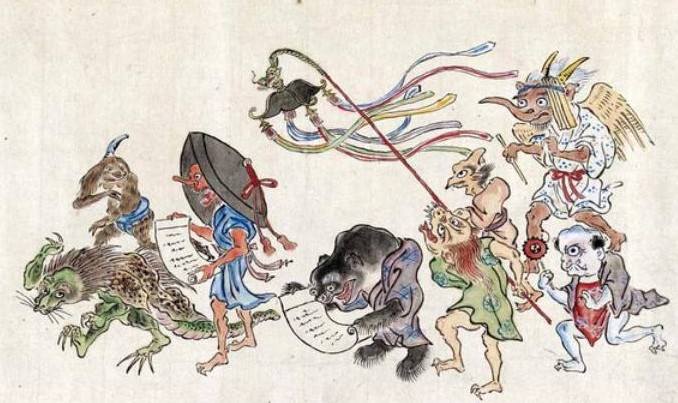
NightParadeof1000demons

When the god Izanagi returned from the Land of Yomi, he purified himself in a bath. As he dried his body, each falling drop of water soaked into the soil and imbued the land with supernatural potential. Thus, the yokai were born.

The story of Izanagi and the origin of yokai comes from the oldest known work of Japanese literature and the basis of Japanese mythology, the 8th century Kojiki (古事記; Record of Ancient Matters). In Japan’s creation myth, the land itself—the rocks, trees, mountains, and rivers—are infused with latent magical energy. This energy needs only a focus to give it life. Just as nebulous gas ignites to form stars, this energy is compressed by events like volcanoes or earthquakes, or strong human emotions like fear or hatred, until it emerges as one of Japan’s menagerie of monsters and phenomena. Yokai take many shapes, and are as varied and complicated as human imagination can make them.

Yokai have not always been a single tradition. In ancient times, small tribes and kingdoms populated the island. Each isolated region gave birth to its own rich folklore, its own gods and monsters. It took the conquering and warlike Yamato clan in the 3rd century to subdue these tribes into a unified nation and culture. As centuries passed, new technologies like the printing press allowed regional folklore to spread. People learned for the first time what scared their neighbors when the lights went out.

The Golden Age of yokai was the Edo period (1603-1868), an unprecedented time of peace and prosperity. Folklorists and artists like Toriyama Sekien (鳥山石燕; 1712 – 1788) scoured the country for obscure legends and half-whispered folktales to populate their Yokai Encyclopedias and illustrated yokai scrolls. As the Brothers Grimm did for Germanic folklore, Toriyama and others rescued these stories from obscurity by putting them on paper at a time when oral traditions were vanishing.

Yokai almost disappeared following the Edo period, when Japan was swept up in a mania for modernization. When meeting with the Western powers, the country was embarrassed of its provincial passion for the supernatural. The government tried to sweep yokai under the carpet in favor of rational thinking and scientific advancement. As the military took over and Japan plunged into the darkness of WWII, the yokai were forgotten.

But one young man remembered. Comic artist Mizuki Shigeru (水木しげる; 1922 – Present) was raised on yokai stories told by his village wise woman. When he came home from the war, he started working in the new manga industry, drawing the stories he had heard as a boy. His comic Ge ge ge no Kitaro (ゲゲゲの鬼太郎) became one of Japan’s most popular comics, and Mizuki taught all of the children of Japan about the country’s mythical past.

Mizuki Shigeru’s influence continues, and yokai are again known throughout Japan. Children who grew up on Mizuki’s comics started creating their own yokai stories. People like Shibashi Hiroshi (椎橋寛; 1980 – present) created comics like Nura: Rise of the Yokai Clan (ぬらりひょんの孫), which were then translated into other languages and spread the yokai phenomenon across the world.

Further Reading:

What Does Yokai Mean in English?

Secrets of the Yokai – Types of Yokai

Secrets of the Yokai II

Translator’s Note

I have been consulting on a Yokai Art exhibition that is being held at the Wereldmuseum in Rotterdam, The Netherlands. This is a short little piece I wrote about this history of yokai and its connection with modern manga, that will be used as an introduction to the exhibition. Just thought I would share it with everyone.

History of Yokai

But don’t worry–I am still working on Hashihime for my next post!

Ushi no Koku Mairi – Shrine Visit at the Hour of the Ox

Ushi_no_Koku_Mairi_Mizuki_Shigeru

Translated and Sourced from Mizuki Shigeru’s Mujyara, Kaii Yokai Densho Database, Japanese Wikipedia, and Other Sources

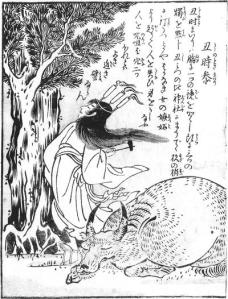
At the Hour of the Ox (between 1-3 A.M.) a lone figure creeps silently towards a sacred tree. She is dressed in white, and on her head an upturned trivet is worn like a crown, three candles burning in the night. In one hand, she carries a doll made of bound straw in the form of a person; in her other hand, a small wooden hammer and a set of long, iron spikes. The hatred in her heart blazes brighter than the candles, appropriate for one completing the curse-ritual known as Ushi no Koku Mairi, the Shrine Visit at the Hour of the Ox.

The Ritual

Ushi no Koku Mairi (丑の刻参り; also known as 丑の時参; Ushi no Toki Mairi, both of which translate as Shrine Visit at the Hour of the Ox) is an ancient, famous, and terrible Japanese curse-ritual. It has been performed for millennia—some sources trace it back as far as the Kofun period (250 – 538 CE), although in a different form. While the costume and ritual have changed over the centuries, the basic rite of pounding nails into dolls remains the same.

To perform an Ushi no Koku Mairi, you first make a straw doll (藁人形; waraningyo) to serve as an effigy of the person you want to curse. For the best effect, the doll should have some part of the person in it, some hair, skin, blood, fingernails, or other DNA. In a pinch a photograph will do, or even their name written on a piece of paper. This done, you done the ritual costume, and sneak into a shrine late at night. Many Shinto shrines have sacred trees, called shinboku, that are the homes of kami spirits. Nail the doll to the sacred tree using long, iron spikes called gosunkugi (五寸釘).

ushinokokumairi

As stated in the name, the timing is very important. The ritual can only be completed at the Hour of the Ox, between 1-3 A.M. in the ancient method of counting time in Japan. The Hour of the Ox is the traditional Witching Hour in Japan, a time when yurei and yokai and other evil spirits come haunting.

And most importantly—the ritual must be done in secret; it is said that if anyone sees you performing Ushi no Koku Mairi, the curse will rebound on the caster. Unless, of course, the eyewitness is immediately slain.

How many times you perform the ritual vary; some say that you must go back seven nights, pounding in a single nail each night. The final nail goes into the head, which will kill the cursed person. The results of the curse vary as well—some say the cursed person will sicken and die. Some say that, like a Voodoo doll, the cursed person will feel pain where the spikes are hammered in. Some say it is a summoning ritual, and that performing an Ushi no Koku Mairi summons a vengeful spirit to torment and ultimately destroy the recipient.

The Costume

An important component to the ritual is the costume. One does not simply waltz into a shrine and pound a doll into a tree. The costume is a demonstration of your intention, and is more than just decoration; the curse is said to be so terrible that in order to be effective you must become a demon yourself.

SekienUshi-no-tokimairi

Although the costume has changed over the years (and there are numerous variations depending on your source), the most recognizable version comes from the Edo period, and is still associated with the ritual.

• A white kimono and obi, with your face painted white (to look like a supernatural creature)
• An upturned trivet on your head, with three candles burning on the legs
• A mirror (a sacred symbol of Shinto) worn over your chest like a necklace
• A shortsword tucked into your sash, to kill anyone that sees you
• Tall, one-toothed geta clogs (or barefoot, if you can’t walk in them)
• A wooden comb (in some accounts, a razor) held between your teeth (It is important not to utter a sound once you enter the shrine, and the comb keeps you silent.)

Some variations of the costume swap out a headband and two candles for the trivet, but I think if you are going to do it, go all out.

The History of Ushi no Koku Mairi

No one really knows how old the ritual really is. In the Nara National Research Institute for Cultural Properties, the is an 8th century relic from an archeological dig of a doll made of bound wooden strips with an iron nail shoved through the chest. This is from a time when iron had just been introduced into Japan, and would have been a rare commodity. In the ruins of Datecho in Shimane prefecture, Matsue City, archeologists found a wooden plaque with a painting of a court lady that had wooden spikes pounded through it. It is known that dolls for curses were used by Onmyoji , the yin/yang sorcerers of the Heian period (794 – 1185 CE).

Going to the shrine at the Hour of the Ox has not always been associated with curses, however. Old records show that people originally snuck in to pray, and that during these nighttime visits your pleas to the kami were more likely to be answered. Somehow, along the way, these prayers for a kami’s blessing turned into prayers for a kami’s curse.

One of the oldest written accounts of the ritual comes from the Sword scroll of the Kamakura period epic poem The Tale of the Heike. It differs from modern accounts—the costume calls for you to bind your hair into five braids, to use bound-together pine branches threaded into an iron ring for torches, and to cake your face in red vermillion clay instead of painted white. Also, instead of a late-night sneak visit to a shrine, the curser runs down the street shouting their curse for all to hear. According to the story, the ritual was taught to a woman by a kami spirit, after she prayed for revenge at a local shrine. The woman would transform into the monstrous Hashi Hime (Bridge Princess), still wearing her frightful costume.

In the Muromachi period (1337 to 1573 CE), a Noh play called Kanawa (鉄輪; Iron Ring)is credited with drawing a connection between the Onmyodo doll ritual and the costume of the Hashi Hime, creating the first account of the Ushi no Koku Mairi as it is known today.

A_woman_makes_a_cursing_ritual_ceremony

By the Edo period, the Ushi no Koku Mairi was firmly established and illustrated by artists in kaidan-shu collections of stories of the strange. One of the main differences in Edo period artists was the results of the ritual—many preferred to show some evil spirit or god lurking in the background, waiting to be summoned by the completed ritual.

Where to Perform the Ritual

Not all shrines are created equal for Ushi no Koku Mairi. Kifune Jinja in Kyoto and Ikurei Jinja in Niimi, Okayama, are famous sites for Ushi no Koku Mairi, as is Jishu Jinja, a small shrine located near the Kyoto Buddhist temple Kiyomizudera. If you look carefully, these sacred sites have shinboku trees that still bear the scars of centuries of iron nails pounded in by vengeance-seekers.

Ushi no Koku Mairi Tree

And if all this seems like a lot of work to put together, don’t worry. In the modern world, a complete Ushi no Koku Mairi kit can be ordered online. But be careful, performers of the ritual can be prosecuted under Japanese law.

Ushinokokumairi_kit

Translator’s Note

The Ushi no Koku Mairi was a difficult project–difficult in knowing what to leave in, and what to leave out.  There are SO many different variations on the ritual it would be impossible to include them all.  I tried to add in what I thought was relevant, and appeared in the highest number of resources.  But this is by no means a complete account.

This is the second of my trivet-wearing yokai stories. Next up is a direct ancestor of the Ushi no Koku Mairi, the Hashi Hime.

Further Reading

For related kaidan stories, check out

Gotokoneko – The Trivet Cat

What are Teruteru Bozu?

The Mistress of Tonbu and Nezu

Next Newer Entries

Copyright notification

All translations and other writing on this website were created by Zack Davisson and are copyright to him.

Copyright notification

In accessing these web pages, you agree that any downloading of content is for personal, non-commercial reference only.

No part of this web site may be reproduced or transmitted in any form or by any means, electronic, mechanical, photocopying, recording or otherwise, without prior permission of Zack Davisson.

Copyright notification

For rights clearance please contact Zack at:

zack.davisson (at) gmail.com

Thank you.