What is the White Kimono Japanese Ghosts Wear?

Translated from Japanese Wikipedia and Other Sources

To learn much more about Japanese Ghosts, check out my book Yurei: The Japanese Ghost

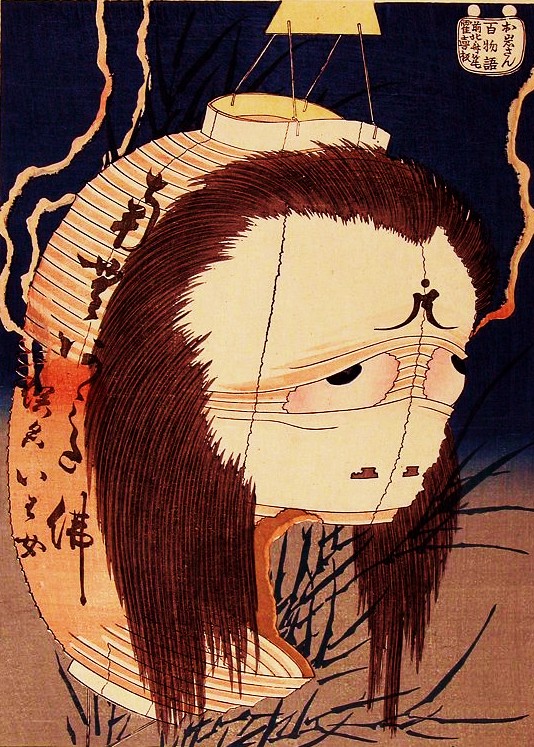
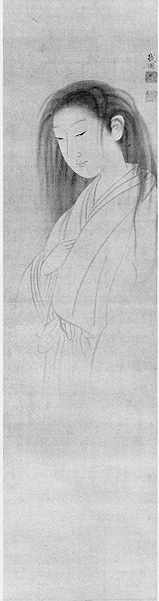
Black hair. White face. White kimono. Whisper the word Japanese ghost to anyone, and that is the image that will appear in their head. For Americans, the image generally comes from Japanese horror films where white-kimonoed girls crawl from TV sets or rise from wells. But to Japanese people, the costume of a white kimono has a more somber feel. Most likely over their lives they will wrap more than one loved one in the traditional burial garment called a kyokatabira.

Kyōkatabira – The Buddhist Robe

The white kimono that most Japanese take their final journey in is called a kyokatabira. The word is split into two terms: kyo (経) which means Buddhist sutra, and katabira (帷子) which is a light, unlined kimono worn on informal occasions, such as rising in your own house in the morning.

Katabira were traditionally made from hemp and came into fashion around the Heian period (794 to 1185). At the time, katabira were a form of underwear. They were stuffed with cotton and used to keep warm as a sort of wearable blanket. But as summer came and people shed layers, they soon learned that the simple, single-layered garment was just as comfortable in Japan’s humid and oppressive summer. These were eventually adapted for use in the bathhouse, which were called yukatabira (湯帷子). This word was later shortened to yukata, a light kimono that are still worn in Japan today— although the kanji 浴衣 is more commonly used.

The use of the white katabira is thought to have appeared around the same period, as a mix of Shinto and Buddhist tradition. The Emperor was said to wear a white kimono when performing religious rituals during the Heian period. Unlike the coarse hemp of the commoners, the Emperors garment was spun from silk and was called a byakue (白衣) meaning nothing more complicated than “white robe.” Shinto priests adopted the fashion, with a full costume called jōe (浄衣) meaning “purified robe.” Brides on their wedding days wore a white kimono called a shiromuku (白無垢) meaning “white purity.”
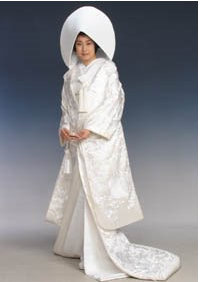
Buddhist priests preferred the rough hemp over the fine silks of the byakue and jōe, and took to wearing what was called kyōkatabira. As the name suggests, kyōkatabira were standard white katabira inscribed with Buddhist sutras. Kyōkatabira came to be work by Buddhist on pilgrimages as they travelled Japan.

All of these types of garments: byakue, jōe, shiromuku, and kyōkatabira; fall under the category of shiro-shozoku (白装束) meainging “white clothing.”

What is the significance of the color white? – Priests, Brides, and Corpses

I sometimes hear people say that white is the color of death in Japan, but this is a mistake. White is the color of purity.

For as long as anyone knows, white in Japan has been the color of purity, specifically ritual purity. The native religion Shinto has always been concerned with cleanliness and purity. At most Shinto shrines there is a place for you to wash yourself before entering.

Ritual purity means more than just taking a good bath, although that is a part of it. In order to be ritually pure, you must be cleansed of kegare (汚れ) meaning “impurities,” which can only be done through a serious of prescribed enigmas under the guidance of a priest. Wearing a white kimono is a visible sign of purity, and is generally done by only three classes of people; priests, brides, and corpses (or those soon to be corpses, like people commiting seppuku).

And of course yurei, Japanese ghosts.

Shinishozoku- Costume for the Dying

Around the 700s, Buddhism arrived in Japan and began to grow in popularity. Buddhism in Japan mixed with Shinto to create a unique religion quite different from its Indian origins. Over time, Shinto and Buddhism split until each oversaw a different aspect of humanity, the kami of Shinto overseeing the living and the deities of Buddhism caring for their souls in death. Buddhism slowly took over all funeral rites, which remains with way it is in Japan today.

In Buddhism, death is not the ending but just the beginning of another cycle. Appropriately, Japanese Buddhist dressed corpses as pilgrims going on their final journey, called the shidenotabi (死出の旅) meaning “the final trip to death.” The full costume for a corpse is called shinishozoku (死に装束),which means roughly “the costume for one going to death.”

A complete shinishozoku will have the corpse dressed in a kyōkatabira with sutras written on the inside and folded right-over-left in the opposite style, a tankan-the triangle-shaped headband, a zutabukuro-a small carrying bag containing ferry passage over the Sanzu river of the dead, a walking cane, and coverings for the legs, arms, and back. The final item is a string of prayer beads nestled in the hands.

What is the significance of folding the kimono right-over-left?

A common occurrence in Japan is seeing a foreigner trying on a yukata for the first time, and eliciting a room full of gasps as they innocently take the right side of the yukata and fold it over the left. I did. And I had no idea why everyone was so shocked.

I found out soon enough that the right-over-left style is reserved exclusively for corpses, Living people always—ALWAYS—fold their yukata or kimono left-over-right. But why? That, no one could tell me.

It took some digging to find the answer, but it comes back to that old Asian favorite, class distinction by clothing. Apparently in ancient China the way you folded your kimono was a visible way to show your rank. Like foot-binding and long fingernails, it was also a way to purposefully hobble yourself to show that you did not need to work for a living.

Folding your kimono left-over-right allows a greater freedom of movement, such as was required by field workers. The leisure class thumbed their noses at freedom of movement, and purposefully folded their kimono right-over-left. During the Nara period, when Chinese culture influenced Japan, this custom was taken up enthusiastically by the aristocratic classes.

Death, however, knows no distinction of rank. One of the principles of Japanese religion and folklore is that the dead are mighty, and you don’t want to offend them. So it became the custom that all dead people, no matter what they were in life, rose to the aristocratic right-over-left class and folded their kimonos that way for their final journey.

The meaning of the kyōkatabira

So the white kimono, the kyōkatabira, is much more than a simple garment. It is a statement of transformation. It shows that here, on their last journey, a person has become ritually pure in the Shinto tradition, a holy pilgrim in the Buddhist tradition, and a wealthy aristocrat in the human tradition.

Few other items of clothes so completely raise you simply buy putting them on. Of course, you have to be dead to wear it, so there is a trade-off.

The Ghost of Oyuki

For more about the origins of Japanese Ghosts, you can purchase Zack Davisson’s limited edition yomihon chapbook The Ghost of Oyuki from Chin Music Press.

The Ghost of Oyuki Chapbook

Further Reading:

Check out other death customs from hyakumonogatari.com:

What is the Triangle Headband Japanese Ghosts Wear?

Nagarekanjyou – A Death Custom

Kimodameshi – The Test of Courage

Translated and sourced from Japanese wikipedia and other sources

Are you brave enough? That is the question that will be answered by playing kimodameshi, the Japanese test of courage. You will have to walk a dark, lonely path to a haunted location and set down your token to prove that you had been there.

The Meaning of Kimodameshi

Kimodameshi (肝試し) is most often translated into English as Test of Courage, which is not literally accurate. The word kimo (肝) actually refers to the liver, while dameshi (試し) does in fact mean “test.” In Japan the liver is associated with courage—for example kimo ga suwaru, or to sit on your liver, means to be brave or self-assured. So a more literal translation of kimodameshi would be to “prove your guts.”

The History of Kimodameshi

Like most folkloric practices, the factual origin of kimodameshi is lost to legend. But there are two possible beginnings, both of which could be equally true.

In the closing years of the Heian Period, during the reign of Emperor Shirakawa (1073 to 1087), the book “O-kagami” (大鏡; “Great Mirror”) was written by an unknown author. In the book was a story of three sons of Fujiwara Kaneie. One night during the Hour of the Ox (around 3 A.M.), the sons dared each other to go to a nearby house that was known to be the home of an oni. Only the son who was the leader of the martial arts school was brave enough to take up the challenge, and as proof of his courage he used his sword to slice a chip from the lintel of the house which he brought back to show the others.

Whether the story of the sons of Fujiwara Kaneie is true or not is unknown, but it is also said that kimodameshi began as a way for those of the samurai class to condition their children against fear, and that the game served as a kind of training.

During the Edo period, the 100 candles game hyakumonogatari kaidankai—which this site is based on—was a form of storytelling kimodameshi. The earliest recording of this game comes from the kaidan-shu “Tonoigusa” (1660) where a group of samurai gather to test their courage by telling ghost stories one by one.

Modern Kimodameshi

There are no set rules to kimodameshi, and there are as many variations as there are people who play it. Kimodameshi can be played impromptu, with only a few friends egging each other on to go somewhere scary or haunted, or it can be an organized event with a preset course, often inside a prepared haunted house with actors playing the roles of spooks.

In its most pure version, a group chooses a destination, one guaranteed to inspire fear. Common examples are dark forests, grave yards, Shinto shrines, abandoned buildings, or known haunted and mysterious spaces called shinrei spots. Challengers can go alone or as a duo. They go to the chosen spot at night, to ensure maximum fear, and they either bring something back to prove that they had gone the distance, or leave some sort of token that can be recovered the next day.

Like all Japanese ghost traditions, kimodameshi traditionally takes place in the summer. In Japan, summer is when the land of the living is thought to intersect with the land of the dead, and it is the time when yokai and yurei come out to play. All organized haunted house kimodameshi will take place during the summertime. It isn’t unusual to see TV celebrities during the summer being filmed walking through a haunted house or to some famous location in a game of kimodameshi.

There are some legal issues with kimodameshi. When an abandoned building becomes a popular spot, the police have been known to set up stings to arrest trespassers. Some of the locations themselves are dangerous, such as long, dark tunnels on country roads where a car can come through at any time.

School Kimodameshi

Many Japanese people experience kimodameshi when they are young, in Elementary or Junior High School. The game is played when the children go on school camping trips, or sometimes at school during school festivals. When played with school children, the game is a set-up.

In order to keep them safe, and still provide a good scare, the location is scouted before hand and scary objects like skulls and horror-props are planted along the way. Teachers and other volunteers dress in ghost costumes and hide along the path to spring out at the children. All of the students are told a scary story about that particular location, then sent off in groups to prove their guts once the Sun has gone down.

Students can also create their own kimodameshi events at school during school festivals. They dress up in costumes and turn one of the classrooms into a haunted house for other students to enter and test their courage.

What are Teruteru Bōzu?

teruterubouzu

Translated and sourced from Yokai Jiten and other sources.

To learn more about Japanese Ghosts, check out my book Yurei: The Japanese Ghost

Teruteru Bozu, the small tissue-paper men, are a not unusual site on overcast days in Japan. Looking exactly like the tissue-paper ghosts American children make on Halloween, they hang from the eaves of houses, each one a wish for sunny weather from a child who wants to go outside and play.

But what the children don’t know—and most likely the parents don’t know either—is that what looks like a simple folk-custom is actually a prayer to ancient Chinese gods and to one of Japan’s monster clan, the yokai called Hiyoribo.

Hiyoribo (日和坊)– The Weather Monk

SekienHiyori-bo

Hiyoribo is a legend that has been passed down for many years in Japan. He is said to come from the mountains of Hitachi-no-kuni—modern day Chiba prefecture—and his season is the summertime. Hiyoribo is said to be a yokai who brings sunny weather, and who cannot be seen on rainy days.

Toriyama Seiken illustrated the Hiyoribo in his picture-scroll “Supplement to the Hundred Demons of the Past,” and explained that this yokai was the origin of teruteru bozu. He said that when children hang up teruteru bozu and pray to them to bring sunshine into the rain, it is actually the spirit of the Hiyoribo that they are praying to.

Teruteru bozu (てるてる坊主) – The Sunshine Monk

Teruteru bozu are made from white cloth or tissue bound together with a bit of string. They are usually hung upright from the eaves of a house, and are used as talisman in the hopes that tomorrow will bring good weather.

In some areas of Japan the dolls are used by farmers on days when they hope for rain instead of sun. The dolls are are hung head-downwards and called furefure bozu or ameame bozu (both meaning roughly The Rain Monk) or ruterute bozu which is simply teruteru bozu said backwards.

And although teruteru bozu is the most common name, they are also known as teretere bozu and sometimes hiyori bozu. Researcher Miyata Noboru has found that in certain places in West Japan they are still called Hiyoribo and remembered as yokai.

Teruteru bozu appeared around the middle of the Edo period in Japan. In the book “Kiyu Shoran” (Inspection of Diversions) the author writes of the custom that if the teruteru bozu is successful, and the following day is clear, then its head is washed with sacred sake and the doll is sent into a river to be washed away. In Edo period Japan, rivers were thought to connect to the afterlife and the realm of the gods, so sending the teruteru bozu down the river was returning it home in the same way that candles and lanterns were floated down the river during Obon, the Festival of the Dead. There was also a custom where—as with Daruma dolls—a face was only drawn on the teruteru bozu if it had been successful in bringing fair weather.

The origins of the custom are vague. Some say that it comes from China, where untou ningyo (cloud-clearing dolls) and ameku musume (rain banishing girls) are just a few of the similar customs that can be found. Folklorist Fujizawa Morihiko sees the origin of both the yokai Hiyoribo and the teruteru bozu in a Chinese drought-god with similar properties.

The Teruteru bozu Song

Like many Japanese customs, there is a warabe uta—a folksong. The lyrics are allegedly about a story of a monk who promised farmers to stop rain and bring clear weather during a prolonged period of rain which was ruining crops. When the monk failed to bring sunshine, he was executed.

Japanese:
てるてるぼうず、てるぼうず
明日天気にしてをくれ
いつかの夢の空のよに
晴れたら金の鈴あげよてるてるぼうず、てるぼうず
明日天気にしてをくれ
私の願いを聞いたなら
甘いお酒をたんと飲ましょてるてるぼうず、てるぼうず
明日天気にしてをくれ
それでも曇って泣いてたら
そなたの首をちょんと切るぞ
Romaji:

Teru-teru-bōzu, teru bōzu
Ashita tenki ni shite o-kure
Itsuka no yume no sora no yo ni
Haretara kin no suzu ageyo

Teru-teru-bōzu, teru bōzu
Ashita tenki ni shite o-kure
Watashi no negai wo kiita nara
Amai o-sake wo tanto nomasho

Teru-teru-bōzu, teru bōzu
Ashita tenki ni shite o-kure
Sore de mo kumotte naitetara
Sonata no kubi wo chon to kiru zo

Translation:
Teru-teru-bozu, teru bozu
Do make tomorrow a sunny day
Like the sky in a dream sometime
If it’s sunny I’ll give you a golden bellTeru-teru-bozu, teru bozu
Do make tomorrow a sunny day
If you make my wish come true
We’ll drink lots of sweet sakeTeru-teru-bozu, teru bozu
Do make tomorrow a sunny day
but if it’s cloudy and I find you crying (i.e. it’s raining)
Then I shall snip your head off

Translator’s Note

This is one of those ubiquitous pieces of folk magic in Japan that people have long forgotten the origins. They look exactly the same as the tissue ghost puppets I made as a child, but with very different intent!

When I lived there, I saw teruteru bozu all over the place but no one could really explain what they were or why they made them. All they knew is that little kids made them to pray for the rain to stop when they wanted to go outside and play.

I went digging and found the yokai origins of the little cotton charms.

Hokusai’s Manga Yurei

This is in response to a reader question about a particular yurei picture, specifically Hokusai’s manga yurei.

Katsushika Hokusai is probably Japan’s best-known artist internationally. His print The Great Wave off Kanagawa, from the woodblock print series Thirty-six Views of Mount Fuji, is without a doubt the most famous work of Japanese art. Like most artists in the Edo period, Hokusai illustrated supernatural scenes from famous kabuki plays and popular hyakumonogatari kaidankai tales. In 1831, he created five prints in a hyakumonogatari series that are still some of the most famous Japanese ghost prints.

The particular yurei in question, however, comes from a different period in his life. In 1811, at the age of 51, Hokusai changed his professional name to Taito, and began work on a series of sketchbooks and small images he called manga. The word manga (漫 画) translates directly to “frivolous pictures,” and Hokusai’s manga series were originally meant to be a quick money-making venture that would attract new students. The manga series was very popular, and Hokusai created fifteen volumes in total.

This yurei image comes from the 13th volume, one of the three not published during Hokusai’s lifetime. This yurei is not from any particular story, but just seems to be a “frivolous picture” of a yurei that Hokusai drew. The text next to the picture say simply yurei, with no other identification. It is a very usual depiction of a yurei in that it is winsome rather than scary. But it does include the standard Edo period yurei characteristics of pale skin, white kimono, black hair, and no feet.

The yurei is part of a four-paneled series of mythological creatures. The yurei is in the top left, with a picture of a Yamauba underneath. On the right side in the top left is a tengu, and underneath that is a mountain yokai called a Hihi. Hihi is the Japanese word for baboon, and at the time a baboon was no less a fantastical creature than a mermaid or tengu.

It is clear from looking at the original that the picture has been color-corrected. The original impressions from Hokusai’s manga series were three-colored, black, gray, and pale flesh.

What is the Triangle Headband Japanese Ghosts Wear?

To learn much more about Japanese Ghosts, check out my book Yurei: The Japanese Ghost

What are those odd, triangle-shaped hats or headbands worn by some Japanese ghosts? That is a difficult question to answer because, while there are several opinions, nobody really knows.

The triangular, white corpse-hat consists of a small strip of cloth, cut or folded into a triangle, which covers the forehead and wraps around the back of the head. It works like a headband, and the Japanese use the word boshi (hat) or nuno (cloth) when describing it. The cloth is not a consistent item on the costume of a yurei, a Japanese ghost. As with everything else in life, burial fads come and go. Although the white burial kimono, called a kyōkatabira, has stayed the same for centuries, the same thing cannot be said about the cloth.

The cloth appeared around the Heian period and yurei-e (ghost pictures) from this era often show yurei wearing the cloth. It is possible the corpse-hat was based on the Heian period eboshi hat that was popular at the time. Whatever its origins, the custom seems to have vanished by the Edo period. It is worth noting that in Maruyama Ōkyo’s famous painting “The Ghost of Oyuki,” considered an accurate portrait of a yurei, Oyuki does not wear the cloth. In modern times, the cloth has become particularly associated with the sea ghosts called funa yurei, who always wear it.

I keep calling it “the cloth” because there is no specific word for it. The cloth goes by multiple names. The most grandiose term is tenkan, meaning heaven’s crown. The most commonplace is zukin, which is a standard word for hood or kerchief. Several of terms are simple and descriptive, like hitaieboshi meaning forehead hat, or hitaikakushi meaning forehead-hider and kamikakushi meaning hair-hider. The most basic term of all is sankaku no shiroi nuno. This means triangle-shaped white cloth.

The meaning of the cloth is speculative, although there are two main theories why it came into fashion. One says that the dead have ascended to a higher level, and thus the tenkan (heaven’s crown) is placed upon their heads to show their new status. Another says that the sharp point of the triangle wards off evil spirits or demons from entering the now-empty body from the head and resurrecting the corpse or preventing the spirit’s transition.

In all likelihood, there is some truth in both of these explanations.

The Ghost of Oyuki

For more about the origins of Japanese Ghosts, you can purchase Zack Davisson’s limited edition yomihon chapbook The Ghost of Oyuki from Chin Music Press.

The Ghost of Oyuki Chapbook

Further Reading:

Check out other yurei tales from hyakumonogatari.com:

How Do You Say Ghost in Japanese?

Goryo Shinko – The Religion of Ghosts

Why do Japanese Ghosts Not Have Feet?

The Yurei Child

Previous Older Entries Next Newer Entries

Copyright notification

All translations and other writing on this website were created by Zack Davisson and are copyright to him.

Copyright notification

In accessing these web pages, you agree that any downloading of content is for personal, non-commercial reference only.

No part of this web site may be reproduced or transmitted in any form or by any means, electronic, mechanical, photocopying, recording or otherwise, without prior permission of Zack Davisson.

Copyright notification

For rights clearance please contact Zack at:

zack.davisson (at) gmail.com

Thank you.