Secrets of the Yokai – Types of Yokai

Translated from Mizuki Shigeru’s Yokai Daihyakka

What is the difference between Yokai and Obake?

Generally speaking, yokai and obake are two words that mean the same thing.   If a distinction must be made, it could be said that obake are those creatures which somehow change from one form to another (the Japanese word bakeru which forms the root of obake means to change for the worse, or adopt a disguise).

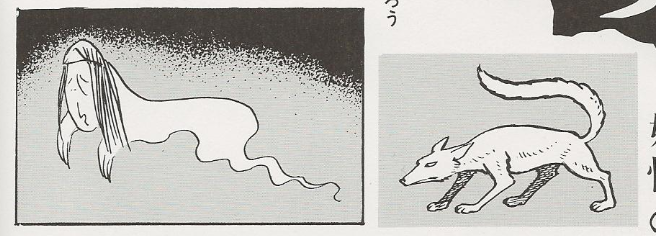
Examples are transforming kitsune (foxes) or of the dead people whose lingering grudges cause them to appear as yurei, or a myriad of other shape-changers.

What kinds of Yokai are there?

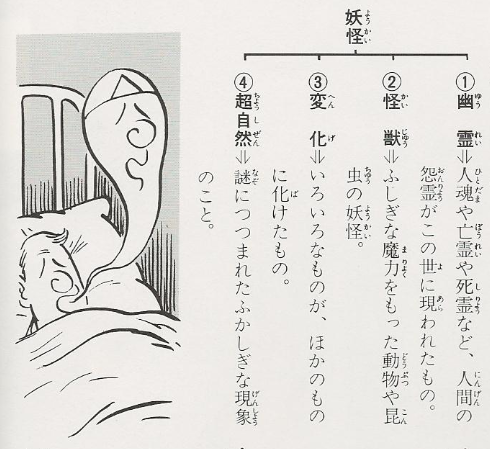
If you wanted to organize yokai by large categories,  it could be said that there are Yurei (spirits of the dead) Kaiju (monsters), Henge (shape-changers) and Choshizen (supernatural phenomena).

A chart would look like this:

 Yokai

Yurei  Kaiju  Henge  Choshizen
Examples are hitodama, borei and shiryo, and onryo.  The spirits of humans still lingering on Earth.  Animals or insects with mysterious and magical powers.  Anything that can change from one form to another. Mysterious or puzzling phenomena.


How many kinds of Yokai are there in Japan?

As a rule, it is said that there are about a thousand different species of yokai.  But if you limit it to those that have appeared in pictures or those about which we have some information, then it is really roughly four hundred different species.

But there are many yokai of other countries.  Nobody knows the number of worldwide yokai.

What is the largest Yokai of them all?

 That is the Onyudo.  The body of the Onyudo is as large as Mt. Fuji.  However, it is said that even if angered the Onyudo would never cause harm to humans.

Further Reading:

For more Types of Yokai, check out:

6 Types of Japanese Yokai From Showa

When Food Attacks – 6 Types of Food Yokai From Japan

10 Famous Japanese Ghost Stories

What’s the Difference Between Yurei and Yokai?

A Brief History of Yokai

Japan’s Concept of Heaven

Translated from Kitaro no Tengoku to Jigoku

When talking about Japan’s idea of Heaven, there are many things to consider such as era, location and religion.  Even the location changes, sometimes being across the ocean, sometimes up above the skies and sometimes being beneath the Earth. 

From long ago, the Japanese people have dreamed of and longed for Heaven.  From the depths of hearts full of big dreams and longings, they created many different versions of the Heaven, and then lived their lives to become magnificent human beings in order to travel to these idealized paradises.  Never surrendering regardless of the pain and suffering, they struggled to live to the best of their abilities, or so many stories say.

To those ancestors who watch over us here in Japan, Heaven is not a dream or something they long for.  However, it is best not to spend too much time pondering Heaven, and much better to live your life to the fullest and learn what you can while you are still around.

The Genealogy of the Yokai Illustrated manual-style Emaki

Translated from Yokai Zukanteki Emaki no Keifu

A few different styles exist of what we call “Yokai Picture Scrolls” or “Yokai Emaki.”  Some tell a continuous story, like the “Night Parade of a Hundred Demons” (“Hyakki Yako”) and the “Inou Mononoke Record” (“Inou Monokeroku Emaki”).   Others show pictures of yokai along with short stories, done in the “Hyakumonogatari”-style and were used to supplement the popular parlor game. Another type imitated the various scientific illustrated manuals of plants and animals, showing a single yokai per page with an encyclopedia-like explanation of that creature.  This last kind is called “illustrated manual-style emaki.”  In this style of emaki a great number of yokai were gathered together and named and identified.  Although the illustrated-manual style is the rarest, it is surely thanks those emaki that we remain familiar with the varieties of yokai.

Far more of the “Night Parade of a Hundred Demons”-style pictures scrolls have survived to the modern era, and so by necessity research into the illustrated manual-style has been limited.  But in recent years, a few more of these illustrated manual-style yokai emaki have begun to surface and it is thought that at one time the books must have been widespread. Even now real research is ongoing investigating this style of emaki.

Because of the limited number available, most research into these illustrated-manual style emaki focused on making an index of their important contents, on identifying and comparing the various images.  One such existing emaki is held in the Fukuoka Modern Museum’s collection and is called the “Hundred Mysteries Picture Book” (“Hyakkai Zukan”) (A reproduction has been published by Kokushoukan Koukai publishers).  Based the old writings of Yoshikawa Kanbo, the “Hundred Mysteries Picture Book” was drawn in 1737 by Sawagi Suushi, a pupil of the great Hanabusa Ichou.   In total, it records thirty different variety of yokai, with a delicate brush work and it is considered the highest quality of the surviving illustrated manual style yokai emaki.  The yokai in the collection are almost identical to those found in Toriyama Sekien’s “The Illustrated Bag of One Hundred Random Demons” (“Gazu Hyakki Tsurezure Bukuro;” 1781), but when considered together the art work of the “Hundred Mysteries Picture Book” is in every way on a higher standard, and the scroll is a rare jewel.

The yokai found in the “Hundred Mysteries Picture Book” appear in many other works.  One excellent example is the “Night Parade of a Hundred Demons” (1832) emaki from the Mitsui Bunko collection in Yatsushiro city in Kumamoto prefecture. (Reproduction published as part of the Mitsui Buko collection).  The scroll has the influence of Tosa Mistunobu from the Shinjuan abbey of Otoku temple, and is done in the style of what is known as “Shinjuan-yype Emaki.”   This type of emaki has the yokai lined up in a wild, rampant procession that develops as the scroll is unrolled.   This unrolling emaki was extraordinarily popular during the Edo period, and bears many similar traits to the “Hundred Mysteries Picture Book.”  However, compared to the thirty yokai of that emaki the “Night Parade of a Hundred Demons” has almost double the number of unique yokai, fifty-eight in total.   There are more yokai recorded today than are found in these illustrated-manual style yokai emaki, and the number seems to have grown with each new publication.  There are some yokai that appear nowhere else except in these yokai emaki and were creations of the artist. 

Recently more consideration is given to the illustrated-manual style yokai emaki, but the Mitsui Bunko collection “Night Parade of a Hundred Demons” is still considered one of the greatest of its kind. 


On Zashiki-Warashi

Translated from Mizuki Shigeru’s Tono Monogatari

There is what is called the Three Great Stories of Tono.  Of these, the legend of the zashiki-warashi is by far the most famous.  Let’s touch on these legends a bit.

Zashiki-warashi (“zashiki” meaning the tatami room of traditional Japanese houses, and “warashi” meaning a kid or small child) are often seen as a kind of omen in the houses of once-great families on the verge of decline.  The disappearance of the zashiki-warashi from the house was a sign that the family’s fortunes had waned.  Looking into this, you can find many families who have used zashiki-warashi to account for the withering away of their wealth and status.   The disappearance of zashiki-warashi was also an easy way to explain away a neighbor’s misfortunes to children who were too young to understand.   Many a parent has relied on this convenient excuse to circumvent uncomfortable questions.

But there are other thoughts on the zashiki-warashi.  In the 42nd year of Meiji, Yanagita wrote in his diary that on the journey from Hanamaki to Tono he saw only three places that showed any sign of human habitation.  On these rough plateaus between the surrounding mountains it was said there were a hardscrabble people making their living off the land called Yamabito.  These people of the mountains were said to be of substantial build and were described as having eyes differently colored from normal Japanese.  The villages of the Tono area were terrified of Yamabito, who were said to sometimes raid the villages and either ravage or kidnap the local women.   Due to this fear of outsiders, as well as due to the special geographical features of the mountain basin in which they lived, the people of Tono were solitary and exclusionary.   Their houses held many secrets.  Old families of rank and reputation sometimes found their daughters ravaged and impregnated by these Yamabito attacks, and any child born of such a union was hidden away in the depths of the family mansion and never allowed to see the daylight.  Other families of lesser fortunes sometimes gave birth to more children than they could afford, so it was said that some children were culled, their bodies buried under the dirt floors or under the kitchen instead of a proper grave.   An eyewitness to both of these ancient customs sites these practices as the origin of the zashiki-warashi legends.

There are of course other origins that have nothing to do with bad parents hiding or killing their own children. Some say that zashiki-warashi are merely spirits of the house, no different than any other kami.

Regardless of their origins, they are a vivid and ancient legend.  One official account, published in 1910 (the 43rd year of Meiji), tells of an elementary school in Tsuchibuchi where a first grade student claimed to see a zashiki-warashi right in front of him, although his teachers and classmates were unable to see the spirit.

Further Reading:

Read more Zashiki Warashi tales on hyakumonogatari.com

Zashiki Warashi

The Legends and Storytellers of Tono

Translated from Mizuki Shigeru’s Tono Monogatari

Yanagita Kunio’s “Tono Monogatari” is mainly the recollections of Tono-native Sasaki Kizen.  Sasaki was a researcher of local legends, and also harbored dreams of becoming an author himself.   Gathered here are the many stories passed down through generations from parent to child in the Sasaki household, including myths and legends, folktales and traditions, ghost stories and fairy tales.   Sasaki told them with out any particular order, plot, literary structure or device, and Yanagita wrote them down accordingly. Together these stories and Yanagita’s other books became the foundation in Japan of minzokugaku, or folklore studies. 

2010 celebrates the 100th anniversary of the initial publication of “Tono Monogatari,” and Tono has planned many events in recognition of this milestone.  This book is one of those events.  Tono itself retains many of the characteristics and atmosphere that it had in Yanagita’s days.  With the images of this book held in your heart, you can visit Tono and be transported back a hundred years to when the stories were first written down.

Tono is found in the northern Japan, in the southern mountainous district of Iwate prefecture.  Located in a valley basin and ringed by three holy mountains, Tono can find on either side Mt. Hayachine, Mr. Rokkoushi and Mt. Ishigami.  Together, these are called the Three Mountains of Tono.   The middle mountain, Mt. Hayachine, also forms a part of another group known as the Three Southern Mountains including Mt. Iwate and Mt. Himegami. As the most outstanding and prominent of the mountains, Mt. Hayachine has been an object of worship for thousands of years. Fukuda Kyuya included Mt. Hayachine on his list of 100 Famous Mountains of Japan.

If you visit Tono you will find that there are elements exactly as in the book.  Story number 98 tells of large rocks by the side of the road with the words “mountain kami,” “kami of the fields” and “kami of the village entrance” carved in them. These can still be seen today.  The many kami of Tono are even now celebrated, including amongst their number the honored dead, important pilgrimages, and even a “kami of wives.”   At the shrine of the kami of wives you can see people praying for good fortune in marriage, or for the blessing of a child, or even those mothers who have lost a child praying for its soul.

All of these stone monuments to spirits and ancestors are surrounded on every side by a rich abundance of natural beauty.  The area brews a peculiar feeling of mystery and magic.  It is no wonder that when night comes and the darkness falls, the children of Tono gather eagerly around the hearth to hear the stories that have been passed down through the ages…

It is these stories, passed down through the ages, which have been collected and bound as “Tono Monogatari.”    What you won’t find here are tales commonly told to children, no classic morality stories of “The Boy from a Certain Village Who Went in Search of Adventure.”  Instead, what you will find are raw stories that sprang from real people.  There are stories of strange circumstances and suspicious encounters (some even filled with blood and gore).  The storyteller who filled children’s head with these stories as night fell also bound them together as a people, providing a collective narrative of society to be shared with each successive generation of children.

However, there are only about twenty-five left of these storytellers.  And while about six of these can be found in a proper performance, the rest are probably found at the train stations, serving as tour guides to visitors.  They ask no fee, but are just there to share their body of lore when the occasion calls, at anytime to anyone.
Next Newer Entries

Copyright notification

All translations and other writing on this website were created by Zack Davisson and are copyright to him.

Copyright notification

In accessing these web pages, you agree that any downloading of content is for personal, non-commercial reference only.

No part of this web site may be reproduced or transmitted in any form or by any means, electronic, mechanical, photocopying, recording or otherwise, without prior permission of Zack Davisson.

Copyright notification

For rights clearance please contact Zack at:

zack.davisson (at) gmail.com

Thank you.