Mizuki Shigeru in Rabaul

Mizuki Shigeru in Rapaul

Translated and Sourced from Showa: A History of Japan, Remembering the war in New Guinea, and Other Sources

Mizuki Shigeru is Japan’s most famous living manga artist, and the greatest modern scholar and writer on Japanese folklore and yokai. But he wouldn’t be alive if it weren’t for a small tribe of Tolai villagers on Rabaul, on the island of New Guinea.

Mizuki Shigeru in WWII

During WWII, like many young men Mizuki Shigeru was drafted into the Army. As great an artist as Mizuki Shigeru is, he was a very poor soldier. And this is what probably saved his life. Because of his poor abilities as a soldier, he was initially assigned to a non-combat position in the bugle corp. But he hated playing the bugle, and in what he describes as one of the worst mistakes of his life, requested a transfer. He was sent to the front in Rabaul as a private in the 229th Infantry Regiment of the 38th Division.

Mizuki Shigeru Soldier

He was constantly being smacked around by his superior officers for slacking off, and being sent on guard duty as punishment. One night when he was stationed far away on guard duty, the Allies attacked and his entire unit was wiped out. Only Mizuki Shigeru survived. Alone and on the run, he had his first encounter with the natives of New Guinea. And it wasn’t a friendly encounter. He was attacked by villagers who most likely planned to turn him into the Allies.

After a harrowing escape, he made his way to a Japanese base, where he was treated as a deserter. Assigned to a unit for a Suicide Charge, his life was saved again by a terrifying case of malaria. While being treated, his hospital was bombed and he lost his arm.

Mizuki Shigeru and Topetoro

While he was recovering from malaria and his lost limb, Mizuki Shigeru would often go for walks, dodging Allied strafing attacks. One walk he found a Tolai village tribe. They were cooking dinner, and Mizuki was so hungry he just sat down and started eating with them.

Here’s how Mizuki described it himself in an interview.

“Villagers used to live in a nice spot on top of the hills. Australian [planes] did not attack their villages. I used to visit their villages quite often. But when I went to their place, [Allied] planes used to appear in the sky. Then the villagers told me to go back to my camp. In fact, when I was walking alone on the trail, I was often strafed by the planes. I was wondering why they shot at me. They said that even if only one man was walking, the pilot could see him. They shot at me even when I was alone. Then I tried to be careful not to attract their attention. But they did not shoot villagers. So Japanese were hiding in holes. The Japanese killed a village chieftain, so villagers did not like us. But personally, I made good friends with them. When I first visited a village, I saw an old woman and I smiled at her, and she smiled back. She welcomed me. But I think now that she just sympathized with me, because I had only one arm. Now I think she just wanted to give me some food or something. Her name was Ikarian. “

Mizuki continued visiting Ikarian and her children, the boy Topetoro and the girl Epupe. He loved their lifestyle, their connection with the spirits and nature, and most of all their Shin Shin dance rituals. With the Tolai people, he found the yokai paradise he always dreamed of.

Rapaul Shinshin Dance

The Tolai accepted Mizuki as one of their own. They called him “Paul,” after one of the names in the Bible left behind by Christian missionaries, and he referred to them as “The People of the Forest.” The Tolai saved his life, keeping him supplied with food to make his body strong during bouts of malaria that killed his fellow soldiers. Epupe in particular loved Mizuki, and even tried to interfere in one of the many beatings Mizuki received from his superior officers. “Paul is Number One!” she shouted angrily in her broken English, not realizing how lowly Mizuki actually was amongst his own people.

Mizuki Shigeru Rapaul Showa Shi

He relationship with the Tolai was so close he almost deserted at the end of the war to go and live with them. Ikarian, Topetoro, and Epupe made him a garden patch, and were planning to build him a house.

“I started visiting her village more often, and I became like a member of her family. They looked after me well. They gave me fruit, and when I was sick in bed with malaria, they came to see me in the camp. When the war finished, they told me to run away from the army and come to live in their village. They make gardens, and their gardens are ready for harvesting very quickly. They told me that they would make a garden for me and build a house for me. They said they would look after me. So they told me to live with them. Ikarian told me to escape from the army. They were so keen. As I used to go to their village many times and had seen their life style, which looked very easy, much easier than the life in Japan. I used to think that village life was nice. And they were so keen to persuade me to escape from the army. I thought that it was not a bad idea. I thought I would not have to work so much. I could stay in bed all the time. I seriously thought about leaving the army there.”

Mizuki Shigeru Rapaul Shinshin Dance 2

Mizuki seriously considered their offer, and consulted with an army surgeon.

“I talked with an army surgeon. I sought his advice, explaining about the villagers’ invitation. He was very surprised. He was too annoyed to answer my question, but told me that I should see my parents in Japan first; then I could decide what to do. I followed his advice and went back to Japan.”

Along with visiting his parents, the surgeon told Mizuki Shigeru that his arm was not properly healed. The battlefield amputation was flawed (actually performed by a dentist), and he would need to go to a proper hospital in Japan or he could die. Mizuki left his Tolai family with a promise to return in seven years and live out his life in New Guinea. But other things got in the way of his promise.

“But when I went back, Japan was so chaotic under the rule of MacArthur. I had no time to think about returning to Rabaul. I had to live in Japan.”

Mizuki didn’t keep his promise. Life in post-war Japan was hard, and success constantly eluded him. He spent months in a veteran’s hospital waiting for surgery for his arm, and tried his hand at many trades from black market rice dealer to fish monger. Returning to his true love—art—he got work as a kamishibai artist and later transitioned to comic books. After twenty years in Japan, and many failures, Mizuki achieved success as a manga artist.

When his life and finances were finally stable, Mizuki returned to Rabaul and found his old friend Topetoro. His Tolai family had always been waiting for him, and kept his garden and house exactly as promised. Mizuki’s return was a cause for celebration, and the Tolai again performed the Shin Shin dance for him that he so loved.

While Mizuki never did move to live amongst the Tolai, over the following years he would return many times. The boy Topetoro became his lifelong friend.

The Rabaul Comics

Mizuki Shigeru Topepo Rapaul

Mizuki Shigeru has always treasured his time among the Tolai, and written several comics about Rabaul. Some of these are war comics, like Onward Towards Our Noble Deaths, An Account of the War in Rabaul by Mizuki Shigeru (Mizuki Shigeru no Rabauru Senki), and the touching Account of War from Father to Daughter (Mizuki Shigeru no Musume ni Kataru Otosan no Senki) that he wrote for his daughter Etsuko.

A film version was made of his time during the war in Rabaul, called The Noble Death Witnessed by Kitaro (Kitaro Ga Mita Gyokusai).
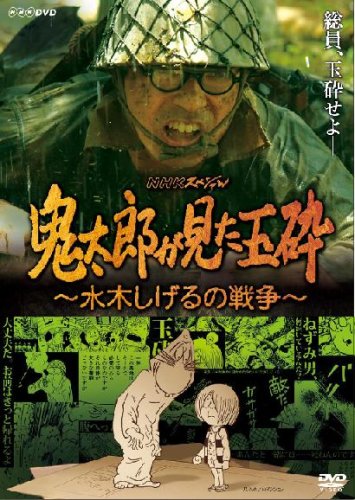
Mizuki Shigeru Rapaul Movie

He honored his friendship with Topetoro with the comic Fifty Years with Topetoro (Topetoro Tono 50 Nen)and wrote an extensive account of his time on Rabaul—both during the war and after—in Showa: A History of Japan.

Artifacts of New Guinea
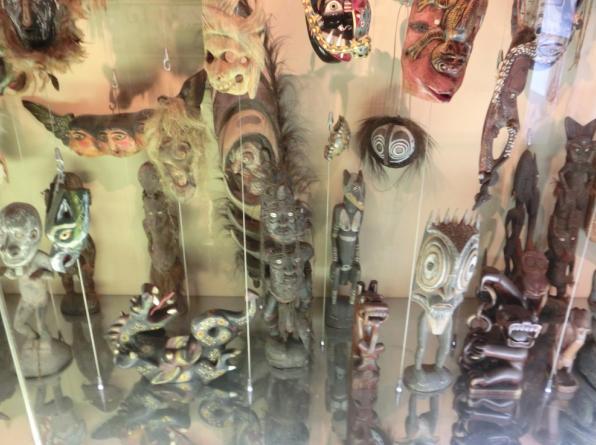
Mizuki Shigeru Rapaul Mask Collectionjpg

Mizuki Shigeru not only loved the people and lifestyle, he also loved the yokai of New Guinea. Over the years he compiled a vast collection of New Guinea masks, statues, and artifacts. He made recordings of the songs and dances of the Tolai, and displayed his collection in his home in what was called the Natural History Room by his family. When things were stressful at work, Mizuki would go into his room, play the sounds of New Guinea and drift away in his mind to life among the Tolai, and his friend Topetoro.

Many of Mizuki’s New Guinea artifacts are now displayed in the Mizuki Shigeru Memorial Museum in his hometown of Sakaiminato, Tottori.

In 2003, the people of New Guinea honored Mizuki Shigeru’s long relationship with the Tolai by inaugurating Mizuki Shigeru Road in Rabaul.

Preorder Showa: A History of Japan

You can read all about Mizuki Shigeru’s adventures on Rabaul and life amongst the Tolai—and much, much more—in Showa: A History of Japan.

The first volume is available for pre-order on amazon.com (and probably other places as well).

Showa 1926-1939: A History of Japan

Translator’s Note:

Mizuki Shigeru’s adventures amongst the Tolai was one of my favorite parts of translating Showa: A History of Japan. Mizuki’s time on Rabaul is both terrifying and touching, and I often found myself getting a bit weepy mid-translation because I was so caught up in the story. It’s pretty powerful.

I was inspired to write this when I found this picture of Mizuki in New Guinea on this blog— the first photograph of this time I have ever seen. Maybe the only one publically available. I looked around but couldn’t find any others. I wanted to post the picture, and figured I better write an article to give it context for those who haven’t yet read Showa: A History of Japan.

What are Hanyō?

Hanyo_Kanji

Half human. Half yokai. Hanyo have become a staple character in recent yokai comics and animation. But do they have roots in Japanese folklore?

Kuniyoshi_Kuzunoha Abe no Seimei

The answer to that is a pretty resounding no. Hanyo are almost exclusively the creation of modern comic book artists and animators. More specifically, hanyo are the creation of Takahashi Rumiko, and to a lesser extent Mizuki Shigeru. While half-human/half-yokai children do exist in Japanese folklore, they are—with few exceptions—normal human beings. Whatever it is that makes a yokai, it doesn’t carry over to their half-human children.

What Does Hanyo Mean?

Hanyo is a neologism invented by Takahashi Rumiko for her comic book Inyuyasha. She took the kanji Han (半; half) and put it next to Yo (妖; apparition)—alternately spelled hanyou in an attempt to imitate the Japanese long vowel sound—to create a word for her concept of half-yokai characters. Takahashi has created an entire mythology around yokai, with variations depending on if their mother or father was a yokai, and attempts to become a full-blood human or yokai.

Inyuyasha Hanyo

Mizuki Shigeru had earlier invented the term hanyokai (半妖怪; half-yokai) for his characters Nezumi Otoko and Neko Musume in his comic Gegege no Kitaro. In Mizuki Shigeru’s comics, the two hanyokai are in practice 100% yokai (Nezumi Otoko is over 360 years old, for example) and the term is used largely as an insult. Kitaro sometimes talks down to Nezumi Otoko for being only a hanyokai and not a true yokai. This was possibly mirroring the distaste for half-Japanese children when Gegege no Kitaro began, most of whom were the children of occupying U.S. soldiers and Japanese women.

Nezumi Otoko Neko Musume

It could also relate to Mizuki Shigeru’s theory of yokai being single-souled and humans having double-souls. Yokai being single-souled, focusing on whatever their task or motivation is—counting beans or whatever. Humans, and the other hand, were conflicted and at war with themselves. In Gegege no Kitaro, Nezumi Otoko is one of the few characters that “switches sides” between good and evil, possibly resulting from his human double-soul. But the same cannot be said for Neko Musume, who is squarely on Kitaro’s side. So this is just speculation. Maybe he just thought hanyokai sounded cool.

Half-Yokai/Half-Human in Japanese Folklore

The children of yokai and humans—and even yurei and humans—are relatively common in Japanese folklore. Almost all of these stories fall in the Magical Wife genre (I have never heard of a Magical Husband story). The stories follow a similar patter where a man performs some task/has an encounter, later a mysterious woman comes to be his wife provided he perform some condition like never speak of the previous encounter, never look in a box, etc … The couple live happily for several years, have some kids, and inevitably the husband breaks his promise and the Magical Wife leaves.

The most famous Magical Wife story is the tale of the Yuki Onna, where a snow demon comes upon two woodgatherers freezing in the forest. The Yuki Onna kills the older one, then falls in love with the younger. She eventually marries him as a human—under the condition that the husband never speak about his frozen encounter—has children and lives together many years. When the husband eventually gabs, the Yuki Onna flees, abandoning her children and spouse.

There are many, many more Magical Wife stories, like Hagoromo the Tennin and some about transformed animals and henge. There are stories where a dead woman’s yurei returns to her husband, take cares of him and bares his children, performing her wifely duties before she is able to return to the afterlife. The one thing these stories have in common is that the children from these mystical mash-ups are all normal, human children.

(The Magical Wife genre is popular in Western folktales as well, popular enough that it has its own classification under the Aarne–Thompson classification system—#402 The Animal Bride.)

The Exceptions—Kintaro and Abe no Seimei

There are always exceptions. In this case, there are two of them, although only one could really be called a hanyo or hanyokai.

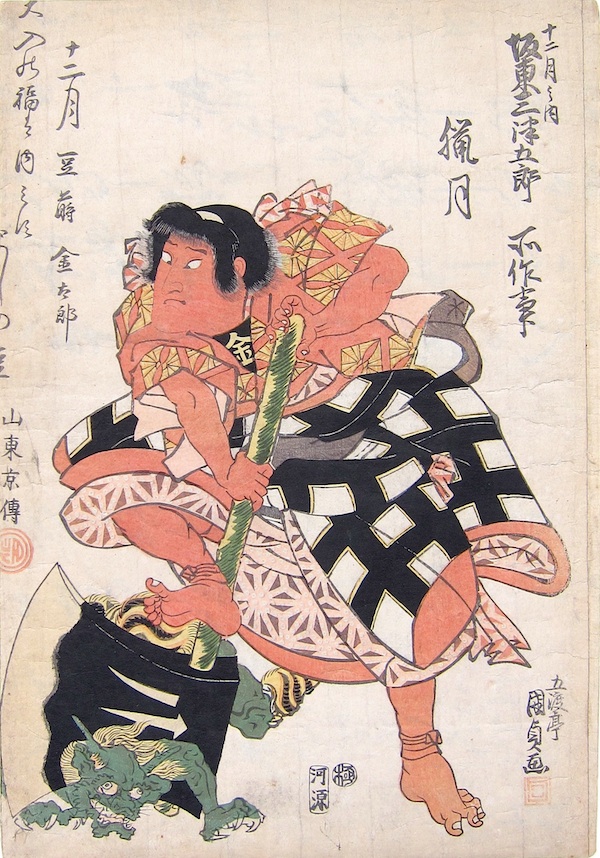
Kintaro the Nature Boy is one of Japan’s most famous and popular folkloric figures. Incredibly strong even as a baby, and friends with the bears of the woods, there are multiple variations of his origins. In one of them, his mother the Princess Yaegiri became pregnant when the Red Dragon god of Mt. Ashigara sent a clap of thunder to her. This is not the most common origin for Kintaro—most stories have his mother fleeing some conflict while pregnant and giving birth in the mountains. And even then, with a Red Dragon as a father Kintaro would more properly be a hanshin, a demi-god, and not a hanyo.

Kunisada_Bando_Mitsugoro_IV_as_Kintaro

Abe no Seimei is the other exception. A real person, Abe no Seimei was a famous onmyoji ying/yang sorcerer during the Heian period. He has since passed into folklore, and it is difficult to separate the fact from the legend when it comes to Abe no Seimei. One of the legends, however, is that his mother Kuzunoha was a kitsume, a magical fox.

Nakifudo_Engi_Abe_no_Seimei

The legend states that Abe no Yasuna came upon a hunter trapping a fox. Yasuna battled the hunter and won, and set the fox free. A beautiful woman named Kuzunoha appeared to tend his wounds, and the two fell in love and married. Their child Seimei was born, who was exceedingly bright. One day, while Kuzunoha was watching chrysanthemums, a young Seimei saw a piece of fox tail poking out from her kimono. The spell broken, Kuzunoha the fox returned to the forest, leaving her son behind but granting him a piece of her magical powers. This makes Abe no Seimei the only true hanyo in Japanese folklore.

Yoshitoshi-Kuzunoha Abe no Seimei

The Children of Ubume

There is one more semi-exception. Ubume are a specialized type of yurei, who die while pregnant leading to a still-living child being born from a dead body. Ubume are ghost mothers who come back to tend for their living child, who is often trapped in a coffin buried under the earth. By some legends, the children of these ubume are special, often faster and stronger than normal humans.

The most famous ubume child is, of course, Kitaro from Gegege no Kitaro.

Translator’s Note:

I wrote this because I get asked fairly often about hanyo, mostly from fans of Inyuyasha who want to know how authentic Takahashi Rumiko’s use of Japanese folklore is. The answer is “not very.” She creates her own worlds with her own mythologies. But her creation of hanyo has proved popular enough to crop up in other comics as well, like Rise of the Nura Clan and Maiden Spirit Zakuro.

However, true human-hybrids are exceedingly rare in Japanese mythology and folklore.

Further Reading:

For more stories from Hyakumonogatari.com, check out:

The Yurei Child

What Does Yokai Mean in English?

How Do You Say Ghost in Japanese?

Hashihime – The Bridge Princess

Mizuki Shigeru Hashihime

Translated and Sourced from Mizuki Shigeru’s Mujyara, Kaii Yokai Densho Database, Japanese Wikipedia, and Other Sources

Nothing quite embodies the saying “Hell hath no fury like a woman scorned” like the Hashihime. A human woman consumed by jealousy and hatred, she transformed herself through sheer willpower—and the assistance of a helpful deity who taught her a complicated ritual—into a living demon of rage and death. A yokai from the Heian period, she is one of the most powerful and fierce creatures in Japan’s menagerie.

What Does Hashihime Mean?

With only two kanji, her name is straight-forward: 橋 (hashi; bridge) 姫 (hime; princess). But there is a secret meaning hidden inside. In ancient Japanese, the word airashi (愛らしい; pretty; charming; lovely; adorable) could be pronounced “hashi.” So “Hashihime the Bridge Princess” was also a homophone for (愛姫) “Hashihime the Pretty Princess.”

Segawa kikunojō no hashihime

The only real question is why does such a horrible demon have such a lovely, delicate name? This is because the name predates the monster. There have been Bridge Princesses—benign deities of the water—for far longer than there have been jealous women with crowns of iron and burning torches clenched between their teeth.

Hashihime as Water Goddess

Masasumi_Hashihime

Going back into ancient, pre-literate Japan, there has long been a mythology built around bridges. Japan was—and still is—an animistic culture where nature is embodied by spirits of good and ill. The wonders of nature, like particularly large and twisted trees or odd and out of place rocks, had their own guardian deities called kami. Rivers too, especially large rivers, were the abodes of gods.

Bridges across these rivers were the proverbial double-edged sword. They allowed you to cross for commerce and trade, but they also allowed enemies in. Any bridge of significant size was believed to have guardian deities that acted as gatekeepers, letting allies in and keeping enemies out.

The guardian deities of bridges were thought to be a matched set—you had both a male and female river deity, a Bridge Prince and a Bridge Princess. Shrines dedicated along these bridges were dedicated to both equally.

Overtime, the female deity became the more popular of the pair—she was thought to be luminously beautiful and sometimes appeared in human form.

In the year 905 CE, we get one of the oldest known written mentions of the Hashihime, in a poem from the 14th scroll of the Kokin Wakashū (古今和歌集; Collection of Poems of Ancient and Modern Times). This is especially notable because it mentions not just any Hashihime, but the Hashihime of Uji—a legend that would come to dominate all images of this fantastic creature.

“Upon a narrow grass mat
laying down her robe only
tonight, again –
she must be waiting for me,
Hashihime of Uji”

Hashihime as Female Demon

How the transformation happened—from benign, sexy river goddess to avatar of female rage—is unknown. Most likely it happened like all folklore, organically and over time. The shrines to the Hashihime existed near bridges, and as people forgot their original purpose they began to make up new stories. Most of these stories tended to include some legend of the Hashihime as “woman done wrong.” There are old legends of a woman whose husband went off to war and never came back, and she wept by the river bank in sorrow until she was transformed into the Hashihime. Others are stories of jealousy and revenge.

“Hashihime” is the title of one of the chapters of Japan’s first work of literature, Genji Monogatari (源氏物語; The Tale of Genji) and she is mentioned several times throughout. While the Hashihime is used mostly as a metaphor, Genji Monogatari tells the story of Lady Rokujo, a woman consumed and transformed by jealousy into a monster. Lady Rokujo becomes an ikiryo, a rare creature in Japanese folklore able to release their soul—their reikon—and all of its powers while they are still alive.

Kikugawa Eizan Hashihime Twelve Seasons of Genji

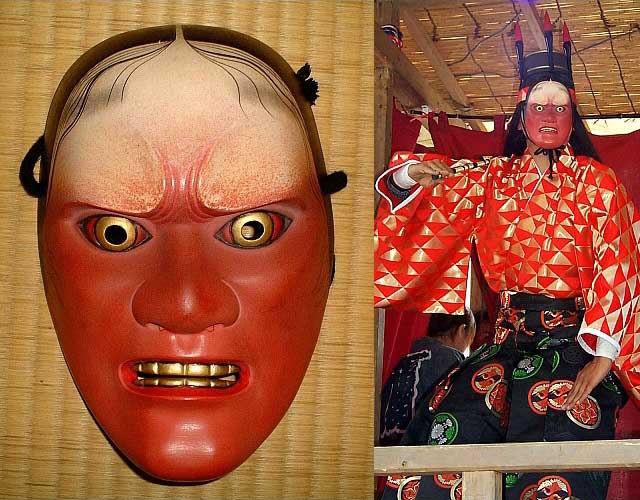
While Lady Rokujo is not the Hashihime, this story of the power of a woman’s jealousy caught the Japanese imagination, and more and more similar characters started to appear in theater and song. Noh Theater in particular loved the Hashihime, and the face of the Hashihime is one of the official masks of Noh.

The Heike Monogatari and the Hashihime of Uji

The story of the Hashihime was solidified in the Heike Monogatari (平家物語; The Tale of the Heike), an epic poem handed down by oral tradition not unlike The Odyssey. Because the Heike Monogatari was told by so many storytellers over so many generations, when written language was discovered multiple, conflicting versions of the poem made it onto the printed page.

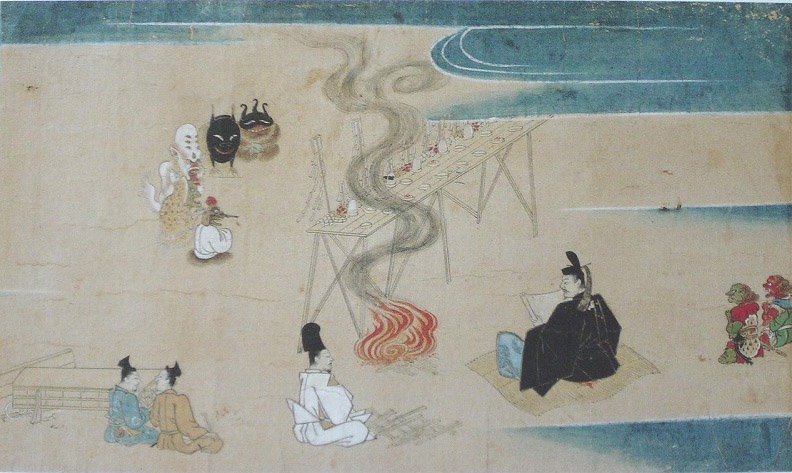
Many of these versions told a story of the Hashihime of Uji. She was a noble woman who—by conflicting accounts—either had a husband who cheated on her, or who took a second wife and paid more attention to her. The unnamed woman prayed to the Kami of Kifune for revenge, and was given a complicated ritual that would turn her into a still-living oni.

For more details and a translation of the Heike Monogatari, see The Tale of the Hashihime of Uji.

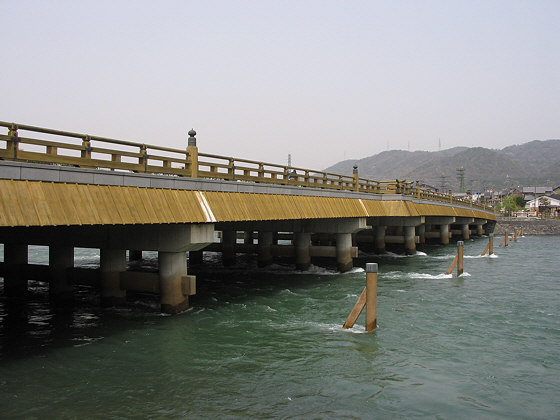
uji_bridge

The Heike Monogatari emphasizes repeatedly than the Hashihime is a “still-living” oni. This is different from other versions of the tale, where the woman dies in the river and rises again as the Hashihime (although not as a yurei. The Hashihime is never a ghost). In Japanese folklore, death has a powerful transformative effect—many stories follow the pattern of post-death revenge. So the Hashihime of Uji being a “still-living” oni adds and extra layer of unnatural terror.

The Hashihime of Uji influenced all following interpretations of the Hashihime, and remains definitive. When Toriyama Sekien put the Hashihime in his Konjyaku Gazu Zokuhyakki (今昔画図続百鬼; The Illustrated One Hundred Demons from the Present and the Past) he specifically referred to her as the Hashihime of Uji.

Toriyama Sekien Hashihime of Uji

Toriyama’s Text:

“The Goddess Hashihime lives in the under the Uji Bridge in Yamashiro province (Modern day Southern Kyoto). That is the explanation for this drawing of the Hashihime of Uji.”

Kanawa – The Iron Crown

hashihime Noh

The Noh play Kanawa (鉄輪; The Iron Crown) comes from one of the versions of the Hashihime story from the Heike Monogatari. In this version, the courtly woman has a husband who takes a second wife, as was the custom at that time. The woman is overcome with jealousy about the second wife, and tries to curse and kill her. But her husband has consulted with the great yin/yang sorcerer Abe no Seimei, who arrives at the last moment to break her curse.

Abe no Seimei then constructs a katashiro, a paper amulet in the form of a human, that reflects the curse back on the first wife, transforming her into a demon. (At this part of the play the lead actor changes into the Hashihime mask). Ashamed of her appearance, the woman (now the Hashihime) flees back to the river, jealousy and revenge burning in her heart.

The Hashihime again attacks the second wife, but is beaten off my Abe no Seimei with the assistance of 30 kami spirits. The Hashihime claims she will return, and disappears.

Other Hashihime

Although she is by far the most famous, the Hashihime of Uji is not the only Hashihime. Nagarabashi bridge over the Yodogawa river in Osaka and the Setanokarabashi bridge over the Setagawa river in Sega prefecture also lay claim to their own Hashihimes.

The Hashihime Shrine

hashihime_shrine

A little off the beaten path, near Uji Bridge, you can find the Hashihime Shrine. It isn’t a big place, and people might not be so eager to guide you there because of the shrines’ reputation—and what it is for.

Shrine records claim the Hashihime Shrine dates back to 646 CE, making it older than most known legends of the Hashihime of Uji. Most likely it was originally dedicated to the water goddess under the bridge, and the kami of the shrine evolved along with the legends.

The shrine is unusual in that it is essentially a divorce shrine. People come—mostly women, to be honest—to pray for freedom from difficult or unwanted attachments. This can be anything or anyone you want to be free of, but in practice most women come to pray for divorce or miscarriage.

The shrine even sells you something to help you on your way. Most Shinto shrines sell some sort of amulet, something to protect you from bad spirits. The Hashihime Shrine does too—it sells magical scissors that you can use to metaphorically cut yourself from entanglements, all without needing to transform yourself into a still-living oni bent on revenge.

Further Reading:

The Hashihime is the last in my series on trivet-wearing yokai. For the rest of the trivet-wearing yokai, check out:

The Tale of the Hashihime of Uji

Ushi no Koku Mairi – The Shrine Visit at the Hour of the Ox

Gotokoneko – The Trivet Cat

Translator’s Note:

This is part 2 of the long-requested Hashihime. I translated the text from the Heike Monogatari for the first part, and this entry gives more of the history and context. The Hashihime is a favorite of mine because I have spent quite a bit of time in Uji. Uji is one of my favorite places in all of Japan. You really should go there if you are ever in Japan. It is stunningly beautiful, with century-old teashops and the magnificent Byoudoin temple. Of course, you must also visit the Uji Bridge where the Hashihime dwells and the Hashihime Shrine to pay your respects.

Mizuki Shigeru’s French Fry Heaven

Mizuki Shigeru French Fry Heaven

Translated from Mizuki Shigeru’s Twitter Account

Mizuki Shigeru relishes his Double Quarter Pounder from McDonalds this spring afternoon. He eats a bit of burger, then some French Fries. Look how he closes his eyes to savor the flavor.

Translator’s Note:

This picture from Mizuki Shigeru’s Twitter account was too good not to share. The great sensei savoring one of his favorite treats, a McDonald French Fry.

Mizuki Shigeru posts a lot of food pictures. This isn’t really anything amazing–lots of people post food pictures.  But after translating Showa: A History of Japan, I have a much better perspective on his absolute adoration of food.

This is a man who almost starved to death, and watched people starve to death all around him when he was stationed on Rabaul island. Food has a deeper meaning to him than I think any of us can understand. One of the lines of Showa that really stood out to me was when his character Nezumi Otoko is explaining the lack of food, and he looks to the audience and says:

“I don’t think you modern readers can really understand how terrible it is, to have no food. Starvation is more than just an empty stomach. Hunger eats away at your soul. You slowly succumb to despair until you can’t see any hope in the world.”

Keep that in mind when you look at this picture. Sure, on the one hand it is a funny picture of a great genius having fun with something as mundane as a McDonald French fry. On the other hand it is a picture of a man who knows more than most people the actual connection between eating and being alive, and who embraces every bite with a gusto we will never know.

Eat well, sensei!

You can pre-order Showa 1926-1939: A History of Japan here:

Showa 1926-1939: A History of Japan

Tesso – The Iron Rat

Mizuki_Shigeru_Tesso_Iron_Rat

Translated and Sourced from Mizuki Shigeru’s Mujyara, Kaii Yokai Densho Database, Japanese Wikipedia, and Other Sources

In Japanese folklore, if you make a promise you had better keep it—even if you are the Emperor of Japan. Otherwise, the person you betrayed might hold it against you and transform into a giant rat with iron claws and teeth and kill your first-born son. That is the story of the Emperor Shirakawa, his son Prince Taruhito, and the Abbot of Miidera temple Raigo—better known as Tesso, the Iron Rat; or more simply as Raigo the Rat.

What Does Tesso Mean?

The kanji for Tesso is about as straight-forward as you can get. 鉄 (te; iron) +鼠 (sso; rat). The name Tesso was given to this yokai by artist Toriyama Sekien in his yokai collection Gazu Hyakki Yako (画図百鬼夜行; The Illustrated Night Parade of a Hundred Demons,), although the character is much older.

SekienTesso

Toriyama’s Text: The Abbot Raigo transformed into a monsterous rat.

Tesso is different from many yokai in that he is a singular character. There is only one Tesso. Until Toriyama came up with the much cooler name for his collection, Tesso was known as Raigo Nezumi (頼豪鼠), meaning Raigo the Rat.

The Story of Raigo the Rat

The tale begins with the Emperor Shirakawa, who was desperate for an heir to his throne. He enlisted the aid of the Abbot of Miidera temple, a powerful Buddhist monk named Raigo. Emperor Shirakawa promised Raigo vast rewards if he could use his spiritual powers to give the Emperor a son. Accepting the offer, Raigo threw himself into meditation and prayer and magic. Soon enough a son was born to Emperor Shirakawa, the Prince Taruhito.

Yoshitoshi_The_Priest_Raigo_of_Mii_Temple

Raigo went to the Emperor for his promised reward, and asked only for the funds to build an ordainment platform at his temple of Miidera. The Emperor was too happy to oblige, until temple politics interfered.

Miidera had a rival temple, the powerful Enraku-ji in Mt. Hiei in Kyoto. The monks of Enraku-ji were not normal, peaceful monks, but a terrible army of militant warriors feared across all Japan. It was said the Emperor could influence all on Earth except three things—the blowing of the wind, the rolling of dice in a cup, and the monks of Enraku-ji. Even though they were both of the Tendai sect of Buddhism, Miidera and Enraku-ji has split into different factions after the death of their founder. Enraku-ji was not about to allow new Tendai monks to be ordained at Miidera, a privilege they reserved for themselves.

The Emperor had no choice but to break his promise to Raigo. He asked if there was anything else he could give, but Raigo was adamant. So adamant, in fact, that he went on a hunger strike and died after 100 days, cursing the Emperor with his final breath. At the house of his death, a figure in white was said to have appeared beside the cradle of the 4-year old Prince Taruhito, who died soon afterward. What Raigo had given, Raigo had taken away.

What happened next was strange—up until now this is the usual ghost story with Raigo returning as a yurei. But the tale does not end there. Raigo used black magic to ensure he was reborn after death as a dread yokai. He twisted his body into the form of a giant rat as large as a man, with a body as strong as stone and with claws and teeth or iron.

The newly-named Raigo the Rat invaded Enraku-ji with an army of rats, devouring their rare and valuable Buddhist scriptures, and even eating statues of the of the Buddha himself. This reign of rat-terror when on until a shrine was built to appease Raigo, transforming him from a deadly emissary of vengeance into a protecting kami spirit. Because that’s how evil spirits roll in Heian-period Japanese folklore.

Raigo the Onryo

Old texts describe Raigo as an onryo, the name for the grudge-bearing spirit popular in Japanese horror films. Raigo wouldn’t be seen as an onryo nowadays—his transformation into a rat makes him more of a monster than a ghost. But in the Heian period the word onryo had a more specific meaning, being something with a grudge against the Emperor of member of the Imperial family. And that label suits Raigo just fine.

Raigo and the Heike Monogatari

The story of Raigo comes from the Heike Monogatari (平家物語; Tale of the Heike) an epic poem from the Heian period that tells of the Heike/Taira wars that split Japan as two factions struggled for the throne. The Heike Monogatari is often called Japan’s version of The Odyssey, freely mixing historical fact with the supernatural and mythological.

Because the Heike Monogatari comes from an oral storytelling tradition, there are multiple versions of it with variations of the story of Raigo the Rat. In one of the older versions—the Engyo Hon (延慶本; Book of the Engyo Period), the story ends with the death of Prince Taruhito. In later versions Raigo gets more and more monstrous. The 48-volume Genpei Seisuiki version has Raigo attacking Enraku-ji with his army of rats, and in the 14th century historical epic Taiheiki (太平記; Record of the Great Peace) Raigo is described as having a body of stone and claws and teeth of iron. This Raigo ate not only the sacred texts of Enrakuji, but also their statue of Buddha.

Other Tales of Raigo

Raigo the Rat was a popular enough character that other writers continued the story after the Heike Monogatari. For example, a collection of Tanka poems from Otsu city, Shiga prefecture called Kyoka Hyakumonogatari (狂歌百物語; A Hundred Stories of Satirical Poems) featured the poem Raigo of Miidera and retold the story from the Heike Monogatari.

During the Edo period, author Gyokutei Bakin wrote the story Raigo Ajari Kaisoden (寺門伝記補録; The Tale of the Abbot Raigo who Transformed into a Monsterous Rat), illustrated by famous ukiyo-e artist Katsushika Hokusai.

Raigo_Ajari_Kaisoden

Gyokutei puts Raigo into a different historical narrative, telling the story of Shimizu Yoshitaka (also known as Minamoto no Yoshitaka), the orphaned son of Minamoto no Yoshihara. Yoshitaka was on a pilgrimage of holy sites when he had a vision of the Raigo, who told Yoshitaka he would teach him the secrets of black magic and help him amass an army to take vengeance against his father’s killers. All Yoshitaka has to do is write an official request for help, and place it before Raigo’s shrine along with a donation.

Yoshitaka does as requested (of course), and soon finds himself in possession of Raigo’s shape-changing ability and mastery over rats. As an additional twist, Yoshitaka is hunted by Nekoma Mitsuzane (who’s name ironically begins with the kanji for “cat” in a traditional cat-and-mouse game). In one scene, Nekoma finds Yoshitaka and is about to kill him when a massive rat leaps to Yoshitaka’s defense. In another scene, Nekoma is torturing Yoshitaka’s mother-in-law and Yoshitaka leads and army of rats to her defense, saving the day.

Hundreds of years later, Raigo still has a hold on the popular imagination. Modern author Kyogoku Natsuhiko used the story of Raigo as the basis for his mystery novel “Tesso no Ori” (鉄鼠の檻; The Cage of the Tesso).

The Historical Raigo

Although the tale of Raigo the Rat is fictional, most of the key players are historically verified. Shrine records show Raigo was the Abbot of Miidera, and at one time petitioned Emperor Shirakawa for funds to build an ordination platform—a petition that was denied. There is little doubt that rival temple Enraku-ji played some hand in the denial. At the time, Enraku-ji’s power was absolute.

The only person not involved in the affair was Prince Taruhito. Records put the young Prince’s death in 1077, while Raigo himself died in 1084. This contradicts the facts of the legend.

Hokusai_Tesso_Monster_Rat

Rats, of course, were an actual source of fear to the fragile book collections of temples across all of Japan. So it is no wonder that a double-punch of an angry spirit and a scroll-eating rat was a natural mixture for Kaidan.

Tesso Shrines

There are a couple of supposed shrines to Raigo, each claiming to be THE shrine that ended Raigo’s scroll-devouring revenge.

In Hyoshi Taisha, in the Sakamoto district of Otsu city, Shiga prefecture, there is a shrine called the Shrine of the Rat that some connect to Raigo. Shrine records, however, say that the shrine is dedicated to the Rat God of the Chinese Zodiac and not to Raigo.

Tesso Shrine of the Rat

Miidera shrine has the most obvious connection, and has a small monument and shrine dedicated to Raigo also called the Shrine of the Rat. This shrine faces directly at Mt. Hiei in Kyoto and is said to be placed in defiance of Enraku-ji’s role in Raigo’s curse.

However, Mt. Hiei has their own shrine—the Shrine of the Cat—that looks directly at Miidera. Some suspect the two shrines are connected by an older legend of a monk who summoned a giant cat to destroy a giant rat that was menacing the area.

In truth, probably both of these Shrines of the Rat were re-dedicated to suit interests in the story. Like Relics in Catholic churches, a shrine or artifact connected to a popular legend can mean tasty tourist dollars and neither Buddhist temples nor Shinto shrines never let the facts get in the way of a good story. Especially one that attracted tourists.

Translator’s Note:

This was translated for Mike Mignola, who picked out Tesso from a copy of Mizuki Shigeru’s Mujyara that I showed him at Emerald City Comic Con. Mignola liked the illustration of Tesso, and I am only too happy to give him the story behind the image.

Plus, I did a lot of cats last year. It is only fair that at least one rat gets to appear as well.

Previous Older Entries Next Newer Entries

Copyright notification

All translations and other writing on this website were created by Zack Davisson and are copyright to him.

Copyright notification

In accessing these web pages, you agree that any downloading of content is for personal, non-commercial reference only.

No part of this web site may be reproduced or transmitted in any form or by any means, electronic, mechanical, photocopying, recording or otherwise, without prior permission of Zack Davisson.

Copyright notification

For rights clearance please contact Zack at:

zack.davisson (at) gmail.com

Thank you.