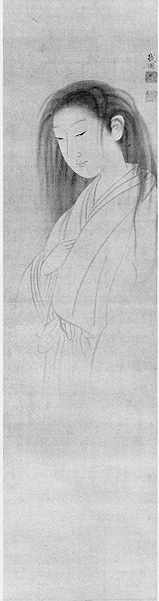
Konnyaku no Yurei – The Konnyaku Ghost of Tenri

Mizuki_Shigeru_Konyaku_Yurei

To learn more about Japanese Ghosts, check out my book Yurei: The Japanese Ghost

Translated and Sourced from Mizuki Shigeru’s Mujyara, Legends of Tenri, and Other Sources

This peculiar story comes from Tenri city, in Nara prefecture. In the span separating Kabata ward from Inaba ward, there is a stone bridge nicknamed the Konnyaku Bridge. This is why.

Long ago, a rice dealer named Magobei was making his way across the city at night when he went to cross the stone bridge. Before he could cross, a female yurei appeared on the center of the bridge, with a large piece of konnyaku hanging from her mouth. Terrified, Magobei dropped to his knees and began chanting the name of the Amida Buddha over and over again. When he reached the 99th repetition of the Buddha’s name, the bizarre konnyaku yurei disappeared. With the way cleared, Magobei ran home as fast as his legs could carry him.

He later heard that there had been a married couple in town who had quarreled over a piece of konnyaku, and that somehow lead to the wife’s death. The details were unclear, nor did anyone know exactly what the woman wanted. It is said that she appeared from time to time on that bridge, always with the same chunk of konnyaku dangling from her mouth. And that stone bridge has been known as the Konnyaku Bridge ever since.

Translator’s Note:

Another short and sweet yurei tale for Halloween! This one is a local legend that Mizuki Shigeru collected, from the town of Tenri in Nara prefecture. I lived in Nara for several years, but unfortunately didn’t know this story at the time. I would have gone in search of the Konnyaku Bridge!

There are actually several Konnyaku Bridges across Japan. Some have legends attached to them, like the Konnyaku Ghost of Tenri, but most likely these legends came long after the name. Traditionally, Konnyaku Bridges were low water wooden crossing bridges that tended to wobble and shake like the eponymous konnyaku. The sturdy stone bridge in Tenri being called a “Konnyaku Bridge” is odd enough for someone to create a ghost story about.

They are fairly unsafe, and most of these have been replaced by modern bridges although they retain their names. Like many vanished parts of Japan, those wobbly Konnyaku Bridges are nostalgic enough for a sappy pop song to be written about them.

Konyaku Bashi

Here’s a picture of a Konnyaku Bridge in Hyogo, from this blog

If you aren’t familiar with it, konnyaku is a unique Japanese food that is almost impossible to describe. The dictionary calls it “solidified jelly made from the rhizome of Devil’s Tongue.” It usually comes in a squishy block of …. yeah, OK. “Solidified jelly” is about the best term there is. So a block of “solidified jelly” that is sliced and added to salads, or boiled and added to soups like nabe and oden, or put on a stick and grilled. I made konnyaku once, and it is a process as bizarre as the food sounds. It makes you wonder who on Earth saw the nasty, starchy root called Devil’s Tongue and figured that it you pounded it and boiled it enough you could render it into something edible.

MINOLTA DIGITAL CAMERA

Needless to say, konnyaku is an acquired taste. I like it myself, mainly grilled and slathered with hot karashi mustard, but I know far more people that loathe it than love it. At least amongst the non-Japanese. In Japan it is just standard fare.

Oh …. And although it doesn’t relate to this story, konnyaku is known to be a killer. Because of its solidified jelly status it can literally be hard to swallow. Konnyaku has been known to get stuck in the throats and suffocate those whose throat muscles aren’t strong enough to move it down—mainly small children and the elderly. With the konnyaku hanging out of this yurei’s mouth, it makes you wonder if her husband didn’t kill her by shoving a piece down her throat. Not a pleasant way to die.

There is another story from Wakayama prefecture called the Konnyaku Yurei, but instead of the ghost of a woman it is about an old piece of konnyaku that somehow became a yokai. A story for another time.

Further Reading:

Bridges are a popular haunting spot for Japanese ghosts and monsters. Check out:

Gatagata Bashi – The Rattling Bridge

Hashihime – The Bridge Princess
The Tale of the Hashihime of Uji

The Kappa of Mikawa-cho

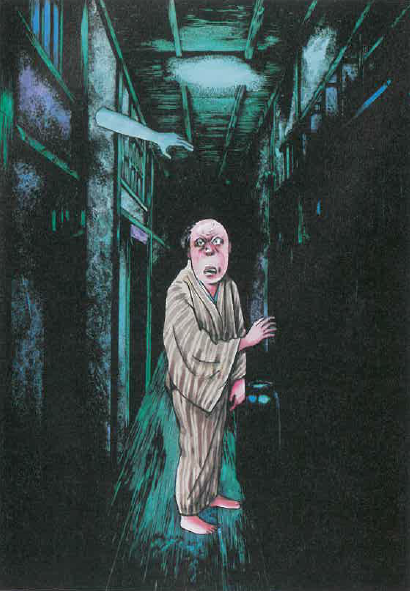
Manekute no Yurei – The Inviting Ghost Hand

Mizuki_Shigeru_Manekute_no_Yurei

Translated and Sourced from Mizuki Shigeru’s Mujyara and Other Sources

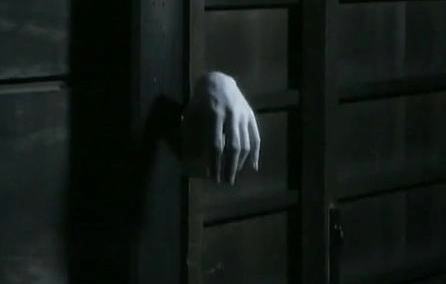
Late at night, when you have to get up to go to the bathroom, a mysterious hand beckons you from a wall. That’s strange enough, but when you go into the room the hand was inviting you to, no one is there. Most likely, you have encountered the yurei of someone who died in that room long ago—they want something, but have only the strength to manifest a single hand to plead with you.

These kinds of stories are typical in Japan, especially in yurei in houses. Generally, they want nothing more than for someone to acknowledge their presence, and read a sutra in their honor at the local temple. Manekute no Yurei tend to gather around houses near temples, or the particularly pious, those who they feel will be able to perform the desired ceremony.They are spooky, but amongst the least dangerous of the types of yurei.

Here is a typical story from the Edo period:

An abbot was making a trip to Akiyama village, when he heard the sounds of footsteps behind him. The abbot was particularly sensitive to ghostly matters, and knew at once what it was. “Ah, that is a poor, lost soul who died in the terrible drought in this village awhile back. So sad to think it is still hanging on long past its time.”

When he arrived at the village, the abbot prepared a copy of a Buddhist sutra. This done, he returned to where he had heard the footsteps and waited for dark. Sure enough, a milk-white hand thrust out to him from the darkness. The abbot laid the sutra in the disembodied hand and began to chant the memorial service for the dead. The unknown yurei disappeared and was never heard from again.

Translator’s Note:

Another yurei story for Halloween, this one short and sweet compared to the last tale of bloody revenge. The Manekunote Yurei (招く手の幽霊; meaning招く手 (manekute; inviting hand) +幽霊 (yurei) is one of those ghosts where there was probably a story or two about it, and Mizuki Shigeru made up a name the phenomenon to include in his yokai encyclopedia. I haven’t found any other reference to the Manekunote Yurei, except for those that specifically site Mizuki as a source. However, like many of his stories the Manekunote Yurei has escaped Mizuki’s pages and into the popular imagination.

Menekute_no_Yurei_TV_Show_1

Menekute_no_Yurei_TV_Show_2

Pictures of a Manekute no Yurei on a TV show from this site.

But naming aside, this is another story that illustrates one of the fundamental principles of yurei, Japanese ghosts—they want something. Western ghosts can linger in a place like psychic residue, or play over and over again like a strip of looped film. But not Japanese ghosts. They are bound to this world by a specific desire, and when that desire is satisfied they move on. One of the most basic desires—and the most common—is the desire for more ritual. Yurei need to be properly feted before they can peacefully move on to the afterlife.

The unusual element of this story is the disembodied hand. It is atypical for yurei to manifest only a hand, and the will of the dead person must be weak indeed if that is the best that they can do.

Further Reading:

For more tales of random body parts, check out:

Tanuki no Kintama – Tanuki’s Giant Balls

Kyōkotsu – The Crazy Bones Yōkai

The Speaking Skull

The One-Armed Kappa

The Severed Heads Hanging in the Fowling Net

Goze no Yurei – The Yurei of the Blind Female Musician

Mizuki_Shigeru_Goze_no_Yurei

Translated and Sourced from Mizuki Shigeru’s Mujyara and Other Sources

To learn much more about Japanese Ghosts, check out my book Yurei: The Japanese Ghost

This story takes place during the Kyoho era (1716-1736). A samurai named Hotsumi Kanji,a minor prefect in Kitakuni province, was making his prescribed annual trip to the capital at Edo one year when he stopped at an inn along the way.

From his room, he heard the most beautiful singing voice he had ever heard in his life. It was coming from one of the rooms of the inn, and belonged to a goze, one of the blind women who traveled the country making their living performing on the shamisen.

Thinking that a voice so beautiful must be attached to an equally beautiful body, Hotsumi resolved to have the woman. Discovering which room was hers, he hid in the dark, waiting for her to return. When the goze returned, Hotsumi sprang from his hiding place and ravished her, an act which the woman was not opposed to in the least.

The next morning, Hotsumi was shocked to discover that the woman with the beautiful voice was unspeakably ugly. Her hideous faced beamed at him with a look of pure joy, thinking that she had at last found love. But nothing could be further from the truth—Hotsumi quickly concocted a plan, and took the woman with him on his way to Edo. On a convenient mountain road, he pushed the ugly blind woman into a ravine, killing her. Thinking he had solved the problem quite nicely, Hotsumi continued on his business.

The following year, Hotsumi had completely forgotten about the incident. Again, the time came for his trip to Edo, and this time he stopped at a small mountain temple to spend the night. That night, the yurei of the goze appeared before him. She said to him:

“Have you already forgotten last Autumn? You played with me, and then tossed me away when you were finished. I have no eyes, but I see you now!”

She grabbed Hotsumi by his ankles and tore him from his bed. He struggled to break away from her, but his strength was nothing compared to her rage-fueled power. Hotsumi saw himself being dragged to the temple’s graveyard. The goze stopped before a certain grave, smiled slightly, then embraced Hotsumi and drove him into the earth with one strong pull.

The monks of the temple heard the commotion and ran to see what the matter was. They followed the trail to the graveyard, and after retrieving shovels they dug quickly into the earth. They soon found Hotsumi’s body, with the skeleton of a woman wrapped around it. By fate or bad luck Hotsumi had chosen the temple where the goze’s body was buried after it had been discovered down in the ravine. And she had come to claim him.

Translator’s Note:

At last, a blood-thirsty tale of ghostly revenge for Halloween! This is one of those stories that pops up in several Edo-period kaidan collections, in a few variations. I created a kind of mix of the different versions, taking the pieces I like and assembling them together into a single story. For example, Mizuki Shigeru’s version in the Mujyara doesn’t have Hotsumi being drug into the grave, but just disappearing from the hotel. But I really like the grave bits so I left that in.

The title of the story is 瞽女の幽霊 (Goze no Yurei). “瞽女” (Goze)  is one of those weirdly specific Edo period words that refers to a blind woman who played the shamisen and worked as an itinerant entertainer. If you were a blind woman in the Edo period, there were only a few jobs available to you, and goze was one of them. Either that or masseuse/assassin, or so the movies tell me.

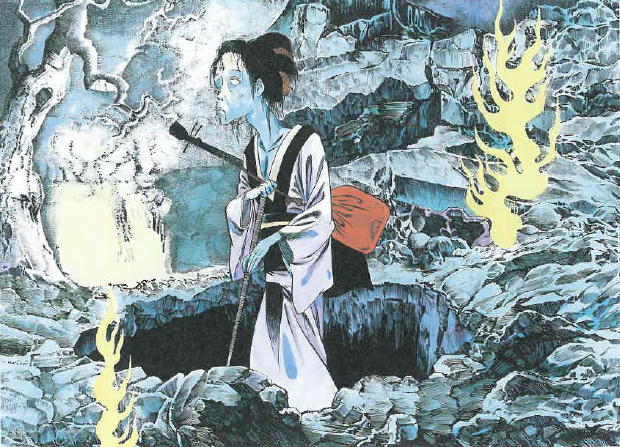
Mizuki Shigeru’s art uses Utagawa Hideyoshi’s 瞽女の幽霊 (Goze no Yurei) as an inspiration. I don’t know if Hideyoshi was painting exactly this story, or just a painting of the “stock character” of a goze’s ghost. Mizuki Shigeru certainly elaborated on the scenery when creating his version—Hideyoshi’s is on a simple background, with the yurei walking in water.

Hiroshige Ghost of a Blind Street Musician

In Japanese folklore, water has always been a pathway to the world of the dead. During the Obon Festival of the Dead yurei zoom across Japan’s rivers like a super expressway, coming home to meet their families then being sent back with lanterns floating out to sea. So Hideyoshi’s picture is more metaphysical than representational. The water is the world of the dead, not an actual river being crossed by the yurei.

Further Reading:

For more Japanese ghost stories, check out:

The Ghost of Oyuki

The Yurei Child

The Speaking Futon

The Yurei of the Melancholy Boy

The Two Measuring Boxes

Yuigon Yurei – The Last Request Yurei

Yuigon_Yurei_Mizuki_Shigeru

Translated and Sourced from Mizuki Shigeru’s Mujyara, Ehon Hyaku Monogatari, Japanese Wikipedia, and Other Sources

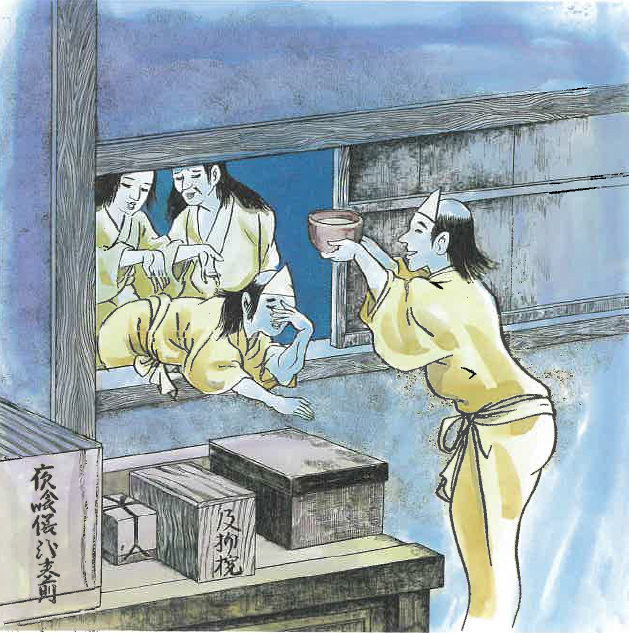
It is said that people who die with some lingering issue—those who didn’t properly close up their lives before dying—go into the afterlife with an overwhelming thirst. They want water. They beg and cry for water. But no one can see or hear them.

This story comes from an acquaintance who I will call A-san. She lives in Musashino city, Tokyo, and one night she met these yuigon yurei. When she was in middle school, one of her classmates suddenly showed up at her house one night. She appeared at the door and mumbled the words “Water please …. Water please … “ A-san ran to the kitchen to get a glass of water, but by the time she returned her classmate was gone. A-san thought it was weird that the girl was so thirsty but she couldn’t even wait the few minutes it took to retrieve the water.

She found out later her classmate had committed suicide that very night.

Later, when A-san told this story to her classmate’s mother, she was overwhelmed by A-san’s kindness in offering her dead daughter a final drink of water, and the two of them went together to place the glass before her child’s grave.

Translator’s Note:

This story is a first-person account from Mizuki Shigeru, telling the story he had heard from a friend about a late-night visit from a yuigon yurei. The term yuigon yurei (遺言幽霊) translates somewhat literally into “last-request ghost,” and refers to yurei making some sort of plea from the living. Usually this is for a drink of water, but it can be for other things—a prayer service, for example. The water-requesting version is also sometimes referred to as a Mizukoi Yurei (水乞幽霊; Thirsty Ghost).

This illustrates how yurei have needs even after death. It is a common custom in Japan to place offerings of food and drink before graves. Usually these are just comfort foods—a can of favorite beer, a pack of cigarettes, a pack of chips. On more formal occasions like the Obon Festival of the Dead they will get a bowl of rice and ritual sake.

The story comes for Yuigon Yurei comes from Mizuki Shigeru, but he modeled his picture after Takehara Shusen’s Yuigon Yurei picture from his Ehon Hyaku Monogatari (絵本百物語 ; Picture Book of a Hundred Stories).

Takehara Shunsen Yuigon Yurei

Takehara wote:

“Those who die without making their final testament, or with some unfinished business or desire, will find themselves thirsty in the afterlife. They will cry bitterly for a drink of water.”

Further Reading:

For more yurei stories, check out:

The Ghost of Oyuki

Shoraida – The Rice Paddy Ghosts

Gatagata Bashi – The Rattling Bridge

The Speaking Skull

Aizuwakamatsu no Yurei – The Yurei of Aizuwakamatsu

Aizuwakamatsu no Yurei – The Yurei of Aizuwakamatsu

Aizuwakamatsu_no_Yurei_Mizuki_Shigeru

Translated from Mizuki Shigeru’s Mujyara

Long ago, in the town of Aizuwakamatsu (modern day Fukushima prefecture) lived a man named Iyo lived with his wife. One night the yurei of a woman appeared in their house.

At first the dead woman—who was completely unknown to Iyo—appeared outside in the garden. She knocked on the closed door and called out the name of Iyo’s wife, who was sleeping beside him. Now, Iyo’s wife was a no-nonsense type of woman. When she heard the yurei calling her name, she shouted back “Who the hell are you and what do you want?” There was no answer other than the yurei again calling her name.

Being prepared for such a thing, Iyo’s wife reached into a special box she kept near their futon and withdrew an ofuda. The ofuda was a strip of paper, prepared by a local monk, with a charm of exorcism against ghosts. Iyo’s wife hurled the ofuda at the yurei, who disappeared like smoke blown away by a fan.

However, this yurei was not finished with Iyo and his wife. The next night she appeared in the kitchen, coming out of the fires of the burning stove. After that, she was in the garden again, walking the perimeter and pounding a bell with a wooden mallet. This went on for four days.

The wife knew when she was outmatched, and went to the local shrine to enlist the help of the kami and Buddhist spirits to protect their house. She reverently prayed to anyone who would listen, and as a result their house was quiet for the night. The yurei did not appear.

It was the eighth day since the haunting began. Apparently the protection Iyo’s wife was good for one night only. This time the woman’s yurei appeared directly in their bedroom, hovering over them near their pillows. Slowly she made her way to the foot of the bed, where she began to caress Iyo’s wife’s feet with her cold, dead hands.

That was enough for Iyo and his wife, who promptly moved out of the house. The ghostly woman remained a mystery; No one in the Iyo household had ever seen her before, or knew what she wanted, or why she had appeared.

Translator’s Note:

Another yurei story for Halloween. This one comes from Mizuki Shigeru’s Mujyara, and I have not been able to discover his source. As seen in Chikaramochi Yurei, Mizuki has no problem renaming stories when he thinks he has a better title, which can make it difficult to track down the originals. This may possibly just be a story he was told once.

This story is interesting because it illustrates one of the main trademarks of yurei (Japanese ghosts)—They want something. The people in the story may not always know what the yurei wants, and it can be something as simple as wanting to say thank you to someone that you didn’t get a chance to when you were alive (The Gratitude Expressing Yurei) to keeping a promised appointment (The Chrysanthemum Vow).

Mizuki makes a point in the story to reinforce the point that Iyo and his wife did not know the woman’s ghost nor what she wanted, which makes the haunting all the more bizarre from the Japanese perspective. Because they don’t know what she wants, they don’t know how to appease her.

(Of course, I think the wife in this story knew EXACTLY what the woman’s yurei wanted, and was just hiding it from her husband. The yurei is clearly only interested in Iyo’s unnamed wife, but her attentions seem like more of a sorrowful companion than a vengeful mistress. That makes me think Iyo’s wife was the one with the secret lover.)

Further Reading:

For more yurei tales of lost love and obligation, check out:

The Ghost of Oyuki

The Gratitude-Expressing Yurei

The Chrysanthemum Vow

The Black Hair

The Yurei Child

The Smoking Husband

Previous Older Entries Next Newer Entries

Copyright notification

All translations and other writing on this website were created by Zack Davisson and are copyright to him.

Copyright notification

In accessing these web pages, you agree that any downloading of content is for personal, non-commercial reference only.

No part of this web site may be reproduced or transmitted in any form or by any means, electronic, mechanical, photocopying, recording or otherwise, without prior permission of Zack Davisson.

Copyright notification

For rights clearance please contact Zack at:

zack.davisson (at) gmail.com

Thank you.