Shoraida – The Rice Paddy Ghosts

Shoryoda Mizuki Shigeru

Translated and Sourced from the Mizuki Shigeru’s Mujyara, Japanese Wikipedia, An Explanation of the Tateyama Mandala and the Tateyama Faith, and Other Sources

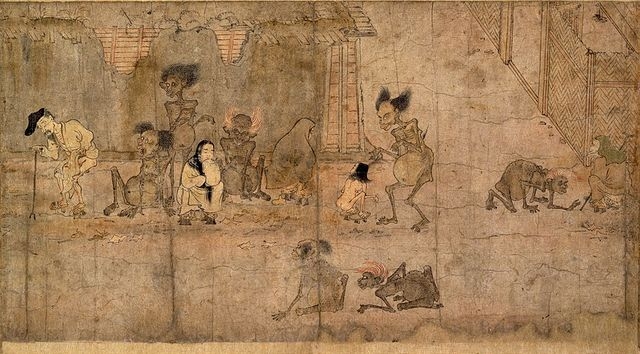
The great Hida mountain range of stretches between Gifu and Nagano prefectures. In the mountain range, on the summit of Mount Norikura, lies the Swamp of Senchogahara. One day the mountaineer Uemaki Taro was traveling near Senchogahara, when he came on a group of men and women together—about 10 of them—drinking from the swamp water.

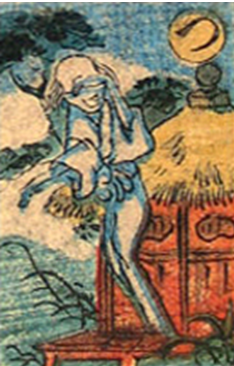
Uemaki was justifiably terrified when he saw their were wearing the white katabira robe and triangle hat that are the garb of yurei. He was even more terrified when the group of yurei looked up and saw Uemaki watching them, and their eyes began to glow red as if on fire. Uemaki closed his eyes tight against the terrible sight and chanted the Amida Buddha’s name over and over again. With this display of devotion, the horrible ghosts vanished instantly.

Uemaki reasoned that the ghosts were making their trip to the Hell Valley of the sacred Mount Take, and had stopped to appease their thirst along the way. When he returned from the mountains, he told others of his terrifying tale and warned them of wandering ghosts on Mount Norikura. Over the years Uemaki’s story passed into legend, and the ghosts of the mountain became known as the Shoraida (精霊田)—the Rice Paddy Ghosts.

Translator’s Note:

Another Halloween tale of Japanese ghosts! This one is short, but has a few unusual characteristics. First is the name. The kanji used here–精霊田—is unusual. Well, the reading is unusual. Normally the kanji 精霊 is read either Seirei or Shoryo (See What is the Japanese Word for Ghost?) This is the only instance I know of it being read Shorai. Also the kanji 田 (ta; rice paddy) is an odd addition since the yurei appear at a swamp (沢) and not a rice paddy. But Japanese yokai have never been known for adhering to strict naming conventions.

Also, this is another tale of Tateyama (立山; Mount Tate). Tateyama—whose name translates as “standing mountain” has a long history of ghosts and the supernatural. Along with Mount Fuji and Mount Haku, it is one of the “Three Holy Mountains of Japan (三霊山)” and was the center of its own religions cult from the Heian period to the end of the Edo period.

Tateyama Jigoku TaniPhoto of the Tachiyama Jigokudani from this personal blog

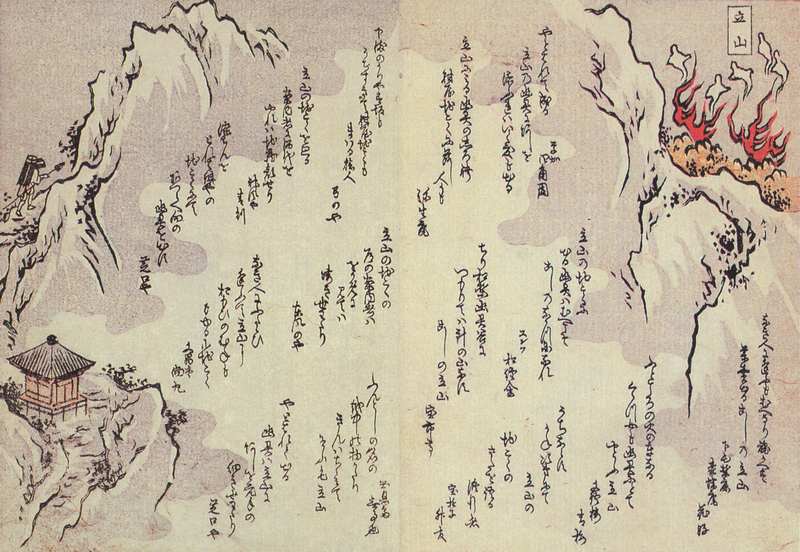
Up near the summit of Tateyama is a placed called Jigokudani (地獄谷)—Hell’s Valley. The place earned its name due to the desolation of its volcanic rock surface and the sulfurous steam that pours of vents in the mountain. There are also several mineral-laden pools of boiling water that are a deep red color and called Lakes of Blood (血の池; Chi no Ike). This references a specific level of Hell in Japanese Buddhist mythology, and there are several “Chi no Ike” across Japan.

Tateyama_Pool_of_BloodImage of the Pool of Blood sold to pilgrims to Tateyama. Image comes from the Tachiyama Museum

Around the Heian period a religion sprang up based on the Tateyama Mandala, which showed a map of the mountain including pilgrimage sites. Tateyama was considered an actual portal to Hell and the gods, and someone walking the true path would find themselves in the welcoming arms of the Amida Buddha. Itinerant priests and aesthetics would carry copies of the Tateyama Mandala with them to preach the faith, and through a form of sympathetic magic guide the faithful through the map of the mountain which was said to have the same benefit as making the pilgrimage itself.

Stories sprang up based on the Tateyama Shinko (立山信仰Tateyama Faith), including ones of bands of yurei taking the trip together to the far mountain. It is implied from most of these stories that the dead are on their way to the Jigokudani instead of the merciful arms of Amida. But you shouldn’t feel too bad for them. Later variations of the Tateyama Shinko placed the every-helpful Jizo in the Jigokudani, allowing the suffering a final way out of their plight and into the Western Pure Land.

Further Reading:

For more Japanese ghost stories, check out:

Gatagata Bashi – The Rattling Bridge

Chikaramochi Yurei – The Strong Japanese Ghost
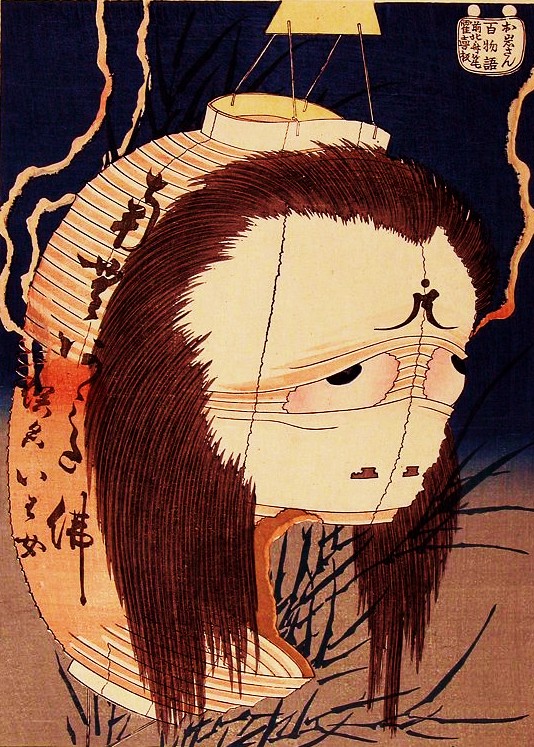
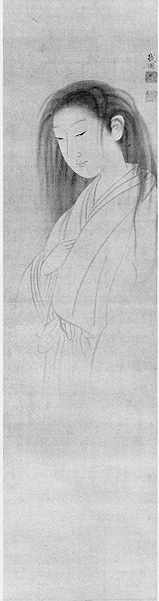
The Ghost of Oyuki

The Yurei Rock of the Cemetery

The Speaking Skull

Gatagata Bashi – The Rattling Bridge

Masasumi Tateyama Gatagata Bashi

Translated and Sourced from the Kyoka Hyakumonogatari and Japanese Wikipedia

In the village of Ozaka in the province of Hida (Modern day Gifu prefecture) there lived a man named Kane’emon. In front of his house was an old wooden suspension bridge that lead across a mountain valley to the neighboring village.

One night, while Kane’emon was in his house, he heard the distinct rattling sound of someone crossing the bridge, accompanied by whispering voices. Making the crossing was far too dangerous at night, so Kane’emon rushed out of his house to warn the travelers whoever they might be. He saw nothing.

This continued for night after night, always the rattling of the bridge and the whispering. On some nights he even heard cries of sorrow and people weeping.

Unsure of what to do, Kane’emon consulted a fortune teller who told him that what he was hearing was a parade of the dead on their way to Tachiyama (Modern day Toyama prefecture). It was known that there were several entrances to Hell located in Tachiyama and that the mojya (亡者; dead people) must have recently discovered his bridge as an expedient path.

Hearing that, Kane’emon resolved to move his entire household as far away from the bridge as possible, and also arranged to have a memorial service held at the bridge, praying to ease the sentence of those poor spirits cast into Hell. He had a permanent memorial posted at the bridge, and from that time no more strange sounds were heard. However, that bridge is still known to this day by the name of Gatagata Bashi, meaning Rattling Bridge.

Translator’s Note:

Another short yurei tale for Halloween. This story of the Gatagata Bashi comes from Masasumi Ryūsaikanjin’s 1853 kaidanshu Kyoka Hyakumonogatari (狂歌百物語; 100 Tales of Kyoka Poetry), where it appeared under the much longer name of “The Sound of the Dead Traveling to Tachiyama Hell as They Crossed the Suspension Bridge.” (立山地獄へ向かう亡者たちが境に架けられた橋の上をわたる音) It has been collected in several kaidanshu and yurei books over the years. Although it refers to小坂, there are old bridges across Japan colloquially called Gatagata Bashi with “gatagata” being an onomonopia for the sound of rattling wooden boards.

Many of these Gatagata Bashi have legends attached. Bridges—being a method of spanning boundaries—are often found in yokai and yurei tales. In many of these cases the nickname of “gatagata bashi” was applied first, and then an appropriate legend dreamed up to add some romance to the name. This one with the parade of the dead making their way to Hell is one of the best.

Tachiyama as the entrance to Hell features in several yurei stories of this period. There will be more about it in my next post.

Further Reading:

For more yurei tales, check out:

Chikaramochi Yurei – The Strong Japanese Ghost

The Ghost of Oyuki

The Dead Wife Who Didn’t Leave

Two Tales of Ubume

Shorokaze – The Ghost Wind

Chikaramochi Yurei – The Strong Japanese Ghost

Chikaramochi Yurei Mizuki Shigeru

Translated and Sourced from Mizuki Shigeru’s Mujyara and Japanese Wikipedia

Long ago in the Empou period (1670 – 1683), an unusual farmer’s wife lived in a small village called Mikoharabara, which was nestled in a remote mountain valley in the province of Noshu (modern day Ishikawa prefecture).

She was unusual for several reasons. For one, she had fish scales growing under her armpits where she should have had skin. Second, her nipples were so long that she could throw them over her shoulder and feed her baby while it was still nestled on her back. Last, she was incredibly strong—it was said this farmer’s wife could do the world of 4-5 grown men, all by herself.

However, even the strongest person is not invulnerable. One winter the farmer’s wife got sick and died.

The 17th day after her death, she came back as a yurei and haunted her husband to death. No one really knew what he did to deserve her curse, but there it was. Even then, she still wasn’t satisfied. From time to time the woman’s yurei would appear in the village and frighten people and cause mischief.

Eventually, a man named Sakuzou was traveling through the mountains on business when he stopped by the village. After hearing the villagers’ stories, he wondered if there might not be a hole in her grave. This, he thought, would account for her restless spirit still haunting the village even after she had killed her husband. The villagers went to check, and sure enough there was a deep hole burrowed into her grave. Working together, the filled the hole and covered it with a large stone.

This wasn’t the solution they were hoping for though, although it did have a strange effect. The woman’s grudge transferred to Sakuzou and almost immediately she began to torment him as much as she had her husband. Under siege, Sakuzou made a pilgrimage to a nearby shrine that he knew, and borrowed a famous sword kept there. The sword was known to be a talisman against yurei with ghost-quelling powers. Sakuzou kept the sword by his side constantly, and was no longer troubled by the woman’s vengeful spirit. Satisfied that he had broken the curse, he returned the sword to the shrine

His business finished at last, Sakuzou began his journey home along the steep mountain pass. He had not walked long when he felt some strange presence coming up behind him. He had no time to react before he was lifted bodily off the grown, and thrown 10 meters over the edge of the road and into the mountain valley below. The impact rendered him unconscious, and Sakuzou lay bleeding, looking as though he had died. The farmer’s wife was apparently satisfied thinking she had killed Sakuzou, and with that her yurei vanished, never to be seen again.

Translator’s Note:

Another in my Japanese ghost series for Halloween, this story comes from the Edo-period Kaidanshu Yotsu Fugoroku (四不語録; Four Recordings of Silence). The story appeared under the generic title of Onna no Yurei (女の幽霊; Female Yurei) until Mizuki Shigeru collected it and included it in his Mujyara series, where he renamed it Chikaramochi Yurei (力持ち幽霊; The Strong Ghost).

Mizuki Shigeru also adds a note saying you should be careful of women with fish scales under their armpits. They are probably already yokai to begin with.

Further Reading:

For more Yurei tales, check out:

The Ghost of Oyuki

Shudan Borei – A Group of Ghosts

Shichinin Dogyo – The Seven Pilgrims

The Gratitude-Expressing Yurei

Hokusai’s Manga Yurei

Kejoro – The Hair Hooker

Mizuki_Shigeru_Kejoro

Translated and Sourced from Mizuki Shigeru’s Mujyara, Japanese Wikipedia, and Kaii Yokai Densho Database.

To learn much more about Japanese Ghosts, check out my book Yurei: The Japanese Ghost

From the sashay of those hips and the long, cascading raven-black hair, you know that you have found a rare beauty. You have only seen her from behind, but you must have her. So you rush to grab her and spin her around only to be confronted by something out of your nightmares—no face. No nose, no eyes, no lips. Just a mass of that same raven-black hair pouring out at you. Only then do you know that this was no sensuous lady of the evening, but an encounter with the Kejoro – The Hair Hooker.

What Does Kejoro Mean?

Another yokai with a (somewhat) straight-forward name, the Kejoro combines the kanji毛 (ke; hair) +倡妓 (Joro; hooker). I say somewhat straight-forward, because the kanji倡妓 is extremely obscure, so obscure that I wasn’t able to find any use of it EXCEPT for the Kejoro.

There is an alternate kanji usage, 毛女郎, which uses a more common 女郎 (Joro) with the same reading. However, while女郎 might be a more common kanji, most instances of the Kejoro use the more obscure 毛倡妓.

What is a Kejoro?

Kejoro Hyakumonogatari 1968Publicity Card from the 1968 Film Yokai Hyakumonogatari

Kejoro is the living embodiment of the “pretty from the back, ugly from the front” phenomenon that almost everyone has encountered at least once in their life. You get drawn in by a spectacle of callipygian splendor and really nice hair, then you run around to see the face that must accompany that body only to see a horror show. Male or female, this has to have happened to all of us. But only Japan made a monster about it.

There have been disagreements over the years exactly what a Kejoro is—a woman with a lot of hair that cascades over her body, or a strange creature made entirely of hair with no body underneath? She has been depicted both ways, largely at the personal preference of the artist.

The Origin of Kejoro

SekienKejoro

Kejoro made her first appearance in Toriyama Sekien’s kaidan-shu Konjaku Gazu Zoku Hyakki (今昔画図続百鬼; The Illustrated One Hundred Demons from the Present and the Past). The story given by Sekein is almost exactly as described in the opening:

“A man is venturing into the Yoshiwara red light district one evening, when he sees a prostitute walking down the street. From the rear, he recognizes her as one of his favorites, and so rushes up to claim her. When she turns around, she reveals her entire body is made up of hair, with no skin visible. “

Toriyama may have been influenced by a similar monster from Chinese mythology, called the Hair Woman (毛女). The Hair Woman is also made up entirely of hair, although she does not have the same connection to the red light district and prostitution. She comes from an old Chinese book投轄録 (Tou Xia Lu-Yu Zhao Xin Zhi; A Grand View of Literary Sketchbooks in the Past Dynasties) and it is not know if Toriayama was familiar with her or not when creating the Kejoro.

More likely Toriyama was making some sort of commentary on the red light district, or playing word games with popular slang of the time. On the adjacent page to the Kejoro of the Konjaku Gazu Zoku Hyakki is another prostitute-turned-yokai, the Aonyobu (青女房; Blue Wife). “Blue Wife” was a derogatory term for a woman who had contracted the kidney disease jinkyo (腎虚; renal ischemia), and it is possible that “Kejoro” was a similar insult that Toriyama made a monster of.

Making yokai from popular slang terms was a common practice of Toriyama, as also seen in the Kyokotsu – Crazy Bones.

Kejoro and the Yellow Books

Like many of Toriyama’s creations, the Kejoro took on a life beyond her initial creation and was a popular character in the Edo-period kiboshi (黄表紙; Yellow Books) such as Sakuragawa Jiginari’s Bakemono Haruasobi (変化物春遊 Bakemono’s Spring Play). Kiboshi were lurid, cheap tales that were some of Japan’s first mass-market literature.

An entire genre of kibosh was dedicated to the Yoshiwara pleasure districts, and the Kejoro fit easily into this “Please District Literature.” Supernatural prostitutes were a popular theme, such as the Bakeneko Prostitutes of Edo.

The Meaning of Kejoro

Whether her creation is just Toriyama indulging in some word play or whether the Kejoro has some deeper meaning has been a debate between yokai scholars over the years.

Many feel the Kejoro falls under the Nopperabo category (See Shirime), a “startling yokai” that appears to be one thing that is actually another. There are many variations on the Nopperabo story in Japan, all based on expectations and the shock of something ordinary turning out to be something extraordinary

Researcher Tada Katsumi sees the Kejoro as a satire and commentary on Edo-period “Pleasure District Literature” that were popular at the time. There were many cautionary tales of prostitutes that turned out to be something horrific, and Tada shows the linking of the words化粧 (kesho; make-up, cosmetics) with お化け (obake; monster). Both share the kanji化 meaning “to change,” and the yokai prostitute tales comment on women’s ability to alter their appearance and hide their true face.

However, my personal favorite explanation of the Kejoro—because it is by far the scariest—relates to the ceremony of心中立 ( Shinjutate; Standing Your True Heart).

In the Edo-period prostitutes were bought and sold like property, and their only real hope was that a client would fall in love with them and buy them out of their contract and take them home as a wife. There were some happy endings, but just as often something got in the way—the man already had a wife, or couldn’t afford to purchase the woman entirely. In these cases 心中 (Shinju; Double Suicide) was often the only way out.

But sometimes the love was one-sided, a prostitute who fell so deeply in love with her client that she refused other customers. In these cases, there were rituals—known collectively as心中立 ( Shinjutate; Standing Your True Heart)—that she could perform to make herself unattractive to new customers.

One of the Shinjutate was to shave off all of your hair, and tattoo the clients name prominently on your body. This self-marked a prostitute, making her useless to her owner. But not all of these gestures were faithfully rewarded. Some (perhaps many) women performed the Shinjutate for men whose affections were not so faithful.

Some yokai researchers and storytellers imagined this hair, shorn off as symbol of love that was betrayed, taking on a life of its own to become the Kejoro.

Kejoro in Nura: Rise of the Yokai Clan

kejoro Nura Clan Yokai

The Kejoro is a character in Nura: Rise of the Yokai clan, where she is decidedly more sexy and bears little resemblance to her folklore counterpart. Unlike Toriyama’s Kejoro, any patron of the Yoshiwara would probably be thrilled to spin a woman around from behind and see the Kejoro of Nura: Rise of the Yokai Clan.

Translator’s Note:

I was in the mood for a legitimately scary yokai after the recent round of magical beasts and yokai from my translation of Mizuki Shigeru’s Showa 1926-1939: A History of Japan. The Kejoro fit the bill, and going into October and Halloween I think I’m going to focus on yurei and some of the more frightening monsters in Japan’s folkloric menagerie.
Further Reading:

For more dangerous ladies, check out:

The Bakeneko Prostitutes of Edo

Takaonna – The Tall Woman

Nure Onago – The Soaked Woman

Hashihime – The Bridge Princess

Hidarugami – The Hunger Gods

Hidarugami Mizuki Shigeru

Translated and Sourced from Mizuki Shigeru’s Mujyara, Showa: A History of Japan, Japanese Wikipedia, Kaii Yokai Densho Database, and Other Sources

If you are walking through a mountain trail, and find yourself overcome with a sudden hunger—a soul-killing hunger that drives you to your knees like true starvation—you might need to do more than reach into your backpack for an energy bar. You might be under attack by the Hidarugami, the Hunger Gods.

What Does Hidarugami Mean?

Hidarugami is written with the katakanaヒダル (hidaru) + the kanji 神 (kami; god). Things written in katakana have no inherent meaning. However, the word “hidaru” is most likely connected with饑い (hidarui), meaning hunger. Hidarui is a colloquial term, used mainly in Gifu prefecture. Hidarugami is also sometimes writtenひだる神 using the hiragana for “hidaru,” also with no inherent meaning.

The fact that the kanji “kami” is used places the hidarugami on a higher level than most yokai, alongside such devastating deities like the Binbogami (貧乏神; God of Poverty) and Shinigami (死神; God of Death). This elevated status is due in part to arising from human spirits, from reikon.

There are other names for the Hidarutami. In Kitakyushu, it is known as the Darashi (ダラシ), in Mie and Wakayama prefectures it is sometimes called the Dari (ダリ), while in Nara and Tokushima prefectures it is called Daru (ダル). All of these use katakana for the names.

The Hunger Strike of the Hidarugami

Hidarugami Road

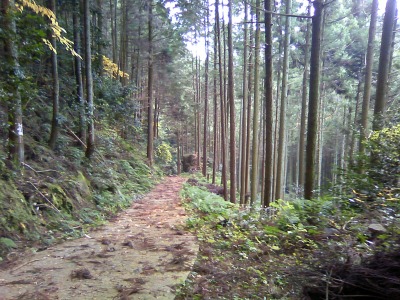
Hidarugami are said to be the spirits of those who starved to death wandering the mountains. Because they died alone, with no marker for their grave or any ceremony, their spirits become evil and seek to share their death agonies.

They are found almost exclusively on mountain trails and passes. Hikers and travelers in the presence of the Hidarugami are suddenly overcome with acute hunger, fatigue, and numbness of the limbs. The feeling is said to be that of actual starvation. The victim is unable to move and often collapse. This attack is a form of possession. The Hidarugami enters your body. If no action is taken, the Hidarugami can cause death—actual death by starvation in a healthy body.

If you are killed, you join the Hidarugami group. In this way, Hidarugamai groups slowly enlarge to contain many souls.

Expelling the Hidarugami is easy, so long as you are prepared. Just a small mouthful of a staple food, such as rice or grain, staves off the attack and the starvation leaves as quickly as it arose. That is why—even today—hikers are advised against going into the mountains without a few riceballs or a bento to eat. Even then, they never eat the entire meal, always leaving a few grains behind in case of emergency.

Old Japanese kaidanshu and traveler’s guides are full of stories of the Hidarugami. In a story coming from 1736 a man named Senkichi was found exhausted and unconscious on a mountain trail. Unable even to speak, he was loaded into a cart and carried back to town where he was fed and recovered. Senkichi related an account of an attack by Hidarugami. Another typical story tells of a merchant crossing the Noborio Pass towards Onohara. Only a few hours after finishing his lunch he became ravenously hungry, struggling to make his way to a nearby temple. A traveler’s guide from 1861 warned of the dangers of going into the mountains without a few riceballs for protection.

Are the Hidarugami Yokai or Yurei?

Obake_Karuta_Hidarugami

Hidarugami defy simple classification, and show the complicated nature of Japanese folklore. Are they yurei? Are they yokai? Are they Gods? Yes to all three questions. (And yes, it is a trick question as all yurei are yokai. Smart catch there!)

Because Hidarugami enter the body and possess it, they are considered a type of the Tsukimono yokai – A Possessing Thing. While most tsukimono are magical animals, anything that possess can fall into this category.

Higarugami are most definitely yurei—they are referred to as either akuryo (悪霊; Evil Spirit) or onryo (怨霊; Vengeful Spirits). But they are not typical yurei. Like Funa Yurei and oddities like the Shichinin Dōgyō – The Seven Pilgrims, the Hidarugami act as a group and actively make new members. Because they are bound to their location, they would be considered a type of jibakurei (地縛霊; Earth-bound Spirit).

Hidarugami are also muenbotoke (無縁仏). This refers to the unworshiped dead, those who die without burial or ceremony. Special rites are often held on Obon, the Festival of the Dead, specifically for muenbotoke to try and get their spirits to pass one. One passage says that the Hidarugami’s grip on the world is not particularly strong—that they are a weak god—and they should be banished by a simple muenbotoke ceremony.

Gaki Hungry Ghosts

They are also associated with Gaki ( 餓鬼), the Preta or Hungry Ghost of Chinese and Tibetan Buddhist mythology. The association is vague and only based on the dual obsession with hunger. Gaki are those whose sins of gluttony condemn them to be reborn as foul creatures with a rapacious hunger for disgusting things such as corpses or feces. Gaki are not native to Japanese folklore, and at sometime after their importation from China a link was made between the Gaki and the Hidarugami.

Hidarugami Across Japan

Like all widespread folklore, the Hidarugami have regional variations and associations. In Wakayama prefecture, —along the ancient pilgrimage route of Kumano Kodo—there is a deep hole called the Gaki Ana, or the Gaki’s Pit. The exact location of the pit is unknown, but it is said to be someone near Mt. Okumotori and Mt. Shokumotori in Wakayama prefecture. Wherever it is, staring into the Gaki Ana is said to summon the Hidarugami.

In Shiga prefecture, possession by a Hidarugami is much more dreadful. The possessed person’s stomach suddenly swells like a starvation victim, and they begs for a bowl of rice with tea. If someone answers that they had food, but have eaten it, the possessed victim will attack with a fury, ripping open their stomachs in search of undigested bits of rice to eat.

In Mie prefecture, Hidarugami are said to attack not only humans but also cattle being moved across mountain trails.

In Kochi, Nagasaki, and Kagoshima prefectures, there are small shrines set up along mountain roads and mountain passes enshrining the kami Shibaorigami (柴折様). Making a small offering at these shrines, even something so small as laying down a few token branches of wood, is said to provide protection against the Hidarugami.

Translator’s Note:

This is the next in my series of yokai who appear in Mizuki Shigeru’s Showa: A History of Japan. A young Mizuki Shigeru encountered the Hidarugami once walking through a mountain road. He survived the attack due to finding a few stray grains of rice. It was only much later in his life while reading a book that he learned to put a name to the strange phenomenon he had encountered.

Further Reading:

To read more about Tsukimono and other sundry ghosts, check out:

Tsukimono – The Possessing Thing

Shichinin Dōgyō – The Seven Pilgrims

Funa Yurei

Previous Older Entries Next Newer Entries

Copyright notification

All translations and other writing on this website were created by Zack Davisson and are copyright to him.

Copyright notification

In accessing these web pages, you agree that any downloading of content is for personal, non-commercial reference only.

No part of this web site may be reproduced or transmitted in any form or by any means, electronic, mechanical, photocopying, recording or otherwise, without prior permission of Zack Davisson.

Copyright notification

For rights clearance please contact Zack at:

zack.davisson (at) gmail.com

Thank you.