Hokusai’s Manga Yurei

This is in response to a reader question about a particular yurei picture, specifically Hokusai’s manga yurei.

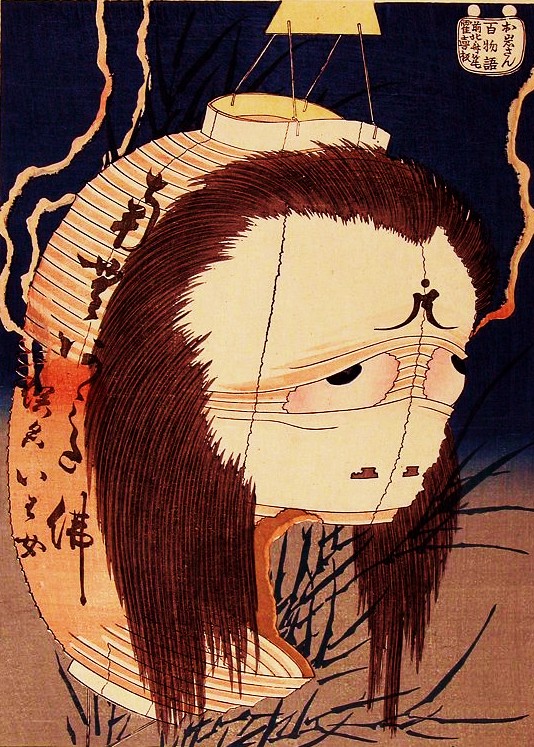
Katsushika Hokusai is probably Japan’s best-known artist internationally. His print The Great Wave off Kanagawa, from the woodblock print series Thirty-six Views of Mount Fuji, is without a doubt the most famous work of Japanese art. Like most artists in the Edo period, Hokusai illustrated supernatural scenes from famous kabuki plays and popular hyakumonogatari kaidankai tales. In 1831, he created five prints in a hyakumonogatari series that are still some of the most famous Japanese ghost prints.

The particular yurei in question, however, comes from a different period in his life. In 1811, at the age of 51, Hokusai changed his professional name to Taito, and began work on a series of sketchbooks and small images he called manga. The word manga (漫 画) translates directly to “frivolous pictures,” and Hokusai’s manga series were originally meant to be a quick money-making venture that would attract new students. The manga series was very popular, and Hokusai created fifteen volumes in total.

This yurei image comes from the 13th volume, one of the three not published during Hokusai’s lifetime. This yurei is not from any particular story, but just seems to be a “frivolous picture” of a yurei that Hokusai drew. The text next to the picture say simply yurei, with no other identification. It is a very usual depiction of a yurei in that it is winsome rather than scary. But it does include the standard Edo period yurei characteristics of pale skin, white kimono, black hair, and no feet.

The yurei is part of a four-paneled series of mythological creatures. The yurei is in the top left, with a picture of a Yamauba underneath. On the right side in the top left is a tengu, and underneath that is a mountain yokai called a Hihi. Hihi is the Japanese word for baboon, and at the time a baboon was no less a fantastical creature than a mermaid or tengu.

It is clear from looking at the original that the picture has been color-corrected. The original impressions from Hokusai’s manga series were three-colored, black, gray, and pale flesh.

The Gratitude-Expressing Yurei

Translated from Mizuki Shigeru’s Mujyara

This took place sometime during the Meiwa era (1764-1772). In Shimabara, there was a famous courtesan named Uriuno. She had been redeemed from the Tomiya house, and now lived in the vicinity of Takatsuji.

One night, Uriuno was awakened by a strange noise. When she listened closer, she could faintly hear the sound of footsteps. It sounded as if someone was approaching her bedroom from the garden just outdoors.

“Good Evening. Is someone out for a stroll tonight” Uriuno called out, thinking this was a very strange thing indeed and strained her ears for an answer.

The answer came at last with a rattle of the paper screens that served as a wall between Uriuno’s bedroom and the garden, and the figure of a woman projected like a shadow against those screens. The mysterious shape bowed down and whispered expressions of gratitude to Uriuno. Just as Uriuno was about to raise her voice in response, the figure blinked out of existence.

When the mysterious apparition had vanished, Uriuno suddenly recalled an odd encounter she had when she still worked in the red light district. One night, a maid of the Tomiya was looking at Uriuno as if she had something very important to say. But Uriuno did not get a chance to hear her, as the maid soon fell terribly ill and fainted dead away. For several days and nights, the maid went in and out of consciousness, and then she spent her final breath saying that she needed to see Uriuno and tell her something. But it was too late.

Uriuno thought about the shape of the figure projected on her screens, and felt that there was no mistake about it. That figure must have been the ghost of that maid of Tomiya. It could be no one else.

What is the Triangle Headband Japanese Ghosts Wear?

To learn much more about Japanese Ghosts, check out my book Yurei: The Japanese Ghost

What are those odd, triangle-shaped hats or headbands worn by some Japanese ghosts? That is a difficult question to answer because, while there are several opinions, nobody really knows.

The triangular, white corpse-hat consists of a small strip of cloth, cut or folded into a triangle, which covers the forehead and wraps around the back of the head. It works like a headband, and the Japanese use the word boshi (hat) or nuno (cloth) when describing it. The cloth is not a consistent item on the costume of a yurei, a Japanese ghost. As with everything else in life, burial fads come and go. Although the white burial kimono, called a kyōkatabira, has stayed the same for centuries, the same thing cannot be said about the cloth.

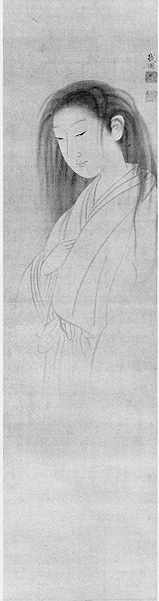
The cloth appeared around the Heian period and yurei-e (ghost pictures) from this era often show yurei wearing the cloth. It is possible the corpse-hat was based on the Heian period eboshi hat that was popular at the time. Whatever its origins, the custom seems to have vanished by the Edo period. It is worth noting that in Maruyama Ōkyo’s famous painting “The Ghost of Oyuki,” considered an accurate portrait of a yurei, Oyuki does not wear the cloth. In modern times, the cloth has become particularly associated with the sea ghosts called funa yurei, who always wear it.

I keep calling it “the cloth” because there is no specific word for it. The cloth goes by multiple names. The most grandiose term is tenkan, meaning heaven’s crown. The most commonplace is zukin, which is a standard word for hood or kerchief. Several of terms are simple and descriptive, like hitaieboshi meaning forehead hat, or hitaikakushi meaning forehead-hider and kamikakushi meaning hair-hider. The most basic term of all is sankaku no shiroi nuno. This means triangle-shaped white cloth.

The meaning of the cloth is speculative, although there are two main theories why it came into fashion. One says that the dead have ascended to a higher level, and thus the tenkan (heaven’s crown) is placed upon their heads to show their new status. Another says that the sharp point of the triangle wards off evil spirits or demons from entering the now-empty body from the head and resurrecting the corpse or preventing the spirit’s transition.

In all likelihood, there is some truth in both of these explanations.

The Ghost of Oyuki

For more about the origins of Japanese Ghosts, you can purchase Zack Davisson’s limited edition yomihon chapbook The Ghost of Oyuki from Chin Music Press.

The Ghost of Oyuki Chapbook

Further Reading:

Check out other yurei tales from hyakumonogatari.com:

How Do You Say Ghost in Japanese?

Goryo Shinko – The Religion of Ghosts

Why do Japanese Ghosts Not Have Feet?

The Yurei Child

Goryo Shinko – The Religion of Ghosts

Translated and Adapted from Mishu Shukyo Shisosho

To learn much more about Japanese Ghosts, check out my book Yurei: The Japanese Ghost

From ancient times, the Japanese attributed natural disasters and plagues to the handiwork of onryo, grudge-bearing spirits of the dead who had died by violence or some other unnatural circumstance.  In order to transform these onryo from horrors into benign deities that would use their powers for the peace and prosperity, the Japanese created Goryo Shinko, the Religion of Ghosts.

About the Spirit

Spirits or souls separating from their bodies at death is a common belief across the world.  Japan is no exception.    From as far back as the distant history of the Jomon period, the Japanese have built their spiritual beliefs on ghosts and the grave.   The unleashed soul, called mitama or tameshi in Japanese, could cause an array of misfortunes.   Of particular danger were the spirits of those who died due to political intrigue, or who were defeated in war.  These spirits inflicted their revenge upon their still-living enemies.   During the Heian period, folk beliefs and rituals dealing with the wrathful dead formalized into a religion.

From Onryo to Goryo

During times of national instability, when political strife and battle dominated the country, the threat of onryo loomed large.  Any who died amidst the chaos were capable of sustaining a powerful hatred.   And this hatred was unfocused.  Onryo did not limit their revenge to those whom had wronged them in life.  The method of an onryo’s revenge; plague, fire and earthquake, did not allow for such precise targeting.

The Heian period is full of examples of these wrathful ghosts, onryo, mostly high-born and privileged in life. Fujiwara Hirotsugu, Prince Sawara, and Prince Osabe were all considered to have transformed into onryo their deaths.   To calm their raging spirits, they were posthumously raised in court rank and title, then enshrined as kami in Shinto shrines.  These rituals, it was said, transformed them from destroyers into protectors of after Japan.

This, in essence, is Goryo Shinko; the transformation of wrathful ghosts into protective entities via ritual and entitlement.  During the Heian period this religion was so pervasive there was even a ceremony in the Imperial Court welcoming new spirits into the ranks of protective spirits. According to official documents, the first such ceremony confirming goryo was on May 20th in 863CE (The 5th year of the Jyogan Era), held in Shinsenen. (From the Nihon Sandai Jitsuroku).

Examples of Goryo Shinko survive to modern Japan.  Kyoto has two ancient temples that remain devoted to Goryo Shinko: the Upper and Lower Goryo Shrines.  The Upper Goryo Shrine enshrines the Hassho Goryo (The Goryo of the Eight Districts): Emperor Sudo (Prince Sawara, son of Emperor Konin), Emperess Inoenai (Wife of Emperor Konin), Prince Osabe (Son of Emperor Konin), Fujiwara Daibunin (Fujiwara Yoshiko, mother of Prince Iyoshin), Tachibana Daibu (Tachibana Hayanari), Budaifu (Bunya Miyatamaru), the diety Honoikatzu (Sugawara Michizane), and Kibi Daijin (Kibi Makibi).  Also enshrined are Prince Shoshin, the Government Inspectors for China (Fujiwara Nakanai and Fujiwara Hirotsugu), the Emperor Sotoku, Fujiwara Yorinaga (known as the Badman of Uji), Emperor Antoku, Emperor Jyuntoku and Emperor Tsuchimikado.

While Goryo Shinko is identified with the Heian period, and the earliest records of Goryo Shinko date to this time, there is speculation that the religion was based on older traditions. Looking at purely historical records, the first known account of an onryo was Fujiwara Hirotsugu, written about in Genbo’s military history “Shoku-Nihongi”
(“The Continued Chronicles of Japan”). But there are other opinions.

In his book “Kakushita Jyujika” (“The Hidden Cross”), author Umehara Takeshi makes the unlikely (and wholly unsupported) claim that the Buddhist Prince Shotoku Taishi was an early onryo.  Another author, Yaegashi Naohiki, sees evidence of onryo activity in the decline of the heads of the Soga clan (Soga Emishi and Soga Iruke).  Another candidate for pre-Heian period onryo is put forward by Ootsu Miko, who identifies Tada Kazuomi in her books “Fusouryakuki” (“An Record of the Approximation of the Lands East of China”) and “Yakushiengi” (“The Omen of Yakushi Temple”).  Ootsu says that the true causes of historical events can be placed on karma coming back to us from future lives.   Each of these writers have some grounds for argument in their individual accounts.

Another more likely candidate is put forth by Terasaki Yasuhiro, who wrote in “Jinbutsu Sousho” (“A Library of Humanity”) that the death by small pox of four children of the Fujiwara clan was cause by the onryo of Nagaya Ookimi.  However, this still sets Goryo Shinko in the Heian period, as Nagaya Ookimi was a contemporary of Fujiwara Hirotsugu, and both of their stories were featured in Heian period compilations like “Shoku Nihongi.”  Timewise, there isn’t much difference between the two, and whether Ookimi or Hirotsugu were first, there is scant hard evidence of onryo from any period before the Heian and Nara periods.

Based not on evidence, but purely on philosophical terms, the author the author Izawa Motohiro, in his book “Gyakusetsu no Nihonshi” (“An Alternate Explanation of Japanese History”), writes that the dangerous nature of improperly worshiped ghosts is native to Japan.  It runs contrary to the influences of the ancestor cult from China.
While Izawa confirms that the Heian period is the beginning for formalized worship, he names the earlier collection of folkbeliefs Pre-Onryo Shinko.  Iwaza also uses Nagaya Ookimi and the deaths of the four Fujiwara children as an example, showing that belief in onryo existed prior to the formalized religion of the Heian period.  Izawa further advocates that Goryo Shinko should properly be called Japanese Onryo Shinko.  In truth, Izawa’s theories almost perfectly reflect statements made previously by author Umehara Takeshi.

There are many theories, but few actual articles written on ancient onryo.  One of the most basic descriptions was made by the monk Jien, who wrote that an onryo was only as powerful as its reason for appearing.  Once the spirit’s claims had been settled, it would be appeased and cease to trouble the world.  Jien’s description remains accurate, and this basic description has carried through from ancient times through Japan’s middle ages and beyond.

Goryo Shinko declined with the advent of Buddhism in Japan, during the Wars of the Northern and Southern Courts.  Buddhism’s rituals and beliefs gradually supplanted the Shinto beliefs of the Heian period, although they never vanished entirely.  In shrines such as Yanbekimiyori (Warei Jinja) and Sakura-sotzuro (Sougorei-do), goryo
were regularly enshrined and worshiped.  And even with the dominant influence of Buddhism, in the “Taiheiki” (“Record of the Taihei Clan”) the violence fo the War of the Northern and Southern Courts was said to be influenced by onryo.  The power of the dead was still blamed for the many great social upheavals in Japan.   The Genpei Gassen, were said to be caused by the onryo of Sutokuin, and still more onryo-derived conflicts are recorded in the “Hogen Monogatari” and the “Heike Monogatari.”

Poverty-stricken Yube and the Oil Seller

Translated from Nihon no Yurei Banashi

Drinking Oil

Long ago in a village in Banshu (Modern day Hyogo Prefecture), there was a man named Yube. So stricken with dire poverty was Yube that he had nothing to eat and nowhere to live.  In desperation, Yube went to the home of a wealthy dealer in oil and bowed his head on the floor and begged to borrow some money.   The Oil Seller loaned Yube the money, and set the conditions for repayment.   But when the promised day to repay the loan came, Yube’s circumstances had not improved and he had not the ability to return the money.

Yube begged the Oil Seller:

“Please, my lord. Just give me another six months to pay back the loan.”

After listening to Yube beg and plead and beg some more, the Oil Seller finally relented and gave Yube six more months.  But he enforced a harsh term for the additional time.

“All right, if you want more time so badly, then prove it!  Right here, before me, drink five cups of oil.  If you can’t do that, then you had better be able to pay me back this minute.”

Yube was shocked at the demand.  But as he lacked the money to repay the loan, there was nothing he could do but set down to drink the oil. The Oil Seller made sure the cups were filled full to the brim, and watched as Yube sucked down every last drop of the thick oil.   First one, then two, until finally all five cups were drained.   Just as Yube finished the last of the oil, he doubled over with in excruciating pain.   First his stomach ached, and then his chest tightened terribly.  Yube began to sway back and forth, howling in agony, before he dropped to the floor dead.

The Burning Grave

The news of the Oil Seller’s deed spread quickly through the town, and it wasn’t long before it was overheard by the local magistrate.   The magistrate hurried at once to the Oil Seller’s home, and began a thorough investigation into the matter.   When he learned enough to know that the rumors were true, he fixed a stern eye on the Oil Seller.

“Well now. You have killed a man, and no mistake.  To tell the truth, there is enough here for me to send you to the executioner to be beheaded. But I would save you that much.  Instead, you will cover the entire cost of Yube’s funeral, and see to it that his family never suffers for money again.   If you can’t promise me that, then I will see your head posted on the town gates.”

The magistrate said this with such conviction in his voice that the Oil Seller trembled in fear. The Oil Seller quickly agreed to the terms, and wasted no time in making the arrangements to give Yube a fine funeral.   When the day came, the Oil Seller laid flowers on Yube’s freshly-cut headstone and then bent down to light the lanterns next to the grave while the people of the village silent watched and prayed.

When the match was touched to the lanterns, something shocking happened.  The five cups of oil that Yube had drunk had seeped from his body into the surrounding soil, and the grave burst into flames, rising up into a fireball.  The villagers shouted in surprise.

“Ahhh!  It is a hi no tama (fireball)!  This is Yube’s curse, and he has turned into a hi no tama!  We have to get out of here!”

Everyone fled from the grave running as if their lives depended on it.   As for the Oil Seller, he would never live another comfortable day in his life; he flesh grew pale and his entire body was overcome with shaking. He ran faster than anyone.

Just as everyone fled the grave, another mysterious thing happened.  The hi no tama blinked out as quickly as it had appeared; Yube’s oily body was burned up.   That is to say, all of the oil in Yube’s body had burned up. Yube himself was left clean and pure again.  When the last of the fires disappeared, Yube’s body down in the grave let out a huge gasp as air rushed back into his lungs.

“Huh?  Where am I?  What am I doing down here?”

With the oil purged from his body, Yube had come back to life and began to dig himself out of his own grave.   Pulling himself clear, he began to walk through town, heading back to his house.

When Yube came walking through town he came on a huge, noisy bunch of men were gathered in the street.   They were making a tremendous ruckus, some shouting with joy and some with anger.

“Hey there!  What are you all doing?”

Yube tried to push his way into the crowd to get a look at what was going on.  Just then, someone noticed him.  Yube caused quite a fright,
as he was still dressed in his white burial kimono that he had been wearing at his funeral.

“Ahhhhh!!!  It is a yurei!!!”

At the site of Yube in his white kimono, the courage of the men fled from them, and soon all the men were fleeing along with it.   Yube looked at the ground where the men had been gathered, and was surprised to see that the streets were littered with money. For sure this wild crowd had gathered for illegal gambling, and they had all left their cash behind when they went running from Yube.

“Ho!  This will certainly provide for my needs!”

Yube gathered all the stray money from the streets, and carried it off to his house.  But if he expected a welcome home greeting, he was sorely disappointed.  To see their dead relative, whose funeral they had been to today, suddenly show up at their doorstep was too much of a shock for Yube’s family.

“Ahhh!  It is a yurei!  Yube must be lost and unable to make his way to the world over there!”

With that they slammed the door shut and held it tight.   No matter how many times Yube knocked and pleaded to be let in, they wouldn’t listen and just yelled at him to go away.   There was nothing for Yube to do, so sadly he left his house and wandered to a near-by temple.   There, he poured out his story to a sympathetic monk who listened patiently. The monk then returned with Yube to his house, and explained Yube’s return to life to the family, who finally let Yube come inside.  They called down everyone in the house to hear Yube’s tale, and after that went out into the streets of the village where everyone celebrated Yube’s return.

With all the money Yube collected from the gambling den, he was now the richest man in the village. He paid off his dept to the terrified Oil Seller, and proceeded to live happily ever after.

This is a very unusual yurei story.  Not only does the dead man return to life, but he also becomes rich and lives a happy life.  This kind of story is mainly told in the Kansai area of Japan.

Previous Older Entries Next Newer Entries

Copyright notification

All translations and other writing on this website were created by Zack Davisson and are copyright to him.

Copyright notification

In accessing these web pages, you agree that any downloading of content is for personal, non-commercial reference only.

No part of this web site may be reproduced or transmitted in any form or by any means, electronic, mechanical, photocopying, recording or otherwise, without prior permission of Zack Davisson.

Copyright notification

For rights clearance please contact Zack at:

zack.davisson (at) gmail.com

Thank you.