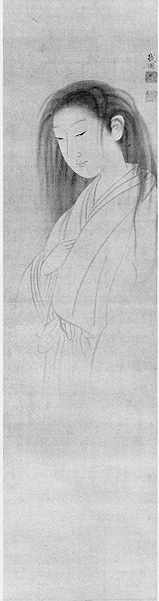
What Does Ayakashi Mean in English?

Mizuki Shigeru Ayakashi

Translated and sourced from Mizuki Shigeru’s Mujyara, Japanese Wikipedia, Kaii Yokai Densho Database Japanese Performing Arts Resource Center, and Other Sources

A sea serpent so massive it takes three days to pass by in a boat? Mysterious lights floating by the beach? A generic term for ghost stories? Ayakashi is one of the most complicated and convoluted terms in all of Japanese folklore. There is no easy answer to this simple question.

What Does Ayakashi Mean?

Usually when investigating a yokai I like to start with deciphering the kanji that make up the name. That is your first, best clue as to what the monster or phenomenon is. But ayakashi is written either in hiragana (あやかし) or katakana (アヤカシ), neither of which give any hints as to the meaning. There is an alternate and specific spelling of ayakashi that does use kanji, and we will look into that later.

In its most basic usage, ayakashi is a general term for yokai that appear above the surface of the water, and can be translated as “strange phenomenon of the sea.” That fact that this is the surface of the water is important—yokai tend to appear at boundaries, places where one thing becomes another thing. So ayakashi are yokai that haunt the boundary between the ocean and the air, instead of sea monsters swimming in the dark depths.

There are many yokai that have been called ayakashi over the years. Here are a few of them:

Ayakashi no Kaika – The Strange Lights of Ayakashi

Seiban_Kaidan_Jikki_Kumobi

In Nagasaki, the term ayakashi refers to strange lights that dance above the surface of the water, and are found mostly on the beaches in twilight.

These lights are different from the typical Japanese kaika (怪火; strange lights), in that the floating fires are said to contain what looks to be small children running around inside of them. This phenomenon is particularly associated with Tsushima city, Nagasaki.

Some of these ayakashi no kaika also appear out on the water, where it is said they can suddenly take on the appearance of massive rocks or landmasses that appear out of nowhere. The goal of this transformation is to panic ships, forcing them to change course and run aground or sink. But the irony is, if the brave captain sails right through the mirage, they vanish leaving everyone unharmed.

Funa Yurei – The Boat Ghosts

Funayurei

See Funa Yurei – The Boat Ghosts

In Yamaguchi and Saga prefectures ayakashi refers to funa yurei, a group of yurei who drowned at sea and now try to sink boats to increase their numbers. Funa yubrei are known to float up to the surface of the water appearing first as kaika, then transforming into figures when they reach the surface. They will demand a hishaku—a bamboo spoon—from any boat they encounter, and if given one they will swiftly fill the boat with water and drag the crew down to the depths.

A wise captain always carried a hishaku with holes drilled in it when sailing in funa yurei infested waters. Giving this spoon to the funa yurei means that they cannot sink your boat.

Several other areas in Western Japan use the term ayakashi to describe ghosts of those drowned at sea, who try to sink boats and drown swimmers either for revenge or to swell their ranks. A good example of this is the Shudan Borei.

The Woman of the Well

This story of the ayakashi appears only once, in the Edo period Kaidanshu Kaidanro no Sue (怪談老の杖; A Cane for an Old Man of Kaidan).

In Taidozaki, in the Chosei district of Chiba prefecture, a group of sailors put to show in order to re-stock their fresh water holds. As they pulled into the beach, a beautiful woman came walking by carrying a large bucket. She said the bucket was filled with fresh water that she had drawn from a nearby well, and that she would be only too happy to share it with the sailors.

Hearing this, the Captain said “There’s no well nearby. I’ve heard similar stories of thirsty sailors beguiled by a beautiful woman offering them water, never to be seen again. That woman is an ayakashi!” He ordered the boat swiftly back to the sea. As the men pulled their oars, the woman came running towards the ship in a rage, and leapt into the ocean biting the hull of the ship and holding on tight. The quick-thinking Captain beat her off with one of the oars, and the ship sailed away unharmed.

Remoras

Spearfish_remora

A real-life animal associated with the term ayakashi are remoras, the leach-like fish with sucker bellies that fasten themselves onto sharks and other ocean-going objects in order to get a free ride and some free food.

According to folk belief, if remoras fasten themselves to the underside of your boat, you will become stuck in the water and unable to move. In this case, remoras are called ayakashi.

Ikuchi – The Oily Sea Serpent

Sekien Ayakashi

By far the most famous depiction of ayakashi is the massive sea serpent Ikuchi. The association comes from Toriyama Seiken (鳥山石燕), and his entry for ayakashi in his Konjyaku Hyakki Shui (今昔百鬼拾遺; A Collection of 100 Ghosts from Times Past)

Toriyama wrote:

“When boats sail the seas of Western Japan, they encounter a beast so large it takes 2-3 days just to sail past. The body of the beast drips oil, but if the sailors work together to clear the boat of the oil no harm will come to them. If they don’t, they will sink.“

The Ikuchi is a legendary monster from Ibaraki prefecture, that was written about in Edo period Kaidanshu like Tsumura Soan (津村正恭)’s Tankai (譚海; Sea Ballads) and Negishi Shizumori (根岸 鎮衛)’s Mimibukuro (耳袋; Ear Bag). The Ikuchi is described as eel-like and massively long, several kilometers at least. It was not inherently dangerous, but would become tangled up with ships accidently. Crews had to work often for days to get their ship free of the Ikuchi. The most dangerous part was the oil that seeped from the monster’s body. The crew had to diligently clean up all the oil, or the ship would sink.

Why Toriyama called his depiction of the Ikuchi “ayakashi” isn’t known. Perhaps he didn’t know the monster’s true name, or perhaps he was using the general term for sea monsters instead of the specific name of Ikuchi. But for whatever reason, such is Toriyama’s influence that Ayakashi has come to describe the Ikuchi in most modern depictions.

Other Depictions

The word ayakashi has been put on almost every variation of sea monster you can think of. The 1918 book Dozoku to Densetsu (土俗と伝説; Local Customs and Legends) describes the ayakashi like this:

“The ayakashi is a mystery of the sea. They haunt boats on the open waters. Their appearance is like an enormous octopus. It will wrap itself around a boat, and only let go when gold coins are given to it.”

The 1923 book Tabi to Densetsu (旅と伝説; Travels and Legends) says this about ayakashi:

“While traveling the open sea at night, you will see lights in the distance. A ship approaches, mysteriously traveling against the wind. The ship is blazing, covered in lanterns of every shape and size, and suddenly overtakes your vessel. Or sometimes it disappears all together, and reappears next to you. The boat is filled with the souls of those who drowned at sea, and they want to add to their number. If they get close enough, they will fling an iron basket filled with fire onto your ship, killing all on board.”

Another Edo period kaidanshu offers this description:

“When the winds blow from the West, the dead travel on the waves. With lanterns hanging from the prow, you can make out the site of a woman clad in a white kimono, standing in the prow of a small ship. This is the ayakashi.”

There are many, many more. Most of the stories are slightly similar—describing either some kind of great sea monster, or a boat full of drowning victims out for revenge—but few of them are exactly the same. This is probably what cause folklorists and storytellers to throw up their hands and say “Fine! Ayakashi just means all sea weirdness. That covers everything, right?”

Not quite …

Ayakashi and the Masks of Noh

Noh Mask Reiayakashijpg

While no one agrees on exactly what kind of ocean phenomenon ayakashi is, they are all at least agreed that it is SOME kind of ocean phenomenon. Except for Noh theater.

Many of Japan’s arts have a specialized vocabulary that is used nowhere else (try going to a sushi restaurant in Japan and asking for some “purple” and you will see what I mean.) As you know (ha ha!) Noh theater uses masks. All of the masks have names, and the name for a male mask of a ghost or violent god is called ayakashi.

Noh uses a specialized kanji, 怪士 meaning strange (怪; ayaka – ) + warrior (士; shi). These masks come in variation, like the chigusa ayakashi which is fleshy and more human-like, or the shin no ayakashi with protruding eyes and bulging blood vessels. The most terrifying is the rei no ayakashi, a skeletonesque face with a white pallor and sunken eyes. The ayakashi masks were designed around the Muromachi period and where used interchangeably for many ghostly roles, but by the Edo period each mask had been assigned a specific role.

Because of the masks of Noh, and Ayakashi no Mono (怪士のもの) can refer to a ghost story of Noh, where one of the ayakashi masks are used. And that is where the confusion comes in, from using the term “ayakashi” as a general word for yokai or “ghost story.” It is … but ONLY in Noh theater.

Ayakashi: Samurai Horror Tales

ayakashis samurai horror tales

And that brings us to where most Westerners have heard the term ayakashi, in the anime Ayakashi: Samurai Horror Tales. While this is a brilliant series, you will notice that nowhere is there a sea creature of any kind, neither monster nor boat full of lantern-bearing yurei.

That is because the series is named after the Noh usage of ayakashi, which gives it a mysterious, nostalgic feel (and is also a bit misleading, as the stories in Ayakashi: Samurai Horror Tales come from Kabuki theater and not Noh. But that’s marketing for you … )

Translator’s Note

This started out with me answering a reader’s question on the difference between yokai, ayakashi, and mononoke. It soon became apparent that there was far too much information for a simple answer, and blossomed into this article.

And I still didn’t answer the question! Sorry! But at least you will have a better understanding of what ayakashi means!

Further Reading:

For other informative posts about yokai and such, check out:

What Does Yokai Mean in English?
How Do You Say Ghost in Japanese?

A Brief History of Yokai

Funa Yurei

Umibozu – The Sea Monk

Bakekujira and Japan’s Whale Cults

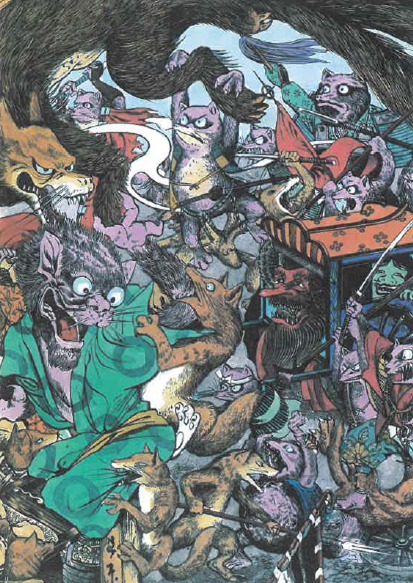
Kori no Tatakai – Kitsune/Tanuki Battles

Mizuki_Shigeru_Kitsune_Tanuki_Battle

Translated and Sourced from Mizuki Shigeru’s Mujyara, The Fox and the Badger in Japanese Folklore, Japanese Wikipedia, and OnMarkProductions.

Kitsune (foxes) and tanuki share much in common. They are the only two animals in Japanese folklore that are naturally magical—they don’t need to live a certain number of years to manifest their powers. Their stories both come from similar source legends in China, and dogs are their bitter enemies. Like many tribes who share so much in common, they are also rivals.

And while they rarely (if ever) engage in knock-down, drag-out fights, confrontations between kitsune and tanuki do happen occasionally. Usually they are magical showdowns of shape-changing ability, in the most classic “demonstration of magical powers” –style combat. Kitsune vastly overpower tanuki in these contests, but tanuki are much better tricksters. And in these cases, the mischief of the tanuki beats the pure evil of the kitsune.

What does Kori no Tatakai mean?

Put the kanji for tanuki (狸) with the kanji for kitsune (狐) together and you get the word kori (狐狸). In ancient times, kitsune and tanuki were considered to be a single group, and the word kori was used in a association with both of them. It appears as far back as 702 CE, in Section VII of the Zokutō Ritsu (賊盗律; Laws Concerning Robbers) which warned against the practice of using smoke to force “kori” (tanuki and kitsune) out of their dens in graveyards.

(And because Japanese is an extra-confusing language, through the kanji for dog in the middle of kori and the word transforms into kokkori (狐犬狸; Fox, Dog, Tanuki) and refers to the Japanese name for a Ouija Board,)

Much simpler is the term no tatakai (の闘い) with just means “battle of.”

Danzaburō Danuki and the Tanuki of Sado Island

Kyosai_Dosan-tanuki

Most Kori no Tatakai involved Danzaburo Danuki and his defense of the tanuki kingdom on Sado Island from invasion by kitsune. Danzaburo Danuki is a legendary figure, possibly based on a real person who lived on Sado Island in the 1650s. Danzaburo (the human) is said to have brought the tanuki to Sado Island as a dealer in meats and pelts. He released several tanuki cubs that soon populated the island. Or at least that was his cover—legends grew that said that Danzaburo was not a human at all, but a powerful bakedanuki (化け狸; transforming tanuki) smuggling his tanuki clan to the island to create a tanuki paradise free from the foxes and dogs that plagued them.

There are many stories of Danzaburo Danuki on Sado Island. He is somewhat of a folk hero. In by Kyokutei Baki’s Enseki Zasshi (燕石雑志 ; ) Danzaburo was said to recover lost treasure from hidden valleys and homes abandoned to fire and war, then loaaned his wealth to the poor island fishermen. This is unusual for a tanuki figure, who deal in illusion and trickery. The money Danzaburo Danuki leant was real gold and didn’t turn into useless leaves like is so many other tanuki tales. He wasn’t entirely pure though—when the fishermen stopped paying him back he stopped loaning out.

But by far the most famous Danzaburo Danuki tales are how he defended Sado Island from the Kitsune.

Danzaburo vs Kitsune – Round 1

Danzaburo Danuki was preparing to take his boat across to Sado Island one day, when he saw a kitsune waiting on the shore. The kitsune said he was looking for a new home for his clan, and wondered if Danzaburo might give him a ride across in his boat—the kitsune could not swim and had no money for passage. Danzaburo agreed, but asked that the kitsune transform himself into a vest so that it would be lest suspicious when he arrived at the far side.

The kitsune agreed that this was a good plan, and transformed himself into a vest that Danzaburo pulled on. Pulling the oar, Danzaburo whistled to himself quietly making his way across the stretch of ocean to Sado Island. When they were about half-way across, Danzaburo calmly slipped off the vest and dropped it into the ocean, leaving the kitsune to drown.

Danzaburo vs Kitsune – Round 2

Danzaburo Danuki met a powerful kitsune near Futatsu Iwa on Sado Island. Danzaburo was not about to allow a kitsune to set foot on Sado Island, and challenged him to a duel—a show of transforming powers. Danzaburo boasted “You may be hot stuff back home but your powers are nothing compared to mine. I don’t just turn from one thing into another. I can transform myself into an entire Daimyo’s procession!”

The kitsune—confident that no mere tanuki could out-transform him—accepted the challenge and settled back to watch Danzaburo make a fool out of himself. “Go ahead,” the kitsune smirked, “show me what you can do.”

In an instant, Danzaburo had disappeared. The kitsune was startled for a moment, but he was even more surprised when a Daimyo’s procession appeared, complete with armored warriors and bearers carrying a heavy palanquin.

“Unbelievable!” He did it!” The kitsune couldn’t believe that such a magical feat and been transformed, and leapt up on top of the palanquin to test the solidness of the illusion.

Unfortunately for the kitsune, Danzaburo was a better boaster and liar than a transformer. He timed his trick perfectly to disappear right when the very real Daimyo’s procession would come along the path. The soldiers, seeing a fox leap on the palanquin and appear to attack their Lord, grabbed it by the scruff of its neck and chopped its head off with one swift blow.

More Kitsune/Taunki Battles

According to Mizuki Shigeru’s Mujyara, the kitsune tried many times to invade Sado Island over the years, but where always beaten back by Danzaburo and his clan. That’s why to this day, there are no foxes on Sado Island—all though there are lots and lots of tanuki.

Flying_Dragon_Tanuki_vs_White_Fox

Another legendary Kitsune/Tanuki battle appeared in the kamishibai theater. Attributed to Musashi Jūnin (武蔵住人), Flying-Dragon Tanuki vs Nine-Tailed White Fox ran for the 21-installments. The story told of the villainous Nine-Tailed White Fox spiriting off the beautiful maiden Hagino, and the Flying-Dragon Tanuki’s battle to rescue her.

Translator’s Note:

This was translated for Katriel Page, who knows way more about kitsune than I do. A big thanks to Mark Schumacher and his OnMarkProductions site, which any fan of Japanese folklore should already have bookmarked.

Further Reading:

For more tanuki and kitsune tales, check out:

The Tanuki and the White Snake

The Belly-Beating of the Tanuki

Kitsune no Yomeiri – The Fox Wedding

Mizuki_Shigeru_Kitsune_no_Yomeiri

Translated from Mizuki Shigeru’s Mujyara, Japanese Wikipedia, Showa: A History of Japan, Tales of Old Japan, Kaii Yokai Densho Database, and Other Sources

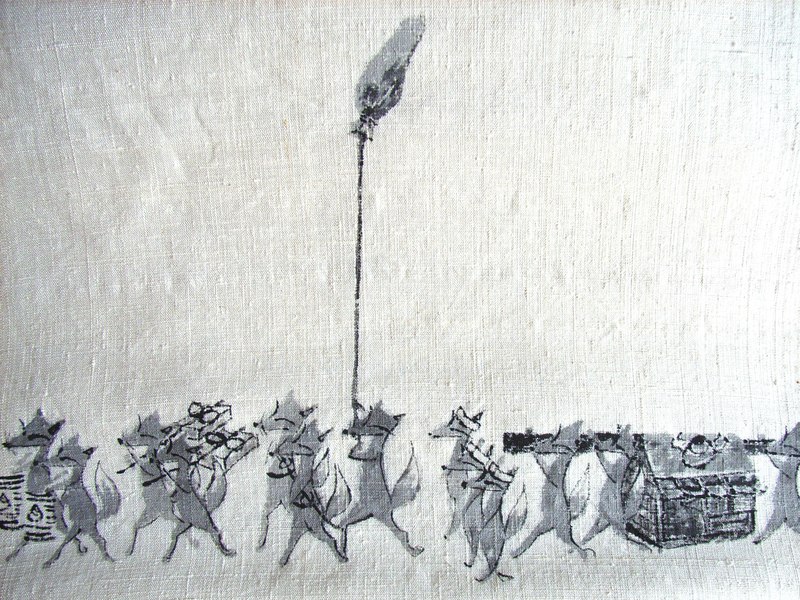
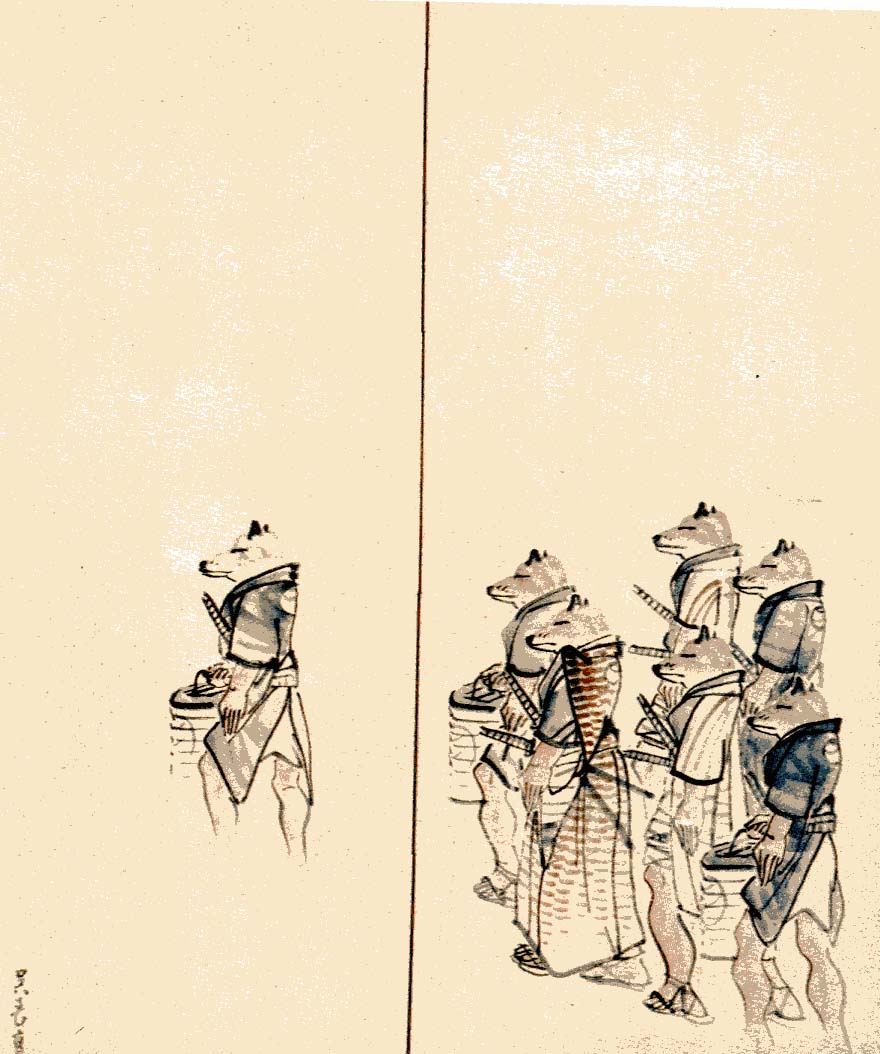
On a day when the sun shines bright and the rain falls, wise parents advise their children to play indoors. It isn’t that they are worried about them catching a cold. No, it is something more mysterious. For on such days the kitsune, the magical foxes of Japan, hold their wedding processions.

From Sakurai city in Ibaraki prefecture to Kashihara city in Nara prefecture, tales of Kitsune no Yomeiri appear all over Japan— with the sole exception of the northern island of Hokkaido. Most stories follow similar patterns with only slight variations. There are two phenomena referred to as Kitsune no Yomeiri—the bizarre weather called sunshowers where rain falls in broad daylight; and the procession of foxfire, called kitsune-bi (狐火), winding through the mountains late at night.

What does Kitsune no Yomeiri mean?

Kitsune no Yomeiri combines the kanji狐の (kitsune no; Fox’s) with嫁入り (Yomeiri; Wedding). In a literal translation, yomeiri means to “receive a bride,” as the custom is for the groom’s family to receive the bride on the wedding day as a proper member of their family. Until the middle-Showa period, Kitsune no Yomeiri Gyoretsu (狐の嫁入り行列; The Fox Wedding Bridal Procession) was more commonly used. But most drop Gyoretsu in the modern age. Just getting lazy, I suppose.

While Kitsune no Yomeiri is the most common term, there are regional versions of the same phenomenon. In Saitama and Ishikawa prefectures it is known as Kitsune no Yomitori (狐の嫁取り; The Taking of a Fox Bride). In Shizuoka it is called Kitsune no Shugen (狐の祝言; The Fox Wedding Celebration).

In Tokushima, the Kitsune no Yomeiri is a less happy occasion. It was called the Kitsune no Soshiki (狐の葬儀; Fox Funeral) and seeing one is considered an omen of death.

The Foxfire Lantern Procession

Fox Wedding Painting

The Kitsune no Yomeiri has long been a part of Japanese folklore, although with the rise of the Inari Fox-cult during the Edo period it gained a greater significance and cultural permeation. A description of Kitsune no Yomeiri comes from the book Echigo Naruse (越後名寄; Encyclopedia of Echigo) published during the Horeki period (1751-1764).

“On dark and quiet nights, in secret places, strings of lanterns or torches can be seen stretching out single file in an unbroken chain more than two miles long. It is a rare site, but an unmistakable one. It can be seen most often in Kanbara county, and it is said that on such night young foxes claim their mates.”

The procession of lights became associated with weddings as it mirrored Japanese wedding ceremonies at the time. Based on traditions established during the Muromachi period (1392–1573), weddings were held at night and the bride was escorted over to her new home by a lamplight parade. This type of ceremony—called the Konrei Gyoretsu (婚礼行列; Wedding Procession) —lasted until the mid-Showa period when Western wedding ceremonies replaced traditional Japanese ceremonies.

Legends of the Kitsune no Yomeiri merged with existing stories of kitsune magic and bewitchment. People who tried to follow these foxfire lantern processions would find that they disappeared as soon as they got close—although on rare occasions traces of the ceremony were found. Shunjitsu Shrine in Saitama prefecture was said to be a popular place for fox weddings. Whenever a Kitsune no Yomeiri lit up the night, the mountain road leading to the shrine was covered with fox poop the following day.

Fox Wedding Kimono

Picture from this website

Stories of Kitsune no Yomeiri continued well into the Edo period. In Toshima village (modern day Kita-ku, Tokyo) Kitsune no Yomeiri was seen on several consecutive nights, eventually becoming one of the Seven Mysteries of Toshima. Mt. Kirin in Niigata prefecture is full of foxes, and Kitsune no Yomeiri was said to be a common occurrence. In both Niigata and Nara prefectures, Kitsune no Yomeiri was thought to be a good omen for the harvest, with the more lanterns being seen the more fruitful the harvest. A year with no fox weddings made people dread the upcoming famine.

The foxes of Gifu prefecture didn’t just content themselves with lanterns. The foxfire procession was accompanied by the sound of cracking and blazing bamboo, although when examined the following day the forests appeared untouched.

Scientific Explanation for Kitsune-bi

The procession of lamplights is not only a widespread phenomenon in Japan; it is worldwide. Japanese kitsune-bi is different from foxfire in Western legends, which comes from a phosphorescent fungus. It is more akin to the Will-o’-the-wisp, also known as ignis fatuus or “Fool’s Fire.”

The most common explanation is that these fires are the oxidation of the chemical phosphine caused by decaying organic matter, such as can be found in forests. Other suggestions are that they are a mere optical illusion caused by the setting sun. But there is no scientific evidence for either of these theories.

The foxfire procession kind of Kitsune no Yomeiri are rarely seen today. This is most likely due to the 1950s deforestation of Japan’s native forests and replanting with fast-growing industrial cedar. Whatever magic of the forests that produced the foxfire lights, it is now gone, sacrificed to industry.

Sunshowers and Fox Weddings

Hokusai_Kitsune-no-yomeiri

The Meiji period Tanka poet Masaoka Shiki wrote:

“When rain falls from a blue sky, in the Hour of the Horse, the Great Fox King takes his bride.”

Another strange natural phenomenon goes by the name of Kitsune no Yomeiri, and in the modern era is much better known. On days when the sun shines and it still rains—a weather condition called tenkiame (天気雨) in Japanese or sunshowers in English—foxes are once again thought to hold their wedding ceremonies.

How sunshowers became associated with fox weddings is vague. Some say that it has to do with mountains where foxes are mostly found. There are times when mountains are covered in rain, while the town below is clear. People said that the foxes summoned the rain with their magic to hide their wedding ceremony. Others just think that because sunshowers are a mysterious occurrence, going against the natural pattern of clouds and rain, that people assumed a supernatural origin and associated it with foxes.

Although most pre-Meiji period accounts are of the foxfire processions, Katsushika Hokusai captured the sunshower-type in his painting Kitsune no Yomeiri-zu (狐の嫁入図; Picture of a Fox Wedding). The sunshower fox wedding was also mentioned in a 1732 Bunkraku puppet play Dan no Ura Kabuto Chronicles (壇浦兜軍記; The Chronicles of a Helmet of Dan no Ura).

As always, there are regional variations. In agricultural regions the sunshower version of Kitsune no Yomeiri was a good omen, promising rain for the crops and many children for the any new brides lucky enough to be married on such a day. In Tokushima, sunshowers are known as Kitsuneame (狐雨; fox rain) and not associated with weddings. In Kumamoto prefecture fox weddings are associated with rainbows, and in Aichi prefecture they are associated with hail.

How to See a Kitsune no Yomeiri

Fox Wedding Ink Painting

While most people go out of their way to avoid seeing strange phenomena (getting wrapped up in kitsune magic is rarely healthy in Japanese folklore) there are a few rituals for the brave and the curious.

In the Fukushima Prefecture, a bizarre ritual exists of wearing a suribachi mortar on your head and sticking the wooden pestle in your belt, then standing under a date tree. Of course, this only works on the 10th day of the 10th month of the Lunar calendar.

Aichi prefecture has a much easier method—just spit in a well and weave your fingers together. You are said to be able to view the Kitsune no Yomeiri though the gaps in your fingers.

But most stories advise against seeing a fox wedding—foxes are powerful in Japanese folklore, but dangerous. A wise person keeps well away.

Kitsune no Yomeiri in Literature

During the Edo period, numerous writers and kaidan-shu collections included first-hand accounts of Kitsune no Yomeiri, including those of people wandering into the middle of them and participating. The Kanei period (1624-1645) Konjyaku Kaidanshu (今昔妖談集; Kaidan Collection of Times Past), the Kansei period (1789-1801) Kaidanro no Tsue (怪談老の杖; A Cane for Old Kaidan Folk), and the Bunsei period (1818-1830) Edo Chirihiroi (江戸塵拾; Picked up Dust from the Edo Period) all contained first-hand accounts of encounters with Kitsune no Yomeiri.

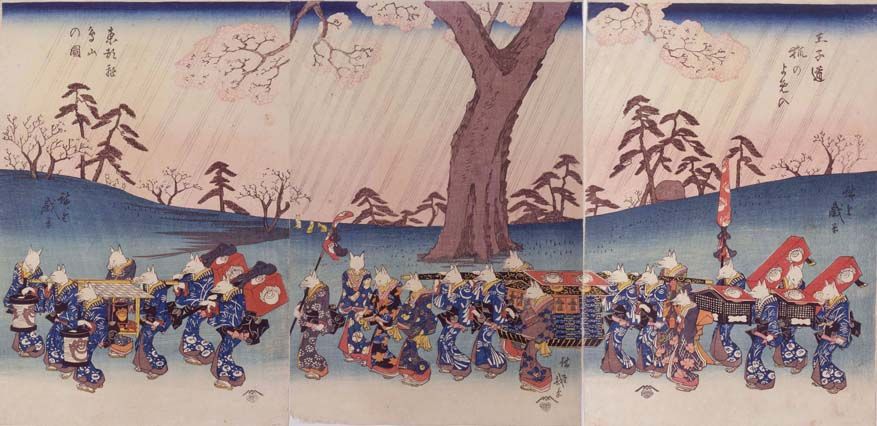
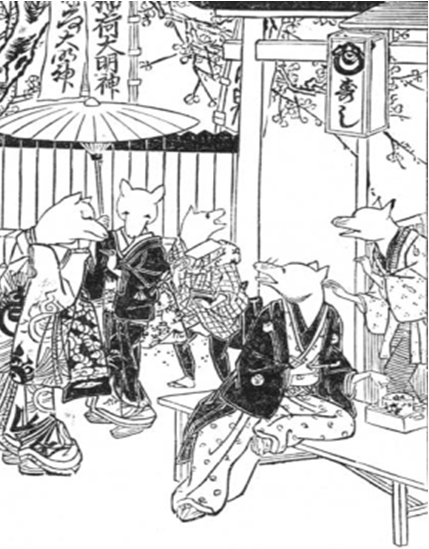
Kitsune no Yomeiri Ukiyoe

Some of the stories can be grim. A tale set in the Warring States period (1467-1568) tells of a young bride who suddenly fell sick and died. The night of her burial, a foxfire procession passed over her gravesite. Some are more uplifting, like the tale of an old couple who cared for a wounded fox pup, and many years later were honored guests at the fox’s wedding procession. Most stories, however, are of the voyeur nature—just a glimpse caught by a frightened soul hiding behind a tree when the wedding train passes by.

Mizuki Shigeru remembers being warned as a young boy against going outside during sunshowers. He writes about his memories of Kitsune no Yomeiri in his comics NonNonBa and Showa 1926-1939: A History of Japan. Kurosawa Akira featured the sunshower-type Kitsune no Yomeiri in his film Dreams

From Algernon Freeman-Mitford’s Tales of Old Japan, 1910

Algernon Freeman-Mitford describes the sunshower type of Kitsune no Yomeiri from the foxes’ point of view in his 1910 book Tales of Old Japan: Folklore, Fairy Tales, Ghost Stories and Legends of the Samurai:

“Once upon a time there was a young white fox, whose name was Fukuyemon. When he had reached the fitting age, he shaved off his forelock and began to think of taking to himself a beautiful bride. The old fox, his father, resolved to give up his inheritance to his son, and retired into private life; so the young fox, in gratitude for this, laboured hard and earnestly to increase his patrimony.

Fox_Wedding_Woodblock_Print

Now it happened that in a famous old family of foxes there was a beautiful young lady-fox, with such lovely fur that the fame of her jewel-like charms was spread far and wide. The young white fox, who had heard of this, was bent on making her his wife, and a meeting was arranged between them. There was not a fault to be found on either side; so the preliminaries were settled, and the wedding presents sent from the bridegroom to the bride’s house, with congratulatory speeches from the messenger, which were duly acknowledged by the person deputed to receive the gifts; the bearers, of course, received the customary fee in copper cash.

When the ceremonies had been concluded, an auspicious day was chosen for the bride to go to her husband’s house, and she was carried off in solemn procession during a shower of rain, the sun shining all the while. After the ceremonies of drinking wine had been gone through, the bride changed her dress, and the wedding was concluded, without let or hindrance, amid singing and dancing and merry-making.

The bride and bridegroom lived lovingly together, and a litter of little foxes were born to them, to the great joy of the old grandsire, who treated the little cubs as tenderly as if they had been butterflies or flowers. “They’re the very image of their old grandfather,” said he, as proud as possible. “As for medicine, bless them, they’re so healthy that they’ll never need a copper coin’s worth!”

As soon as they were old enough, they were carried off to the temple of Inari Sama, the patron saint of foxes, and the old grand-parents prayed that they might be delivered from dogs and all the other ills to which fox flesh is heir.

In this way the white fox by degrees waxed old and prosperous, and his children, year by year, became more and more numerous around him; so that, happy in his family and his business, every recurring spring brought him fresh cause for joy. “

Kitsune no Yomeiri Matsuri – Fox Wedding Festivals

Fox Wedding Parade

Kitsune no Yomeiri remains a popular aspect of Japanese culture and folklore. Many towns hold Kitsune no Yomeiri festivals re-creating the famous processions. Most of these festivals are modern—coming from the 1950s to as recently as the 1990s—and were started as tourist attractions to draw people into town. Local politicians and businesses participate in the festival, and sometimes the fox bride and groom are selected as a sort of “beauty pageant.”

Not all are modern tourist traps, however. The Yokaichi city, Mie prefecture Kitsune no Yomeiri procession to Suzakiha Mamiyashimei Shrine dates back to the Edo period, and is a ritual to drive out evil spirits and ask for blessings for the harvest. The festival in Kudamatsu city, Yamaguchi prefecture, has also been held since ancient times, although it bears little relationship to popular images of the Kitsune no Yomeiri. It involves asking the blessing of a pair of white fox deities whose wedding ceremony is re-enacted every year.

Translator’s Note:

The latest entry in my series on yokai who appear in Mizuki Shigeru’s Showa 1926-1939: A History of Japan. In the story, a young Mizuki Shigeru is told about foxes and Kitsune no Yomeiri by his friend and mentor, the local wise woman NonNonBa. Mizuki does not believe her until, later that night, he hears foxes barking from the mountain that NonNonBa talked about. It is at that moment he realizes all of NonNonBa’s stories—and the yokai themselves—are real.

Further Reading:

For more yokai from Mizuki Shigeru’s Showa: A History of Japan check out:

Hidarugami – The Hunger Gods
Sazae Oni – The Turban Shell Demon
Nezumi Otoko – Rat Man

For more kitsune stories, check out:

Tsukimono – The Possessing Thing

Countdown to Kitaro!

Kitaro Mizuki Shigeru Cover

As most of my readers are probably aware, August 6th marks the arrival of Kitaro from Drawn & Quarterly. Kitaro—known as Gegege no Kitaro in Japan—is THE yokai manga, created and written by Japan’s most eminent yokai scholar, Mizuki Shigeru. It is thanks to Mizuki Shigeru that yokai are still known and loved in Japan, and it is thanks to Gegege no Kitaro that this website even exits.

This is the first official English-language translation of one of Japan’s most popular and enduring comic books. Previously Kodansha published 3 Japanese/English bilingual volumes of Kitaro, but they were aimed primarily for a Japanese audience studying English and the translation was notoriously terrible.

Needless to say I am pretty excited about this. And you should be too!

What’s in it?

Kitaro collects the first two volumes of Gegege no Kitaro into a single book. There are lots of classic Kitaro tales; like the Great Yokai War where Kitaro and company take on the Western yokai like Dracula, Frankenstein’s Monster, and the Werewolf, all lead by the bizarre Bacbeard; or the late night game of Yokai Baseball; Or possibly one of the first Giant Monster vs. Giant Robot battles where Zeuglodon dukes it out with Mecha Zeuglodon.

Kitaro_Yokai_Files_Zack_Davisson

I didn’t translate Kitaro (for my translation you have to pick up Mizuki Shigeru’s next release Showa 1926-1939: A History of Japan) but I wrote all of the Yokai Files included in the volume. Matt Alt (Yokai Attack!) wrote the introduction talking about Mizuki Shigeru’s legacy and place in Japanese culture.

I think it is safe to say that this is the most important Japanese comic release of this year.

To read more about it, check out this blog posting from Kitaro-publisher Drawn & Quarterly:

http://drawnandquarterly.blogspot.ca/2013/07/mark-your-calendars-mizuki-fans-kitaro.html

Will There be any More Kitaro?

My most asked question about Kitaro is: “Will there be more?” And the only answer is—that’s up to you!

Here comes my pitch …

Whether there will be more Kitaro—or even any more English-language releases of Mizuki Shigeru’s excellent work at all—depends almost entirely on how well Kitaro does. If we can show that there is an English-speaking audience for Kitaro and Mizuki Shigeru—if this first volume is successful—then odds are good you will get more. If not, well … it’s just like a movie; the first one has to do well in order to justify the sequel.

So I highly encourage you (beg? plead?) to pre-order a copy of Kitaro if you can. You still have a couple of weeks to get your orders in and ensure you get a copy right away. I guarantee you will love it. If you’re a fan of hyakumonogatari.com, you’re a fan of Japanese folklore and yokai. And that means you’re a fan of Kitaro, even if you haven’t discovered it yet.

You can pre-order on Amazon.com:

Kitaro

Whew! Pitch ended …

And Another Thing – Vote Mizuki Shigeru for Cool Japan!!

Tottori_Yokai_Road_Japan_Cool

One last thing I encourage you to do (beg? plead?). And this one is totally free and easy. Just click a link and click “Like” and that’s all there is to it.

As you may have read in the news, Japan is currently sponsoring a “Cool Japan” tourism campaign showing off some of Japan’s cooler aspects, as well as being an appreciation of Japanese culture and creativity. In partner with this, the airline company ANA has started their own “Is Japan Cool?” website, where you can vote on what is cool in Japan.

Mizuki Shigeru and his Tottori Yokai Road is a candidate on the “Is Japan Cool?” website. To vote, all you have to do is go to the website and click “Like.” When I wrote this post, Mizuki was in the #1 spot. Let’s keep him there!

https://www.ana-cooljapan.com/dreams/movie/yokaiload/

If you don’t know about Tottori Yokai Road, the “Is Japan Cool?” website has a great collection of images and a video talking about Mizuki’s famous yokai. It’s a cool website just on its own, and it’s even better because you get to show your love for Mizuki Shigeru by throwing a Like his way.

That’s all folks! Now get crackin! Kitaro is waiting for you.

Hidarugami – The Hunger Gods

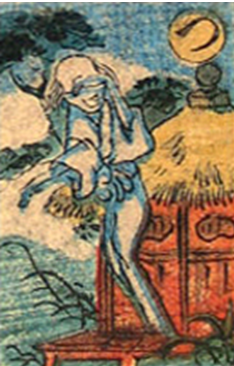
Hidarugami Mizuki Shigeru

Translated and Sourced from Mizuki Shigeru’s Mujyara, Showa: A History of Japan, Japanese Wikipedia, Kaii Yokai Densho Database, and Other Sources

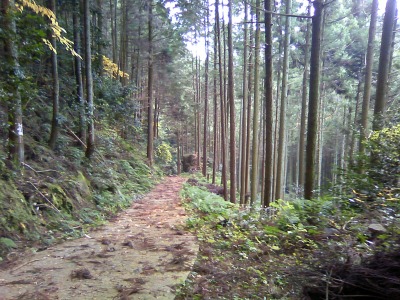
If you are walking through a mountain trail, and find yourself overcome with a sudden hunger—a soul-killing hunger that drives you to your knees like true starvation—you might need to do more than reach into your backpack for an energy bar. You might be under attack by the Hidarugami, the Hunger Gods.

What Does Hidarugami Mean?

Hidarugami is written with the katakanaヒダル (hidaru) + the kanji 神 (kami; god). Things written in katakana have no inherent meaning. However, the word “hidaru” is most likely connected with饑い (hidarui), meaning hunger. Hidarui is a colloquial term, used mainly in Gifu prefecture. Hidarugami is also sometimes writtenひだる神 using the hiragana for “hidaru,” also with no inherent meaning.

The fact that the kanji “kami” is used places the hidarugami on a higher level than most yokai, alongside such devastating deities like the Binbogami (貧乏神; God of Poverty) and Shinigami (死神; God of Death). This elevated status is due in part to arising from human spirits, from reikon.

There are other names for the Hidarutami. In Kitakyushu, it is known as the Darashi (ダラシ), in Mie and Wakayama prefectures it is sometimes called the Dari (ダリ), while in Nara and Tokushima prefectures it is called Daru (ダル). All of these use katakana for the names.

The Hunger Strike of the Hidarugami

Hidarugami Road

Hidarugami are said to be the spirits of those who starved to death wandering the mountains. Because they died alone, with no marker for their grave or any ceremony, their spirits become evil and seek to share their death agonies.

They are found almost exclusively on mountain trails and passes. Hikers and travelers in the presence of the Hidarugami are suddenly overcome with acute hunger, fatigue, and numbness of the limbs. The feeling is said to be that of actual starvation. The victim is unable to move and often collapse. This attack is a form of possession. The Hidarugami enters your body. If no action is taken, the Hidarugami can cause death—actual death by starvation in a healthy body.

If you are killed, you join the Hidarugami group. In this way, Hidarugamai groups slowly enlarge to contain many souls.

Expelling the Hidarugami is easy, so long as you are prepared. Just a small mouthful of a staple food, such as rice or grain, staves off the attack and the starvation leaves as quickly as it arose. That is why—even today—hikers are advised against going into the mountains without a few riceballs or a bento to eat. Even then, they never eat the entire meal, always leaving a few grains behind in case of emergency.

Old Japanese kaidanshu and traveler’s guides are full of stories of the Hidarugami. In a story coming from 1736 a man named Senkichi was found exhausted and unconscious on a mountain trail. Unable even to speak, he was loaded into a cart and carried back to town where he was fed and recovered. Senkichi related an account of an attack by Hidarugami. Another typical story tells of a merchant crossing the Noborio Pass towards Onohara. Only a few hours after finishing his lunch he became ravenously hungry, struggling to make his way to a nearby temple. A traveler’s guide from 1861 warned of the dangers of going into the mountains without a few riceballs for protection.

Are the Hidarugami Yokai or Yurei?

Obake_Karuta_Hidarugami

Hidarugami defy simple classification, and show the complicated nature of Japanese folklore. Are they yurei? Are they yokai? Are they Gods? Yes to all three questions. (And yes, it is a trick question as all yurei are yokai. Smart catch there!)

Because Hidarugami enter the body and possess it, they are considered a type of the Tsukimono yokai – A Possessing Thing. While most tsukimono are magical animals, anything that possess can fall into this category.

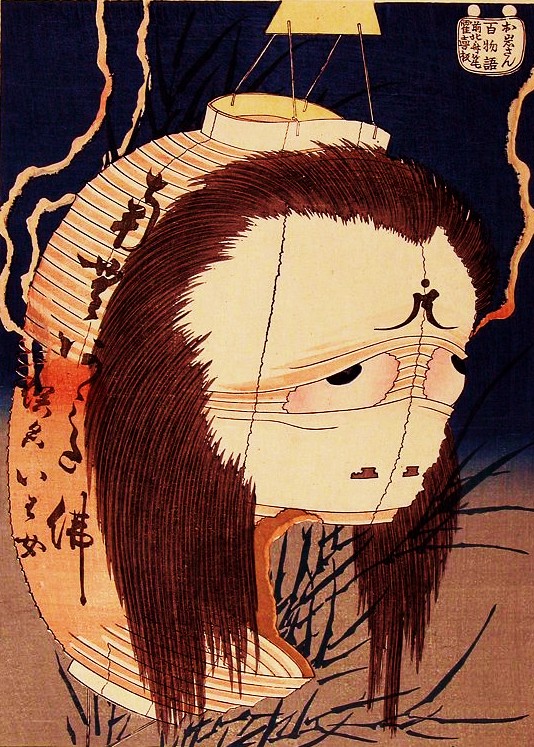
Higarugami are most definitely yurei—they are referred to as either akuryo (悪霊; Evil Spirit) or onryo (怨霊; Vengeful Spirits). But they are not typical yurei. Like Funa Yurei and oddities like the Shichinin Dōgyō – The Seven Pilgrims, the Hidarugami act as a group and actively make new members. Because they are bound to their location, they would be considered a type of jibakurei (地縛霊; Earth-bound Spirit).

Hidarugami are also muenbotoke (無縁仏). This refers to the unworshiped dead, those who die without burial or ceremony. Special rites are often held on Obon, the Festival of the Dead, specifically for muenbotoke to try and get their spirits to pass one. One passage says that the Hidarugami’s grip on the world is not particularly strong—that they are a weak god—and they should be banished by a simple muenbotoke ceremony.

Gaki Hungry Ghosts

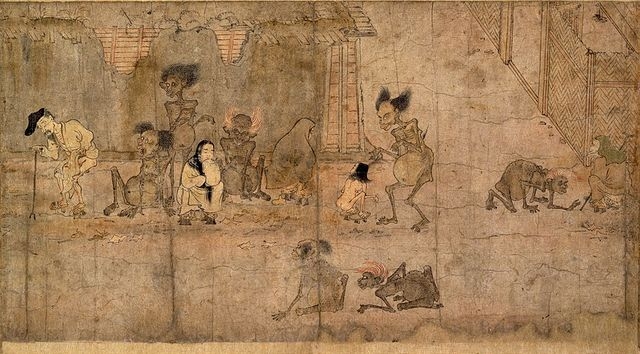
They are also associated with Gaki ( 餓鬼), the Preta or Hungry Ghost of Chinese and Tibetan Buddhist mythology. The association is vague and only based on the dual obsession with hunger. Gaki are those whose sins of gluttony condemn them to be reborn as foul creatures with a rapacious hunger for disgusting things such as corpses or feces. Gaki are not native to Japanese folklore, and at sometime after their importation from China a link was made between the Gaki and the Hidarugami.

Hidarugami Across Japan

Like all widespread folklore, the Hidarugami have regional variations and associations. In Wakayama prefecture, —along the ancient pilgrimage route of Kumano Kodo—there is a deep hole called the Gaki Ana, or the Gaki’s Pit. The exact location of the pit is unknown, but it is said to be someone near Mt. Okumotori and Mt. Shokumotori in Wakayama prefecture. Wherever it is, staring into the Gaki Ana is said to summon the Hidarugami.

In Shiga prefecture, possession by a Hidarugami is much more dreadful. The possessed person’s stomach suddenly swells like a starvation victim, and they begs for a bowl of rice with tea. If someone answers that they had food, but have eaten it, the possessed victim will attack with a fury, ripping open their stomachs in search of undigested bits of rice to eat.

In Mie prefecture, Hidarugami are said to attack not only humans but also cattle being moved across mountain trails.

In Kochi, Nagasaki, and Kagoshima prefectures, there are small shrines set up along mountain roads and mountain passes enshrining the kami Shibaorigami (柴折様). Making a small offering at these shrines, even something so small as laying down a few token branches of wood, is said to provide protection against the Hidarugami.

Translator’s Note:

This is the next in my series of yokai who appear in Mizuki Shigeru’s Showa: A History of Japan. A young Mizuki Shigeru encountered the Hidarugami once walking through a mountain road. He survived the attack due to finding a few stray grains of rice. It was only much later in his life while reading a book that he learned to put a name to the strange phenomenon he had encountered.

Further Reading:

To read more about Tsukimono and other sundry ghosts, check out:

Tsukimono – The Possessing Thing

Shichinin Dōgyō – The Seven Pilgrims

Funa Yurei

Previous Older Entries Next Newer Entries

Copyright notification

All translations and other writing on this website were created by Zack Davisson and are copyright to him.

Copyright notification

In accessing these web pages, you agree that any downloading of content is for personal, non-commercial reference only.

No part of this web site may be reproduced or transmitted in any form or by any means, electronic, mechanical, photocopying, recording or otherwise, without prior permission of Zack Davisson.

Copyright notification

For rights clearance please contact Zack at:

zack.davisson (at) gmail.com

Thank you.