Ki no Kami – The God in the Tree

Translated from Mizuki Shigeru’s Mujara

From ancient times in Japan, certain types of trees were thought to be abodes for kami, the spiritual deities of Japan’s native animistic religion. Specific trees such as the Chinese bunyan tree or the Indian laurel were said to be favored by these kami. The importance of these tree-dwelling kami was established in the Kojiki (Record of Ancient Matters), where the legend is told of the founding sibling gods of Japan Izanagi and Izanami. The two gave birth to hundreds of thousands of godling children, but their second-born was the kami of the trees.

All around Japan you can see trees that resemble humans in some uncanny way. Legends say this comes from the kami spirits who dwell inside. Called Jiyushin (), shinboku (神木), or kodama (古多万), these sacred trees are often found on the grounds of Shinto shrines or Buddhist temples. The spirits that dwell in the trees are said to offer protection to worshipers and watch over homes in the vicinity.

At the same time, these trees offer protection to the kami themselves, giving them a physical space to inhabit. It is sometimes said that the kami come down to earth from heaven, but they cannot remain in their natural state. The holy trees act as a medium, giving the spiritual essence of the kami somewhere to exist while they are in the human realm. They resonate with trees of a certain shape—it is said spiritual energy of the kami can be felt the most strongly in trees that have double, or even triple, trunks.

There are still shrines throughout Japan that venerate local tree-dwelling kami. Many of these are found in the mountains, where the trees are said to be inhabited by various mountain kami or even ancestor spirits. But no matter the origin, when they kami take up residence in a tree they are called ki no kami, the gods in the trees.

Translator’s Note

This is another magical tree legend, with a different take than the previously translated moidon. The fundamental concept is different, in that the moidon are themselves gods (kami) while the ki no kami are more like dryads in the European tradition (Notice I said “more like.” Obviously they are not exactly alike). The trees are just the shells the spirits inhabit while on earth. And kami can be fickle things. All over Japan you can see several abandoned shrines that look as though the kami has left them.

For more magical tree stories, see:

Moidon – The Lord of the Forest

Ochiba Naki Shii – The Chinkapan Tree of Unfallen Leaves

Enju no Jashin – The Evil God of the Pagoda Tree

Jinmenju – The Human-Faced Tree

Moidon – The Lords of the Forest

Translated from Mizuki Shigeru’s Mujara

The Moidon’s name tells you exactly what it is. The word moi (森) means “forest,” and the word don (殿) means “Lord.” It is a title of honor bestowed upon grand and aged trees. In ancient Japan, long before there was any sort of organized religion, people believed that these great trees were deities and the land they inhabited was a sacred space. Southern Kyushu in particular is home to moidon, although on Osumi peninsula they are called moriyama. In Kagoshima prefecture you can find more than a hundred moidon.

Long before any shrines were built, moidon served as places of worship to the ancient Japanese. Very old and massive trees were said to be the bodies for gods. In particular, broad-leaf evergreen trees were considered to be moidon, such as beech, camphor, and fig trees. In modern day Shinto, you can still see moidon that existed long before the buildings were built. Indeed, many of those oldest shrines were built around a particular moidon, as the area was already considered a sacred space by virtue of the tree.

In Hioki ward, Ichiki city, there is a moidon whose festival is celebrated every year. On November 5th, by the counting of the old Japanese lunar calendar, people eat festive red rice to mark the occasion, and a dish is always set in front of the tree as an offering. However it is said that if you take a single leaf home, or if any part of the great tree is burned as firewood, you will fall under its curse.

Moidon were long worshiped as gods, but they were also greatly feared. It is said that moidon are quick to take offense, and bestow curses more readily than blessings. Those who ask too much of them, or who gather their fallen branches to burn, will find themselves stricken with various illnesses, including a burning, itchy skin. Sometimes doing so much as to touch the tree brings about its curse, so villagers are often careful to give their moidon trees a wide birth except at festival time.

Because of their ability to curse, it is thought that these lords of the forest may be one of the origins of yokai legends throughout Japan.

Translator’s Note

A new translation at last! Sorry about the delay, but work has kept me very busy as of late.

The moidon is a choshizen type of yokai, referring to a sort of natural phenomenon. As Mizuki Shigeru says, you can still see these ancient trees in old Shinto shrines, usually demarcated by a straw rope and other sacred symbols. When I lived in Nara prefecture, I used to go to Miwa shrine that had a massive, ancient tree that was said to be much older than the shrine itself, which was already several centuries old.

Other magical tree stories on Hyakumonogatari.com

Jinmenju – The Human-faced Tree

Enjyu no Jashin – The Evil God in the Pagoda Tree

Ochibanashi nantoka – The Chinkapin Tree of Unfalled Leaves

Jinmenju – The Human Face Tree

Translated from Mizuki Shigeru’s Mujyara

This tree is found in mountain valleys. The fruit of the tree looks like a human head. It doesn’t say a word, but it is constantly laughing. It is said that if the fruit laughs too heartily, it falls from the tree.

According to the Edo period Hyakka Jiten encyclopedia Wakan Sansai Zue (和漢三才図会; A Collection of Pictures of Heaven, Earth, and Man from China and Japan), the Jinmenju trees are found in the south, and the fruit of the tree is called the jinmenshi, or human-faced child. They ripen in the fall, and if you eat the fruit they have a sweet/sour taste. It is said that the Jinmenju seed also has a human face, eyes, ears, nose, and mouth. It is possible that the trees were all eaten and it is why we don’t see them today.

In the past however, it was said that people planted great orchards of the laughing Jinmenju. That must have been a beautiful sight.

The legend of the Jinmenju comes from China, and was passed onto Japan where it was considered to be a yokai due to its peculiar nature. There are also stories of trees bearing human-faced fruit from India and Persia, usually with the faces of beautiful girls. Even now, when you walk through the forest you can see trees whose roots bear a resemblance to human and yokai faces. I have five pictures of trees like this in my photo albums. I wonder if this is some new species of Jinmenju?

Translator’s Note

Most people think of yokai as some kind of monster, but the Jinmenju is a type of yokai called choshizen, or super-nature, which includes mysterious plants and animals. Toriyama Sekien included the Jinmenju in his collection Konjyaku Hyakki Shui (今昔百鬼拾遺; Supplement to The Hundred Demons from the Present and the Past). All Jinmenju stories have their origin in a Chinese book Sansai Zue(三才図会; A Collection of Pictures of Heaven, Earth, and Man).

This entry was translated for Dan Tsukasa, who is developing a Japanese folklore video game called Kodama. (Which you all should all check out!) I am helping Dan out with some yokai info for the game, part of which takes place in a magic forest. So look forward to some more choshizen offerings.

Further reading:

Read more yokai magical tree tales on hyakumonogatari.com:

Ochiba Naki Shii – The Chinkapin Tree of Unfallen Leaves

Enju no Jashin – The Evil God in the Pagoda Tree

Ubume-zu – Portrait of an Ubume

Translated from Mikzuki Shigeru’s Yokai Zukan

Here we have yet another yurei portrait, but this one gives an impression of sadness instead of fear. The title of this piece is ubume (姑獲鳥), which makes a reference to a Chinese yokai that took the form of a bird. This yokai entered Japanese folklore as the spirit of a woman who had given birth, and stories are told of a ghostly woman who wanders through town carrying her child in her arms.

This image of the ubume (産女) is the one drawn by Sawaki Sushi in Hyakaizukan (百怪図巻; “The Illustrated Volume of a Hundred Demons”) and by Sekien in Gazu Hyakki Yagyō (画図百鬼夜行; “The Illustrated Night Parade of a Hundred Demons”). Kyosai’s painting is of the same genus. In fact, Kyosai’s painting is so similar to that of another artist, Kano Tosen’s work “Umesachi,” that it could almost be considered a reproduction.

The ubume’s clothing and hair are swept back by the wind. She covers her face with her sleeve. The whole scene is one of plaintive sorrow.

Further Reading:

Check out other yurei art from hyakumonogatari.com:

Yūrei-zu – A Portrait of a Yūrei, a Japanese Ghost

Two Tales of Ubume

Hokusai’s Manga Yurei

Translator’s Note

This is Mizuki Shigeru’s commentary on a famous painting by Meiji-era artist Kawanabe Kyosai (河鍋暁斎; 1831-1889). Known as the last great painter in the Japanese style, Kyosai was said to be the inheritor of Hokusai and the other great ukiyo-e masters, although he did not study under Hokusai.

This painting is of a traditional type of ghost known as ubume. Ubume can be written with two sets of kanji, either 姑獲鳥 or 産女. The more typical one is 産女, which translates as “birthing mother.” Ubume are said to be ghosts of women who died in childbirth, or died with their still living child in their womb who is then born from a dead mother. They wander the streets trying to buy sweets and to get care for their still living child. In still other legends their child is as dead as they are. The kanji Kyosai used to title his painting, 姑獲鳥 translates rather strangely as “bird-catching mother-in-law” and shows the Chinese origin of the name. As stated by Shigeru, the Chinese ubume can take on a bird shape.

Kyosai probably used this archaic kanji to give an allure of mystery to his work, and to show his knowledge of Chinese.

What is the White Kimono Japanese Ghosts Wear?

Translated from Japanese Wikipedia and Other Sources

To learn much more about Japanese Ghosts, check out my book Yurei: The Japanese Ghost

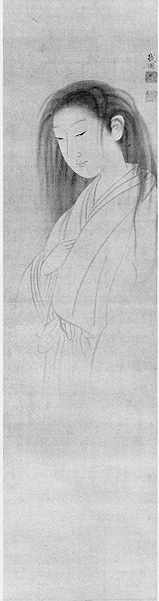
Black hair. White face. White kimono. Whisper the word Japanese ghost to anyone, and that is the image that will appear in their head. For Americans, the image generally comes from Japanese horror films where white-kimonoed girls crawl from TV sets or rise from wells. But to Japanese people, the costume of a white kimono has a more somber feel. Most likely over their lives they will wrap more than one loved one in the traditional burial garment called a kyokatabira.

Kyōkatabira – The Buddhist Robe

The white kimono that most Japanese take their final journey in is called a kyokatabira. The word is split into two terms: kyo (経) which means Buddhist sutra, and katabira (帷子) which is a light, unlined kimono worn on informal occasions, such as rising in your own house in the morning.

Katabira were traditionally made from hemp and came into fashion around the Heian period (794 to 1185). At the time, katabira were a form of underwear. They were stuffed with cotton and used to keep warm as a sort of wearable blanket. But as summer came and people shed layers, they soon learned that the simple, single-layered garment was just as comfortable in Japan’s humid and oppressive summer. These were eventually adapted for use in the bathhouse, which were called yukatabira (湯帷子). This word was later shortened to yukata, a light kimono that are still worn in Japan today— although the kanji 浴衣 is more commonly used.

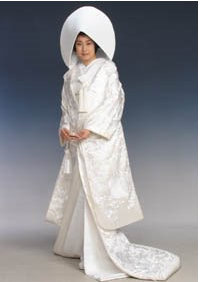
The use of the white katabira is thought to have appeared around the same period, as a mix of Shinto and Buddhist tradition. The Emperor was said to wear a white kimono when performing religious rituals during the Heian period. Unlike the coarse hemp of the commoners, the Emperors garment was spun from silk and was called a byakue (白衣) meaning nothing more complicated than “white robe.” Shinto priests adopted the fashion, with a full costume called jōe (浄衣) meaning “purified robe.” Brides on their wedding days wore a white kimono called a shiromuku (白無垢) meaning “white purity.”

Buddhist priests preferred the rough hemp over the fine silks of the byakue and jōe, and took to wearing what was called kyōkatabira. As the name suggests, kyōkatabira were standard white katabira inscribed with Buddhist sutras. Kyōkatabira came to be work by Buddhist on pilgrimages as they travelled Japan.

All of these types of garments: byakue, jōe, shiromuku, and kyōkatabira; fall under the category of shiro-shozoku (白装束) meainging “white clothing.”

What is the significance of the color white? – Priests, Brides, and Corpses

I sometimes hear people say that white is the color of death in Japan, but this is a mistake. White is the color of purity.

For as long as anyone knows, white in Japan has been the color of purity, specifically ritual purity. The native religion Shinto has always been concerned with cleanliness and purity. At most Shinto shrines there is a place for you to wash yourself before entering.

Ritual purity means more than just taking a good bath, although that is a part of it. In order to be ritually pure, you must be cleansed of kegare (汚れ) meaning “impurities,” which can only be done through a serious of prescribed enigmas under the guidance of a priest. Wearing a white kimono is a visible sign of purity, and is generally done by only three classes of people; priests, brides, and corpses (or those soon to be corpses, like people commiting seppuku).

And of course yurei, Japanese ghosts.

Shinishozoku- Costume for the Dying

Around the 700s, Buddhism arrived in Japan and began to grow in popularity. Buddhism in Japan mixed with Shinto to create a unique religion quite different from its Indian origins. Over time, Shinto and Buddhism split until each oversaw a different aspect of humanity, the kami of Shinto overseeing the living and the deities of Buddhism caring for their souls in death. Buddhism slowly took over all funeral rites, which remains with way it is in Japan today.

In Buddhism, death is not the ending but just the beginning of another cycle. Appropriately, Japanese Buddhist dressed corpses as pilgrims going on their final journey, called the shidenotabi (死出の旅) meaning “the final trip to death.” The full costume for a corpse is called shinishozoku (死に装束),which means roughly “the costume for one going to death.”

A complete shinishozoku will have the corpse dressed in a kyōkatabira with sutras written on the inside and folded right-over-left in the opposite style, a tankan-the triangle-shaped headband, a zutabukuro-a small carrying bag containing ferry passage over the Sanzu river of the dead, a walking cane, and coverings for the legs, arms, and back. The final item is a string of prayer beads nestled in the hands.

What is the significance of folding the kimono right-over-left?

A common occurrence in Japan is seeing a foreigner trying on a yukata for the first time, and eliciting a room full of gasps as they innocently take the right side of the yukata and fold it over the left. I did. And I had no idea why everyone was so shocked.

I found out soon enough that the right-over-left style is reserved exclusively for corpses, Living people always—ALWAYS—fold their yukata or kimono left-over-right. But why? That, no one could tell me.

It took some digging to find the answer, but it comes back to that old Asian favorite, class distinction by clothing. Apparently in ancient China the way you folded your kimono was a visible way to show your rank. Like foot-binding and long fingernails, it was also a way to purposefully hobble yourself to show that you did not need to work for a living.

Folding your kimono left-over-right allows a greater freedom of movement, such as was required by field workers. The leisure class thumbed their noses at freedom of movement, and purposefully folded their kimono right-over-left. During the Nara period, when Chinese culture influenced Japan, this custom was taken up enthusiastically by the aristocratic classes.

Death, however, knows no distinction of rank. One of the principles of Japanese religion and folklore is that the dead are mighty, and you don’t want to offend them. So it became the custom that all dead people, no matter what they were in life, rose to the aristocratic right-over-left class and folded their kimonos that way for their final journey.

The meaning of the kyōkatabira

So the white kimono, the kyōkatabira, is much more than a simple garment. It is a statement of transformation. It shows that here, on their last journey, a person has become ritually pure in the Shinto tradition, a holy pilgrim in the Buddhist tradition, and a wealthy aristocrat in the human tradition.

Few other items of clothes so completely raise you simply buy putting them on. Of course, you have to be dead to wear it, so there is a trade-off.

The Ghost of Oyuki

For more about the origins of Japanese Ghosts, you can purchase Zack Davisson’s limited edition yomihon chapbook The Ghost of Oyuki from Chin Music Press.

The Ghost of Oyuki Chapbook

Further Reading:

Check out other death customs from hyakumonogatari.com:

What is the Triangle Headband Japanese Ghosts Wear?

Nagarekanjyou – A Death Custom

Previous Older Entries Next Newer Entries

Copyright notification

All translations and other writing on this website were created by Zack Davisson and are copyright to him.

Copyright notification

In accessing these web pages, you agree that any downloading of content is for personal, non-commercial reference only.

No part of this web site may be reproduced or transmitted in any form or by any means, electronic, mechanical, photocopying, recording or otherwise, without prior permission of Zack Davisson.

Copyright notification

For rights clearance please contact Zack at:

zack.davisson (at) gmail.com

Thank you.