Baku – The Dream Eater

Translated from Mizuki Shigeru’s Mujara and Japanese Wikipedia

When a child in Japan wakes shaking from a nightmare, she knows what to do. Hugging her face in her pillow, she whispers three times “Baku-san, come eat my dream. Baku-san, come eat my dream. Baku-san, come eat my dream.” If her request is granted, the monstrous baku will come into her room and suck the bad dream away. But the baku cannot be summoned without caution. A too-hungry baku might not be satiated with a single dream, and might suck away her hopes and ambitions along with it, leaving her hollow.

What is a Baku?

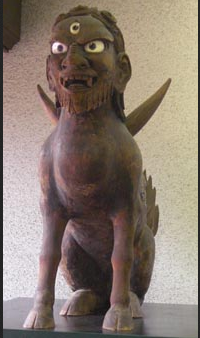
Baku are classic chimera; the body of a bear, the nose of an elephant, the feet of a tiger, the tail of an ox, and the eyes of a rhinoceros. One legend says that when the gods were finished creating the animals, they took all of the odds and ends lying around and put them together to make the baku.

According to Japanese legend, baku are the eaters of bad dreams. They are a talismanic figure, that people pray to at night to come and suck away nightmares so that they may never be seen again. But there is a darker side to the baku; some say that baku eat all dreams, not only nightmares. This includes dreams of aspiration, dreams of your future, and dreams of hope.

Is the Baku Real?

While they are wildly stylized, baku resemble the Asian tapir. And in fact, in Japanese they share the same name and kanji (獏). The baku is not alone in this; the word kirin is not only Japanese for giraffe but also a mythical Chinese monster.

Which came first—the legend or the animal—is hidden in the past, with no solid agreement on either side. Many say that the two are unconnected, and that the similar appearance is pure coincidence, with the animal being named after the legend. Some say a wayward sailor drifted to Malaysia, and came back with stories of a massive creature that was transformed by legend.

Either way, the legend is old in his book “Ancient Chinese Gods and Beasts,” Kyoto University professor Hayashi Minao points to ancient bronze ware and other artifacts inscribed with images of the mythical baku. He postulated that some creature like the Asian tapir might have existed in China at sometime, but has since gone extinct.

Baku are often confused with another Chinese legendary animal, the hakutaku (called a bai ze in Chinese). In fact, at Gobyakukan-ji temple in Tokyo, there is a statue called the Baku King, which was originally a statue of a hakutaku.
Is the Baku a Yokai?

A complicated question, that depends on how broad your definition of a yokai is. It isn’t a yokai in the sense of fantasy creatures like the nure onago or bakeneko. It is more of a sacred animal, more associated with gods than monsters. Mizuki Shigeru uses the broadest possible definition of yokai, meaning anything mysterious from Bigfoot to rains of frogs, by which the baku definitely qualifies.

The History and Legends of the Baku

Like many folkloric creatures, baku have changed over the centuries. In the oldest Chinese legends, baku were hunted for their pelts. It was said that using a blanket made from a baku was a talisman against illness and the malice of evil spirits. Due to a lack of available baku pelts, this eventually changed to where putting an image of a baku over the bed would afford you equal protection. During the Tang dynasty( 618 – 907), folding screens decorated with baku were a popular item.

Somehow, the legend of the baku was transmitted to Japan, where the beast became associated with the dream eating that it is best known for today. The Tang period book Torokuten (Six Stories of the Tang dynasty) also tells of a sacred animal called a bakuki that eats dreams, and it is likely that the two were merged into a single legend.

The baku legend as a dream-eater has stayed consistent since adopted by Japan. There have been various ways of summoning the baku. In Fukushima it is said that if, after awaking from a bad dream, you say “I give this dream to the baku,” then that dream will never trouble you again. In other prefectures, you repeat “Baku-san, come eat my dream” three times in a row to summon to baku to come and eat your nightmares.

During the Muromachi period (1337 to 1573) in Japan, it became popular for people on their death bed to hold an image of a baku as a talisman against evil spirits. They also became associated with the fantastical Treasure Galley, which often had a baku painted on its sails. During the Edo period (1603 to 1868), pillows were sold in the shape of baku, said to protect the sleeper from bad dreams.


Baku in Modern Japan

While many yokai and legendary creatures have faded until they live only in the memory of academics and comic artists, baku are still a popular figure in modern Japan. The baku appears in many modern animation and comic books, although in appearance they look more and more like authentic tapir, and less and less like the folkloric chimera.

Shudan Borei – A Group of Ghosts


shudan borei

To learn much more about Japanese Ghosts, check out my book Yurei: The Japanese Ghost

Translated from Mizuki Shigeru’s Mujara

On July 28th, Showa 30th (1955), in a heartbreaking incident 36 junior high school girls drowned on a beach in Mie prefecture. Of the nine girls who survived the incident, five had the same story to tell.

The girls were all playing and swimming in the calm waters, enjoying the gentle lapping of the waves. Without warning, the water seemed to gather together, and a dark mass rose from the surface of the ocean. The mass took the shape of people in WWII air-raid hoods, dark in color, soaking wet and pouring water from every surface. As the mass rose, the figures become more defined, dressed in old-fashioned women’s work pants. There were hundreds of them.

The girls tried to get away, but the water seemed to be sucked up towards the dark figures, dragging the girls towards them. One of the girls who survived said she felt a hand grab her leg and try and pull her under the water. She was able to break the hands grasp and make her way to the shore, but her friends were not so lucky.

Afterwards, students who were on the beach and not in the water confirmed the story and all of its details. They saw the ghosts rising and dragging the girls under the water.

After investigating the incident, it was discovered that exactly ten years before the incident, U.S. aircraft had firebombed that area, killing around 250 people. The bodies were not cremated, but were piled without ceremony into a mass grave on that beach. In this way one tragedy became two tragedies, as the ghosts of the war dead rose up again.

Translator Note:

The kanji for this is集団 (shudan, meaning “group” or “gathering”) and亡霊 (borei, which is a somewhat Gothic term for “ghost”).

This story is based on a actual event, called the Kyohaku Junior High School Drowning Incident (橋北中学校水難事件) in Japanese. The school had gone to the beach as their annual excursion, and as swimming practice for the girls. At the time, swimming had been added to the official school curriculum, but as the school had no pool swimming practice was held in the nearby, usually calm ocean.

The school principle and teachers were arrested and charged with negligence—the school was short-handed and had not brought along the required number of adult observers, and parents claimed their children were not yet strong enough swimmers to be unsupervised in the ocean. Ultimately, they were found not-guilty and cleared of charges. The girls’ deaths were ruled a mysterious, unfortunate accident. A pool was quickly built for the school, and the students no longer practice swimming in the ocean.

Observers reported a sudden swelling of the waves and a rise in the water level that drowned the girls. Of the nine surviving girls, five reported a sensation of pulling on their legs, as if the sand was sucking down on their feet, holding them down while the water rose. Several also reported seeing the dark shape of women in air-raid hoods rising from the water.

In 1956, the Ise Newspaper reported on the story of the war dead buried on the beach, noting that most of the dead had been refugees and were thus buried without name or ceremony. In 1963, one of the girls published an article in a Joshi Jishin magazine (Women’s Own Stories) called “How I survived an Encounter with a Ghost” that further spread the supernatural origin of the drowning.

Several scientific explanations have been offered for the sudden swelling of the water based on the geographical features of the beach, along the supernatural one. It is clear Mizuki Shigeru prefers the supernatural explanation.

The beach remains off-limits for swimmers. A year after the incident, a shrine was raised on the location, and a statue called the Goddess of Protecting Swimmers in the Ocean was placed on the beach as a memorial.

Further Reading:

For more tales of haunted oceans, read:

Umi Bozu – The Sea Monk

Funa Yurei – The Boat Ghosts

Nure Onnago – The Soaked Woman

Shichinin Dōgyō – The Seven Pilgrims

Translated from Mizuki Shigeru’s Mujara

This is a legend from Kagawa prefecture, and is one of several legends about someone out for a walk who runs into a mysterious band on the road, and dies as a result.

The Seven Pilgrims cannot be seen under normal circumstances. According to legend, only those with the ability to wiggle their ears can see them unaided. Everyone else has to look beneath the legs of a cow in order to make the invisible visible. Cows in particular are said to be sensitive to the presence of the Seven Pilgrims. If a farmer is out walking with his cows, and they come to a sudden stop at a crossroads, the wise farmer bends down and peeks from between his cows’ legs until he is sure the coast is clear. But, if he sees seven dark pilgrims walking single file … then his time has come.

Along with the Seven Pilgrims, Kagawa prefecture also has the legend of the Seven Boys. This is essentially the same story as the Seven Pilgrims, substituting a group of wandering young boys. The Seven Boys are also encountered on crossroads, and because of this the Nakatado District of Kagawa is spotted with long-abandoned crossroads where no human dares to walk.

The Seven Pilgrims and the Seven Children are most likely the same entity. Whether they look like weary travelers or small children, in truth, no one knows. No one has ever survived an encounter.

In Kochi prefecture, there is a similar legend of the Seven Misaki . They say that people who drown in the ocean are chained together in gangs of seven. The number is always seven, and there is a hierarchy. In order to gain their freedom and go on to the afterlife, the Seven Misaki need a new member in the form of a drowning victim. Then, the ghost in the front gets to heaven, while the rest of the members move up a rank. And the Seven Misaki feel no need to wait for an accidental drowning. They will kill if they can, to gain new members and free themselves from their torment.

So powerful is this bond that not even invoking the Nembutsu (prayer to the Ahmida Buddha) can help the Seven Misaki. Far better to save your prayers for yourself, and hope that they don’t come to you one night, looking for someone to step into the back row.

Translator’s Note

As I have said before, Japanese folklore runs the gambit from funny, to strange, to terrifying. After doing Eyeball Butt, I was in the mood for a monster that was honestly scary. Well, except for looking between a cow’s legs … that’s just weird.

One of the interesting things about the Seven Pilgrims is they show the fine line between yurei and yokai in Japanese folklore. The pilgrims are referred to either as “shiryo” (dead spirits) or “borei” (departed spirits), but they don’t follow the normal rules and tropes of Japanese ghosts. Generally, Japanese ghosts require some purpose or reason to manifest, whereas the Seven Pilgrims act as if they are under a curse. Unless their reason is more mysterious than we know.

The kanji used for the Seven Pilgrims is 七人同行, which translates literally as “Seven Fellow Travelers,” although in this case “travelers” implies “walkers of the path” which is a reference to Buddhist pilgrims. Their alternate form, the Seven Boys is 七人童子, or Shichinen Doshi. Based on that term, they don’t necessarily have to be boys—you could say the Seven Little Kids—but that is the most common usage.

The terrifying Seven Misaki uses katakana for the name (七人ミサキ). Misaki refers to a classification of Shinto spirits that are sort of “subordinate gods” to the main kami. Kitsune that serve the deity Inari are a type of misaki, for example.

Further Reading:

For most ghostly tales on hyakumonogatari.com, check out:

Shōrōkaze – The Ghost Wind

The Gratitude-Expressing Yurei

How Do You Say Ghost in Japanese?

The Yurei Child

Shirime – Eyeball Butt

Translated from Mizuki Shigeru’s Mujara

To learn much more about Japanese Ghosts, check out my book Yurei: The Japanese Ghost

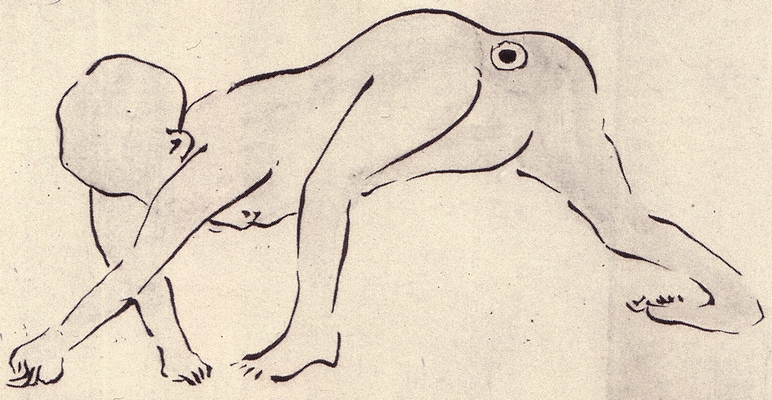
In old times, this was a yokai found on the roads leading to Kyoto. The legend goes that late at night, a samurai walking down the street when a man in a kimono stepped in to block his path and said “Excuse me … just a moment of your time … “ The samurai readied himself for an attack, and shouted back “What do you want?”

The man suddenly shed his kimono and stood stark naked. He then bent over and showed his ass to the samurai, which had a single, huge eye. When the eye opened, it shown with a bright light. The samurai screamed with fright and fled from the mysterious monster.

The poet and artist Buzon included the shirime in his collection “Buzon’s Yokai Picture Scroll” (蕪村妖怪絵巻), which is the only known source of the story. It is a variation of the nopperabo legend, and the shirime is considered to be a type of nopperabo.

Regular nopperabo surprise people by suddenly showing them a featureless face, smooth as an egg. The shimire species of nopperable can give a double surprise, first showing the featureless face then bending over and exposing the eyeball butt. The shirime doesn’t have any bad intentions or evil purpose. It just thinks it is fun to surprise people.

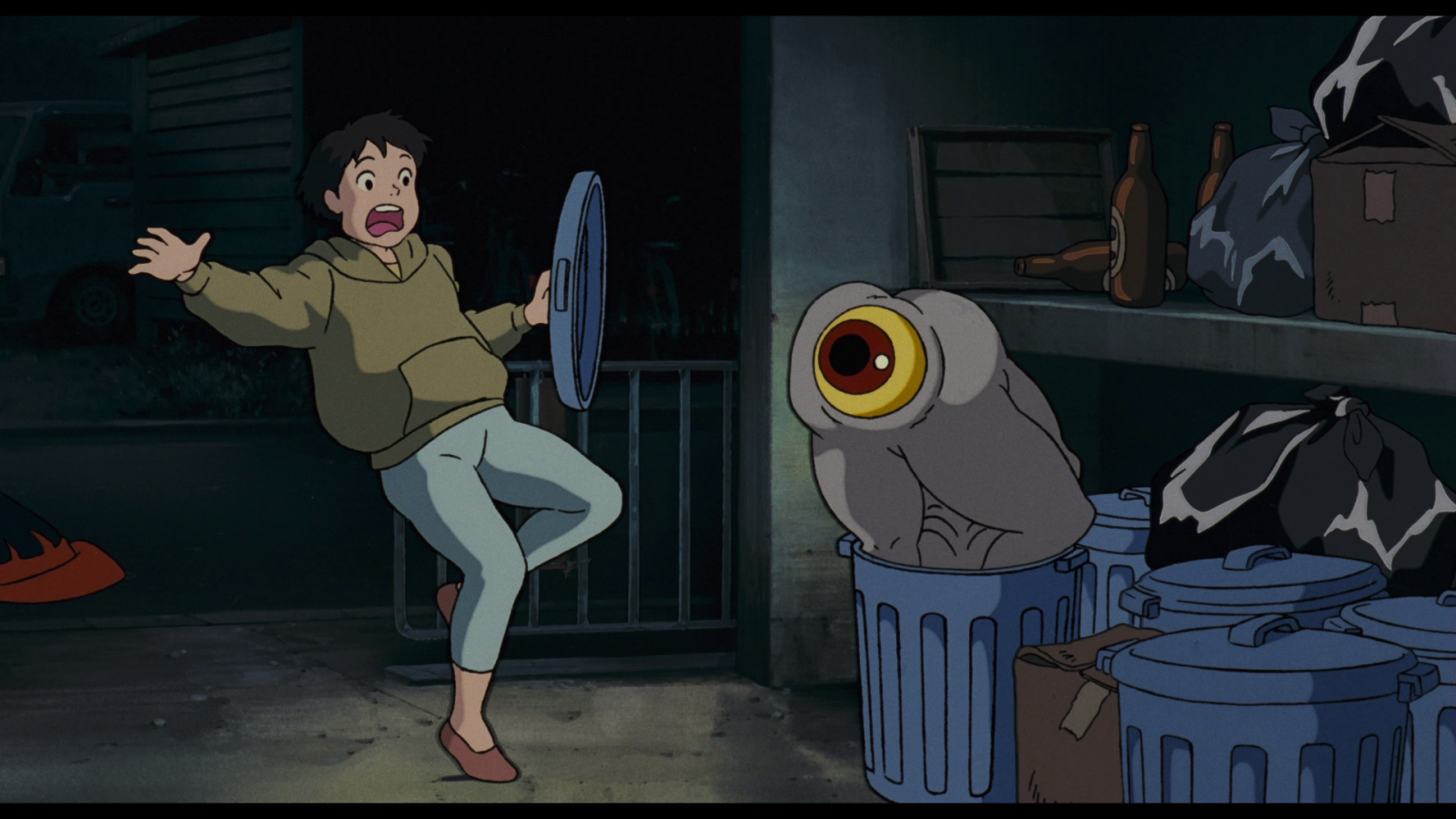
Shirime Pom Poko

Shrimime’s Cameo in Pom PokoTranslator’s Note:

The shirime’s name is pretty self-explanatory; 尻 (shiri – butt)目(me – eye). The term can also be used to mean to look down on someone, or to look askance at.

Like many of this type of yokai, there isn’t much more to the story than a mischievous creature that likes to startle people. Japan has a high tolerance for body humor and grotesqueness, and the shirime is a good example of this.

Further Reading:

Check out other butt-related tales from hyakumonogatari.com:

Kappa to Shirikodama – Kappa and the Small Anus Ball

Kodama – The Tree Spirit

Sourced and translated from Kaii Yokai Densho Database, Japanese Wikipedia, Yokai Jiten, Nihon Kokugo Dai-ten, and Other Sources

If a tree falls in the forest, and someone hears it, is that the plaintive cry of a kodama? Because that is what ancient, tree-worshipping Japanese people thought.

The Japanese have always known that some trees were special. For whatever reason—maybe because of an interestingly shaped trunk, or a sequence of knots resembling a human face, or just a certain sense of awe—some trees were identified as being the abodes of spirits. Depending on where you lived, these spirits went by many names. But the most common term, the one that is still used today, is kodama.

What does kodama mean?

Kodama is a very old belief, and a very old word. It was spoken long before Japan had a written language, and over the centuries there have been three different kanji used to write kodama.

The oldest, 古多万, is ambiguous to say the least. The word breaks down into 古 – (ko; old) – 多- (da; many) – 万 (ma; 10,000). Because ancient Japanese had no writing system, when the Chinese writing system was adopted kanji characters were often selected for sound rather than meaning. Unrelated symbols were jammed together to approximate the pronunciation of existing Japanese words. This is the most likely explanation for the use of 古多万.

But this combination is unsatisfying, and in later years 木魂 (木 ; ko; tree – 魂 ; dama; soul) was adopted as well as木魅(木 ; ko; tree – 魅 ; dama; soul), and now in modern times木霊 (木 ; ko; tree) – 霊 ; dama; spirit) tends to be used. There is little difference between木魂, 木魅, or 木霊, all being variations of the term “tree spirit.”

Another kanji used for kodama, 谺, also means echo. And if you read below you will find out why.

The Legends of Kodama

Mizuki_Shigeru_Kodama

Along with the kanji , what exactly a kodama is has changed over the centuries, from nature gods to goblin spirits.

In ancient times, kodama were said to be kami, nature dieties that dwelled in trees. Some believed that kodama were not linked to a single tree but could move nimbly through the forest, traveling freely from tree to tree.

Still others believed that kodama were rooted like the trees themselves, or in fact looked no different from other trees in the forest. Woe betide any unwary woodsman who took an axe to what looked like a regular tree, only to draw blood as he chopped into a kodama. A kodama’s curse was something to be feared.

But they were also a sound. Echoes that reverberated through mountains and valleys were said to be kodama. The sound of a tree crashing in the woods was also said to be the plaintive cry of a kodama. (In modern times this mountain echo is associated with the yokai yamabiko and not with kodama).

Whatever form they took, kodama were said to be possessed of supernatural power, that could either be a blessing or a curse. Kodama that were properly worshipped and honored would protect houses and villages. Kodama that were mistreated or disrespected brought down powerful curses.

The History of Kodama

The first known mention of tree spirits is in Japan’s oldest known book, the Kojiki (Record of Thing’s Past) that talks about the tree god Wakunochi-no-kami, second born of the godling brood of Izanagi and Izanami.

The oldest, specific known use of the term kodama comes from the Heian period, in the book Wamuryorui Jyusho (和名類聚抄; Japanese Names for Things; written 931 – 938 CE). Wamuryorui Jyusho was a dictionary showing the appropriate kanji for Japanese words, and listed古多万 as the Japanese word for spirits of the trees. Another Heian era book, Genji Monogatari (源氏物語; The Tale of Genji), uses木魂 to describe kodama as sort of tree-dwelling goblin. Genji Monogatari also uses the phrase “either oni or kami or kitsune or kodama,” showing that these four spirits were thought to be separate entities.

Around the Edo period, kodama lost their rank as gods of the forest and were included as just one of Japan’s ubiquitous yokai. Kodama became humanized as well—there are stories of kodama falling in love with humans and taking human shape in order to marry their beloved.

Kodama Across Japan

In Aogashima, Izu Islands, people place small shrines at the base of cryptomeria (Japanese cedar) trees and still worship and pray to them. This is said to be the remainders of a nature-worshiping religion that once dominated.

In Mitsune village, in Hachijō-jima, they still have a festival every year giving thanks and respect to “kidama-san” or “kodama-san,” hoping for forgiveness and blessing when they cut down trees for the logging industry.

In Okinawa, they call the tree spirit kinushi. At night, if you hear the sound of a falling tree it is said to be the cry of a kinushi, and Okinawa’s tree-dwelling famous yokai kijimuna is thought to be a descendant of these ancient kinushi tree spirits.

Appearance of Kodama

No one really agrees what kodama look like. In ancient legends they are either invisible or indistinguishable from regular trees. Toriyama Sekian, who has set the standard for the appearance of many creatures of Japanese folklore, drew kodama as an ancient man or woman standing near a tree in his famous Gazu Hyakki Yagyō (画図百鬼夜行; The Illustrated Night Parade of a Hundred Demons).

Miyazaki Hayao used kodama extensively in his film Mononoke Hime (Princess Mononoke) and illustrated kodama as dual-color bobble-heads. Modern interpretations are wildly various, showing kodama as human young and old, or small nature sprites borrowing from European pagan traditions, or just cute animated characters.

Clearly, they are open for interpretation.

Kodama: The Game

This version of kodama comes from a Kodama game being developed by Dan Tsukasa, that I am helping out with as “yokai advisor.”

Here is Dan’s blurb for the game:

——————————————————-
Kodama is a game set in Japan during the time of Yokai. A nameless Kodama journeys across Japan to find his fellow Kodama and return them to the forest in order to protect it from a powerful Yokai. During his travels Kodama must use his abilities as a tree spirit to overcome countless obstacles, using nothing but the elements around him, he must traverse dangerous swamps, caverns and even Jigoku itself in order to protect the Kodama Forest. Kodama is able to use the world around him to his advantage, using his unique tree spirit abilities he is able to float on a breeze, grow to reach new heights and perform other abilities only known to a Kodama.

Kodama is a puzzle platformer with a few unique twists & a never before seen system known as the ‘Mori System’, the game features over 30 unique Yokai, 12 different locations and a wealth of information concerning the featuring Yokai themselves.

If I had to describe the ‘feeling’ of Kodama in a few short words, I’d say it was more of a ‘stop, smell the roses and take in the magnificent view’ type of game.
——————————————————-

You can find out more about the very cook Kodama game (along with some stunning art) at the Kodama Devlog.

Translator’s Note:

Kodama is the latest in my magical tree series of translations. Kodama are slightly different from my previous translation Ki no Kami, in that they are mostly considered to be lower-level tree spirits that actual gods. The Ki no Kami come down from heaven to inhabit the trees, whereas the kodama are the spirits of the trees themselves. And then there are the moidon, which are awakened trees with a soul like any human.

Thanks to Miyazaki, kodama are well-known in Japan (unlike some of the obscure folklore on familiar to true yokai lovers), although most would associate kodama with the white bobble-head from Mononoke Hime.

Further Reading:

For more magical tree stories, check out:

Ki no Kami – The God in the Tree

Moidon – The Lords of the Forest

Jinmenju – The Human Face Tree

Enju no Jashin – The Evil God in the Pagoda Tree

Ochiba Naki Shii – The Chinkapin Tree of Unfallen Leaves

Previous Older Entries Next Newer Entries

Copyright notification

All translations and other writing on this website were created by Zack Davisson and are copyright to him.

Copyright notification

In accessing these web pages, you agree that any downloading of content is for personal, non-commercial reference only.

No part of this web site may be reproduced or transmitted in any form or by any means, electronic, mechanical, photocopying, recording or otherwise, without prior permission of Zack Davisson.

Copyright notification

For rights clearance please contact Zack at:

zack.davisson (at) gmail.com

Thank you.