Shudan Borei – A Group of Ghosts


shudan borei

To learn much more about Japanese Ghosts, check out my book Yurei: The Japanese Ghost

Translated from Mizuki Shigeru’s Mujara

On July 28th, Showa 30th (1955), in a heartbreaking incident 36 junior high school girls drowned on a beach in Mie prefecture. Of the nine girls who survived the incident, five had the same story to tell.

The girls were all playing and swimming in the calm waters, enjoying the gentle lapping of the waves. Without warning, the water seemed to gather together, and a dark mass rose from the surface of the ocean. The mass took the shape of people in WWII air-raid hoods, dark in color, soaking wet and pouring water from every surface. As the mass rose, the figures become more defined, dressed in old-fashioned women’s work pants. There were hundreds of them.

The girls tried to get away, but the water seemed to be sucked up towards the dark figures, dragging the girls towards them. One of the girls who survived said she felt a hand grab her leg and try and pull her under the water. She was able to break the hands grasp and make her way to the shore, but her friends were not so lucky.

Afterwards, students who were on the beach and not in the water confirmed the story and all of its details. They saw the ghosts rising and dragging the girls under the water.

After investigating the incident, it was discovered that exactly ten years before the incident, U.S. aircraft had firebombed that area, killing around 250 people. The bodies were not cremated, but were piled without ceremony into a mass grave on that beach. In this way one tragedy became two tragedies, as the ghosts of the war dead rose up again.

Translator Note:

The kanji for this is集団 (shudan, meaning “group” or “gathering”) and亡霊 (borei, which is a somewhat Gothic term for “ghost”).

This story is based on a actual event, called the Kyohaku Junior High School Drowning Incident (橋北中学校水難事件) in Japanese. The school had gone to the beach as their annual excursion, and as swimming practice for the girls. At the time, swimming had been added to the official school curriculum, but as the school had no pool swimming practice was held in the nearby, usually calm ocean.

The school principle and teachers were arrested and charged with negligence—the school was short-handed and had not brought along the required number of adult observers, and parents claimed their children were not yet strong enough swimmers to be unsupervised in the ocean. Ultimately, they were found not-guilty and cleared of charges. The girls’ deaths were ruled a mysterious, unfortunate accident. A pool was quickly built for the school, and the students no longer practice swimming in the ocean.

Observers reported a sudden swelling of the waves and a rise in the water level that drowned the girls. Of the nine surviving girls, five reported a sensation of pulling on their legs, as if the sand was sucking down on their feet, holding them down while the water rose. Several also reported seeing the dark shape of women in air-raid hoods rising from the water.

In 1956, the Ise Newspaper reported on the story of the war dead buried on the beach, noting that most of the dead had been refugees and were thus buried without name or ceremony. In 1963, one of the girls published an article in a Joshi Jishin magazine (Women’s Own Stories) called “How I survived an Encounter with a Ghost” that further spread the supernatural origin of the drowning.

Several scientific explanations have been offered for the sudden swelling of the water based on the geographical features of the beach, along the supernatural one. It is clear Mizuki Shigeru prefers the supernatural explanation.

The beach remains off-limits for swimmers. A year after the incident, a shrine was raised on the location, and a statue called the Goddess of Protecting Swimmers in the Ocean was placed on the beach as a memorial.

Further Reading:

For more tales of haunted oceans, read:

Umi Bozu – The Sea Monk

Funa Yurei – The Boat Ghosts

Nure Onnago – The Soaked Woman

Shichinin Dōgyō – The Seven Pilgrims

Translated from Mizuki Shigeru’s Mujara

This is a legend from Kagawa prefecture, and is one of several legends about someone out for a walk who runs into a mysterious band on the road, and dies as a result.

The Seven Pilgrims cannot be seen under normal circumstances. According to legend, only those with the ability to wiggle their ears can see them unaided. Everyone else has to look beneath the legs of a cow in order to make the invisible visible. Cows in particular are said to be sensitive to the presence of the Seven Pilgrims. If a farmer is out walking with his cows, and they come to a sudden stop at a crossroads, the wise farmer bends down and peeks from between his cows’ legs until he is sure the coast is clear. But, if he sees seven dark pilgrims walking single file … then his time has come.

Along with the Seven Pilgrims, Kagawa prefecture also has the legend of the Seven Boys. This is essentially the same story as the Seven Pilgrims, substituting a group of wandering young boys. The Seven Boys are also encountered on crossroads, and because of this the Nakatado District of Kagawa is spotted with long-abandoned crossroads where no human dares to walk.

The Seven Pilgrims and the Seven Children are most likely the same entity. Whether they look like weary travelers or small children, in truth, no one knows. No one has ever survived an encounter.

In Kochi prefecture, there is a similar legend of the Seven Misaki . They say that people who drown in the ocean are chained together in gangs of seven. The number is always seven, and there is a hierarchy. In order to gain their freedom and go on to the afterlife, the Seven Misaki need a new member in the form of a drowning victim. Then, the ghost in the front gets to heaven, while the rest of the members move up a rank. And the Seven Misaki feel no need to wait for an accidental drowning. They will kill if they can, to gain new members and free themselves from their torment.

So powerful is this bond that not even invoking the Nembutsu (prayer to the Ahmida Buddha) can help the Seven Misaki. Far better to save your prayers for yourself, and hope that they don’t come to you one night, looking for someone to step into the back row.

Translator’s Note

As I have said before, Japanese folklore runs the gambit from funny, to strange, to terrifying. After doing Eyeball Butt, I was in the mood for a monster that was honestly scary. Well, except for looking between a cow’s legs … that’s just weird.

One of the interesting things about the Seven Pilgrims is they show the fine line between yurei and yokai in Japanese folklore. The pilgrims are referred to either as “shiryo” (dead spirits) or “borei” (departed spirits), but they don’t follow the normal rules and tropes of Japanese ghosts. Generally, Japanese ghosts require some purpose or reason to manifest, whereas the Seven Pilgrims act as if they are under a curse. Unless their reason is more mysterious than we know.

The kanji used for the Seven Pilgrims is 七人同行, which translates literally as “Seven Fellow Travelers,” although in this case “travelers” implies “walkers of the path” which is a reference to Buddhist pilgrims. Their alternate form, the Seven Boys is 七人童子, or Shichinen Doshi. Based on that term, they don’t necessarily have to be boys—you could say the Seven Little Kids—but that is the most common usage.

The terrifying Seven Misaki uses katakana for the name (七人ミサキ). Misaki refers to a classification of Shinto spirits that are sort of “subordinate gods” to the main kami. Kitsune that serve the deity Inari are a type of misaki, for example.

Further Reading:

For most ghostly tales on hyakumonogatari.com, check out:

Shōrōkaze – The Ghost Wind

The Gratitude-Expressing Yurei

How Do You Say Ghost in Japanese?

The Yurei Child

Shirime – Eyeball Butt

Translated from Mizuki Shigeru’s Mujara

To learn much more about Japanese Ghosts, check out my book Yurei: The Japanese Ghost

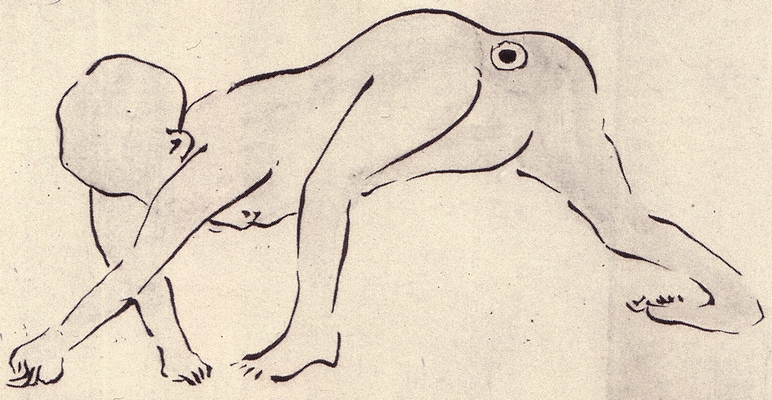
In old times, this was a yokai found on the roads leading to Kyoto. The legend goes that late at night, a samurai walking down the street when a man in a kimono stepped in to block his path and said “Excuse me … just a moment of your time … “ The samurai readied himself for an attack, and shouted back “What do you want?”

The man suddenly shed his kimono and stood stark naked. He then bent over and showed his ass to the samurai, which had a single, huge eye. When the eye opened, it shown with a bright light. The samurai screamed with fright and fled from the mysterious monster.

The poet and artist Buzon included the shirime in his collection “Buzon’s Yokai Picture Scroll” (蕪村妖怪絵巻), which is the only known source of the story. It is a variation of the nopperabo legend, and the shirime is considered to be a type of nopperabo.

Regular nopperabo surprise people by suddenly showing them a featureless face, smooth as an egg. The shimire species of nopperable can give a double surprise, first showing the featureless face then bending over and exposing the eyeball butt. The shirime doesn’t have any bad intentions or evil purpose. It just thinks it is fun to surprise people.

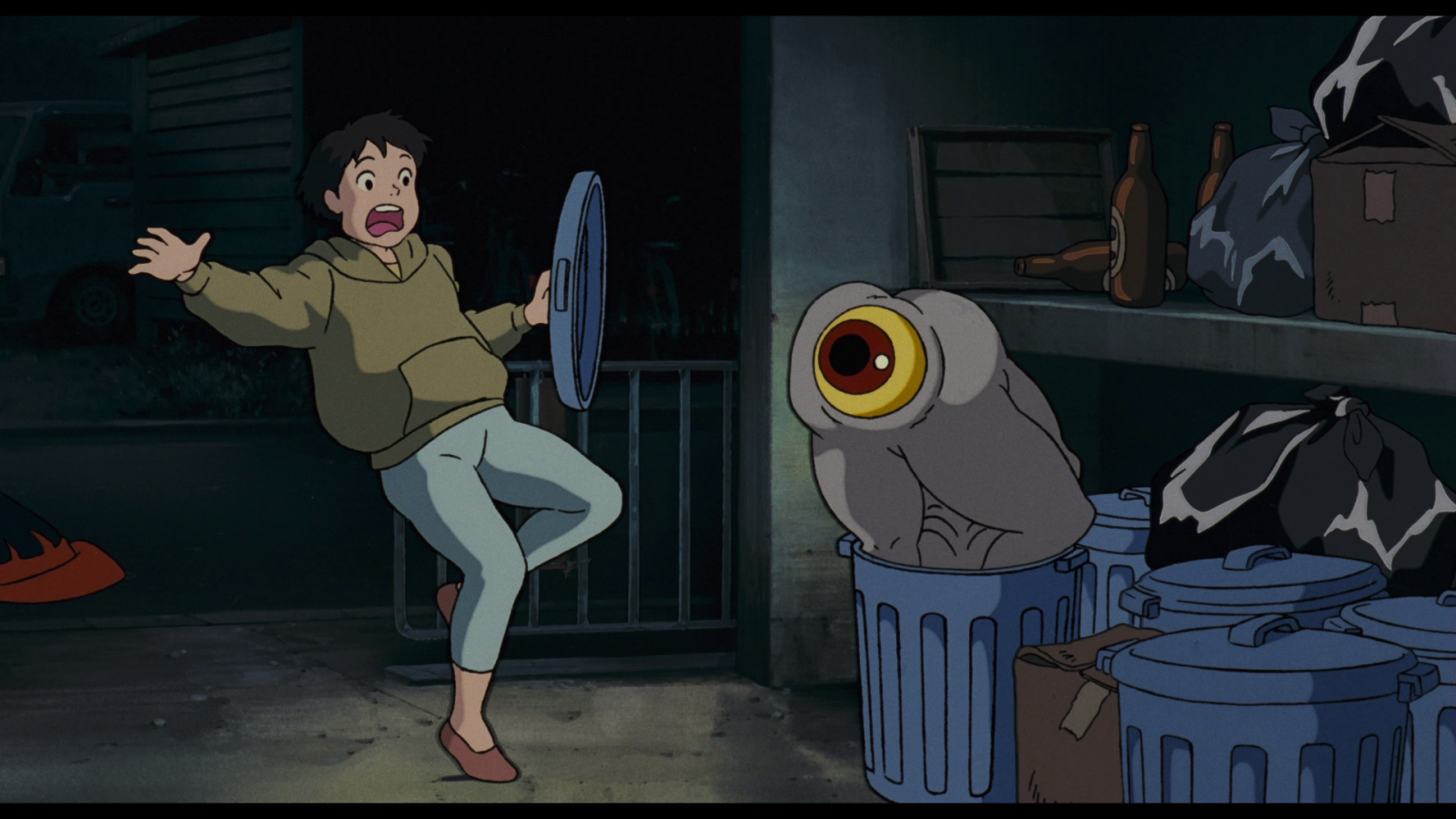
Shirime Pom Poko

Shrimime’s Cameo in Pom PokoTranslator’s Note:

The shirime’s name is pretty self-explanatory; 尻 (shiri – butt)目(me – eye). The term can also be used to mean to look down on someone, or to look askance at.

Like many of this type of yokai, there isn’t much more to the story than a mischievous creature that likes to startle people. Japan has a high tolerance for body humor and grotesqueness, and the shirime is a good example of this.

Further Reading:

Check out other butt-related tales from hyakumonogatari.com:

Kappa to Shirikodama – Kappa and the Small Anus Ball

Ki no Kami – The God in the Tree

Translated from Mizuki Shigeru’s Mujara

From ancient times in Japan, certain types of trees were thought to be abodes for kami, the spiritual deities of Japan’s native animistic religion. Specific trees such as the Chinese bunyan tree or the Indian laurel were said to be favored by these kami. The importance of these tree-dwelling kami was established in the Kojiki (Record of Ancient Matters), where the legend is told of the founding sibling gods of Japan Izanagi and Izanami. The two gave birth to hundreds of thousands of godling children, but their second-born was the kami of the trees.

All around Japan you can see trees that resemble humans in some uncanny way. Legends say this comes from the kami spirits who dwell inside. Called Jiyushin (), shinboku (神木), or kodama (古多万), these sacred trees are often found on the grounds of Shinto shrines or Buddhist temples. The spirits that dwell in the trees are said to offer protection to worshipers and watch over homes in the vicinity.

At the same time, these trees offer protection to the kami themselves, giving them a physical space to inhabit. It is sometimes said that the kami come down to earth from heaven, but they cannot remain in their natural state. The holy trees act as a medium, giving the spiritual essence of the kami somewhere to exist while they are in the human realm. They resonate with trees of a certain shape—it is said spiritual energy of the kami can be felt the most strongly in trees that have double, or even triple, trunks.

There are still shrines throughout Japan that venerate local tree-dwelling kami. Many of these are found in the mountains, where the trees are said to be inhabited by various mountain kami or even ancestor spirits. But no matter the origin, when they kami take up residence in a tree they are called ki no kami, the gods in the trees.

Translator’s Note

This is another magical tree legend, with a different take than the previously translated moidon. The fundamental concept is different, in that the moidon are themselves gods (kami) while the ki no kami are more like dryads in the European tradition (Notice I said “more like.” Obviously they are not exactly alike). The trees are just the shells the spirits inhabit while on earth. And kami can be fickle things. All over Japan you can see several abandoned shrines that look as though the kami has left them.

For more magical tree stories, see:

Moidon – The Lord of the Forest

Ochiba Naki Shii – The Chinkapan Tree of Unfallen Leaves

Enju no Jashin – The Evil God of the Pagoda Tree

Jinmenju – The Human-Faced Tree

Moidon – The Lords of the Forest

Translated from Mizuki Shigeru’s Mujara

The Moidon’s name tells you exactly what it is. The word moi (森) means “forest,” and the word don (殿) means “Lord.” It is a title of honor bestowed upon grand and aged trees. In ancient Japan, long before there was any sort of organized religion, people believed that these great trees were deities and the land they inhabited was a sacred space. Southern Kyushu in particular is home to moidon, although on Osumi peninsula they are called moriyama. In Kagoshima prefecture you can find more than a hundred moidon.

Long before any shrines were built, moidon served as places of worship to the ancient Japanese. Very old and massive trees were said to be the bodies for gods. In particular, broad-leaf evergreen trees were considered to be moidon, such as beech, camphor, and fig trees. In modern day Shinto, you can still see moidon that existed long before the buildings were built. Indeed, many of those oldest shrines were built around a particular moidon, as the area was already considered a sacred space by virtue of the tree.

In Hioki ward, Ichiki city, there is a moidon whose festival is celebrated every year. On November 5th, by the counting of the old Japanese lunar calendar, people eat festive red rice to mark the occasion, and a dish is always set in front of the tree as an offering. However it is said that if you take a single leaf home, or if any part of the great tree is burned as firewood, you will fall under its curse.

Moidon were long worshiped as gods, but they were also greatly feared. It is said that moidon are quick to take offense, and bestow curses more readily than blessings. Those who ask too much of them, or who gather their fallen branches to burn, will find themselves stricken with various illnesses, including a burning, itchy skin. Sometimes doing so much as to touch the tree brings about its curse, so villagers are often careful to give their moidon trees a wide birth except at festival time.

Because of their ability to curse, it is thought that these lords of the forest may be one of the origins of yokai legends throughout Japan.

Translator’s Note

A new translation at last! Sorry about the delay, but work has kept me very busy as of late.

The moidon is a choshizen type of yokai, referring to a sort of natural phenomenon. As Mizuki Shigeru says, you can still see these ancient trees in old Shinto shrines, usually demarcated by a straw rope and other sacred symbols. When I lived in Nara prefecture, I used to go to Miwa shrine that had a massive, ancient tree that was said to be much older than the shrine itself, which was already several centuries old.

Other magical tree stories on Hyakumonogatari.com

Jinmenju – The Human-faced Tree

Enjyu no Jashin – The Evil God in the Pagoda Tree

Ochibanashi nantoka – The Chinkapin Tree of Unfalled Leaves

Previous Older Entries Next Newer Entries

Copyright notification

All translations and other writing on this website were created by Zack Davisson and are copyright to him.

Copyright notification

In accessing these web pages, you agree that any downloading of content is for personal, non-commercial reference only.

No part of this web site may be reproduced or transmitted in any form or by any means, electronic, mechanical, photocopying, recording or otherwise, without prior permission of Zack Davisson.

Copyright notification

For rights clearance please contact Zack at:

zack.davisson (at) gmail.com

Thank you.