Secrets of the Yokai II

Translated from Mizuki Shigeru’s Yokai Daihyakka

How are Yokai born?

It is said that the vast majority of Yokai are born from the emotions of human, especially the powerful emotions of fear, yearning or hate.

But there are other ways for a Yokai to come into being:

1. From the violence of natural disasters such as floods, earthquakes, windstorms or volcanic eruptions.

2.  From the fear of dying accompanying disease and dire poverty.

3. From fear of animals, especially the terror humans feel at the prospect of being eaten by some beast.

4. From plants with lifespans that outstrip humans, like cedar and pine trees.  It was thought that these trees would live forever, and there was a desire of humans to believe in something that had power over death, something indestructible.

5. From human belief in superstitions and stories, or the teachings of religions.  There are things that scientific knowledge cannot explain, and it is there that Yokai are born.

Further Reading:

For more information about yokai and their meaning, check out:
What Does Yokai Mean in English?

A Brief History of Yokai

Secrets of the Yokai – Types of Yokai

Secrets of the Yokai – Types of Yokai

Translated from Mizuki Shigeru’s Yokai Daihyakka

What is the difference between Yokai and Obake?

Generally speaking, yokai and obake are two words that mean the same thing.   If a distinction must be made, it could be said that obake are those creatures which somehow change from one form to another (the Japanese word bakeru which forms the root of obake means to change for the worse, or adopt a disguise).

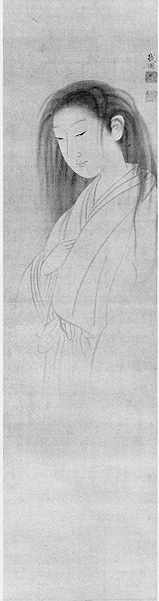
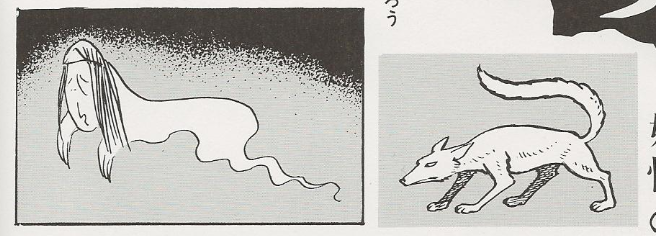
Examples are transforming kitsune (foxes) or of the dead people whose lingering grudges cause them to appear as yurei, or a myriad of other shape-changers.

What kinds of Yokai are there?

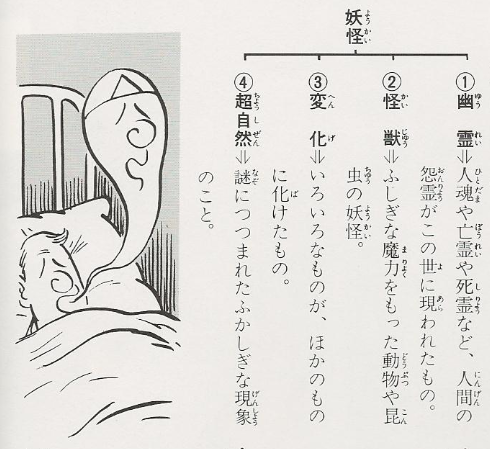
If you wanted to organize yokai by large categories,  it could be said that there are Yurei (spirits of the dead) Kaiju (monsters), Henge (shape-changers) and Choshizen (supernatural phenomena).

A chart would look like this:

 Yokai

Yurei  Kaiju  Henge  Choshizen
Examples are hitodama, borei and shiryo, and onryo.  The spirits of humans still lingering on Earth.  Animals or insects with mysterious and magical powers.  Anything that can change from one form to another. Mysterious or puzzling phenomena.


How many kinds of Yokai are there in Japan?

As a rule, it is said that there are about a thousand different species of yokai.  But if you limit it to those that have appeared in pictures or those about which we have some information, then it is really roughly four hundred different species.

But there are many yokai of other countries.  Nobody knows the number of worldwide yokai.

What is the largest Yokai of them all?

 That is the Onyudo.  The body of the Onyudo is as large as Mt. Fuji.  However, it is said that even if angered the Onyudo would never cause harm to humans.

Further Reading:

For more Types of Yokai, check out:

6 Types of Japanese Yokai From Showa

When Food Attacks – 6 Types of Food Yokai From Japan

10 Famous Japanese Ghost Stories

What’s the Difference Between Yurei and Yokai?

A Brief History of Yokai

Zashiki Warashi

Translated from Mizuki Shigeru’s Yokai Daihyakka

Zashiki warashi are a yokai from the Tohoku region of Japan.  They live in the rafters of ceilings or in old storehouses.  One of the mysteries of zashiki warashi is that they always take the appearance of small children, and never of adults.

In Iwate prefecture, zashiki warashi are said to appear in many of the local Elementary schools, and play with the children.  At nine o’ clock, dressed in a white kimono, the zashiki warashi slip through cracks in the door and play around between the desks and chairs, having a great time.  Of course, only the children can see the zashiki warashi as they romp around the classroom.

Also, about a hundred years ago in Tokyo, zashiki warashi were said to live in the storehouse of a man named Umehara Sotoku.  Whenever any human went into the storehouse they would suddenly be overcome by the need to urinate and would have to flee running from the storehouse.  It was said that this was due to the presence of the zashiki warashi.    Also, sometimes at night the sound of something striking a metal pole could be heard.

One year, there was a fire near that house and the flames rapidly spread.   The family was busy bringing the furniture out of the house when a child that no one knew was seen running out of the storehouse and helped carry the furniture into the cellar for safekeeping.   Even though they tried, no one got a good look at his face.  When all of the goods and people were safely in the cellar, the door was shut tight but the small boy was no were to be seen.

That old storehouse was nothing special, the kind that could be found anywhere.  But high up on the shelf that was used to store charcoal there was a box about 15 by 16 centimeters that no one ever touched.  Most likely that was the home of the zashiki warashi.

The old storehouse did eventually burn down in a fire in the middle of the Meiji period, and from then on the zashiki warashi was never seen or heard from again.  I wonder where it went?

Further Reading:

Read more about Zashiki Warashi on hyakumonogatari.com

On Zashiki Warashi


Yokai of the House

Translated from Mizuki Shigeru’s Yokai Daihyakka

 Shiryo – The Dead Spirit

Shiryo are the spirits of those who died and did not receive the proper respect after death.  From this, they change to become a form of yokai.

In the forty-nine days following death, if a family does not visit the grave, or set tea in remembrance before the family Buddhist altar,  instead of moving on to become a protective ancestor spirit the dead soul will return as a grudge-bearing Shiryo

 Amamehagi

Long ago in Kashima district in Noto (Modern day Ishikawa prefecture), when the bells sounded on New Year’s Eve to ring in the coming of the new year, the Amamehagi came creeping dowm from the mountains.

If they found any children out after dark, the Amamehagi would strip the skin from the children’s feet and wear them as shoes.

Needless to say, in those olden times all the children of Noto went to bed early on New Year’s Eve.

The Fudaraku Pure Land

Translated from Kitaro no Tengoku to Jigoku

Mt. Fudaraku is the home of the bodhisattva Kannon.  There also is found the beautiful garden known as the Fudaraku Pure Land.

The Fudaraku Pure Land can be reached by a small boat called the utsubo-bune.   That boat primarily departs from Kumano beach in Kishu province (modern-day Wakayama prefecture).   The utsubo-bune has no windows, and instead has three or four tori gates where windows would be.  Passengers bring fruits and nuts for the journey, and the utsubo-bune has pegs on which to hang them. 

The utsubo-bune goes with the North wind, and travels onward until it reaches the Fudaraku Pure Land.

Previous Older Entries Next Newer Entries

Copyright notification

All translations and other writing on this website were created by Zack Davisson and are copyright to him.

Copyright notification

In accessing these web pages, you agree that any downloading of content is for personal, non-commercial reference only.

No part of this web site may be reproduced or transmitted in any form or by any means, electronic, mechanical, photocopying, recording or otherwise, without prior permission of Zack Davisson.

Copyright notification

For rights clearance please contact Zack at:

zack.davisson (at) gmail.com

Thank you.