Yuki Warashi / Yukinbo – The Snow Babies

Mizuki Shigeru Yukinbo

Translated and Sourced from Mizuki Shigeru’s Mujyara, Japanese Wikipedia, and Other Sources

Snow and ice have a certain magic to them. You can craft them into whatever shape you want, from snow men to snow wives to snow babies. And—legend tells us—if you wish hard enough, they just might come to life. But snow is fickle. To an elderly childless couple, it might bring joy and comfort—but only for a little while. Spring comes and snow melts and takes the beauty and magic with it. That is the lesson of the story of the Yuki Warashi.

The Yukinbo, however. tells an entirely different kind of story …

What Do Yuki Warashi and Yukinbo Mean?

Both of these snow babies’ names mean roughly the same thing, just using different kanji

  • 雪童子 – Yuki Warashi – Combines雪 (yuki; snow) + 童子 (warashi; small child). Sharp-eared readers will recognize this as using the same kanji as the good luck house spirit Zashiki Warashi.
  • 雪坊 – Yukinbo – Combines雪 (yuki; snow) + 坊 (bo; priest). Note that by itself “bo” is a slang term for young boys, like the diminutive “Bo-chan.” Of the two names, only the Yukinbo specifies a gender.

What Do They Look Like?

Images of the Yuki Warashi and Yunkinbo are exceedingly rare. When they do appear, they look like cute, red-cheeked children clad in the traditional straw-peaked snow jackets. Their jackets have a hood that comes up to a point so that the snow can’t accumulate. The hood ties under the chin, and there are armholes that give freedom of movement.
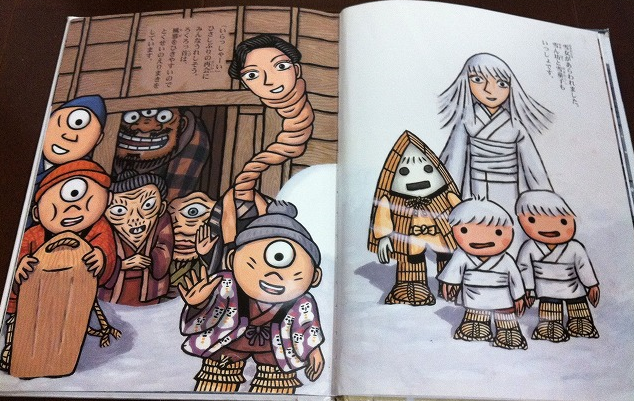
Yuki_Warashi_Childrens_Book

From the children’s book お化けの冬ごもり (Obake no Fuyu Gomori)

In some Yuki Warashi depictions their face is blank and featureless like a doll. This comes less from folklore and stories and more from folk art. Wooden sculptures of children dressed in this ancient costume are popular. In fact, people in snowy regions still dress their children in these costumes for pictures. After all, they are awfully cute. But not every child in a straw snow coat is snow baby.

Definitely not a Yukinbo, unless they are hopping on one leg …

Yuki Warashi – The Good Little Snow Child

This is a legend from Nigata prefecture.

Long ago there was an old, childless couple. They were very lonely, and wished desperately for a child. One snowy day, in order to distract themselves from their desolation, they went out into the new fallen snow and sculpted a snow child. Pleased with their creation, they went back inside.

That night there was a fierce blizzard. There was a knock and the door, and when they answered it the couple were shocked to see a bright, young child leap into their house. They were too overjoyed to question their good fortune, and welcomed the child into their hearts. They loved their snow baby, and vowed to raise it with affection.

The new family passed a wonderful winter together, but as spring neared the couple noticed that their child got slimmer and slimmer. They were terribly worried, and woke up one morning to find their child gone completely. Their hearts were broken, but there was nothing they could do.

Time passed, and soon it was winter again. On yet another storming snowy night, there was a knock at the door and the couple’s happy snow baby came bounding home again, fat and happy and red-cheeked. The couple realized that this was the spirit of the child they sculpted out of snow, could only stay with them through the winter.

This pattern repeated itself for many years, until one day the snow baby came no more. They never saw their child again. But the couple was content with what happiness the kami allotted them, and forever cherished the sweet memories of their snow baby.

Yukinbo – The One-Legged Snow Boy

The Yukinbo comes from Wakayama prefecture, and is essentially a personification of a natural phenomenon.

As anyone who lives in a snowy climate—or participates in winter sports—knows, the snow around trees and plants melts faster than elsewhere. We call these “tree wells” when skiing, and falling into a tree well can be a dangerous proposition. You sink into the semi-melted snow and can have a hard time tunneling back out.

Strangely, there is no real known scientific explanation for this. Oh, there are theories to be sure, most amounting to internal heat generated by the plants. But there is no absolute answer (At least not according to Susan Pell, director of science at the Brooklyn Botanic Garden.)

But the people of Wakayama didn’t need science. They knew tree wells were cause by a one-legged yokai called the Yukinbo who came out in the morning and hopped circles around trees.

Translator’s Note:

More snow monsters for December! Although they aren’t really related, I decided to combine the Yuki Warashi and Yukinbo into a single entry. Mainly because they are both obscure, without much detail to their stories and descriptions. Also because of a lack of pictures. I wasn’t able to find a single picture of a Yukinbo. Neither of them appear in my volumes of Mizuki Shigeru’s Mujyara, except as footnotes to other yokai, nor do they appear in Toriyama’s catalogs of any other yokai resource. But they are cool legends, so I decided to add them to the series.

Yukinbo and Kitaro

The Yukinbo in particular gave me some trouble. As a one-legged snow monster he shares and almost identical story to the Yukinba and Yuki Nyudo. I considered sticking them all together, but eventually went with age/gender instead of number of limbs. The Yukiba went with the Yukifuriba, and the Yuki Nyudo will go with the Yukifuri Bozu (If I have time to get around the them!)

Related Stories:

For more December yokai chills, check out:

Tsurara Onna – The Icicle Woman

Yukiba/Yukifuriba – The Snow Hags

Oshiroi Baba – The Wife Face Powder Hag

Tsurara Onna – The Icicle Woman

Mizuki_Shigeru_Tsurara_Onnna

Translated and Sourced from Mizuki Shigeru’s Mujyara, Kaii Yokai Densho Database, Japanese Wikipedia, and Other Sources

Is Japan’s Icicle Woman naughty or nice? Loving or lethal? If the stories are to be believed, Japan’s answer to Pygmalion can swing both ways. So a warning to men—if you fashion a woman out of an icicle, even when you pour your entire heart into it, don’t be surprised if she turns out cold-blooded.

What Does Tsurara Onna Mean?

Another yokai with a straight-forward name, tsurara onna’s name is written asつらら (tsurara; icicle) + 女 (onna; woman). Strangely enough, she almost never uses the kanji for tsurara (氷柱), always using the hiragana instead. The only reason I can think of for this is that kanji was once considered masculine for names, and hiragana feminine. It’s a possibility, but that’s all it is.

There are two regional variations on Tsurara Onna, using local dialect for the word “icicle.” One is Shigama Nyobo (シガマ女房; Icicle Wife) from Western Aomori prefecture, and the other is Kanekori Musume  (カネコリ娘; Icicle Daughter) from Gifu prefecture.

What are Tsurara Onna?

All Tsurara Onna stories start out the same—a lonely man gazes out of his window in winter, and marvels at the beauty of an icicle hanging from his eaves. As he stares deeply into its crystal structure, he wishes he could meet a woman as beautiful as the icicle to ease the pains of his loneliness. Like magic (for it is indeed magic) a woman fitting that description shows up the very next day.

The woman appears at the man’s door, seeking refuge from a massive, sudden snow storm. The man lets the beautiful woman in, and they fall in love. The woman decides never to leave, and the two become husband and wife. (In old Japan, no ceremony was necessary for this; as soon as a couple decided they were married, then they were married).

Life is good—for a while. The man’s new wife is attentive and loving and everything he hoped for. But then things go wrong, because there is rarely a Happily Ever After in Japanese folklore, and never when you are dealing with snow monsters.

Tsurara Onna tales fork at this point, into one of two endings. The ending you get depends largely on the region of Japan you live in.

Story #1 – The Sweet Woman Undone by Her Husband’s Love

The man is overjoyed at his new wife, but worried too. He cannot help but notice that his bride never uses the bath, even on the most chilly of nights. The poor man is worried about his wife’s health—surely she will take sick if she does not warm herself in the bath? Not to mention cleanliness. Time after time, he entreats her to use the bath. They are married now, he assures her, and she shouldn’t feel shy or ashamed.

The woman demurs, but eventually she can no longer refuse her husband. After he prepares a warming bath for her, the man busies himself about the house so she can enjoy her soak. Hours pass, and the man becomes worried about her. Perhaps she has fallen asleep? He goes into the back to check on her, and finds the tub empty, with only frozen shards of shattered icicles laying around the perimeter of the bath. These too slowly melt away …

This version of the tale is most often found in the Tohoku region, including Aomori and Nigata prefectures. There are some further variations:

Yamagata Prefecture – The woman does not go to the bath, but into the kitchen to heat up some hot sake for her husband. After a long wait, he goes to the kitchen to find the shattered icicle shards.

Akita Prefecture – This version has a husband and wife taking care of a young woman traveler instead of a new bride; but the results are the same. Against her wishes, into the bath the young traveler goes.

Story #2 – The Frozen Dagger of Hate

Her, the husband does not coax his wife into the bath, or ask her to retrieve hot sake for him. Instead they pass the winter in bliss. But as spring comes and the temperature warms, the man notices his wife getting anxious. One day he wakes up to find her gone, the door of their house standing open and the last of the winter winds blowing through.

The man is heartbroken, but assumes his wife has left him after using him for shelter though the winter. He moves on with his life, and meets a new woman and falls in love. Come summer, he moves his new wife into his house. They pass the months happily until winter comes again.

When the world again freezes over, the man notices a particularly large icicle forming from the eaves of his house. Fascinated by it, he goes outside for a better look. There he sees his former wife, livid that she has been replaced.

Inside the house, the new wife hears her husband shriek in agony. She rushes outside and finds him dead, a large icicle piercing his head through his eyeball.

This angrier version of the Tsurara Onna tale is found mostly in Nigata prefecture.

Translator’s Note:

The second in a series on snow monsters for December, the Tsurara Onna is a type of story found all over the world. A man bringing a woman to life from an inanimate object is a typical folklore story, the archetype of which is the Greek story of Pygmalion. With the second version of Tsurara Onna, I also can’t help but think of a sexier, angrier version of Frosty the Snowman—especially how she has to leave in the spring and return in the winter.

The Tsurara Onna also falls into the “magical wife” category so often found in Japanese folklore. These come in a myriad of variety, but always with the same simple plot. An unmarried man suddenly meets a wonderful woman, and they are married. They can stay happy forever so long as the husband obeys a single rule (for example, “Don’t look in a box,” or “Don’t tell anyone your story,” or “Don’t make me take a bath.”). The rule is inevitably broken, the wife leaves—with or without vengeance—and the man is left alone again, knowing that he could have had a happy life if he just would have obeyed the stupid rule.

Further Reading:

For more tales of snow monsters and magical wives, check out:

Oshiroi Baba – The White Face Powder Hag

Kitsune no Yomeiri – The Fox Wedding

The Yurei Child

Oshiroi Baba – The Face Powder Hag

Mizuki_Shigeru_Oshiroibaba

Translated and Sourced from Mizuki Shigeru’s Mujyara, Konjyaku Hyakki Shui, and Japanese Wikipedia

Weather-beaten, sake-bearing snow lady or servant to the Goddess of Cosmetics? It all depends on who ask when you are dealing with Oshiroi Baba – The Face Powder Hag.

What Does Oshiroi Baba Mean?

Oshiroi Baba uses the kanji 白粉 (oshiroi; white face powder) + 婆 (baba; old woman, hag). The word oshiroi specifically refers to the white face powder used by geisha and maiko.

Her name is pretty straight forward, and leans towards the Goddess of Cosmetics definition of this yokai.

What Does Oshiroi Baba Look Like?

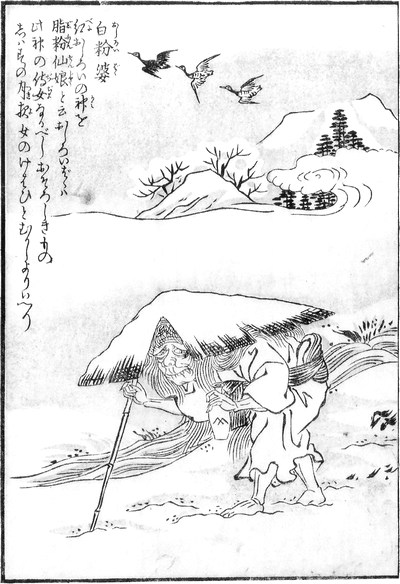
No matter which definition of Oshiroi Baba you prefer, she always looks the same. An ancient woman with a back severely bent by age, she leans on a bamboo cane. She wears a ragged kimono and a massive, straw umbrella hat covered in heavy snow. In her hand is a bottle of sake, usually a classic ceramic tokkuri. Her face is covered in oshiroi powder, often slathered on without delicacy or care.

By some accounts she drags a mirror behind her, which clangs and rattles in her wake. The mirror, however, is almost always heard but not seen. Few depictions of the Oshiroi Baba include this detail.

Servant to The Goddess of Cosmetics

SekienOshiroi-baba

Oshiroi Baba appears in Toriyama Sekien’s Konjyaku Hyakki Shui (今昔百鬼拾遺; Supplement to The Hundred Demons from the Present and the Past). Toriyama wrote:

“Legend tells of a Goddess of Crimson Cosmetics named Shifun Senjo (脂粉仙娘). Her servant is the possibly Oshiroi Baba, who comes on moonlit nights in the twelfth month as she has since long ago.”

The source for Toriyama’s picture and story are not known. In fact, even this so-called “Goddess of Crimson Cosmetics” Shifun Senjo appears nowhere other than Toriyama’s prescription. Draw what conclusions from that as you may.

The Sake-Bearing Snow Hag

Another legend of the Oshiroi Baba supposedly comes from the Noto Peninsula in Ishikawa prefecture. The story tells of an old yokai woman who comes out during heavy snow storms bringing hot sake to those in need—like some alcohol-bearing Santa Claus.

This story comes from folklorist Fujiwara Morihiko’s book Zusetsu Minzokugaku Zensho(図説民俗学全集; Complete Illustrated Work of Folklore). Fujiwara describes the Oshiroi Baba as analogous to the Yuki Onna. However, there is no supporting evidence to Fujiwara’s claims, and subsequent folklorists have been unable to find any such legends from the Noto Peninsula or elsewhere.

The Oshiroi Baba of Hasedera Temple

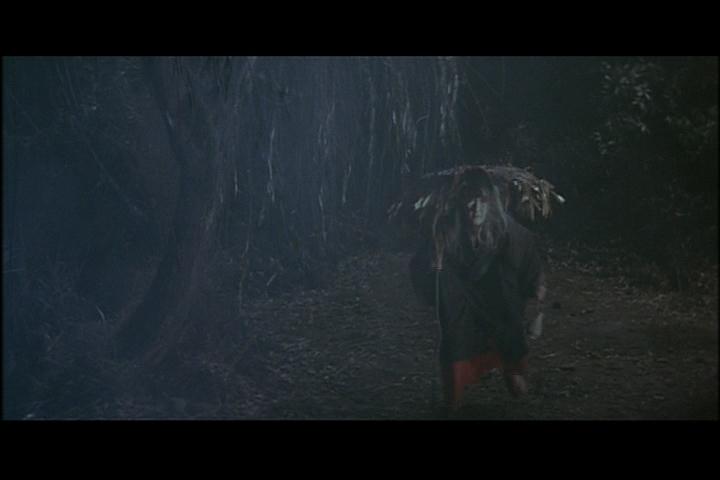
Oshiroi Baba HyakumonogatariOshiroi Baba from the film Yokai Hyakumonogatari. Image found on this site.

A further story of the Oshiroi Baba comes from Hasedera Temple in Nara prefecture. It has been sourced back to the Muromachi period, and has little in common with other legends.

In the 6th year of Tembun (1537), Abbot Koshin of Hasedera Temple had an idea to help the war-torn state of the nation. He would assemble artistic monks from across the country to paint an image of the Goddess Kannon—an image on a sheet of paper as large as the Hondo main temple itself.

Unfortunately, the army of the Ashikaga shogunate came into town at the same time, and requisitioned all of the provisions that were supposed to go to feeding the artist-monks. With the food all going to the soldiers, the monks were starving and were unable to complete their painting. They pleaded and prayed to Kannon to give them the means to finish their great work.

The next day, a young monk spotted an unknown young woman washing rice down at the local well. She pulled rice from her bucket, washed and ground it on a stone, then set it into a plate to dry. The strange thing was, her bucket never seemed to empty. So long as she left a single grain behind, the bucket would magically refill with rice. Soon there was enough rice to feed the entire Temple.

The young monk was amazed, and felt this woman must be an emissary of Kannon, if not Kannon herself. But as she was bent over her work, he could not see her face. And the young monk desperately wanted to see her face. He came up with a plan and lobbed a small stone at her back. As she looked up, he saw her face glowed with a holy light. Her skin was snow white, and looked as if she were made of oshiroi powder. And in spite of the young appearance of her body, her face was deeply lined as if she felt all of the worries of the monks of the world.

Fortified by this miracle, the artist monks were able to finish their portrait. In gratitude, they enshrined the Oishiroi Baba and built a temple in her honor. This temple can still be seen on the grounds of Hasedera Temple today.

Translator’s Note:

My theme for December is snow monsters, so of course the first one I pick isn’t really a snow monster! Well, I suppose it all depends on which legend you prefer. There is very little background on this yokai, and most agree that it was invented by Toriyama Sekein and that others have attempted to fill in the blanks ever since. Why he would draw an old woman in the snow, then make her the servant of some mysterious Goddess of Cosmetics, is a mystery. Not to mention the fact that she is clearly carrying a sake bottle and not some sort of cosmetics palette … ah well, no one every accused Toriyama of making sense.

Personally, I like the sake-bearing snow yokai who bounds up like some sort of magical St. Bernard dog or Santa Claus and pours hot sake down the throats of those in need. I think it suits the image best.  But then I also love the story of Hasedera Temple, as that was a temple I spent quite a bit of time at when I was a JET in Nara prefecture. I heard the story of the rice when I was there, but never connected it with the Oshiroi Baba until now.

When Food Attacks – 6 Types of Food Yokai From Japan

Japan’s native Yokai monsters can be almost anything—haunted trees, magical cats, transformed rats, or vengeful ghosts of slaughtered warriors. Or they can be food. Maybe animals who are sick of being overeaten. Or mysterious bugs that get into your system and infect you like a disease.

I put this series together for American Thanksgiving, to showcase some of Japan’s more bizarre yokai and as a cautionary tale for those tempted to over-indulge in their favorite foods. After all, eating a few soft-shelled turtles or savoring some salted horse meat is perfectly natural and fine. But consuming it by the hundreds invites ghostly revenge.

Click Each Title to Read the Full Story of Each Yokai

6. Sazae Oni – The Turban Shell Demon

Mizuki_Shigeru_Sazae_Oni

Sazae are a delicacy in Japan. The official English translation is “turban shell,” but they are more like a type of sea snail. And they are delicious. This tale of the Sazae Oni is something that would probably never associate with a sea snail—a shape-shifting supernatural seductress who boards and beds a ship full of men, then robs them of something very previous indeed.

5. Oseichu – The Mimicking Roundworm

Mizuki_Shigeru_Oseichu

This yokai disease starts as a small bump on your stomach, but soon enlarges into an angry red boil. The one day, the boil explodes into a giant mouth that speaks in your own voice and demands to be fed. This insatiable mouth will eat everything in the house unless it is stopped, slowly starving its host to death.

4. Suppon no Yurei – The Turtle Ghost

Mizuki_Shigeru_Suppon_no_Yurei

Being a connoisseur can be a good thing, but being a glutton is another thing all together. This is a tale of three friends who loved the taste of turtle flesh, and went from restaurant to restaurant like Edo period foodies eating all of the turtles they could. One night they spotted a new restaurant, but the chef has a little surprise in store for them.

3. Suppon on Onryo – The Vengeful Ghosts of the Turtles

Mizuki_Shigeru_Suppon_no_Onryo

Another tale of too many turtles. This one from a husband and wife who owned a popular turtle restaurant and who slaughtered and served up turtles by the hundreds. One day, the turtles decided enough was enough, and turned the tables. Illustrated Japan’s most famous artist, Katsushika Hokusai.

2. Shio no Choji – Salty Choji

Mizuki_Shigeru_Salty_Choji

Choji was a man who loved salted horse meat. And he loved it a lot. He owned a herd of 300 horse, and ate them down to the last one. When he was about to eat on his final horse—an old, beaten down old thing without an ounce of edible meat on him—his gluttony was finally undone. Choji was treated to an excruciating feast.

1. Nebutori – The Sleeping Fatty

Mizuki_Shigeru_Nebutori

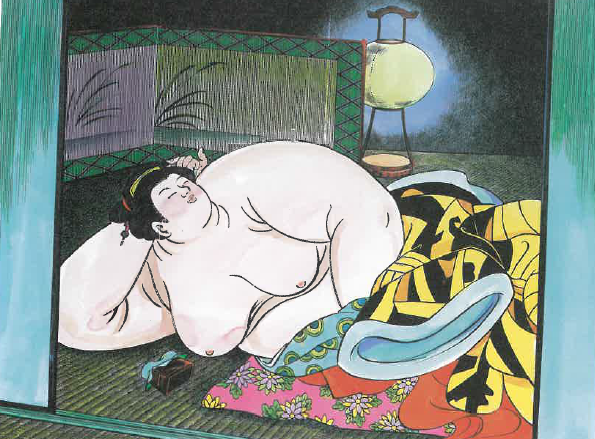
A classic story—a man goes out drinking one night and brings home a slender, sexy woman. After a night of passion, they fall asleep exhausted. The next morning the man is shocked to find out that he is not in bed with a beautiful woman, but a giant mound of flesh the size of four woman. Somehow, over the night, he bedmate caught the yokai disease nebutori-the sleeping fatty.

Nebutori – The Sleeping Fatty

Mizuki_Shigeru_Nebutori

Translated and adapted from Mizuki Shigeru’s Mujyara, Ehon Hyakumonogatari, and Japanese Wikipedia

A tale as old as time; in a drunken night of revelry, you climb in bed with a beautiful girl but wake up the next day sleeping besides a giant fat woman. What happened? That hot, sexy gal must have been infected by that insidious yokai disease nebutori – the Sleeping Fatty.

What Does Nebutori Mean?

Nebutori can be written a few ways, all of which are disgusting. The most common is寝肥 which combines 寝 (ne; Sleep) + 肥 (butori; dung, night soil … you know; poop). The term is a play on words, rhyming with 寝太 , meaning寝 (ne; Sleep) + 太 (futori; to gain weight, fat).

Nebutori is a yokai disease. It only infects women, and makes them fat while they sleep–either suddenly or gradually. It is considered an infectious disease, like a bacteria. Women infected with nebutori don’t necessesarily eat more—they just get fat while they sleep. (And yes, it is just women. I have never seen a nebutori tale involving men. Sorry.)

The term has spread into modern Japanese, where it is sometimes used in context to sudden or inexplicable weight gain. Nebutori is also used to describe weight gain in elderly women, especially those on a high-calorie / low-exorcize diet.

Sad Stories of Nebutori

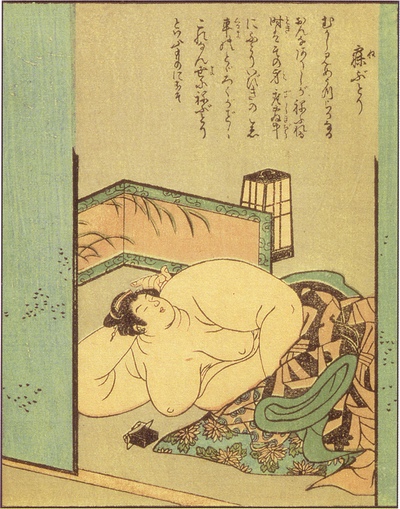
Nebutori originates from the Edo period Ehon Monogatari (絵本百物語; Picture Book of 100 Strange Stories). The story is short and sweet.

A man goes out for a night on the town. After a marathon drinking sessions, he meets and beds a beautiful young girl. They fall asleep next to each other, but in the middle of the night, the man is awoken by a thunderous snore—louder than a passing carriage. He opens his eyes and is shocked to find that—instead of the beautiful girl he went to bed with—he is sleeping next to an enormous mass of quivering flesh.

I found a different story while researching, but I am not sure of its literary origin. It comes from Okushu (modern day Aomori and Iwate prefectures). It doesn’t really seem to describe a case of nebutori—just a woman slowly gaining weight over time—but that is how the tale is listed.

A man and his wife lived together. When they married the wife was slim and beautiful, but she caught nebutori and ballooned in size. The couple owned ten futons, and seven were spread out for the wife to sleep on. Eventually the man became disgusted with this gigantic wife and divorced her. That’s why wives in Okushu are warned to be on the lookout for catching nebutori.

Nebutori and Tanuki Possession

This is an additional tale that is sometimes called nebutori, although in truth it is a case of tanukitsukai—tanuki possession. This story, coming from the 1828 book Shichuso (視聴草; Tales of Looking and Listening).

An elderly woman named Yachi lay on her death bed, breathing her last. To the stunned surprise of her assembled family, Yachi suddenly sprang up and declared herself healthy, but starving. The family brought forth food they had prepared for the funeral service, and the old woman ate it all. But Yachi was still ravenous. While waiting for more food to be prepared, she drank sake and sang boisterous songs. The family was pleased to have Yachi so energetic again, but perplexed. They summoned a doctor to examine her.

The doctor could find nothing wrong with Yachi. Meanwhile, her body was swelling to enormous proportions and she soon outgrew her clothes. The family dug out the winter clothes to try and drape around her, and as they took away her light summer kimono they noticed something strange—the inside was covered in the hair of some kind of beast. The family grew suspicious, and placed a paper and pen next to Yachi asking her to write down her next menu request. With this promptly done, the family knew something was wrong—Yachi could neither read nor write.

That night, the family secretly moved an image of the Amidha Buddha into Yachi’s room. With that done, they saw a shocked tanuki crawl from Yachi’s mouth and flee into the night, leaving behind the dead body it had occupied for awhile.

Translator’s Note:

Is anyone feeling like they caught a case of nebutori after Thanksgiving? Although nebutori isn’t really from overeating—it is more like the yokai equivalent of beer goggles. A drunken guy goes to bed with a hotty and wakes up with a notty. It couldn’t have been a drunken mistake, right? Best to blame it on a yokai disease!

ShunsenNebutori

Nebutori is another example that shows just how wide the definition of “yokai” can be. There is no creature here, no monster. Just a “yokai disease” that infects ordinary people.

Further Reading:

For more Thanksgiving-inspired tales of overeating yokai, check out:

Shio no Choji – Salty Choji

Suppon no Onryo – The Vengeful Ghosts of the Turtles

Suppon no Yurei – The Turtle Ghost

Oseichu – The Mimicking Roundworm

Previous Older Entries Next Newer Entries

Copyright notification

All translations and other writing on this website were created by Zack Davisson and are copyright to him.

Copyright notification

In accessing these web pages, you agree that any downloading of content is for personal, non-commercial reference only.

No part of this web site may be reproduced or transmitted in any form or by any means, electronic, mechanical, photocopying, recording or otherwise, without prior permission of Zack Davisson.

Copyright notification

For rights clearance please contact Zack at:

zack.davisson (at) gmail.com

Thank you.