When Food Attacks – 6 Types of Food Yokai From Japan

Japan’s native Yokai monsters can be almost anything—haunted trees, magical cats, transformed rats, or vengeful ghosts of slaughtered warriors. Or they can be food. Maybe animals who are sick of being overeaten. Or mysterious bugs that get into your system and infect you like a disease.

I put this series together for American Thanksgiving, to showcase some of Japan’s more bizarre yokai and as a cautionary tale for those tempted to over-indulge in their favorite foods. After all, eating a few soft-shelled turtles or savoring some salted horse meat is perfectly natural and fine. But consuming it by the hundreds invites ghostly revenge.

Click Each Title to Read the Full Story of Each Yokai

6. Sazae Oni – The Turban Shell Demon

Mizuki_Shigeru_Sazae_Oni

Sazae are a delicacy in Japan. The official English translation is “turban shell,” but they are more like a type of sea snail. And they are delicious. This tale of the Sazae Oni is something that would probably never associate with a sea snail—a shape-shifting supernatural seductress who boards and beds a ship full of men, then robs them of something very previous indeed.

5. Oseichu – The Mimicking Roundworm

Mizuki_Shigeru_Oseichu

This yokai disease starts as a small bump on your stomach, but soon enlarges into an angry red boil. The one day, the boil explodes into a giant mouth that speaks in your own voice and demands to be fed. This insatiable mouth will eat everything in the house unless it is stopped, slowly starving its host to death.

4. Suppon no Yurei – The Turtle Ghost

Mizuki_Shigeru_Suppon_no_Yurei

Being a connoisseur can be a good thing, but being a glutton is another thing all together. This is a tale of three friends who loved the taste of turtle flesh, and went from restaurant to restaurant like Edo period foodies eating all of the turtles they could. One night they spotted a new restaurant, but the chef has a little surprise in store for them.

3. Suppon on Onryo – The Vengeful Ghosts of the Turtles

Mizuki_Shigeru_Suppon_no_Onryo

Another tale of too many turtles. This one from a husband and wife who owned a popular turtle restaurant and who slaughtered and served up turtles by the hundreds. One day, the turtles decided enough was enough, and turned the tables. Illustrated Japan’s most famous artist, Katsushika Hokusai.

2. Shio no Choji – Salty Choji

Mizuki_Shigeru_Salty_Choji

Choji was a man who loved salted horse meat. And he loved it a lot. He owned a herd of 300 horse, and ate them down to the last one. When he was about to eat on his final horse—an old, beaten down old thing without an ounce of edible meat on him—his gluttony was finally undone. Choji was treated to an excruciating feast.

1. Nebutori – The Sleeping Fatty
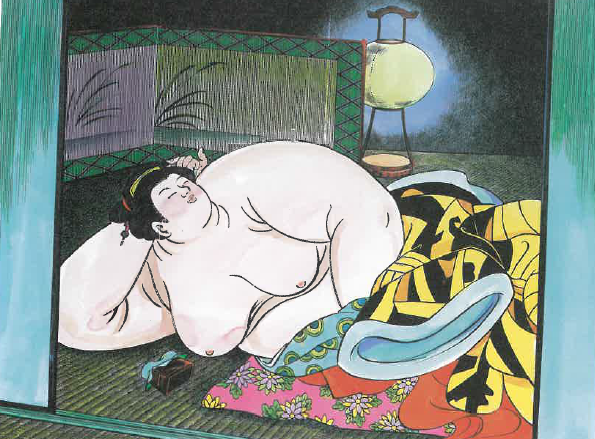
Mizuki_Shigeru_Nebutori

A classic story—a man goes out drinking one night and brings home a slender, sexy woman. After a night of passion, they fall asleep exhausted. The next morning the man is shocked to find out that he is not in bed with a beautiful woman, but a giant mound of flesh the size of four woman. Somehow, over the night, he bedmate caught the yokai disease nebutori-the sleeping fatty.
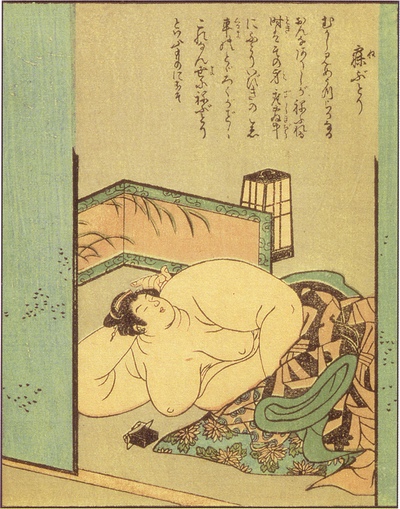
Nebutori – The Sleeping Fatty

Mizuki_Shigeru_Nebutori

Translated and adapted from Mizuki Shigeru’s Mujyara, Ehon Hyakumonogatari, and Japanese Wikipedia

A tale as old as time; in a drunken night of revelry, you climb in bed with a beautiful girl but wake up the next day sleeping besides a giant fat woman. What happened? That hot, sexy gal must have been infected by that insidious yokai disease nebutori – the Sleeping Fatty.

What Does Nebutori Mean?

Nebutori can be written a few ways, all of which are disgusting. The most common is寝肥 which combines 寝 (ne; Sleep) + 肥 (butori; dung, night soil … you know; poop). The term is a play on words, rhyming with 寝太 , meaning寝 (ne; Sleep) + 太 (futori; to gain weight, fat).

Nebutori is a yokai disease. It only infects women, and makes them fat while they sleep–either suddenly or gradually. It is considered an infectious disease, like a bacteria. Women infected with nebutori don’t necessesarily eat more—they just get fat while they sleep. (And yes, it is just women. I have never seen a nebutori tale involving men. Sorry.)

The term has spread into modern Japanese, where it is sometimes used in context to sudden or inexplicable weight gain. Nebutori is also used to describe weight gain in elderly women, especially those on a high-calorie / low-exorcize diet.

Sad Stories of Nebutori

Nebutori originates from the Edo period Ehon Monogatari (絵本百物語; Picture Book of 100 Strange Stories). The story is short and sweet.

A man goes out for a night on the town. After a marathon drinking sessions, he meets and beds a beautiful young girl. They fall asleep next to each other, but in the middle of the night, the man is awoken by a thunderous snore—louder than a passing carriage. He opens his eyes and is shocked to find that—instead of the beautiful girl he went to bed with—he is sleeping next to an enormous mass of quivering flesh.

I found a different story while researching, but I am not sure of its literary origin. It comes from Okushu (modern day Aomori and Iwate prefectures). It doesn’t really seem to describe a case of nebutori—just a woman slowly gaining weight over time—but that is how the tale is listed.

A man and his wife lived together. When they married the wife was slim and beautiful, but she caught nebutori and ballooned in size. The couple owned ten futons, and seven were spread out for the wife to sleep on. Eventually the man became disgusted with this gigantic wife and divorced her. That’s why wives in Okushu are warned to be on the lookout for catching nebutori.

Nebutori and Tanuki Possession

This is an additional tale that is sometimes called nebutori, although in truth it is a case of tanukitsukai—tanuki possession. This story, coming from the 1828 book Shichuso (視聴草; Tales of Looking and Listening).

An elderly woman named Yachi lay on her death bed, breathing her last. To the stunned surprise of her assembled family, Yachi suddenly sprang up and declared herself healthy, but starving. The family brought forth food they had prepared for the funeral service, and the old woman ate it all. But Yachi was still ravenous. While waiting for more food to be prepared, she drank sake and sang boisterous songs. The family was pleased to have Yachi so energetic again, but perplexed. They summoned a doctor to examine her.

The doctor could find nothing wrong with Yachi. Meanwhile, her body was swelling to enormous proportions and she soon outgrew her clothes. The family dug out the winter clothes to try and drape around her, and as they took away her light summer kimono they noticed something strange—the inside was covered in the hair of some kind of beast. The family grew suspicious, and placed a paper and pen next to Yachi asking her to write down her next menu request. With this promptly done, the family knew something was wrong—Yachi could neither read nor write.

That night, the family secretly moved an image of the Amidha Buddha into Yachi’s room. With that done, they saw a shocked tanuki crawl from Yachi’s mouth and flee into the night, leaving behind the dead body it had occupied for awhile.

Translator’s Note:

Is anyone feeling like they caught a case of nebutori after Thanksgiving? Although nebutori isn’t really from overeating—it is more like the yokai equivalent of beer goggles. A drunken guy goes to bed with a hotty and wakes up with a notty. It couldn’t have been a drunken mistake, right? Best to blame it on a yokai disease!

ShunsenNebutori

Nebutori is another example that shows just how wide the definition of “yokai” can be. There is no creature here, no monster. Just a “yokai disease” that infects ordinary people.

Further Reading:

For more Thanksgiving-inspired tales of overeating yokai, check out:

Shio no Choji – Salty Choji

Suppon no Onryo – The Vengeful Ghosts of the Turtles

Suppon no Yurei – The Turtle Ghost

Oseichu – The Mimicking Roundworm

Suppon on Onryo – The Vengeful Ghosts of the Turtles

Mizuki_Shigeru_Suppon_no_Onryo

Translated and Sourced from Mizuki Shigeru’s Mujyara and Japanese Wikipedia

You can still see turtle restaurants in Japan today offering a full-course suppon meal, including a glass of blood served with sake. But they are much rarer today than they were during the Edo period. A few strange stories come down to us from those times about ghostly goings-on in the turtle shops. This is one of them.

A man named Kiroku had a successful suppon shop in Nigata city. Every day he butchered and served up hundreds of turtles. One day at work, his body suddenly felt heavy. At the same time, everything became cold and dark, and it felt like he was being submerged under water. He tried to shout, but no voice came out. He felt around with his hands, and felt something even colder. It was a turtle shell. All around him were hundreds of turtles, crawling over his body and dragging him down.

Finally, Kiroku managed to let out a cry of horror, which brought his wife running into the room. When she opened the door, all of the turtles vanished.

This happened night after night, until finally Kiroku had enough. He had learned his lesson, and swore an oath against the taking of life. The wrathful turtle ghosts never came again.

Translator’s Note:

The second story of the dangers of overindulgence of suppon and ghostly revenge for Thanksgiving. This tale comes from the Edo period kaidan-shu Hokuetsu Kidan (北越奇談; Strange Stories from Hokuetsu), where it was illustrated by the famous artist Katsushika Hokusai.

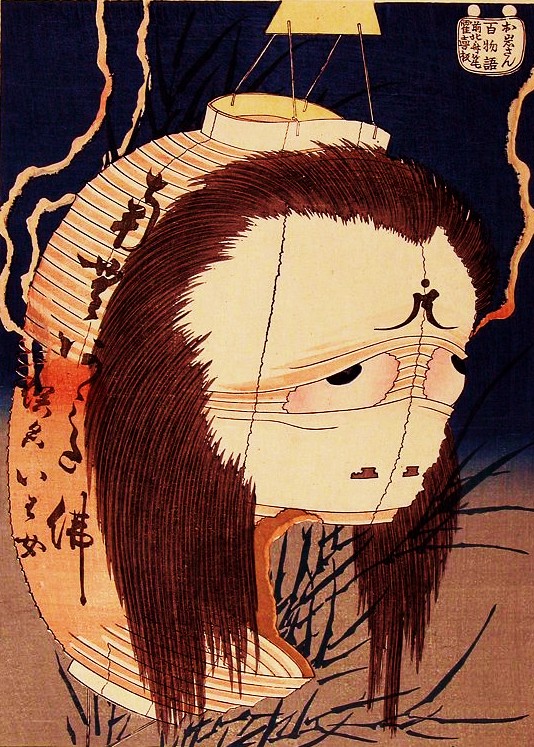
Hokusai_Suppon_no_Kaii

The original story was called Suppon no Kaii, which used the term怪異 (Kaii; strangeness). Mizuki changed it to the term onryo (怨霊), which refers specifically to a grudge-bearing spirit. The word is used almost exclusively for the yurei of human beings, so it is a bit odd seeing it used in the context of these turtles who are angry at being eaten. But it just goes to show the flexibility of folklore.

Mizuki Shigeru adds a footnote to this story, saying that living things must consume other living things in order to stay alive—that is the very nature of life. Even the turtles in this story needed to kill in order to live, so logically they object to the gluttony of so many of them being eaten, not the very fact they were eaten at all. Go ahead and eat turtles, Mizuki says, just appreciate their sacrifice and don’t eat too many!

Further Reading:

For more tales of magical turtles and over-eating yokai, check out:

Suppon no Yurei – The Turtle Ghost

The Appearance of the Spirit Turtle

Shio no Choji – Salty Choji

Oseichu – The Mimicking Roundworm

Shio no Choji – Salty Choji

Mizuki_Shigeru_Salty_Choji

Translated and Sourced from Mizuki Shigeru’s Mujyara, Ehon Hyakumonogatari, and Japanese Wikipedia

In Kaga province (modern day Ishikawa prefecture), there lived a wealthy man known as “Salty Choji” who kept 300 head of horses. Now, these horses weren’t for riding. This man had a taste for horse flesh, and would slaughter his horses like cattle then pickle them in salt or preserve them in miso paste to get them tasting just right. Every night he tucked into a pile of salty horse meat with gusto.

Such was the man’s appetite that Choji ate his way through 299 of his own horses, until all that was left was an ancient animal that wasn’t good for labor or food. One night Choji just couldn’t stand it any longer, and he shot the old beast anyways, then slathered it in salt and ate it down in a gluttonous frenzy. That night, however, the tables turned against Choji—the spirit of the old horse came to him in a dream and bit him on his neck.

From that night on, whenever the clock stuck the hour of the time when Choji had killed the old horse, its spirit appeared and entered Choji’s body. But this wasn’t your normal possession; the horse forced his way through Choji’s mouth, and crawled straight through to his stomach. The pain was intense, and Choji felt every inch of the massive horse stretching his innards and intestinal tract. As he lay in agony night after night, Choji bitterly regretted all of his evil deeds and his ravenous appetites that lead him to this fate. But his regrets did him no good. For it was too late.

Choji summoned every manner of doctor and exorcist to aid him in his suffering. They tried everything they could but without effect. No amount of medicine or prayers for reprieve could lessen his agony. Choji’s torment continued for 100 days until at last he died. It was said his corpse was broken and shattered, like an overburdened packhorse.

Translator’s Note:

Another tale of overeating for November, and the American Thanksgiving holiday. There are a few more to come in their series! This story comes from the Edo period kaidan-shu Ehon Hyakumonogatari (絵本百物語; Picture Book of 100 Stories).

ShunsenShionoChoji

The tale of Salty Choji isn’t as strange as it seems. Although rare nowadays, horse is a standard part of Japanese cuisine, mostly eaten raw and sliced as the sashimi called basashi. I have eaten it many times. It’s delicious! So the shock of the story isn’t really what Choji was eating, but how much of it. All things in moderation is the moral of the story. That and Choji forgetting an important fact of Japanese folklore—the older an animal is, the more likely it is to have developed supernatural powers. Salty Choji should have left that old horse alone, and just gone shopping for some new ones.

The story of Shio no Choji (Salty Choji) inspired a story for the anime series Kyogoku Natsuhiko Kosetsu Hyaku Monogatari (京極夏彦 巷説百物語; Natsuhiko Kyogohe ku’s Hundred Stories), most commonly known in English as Requiem From the Darkness. I say “inspired by” instead of “adapted from” because the version of Salty Choji found in the series is VERY different from the original folktale. There is cannibalism involved, and fratricide, and all sorts of things that never appear in the simple story of Shio no Choji who could couldn’t control his appetite.

Requiem_From_The_Darkness_cover

Further Reading:

For more tales of hungry yokai and yokai food, check out:

Oseichu – The Mimicking Roundworm

Jinmenju – The Human Face Tree

Katabira no Tsuji – The Crossroad of Corpses

Katabira_no_Tsuji_Mizuki_Shigeru

Translated and Sourced from Mizuki Shigeru’s Mujyara, A Diplomat in Japan, Part II: The Diaries of Ernest Satow, 1870-1883, Japanese Wikipedia, and Other Sources

To learn much more about Japanese Ghosts, check out my book Yurei: The Japanese Ghost

At the beginning of the Heian era, during the reign of the Emperor Saga, lived the Empress-Consort Tachibana no Kachiko (橘嘉智子; 786-850CE). A devout Buddhist and holy woman, Tachibana founded the great Buddhist temple complex and learning center of Danrin-ji, and because of this was known as the Empress Danrin.

All of her life the Empress wanted to use her position and education to forward and spread the teachings of Buddha. But she had one major problem—Tachibana no Kachiko was cursed with a beautiful face. So much so that whenever she tried to teach people of the Buddha and warn them of the impermanent nature of life, she found herself constantly assailed by love letters and obscene offers instead of interested students . Even when she went to the mountain retreats to practice ascetic disciplines amongst the holy brothers—those who should have been spiritually armored against the temptations of flesh—the unwanted attentions were never ceasing.

This troubled Tachibana deeply. She knew that the beauty of her face and body were nothing; mere illusion that would fade and disappear. Yet with everyone so distracted by her transient beauty, how could they learn about the deeper truths of eternity? It was a question that would cloud her entire existence.

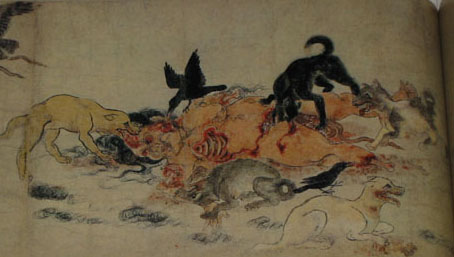
When the Empress died at the age of 64—still beautiful—her last will and testament was opened, and shocked the entire royal family. Instead of a state funeral and proper internment, the Empress requested that her body be garbed in the simplest cloth, then flung onto the streets. When people saw her delicate flesh rot away, the meat of her body picked at by crows and wild dogs, and her beautiful body reduced to unlovely bones, at last they would understand the impermanence of things and perhaps learn the lesson she had been trying to teach them.

And that is exactly what happened. The body of the Empress Tachibana no Kachiko was flung onto a dirty street in Kyoto, where it slowly rotted away and was picked at by crows and wild dogs. The body was dressed only in a simple katabira—the white kimono worn by Japanese corpses—and so the street where her body lay became known as the Katabira no Tsuji – The Crossroad of Corpses. Although many have forgotten the reason, the name remains and you can still go to Katabira no Tsuji today (Stop B1/A9 on the Arashiyama and Kitano lines in Kyoto).

Katabiru no Tsuji Train Sign

Translator’s Note:

Another grim tale for Halloween, but one that involves no actual ghost. In fact, according to Japanese tradition it would be impossible for Katabira no Tsuji to be haunted because the Empress got exactly what she wanted—she would have no lingering attachments or resentments keeping her tied to the living world. But you have to love the gruesome image, and the story that goes with it.

Katabira no Tsuji was included in Takehara Shunsen’s Yokai Catalog, the Ehon Hyaku Monogatari (絵本百物語; Picture Book of a Hundred Stories).

ShunsenKatabiragatsuji

There is slightly more to the story. The devout Empress Tachibana no Kachiko’s final act did not go unnoticed, and started an entirely new kind of Buddhist painting known as Kusozu (九相図; The Nine Signs). These paintings juxtapose scenes of a person beautiful and alive with the nine stages of their corpse as it decomposes. These pictures were extremely realistic, and obviously drawn from studies of actual corpses decomposing over time.

Kyuaizu were generally painted of famous, beautiful woman to show how their charms and wonders were nothing more than rotting flesh and death—only the soul mattered. The honored courtesan Onono Komachi was a popular subject of Kyuaizu, which lead to some mixing between her story and the story of the Empress Tachinbana.

Ernest Satow, a diplomat stationed in Japan, was being shown around Kyoto in the late 1800s when he related this story in his diary:

“Passed Katabira ga Tsuji where the body of Onono Komachi was flung out to be devoured by kites. Kukakusa no Shosho made love to her and was refused. She promised to be his if he would visit her first during 100 continuous nights. He walked 3 ri there and 3 ri back, but when the 100th night came she was from home.”

This blog shows the Kyuaizu of Komachi in its entirety.

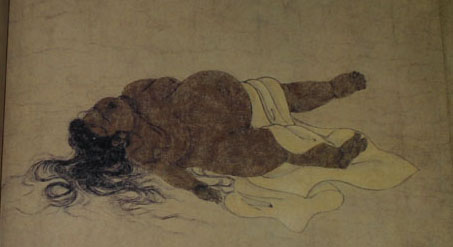
Stage 1 – Still Living (生前相)

Kyuaizu Stage 1

Stage 2 – Freshly Dead (新死相)

Kyuaizu Stage 2

Stage 3 – Filled with Gas (肪脹相)

Kyuaizu Stage 3

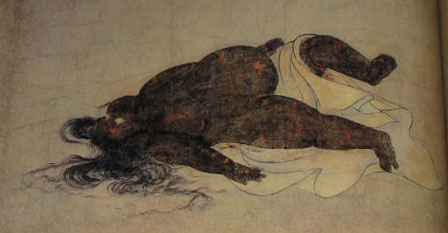
Stage 4 – Consanguinity (血塗相)

Kyuaizu Stage 4

Stage 5 – Flesh Rot (肪乱相)

Kyuaizu Stage 5

Stage 6 – Discoloration (青瘀相)

Kyuaizu Stage 6

Stage 7 – Food for Beasts (噉食相)

Kyuaizu Stage 7

Stage 8 – Skeletal (骨連相)

Kyuaizu Stage 8

Stage 9 – Nothing but Dust (古墳相)

Kyuaizu Stage 9

Further Reading:

For other death customs of Japan, check out:

What is the White Kimono Japanese Ghosts Wear?

Nagarekanjyo – A Death Custom

Previous Older Entries Next Newer Entries

Copyright notification

All translations and other writing on this website were created by Zack Davisson and are copyright to him.

Copyright notification

In accessing these web pages, you agree that any downloading of content is for personal, non-commercial reference only.

No part of this web site may be reproduced or transmitted in any form or by any means, electronic, mechanical, photocopying, recording or otherwise, without prior permission of Zack Davisson.

Copyright notification

For rights clearance please contact Zack at:

zack.davisson (at) gmail.com

Thank you.