Kyōkotsu – The Crazy Bones Yōkai

Kyokotsu Mizuki Shigeru
Translated and adapted from Hyakiyako Kaitai Shisho and other sources

Be careful when you pull up a bucket of water from an ancient, abandoned well. You might get more than you bargained for if a kyokotsu 狂骨—which translates literally as “crazy bones”—springs up from the bucket like a Jack-in-the-Box to deliver its curse.

Clad in a white burial kimono, kyokotsu almost look like a classical yurei but they lack the black/white contrast due to shocks of white hair that spring from its bleached-white skull. Kyokotsu appear as little more than bones wrapped in a shroud, springing from a well.

The yokai is best-known from Toriyama Sekien’s Edo-period yokai print-book “Konjyaku Hyaku Kishui” or  “Supplement to the Hundred Demons of the Past.” Author Kyogoku Natsuhiko also recent featured a kyokotsu in his book “Dream of the Kyokotsu.”

Sekien’s original woodblock print was accompanied by this text:

“Kyokotsu rise from the bones in the well. It is said that whosoever commits the horrendous act of abandoning august bones will find it impossible to abandon the horrendous wrath that follows.”
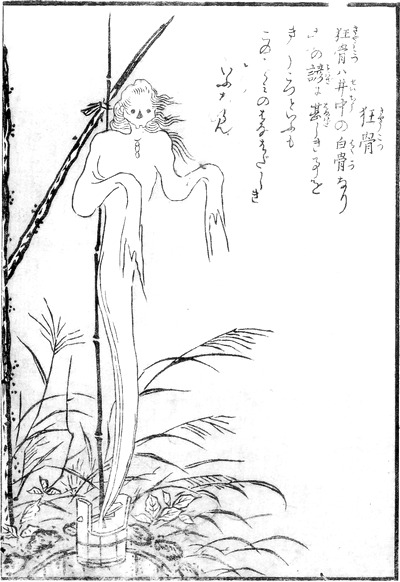
Sekien’s text seems to explain that kyokotsu appear from a well in response to some wrongdoing and bearing a terrible grudge. Seiken also claimed that the regional-dialect term “kyokotsu,” meaning “violent” or “furious,” is an allusion to this yokai. However, while such a term does exist, specifically in Tsuki-gun in Kanagawa prefecture, there is no concrete evidence linking either the term or Seiken’s picture to an older folktale.

It is much more likely that the opposite occurred, that Seiken heard the term “kyokotsu” and decided to invent a yurei to match—much like if an English-language author decided to create a monster called “Lazy Bones” after the pre-existing term. To get the image for his yokai, Seiken was probably just playing on works, combining the local term “kyokotsu” (crazy bones) with “gyokotsu,” which means bones from which all of the meat has fallen off. He might also have been influenced by the words “keikotsu” or “sokotsu” which can mean drifter or wander, but also can be phrased as “someone from the bottom.” It seems likely that Seiken was influenced both by these words and by the old belief of an inexhaustible grudge that can come from the bottom of wells.

There are several Japanese folklore stories—involving both yokai and yurei—that involve the bottom of a well. In Japanese folklore, water was a channel to the world of the dead, and the bottoms of wells were directly connected. Wells also served as a convenient hiding place for murders committed in the dark of the night, and the superstitious believed that any such-disposed of corpse was capable of a powerful curse. Those who died from falling in wells, by accident, suicide, or murder, were thought to transform into shiryo and haunt the well. The spirit connects to the well itself, rather than where they were murdered, and their curse is likely to fall on anyone who used the well and not specifically targeted to the murderer.

A cursed set of bones is another typical trope in Japanese folklore and does not need to be connected to a well. In her book “Nozarashi Monogatari,” the literary scholar Sawada Mizuho wrote a similar story of a weather-beaten, abandoned skull that gets its revenge.

The biggest difference between the kyokotsu and typical Japanese folklore tales of skeletal ghosts is the element of disparity between the spirit form and the physical remains. In most stories, the spirit resembles a typical Japanese yurei—with a physical, full human body—even while the discovered remains are nothing more than a pile of rotting bones. The kyokotsu is rare in that Sekien drew the spirit in skeletal form as well. Because of this, kyokotsu is most often identified as a type of yokai, being a possessed skeleton, rather than a type of yurei, a Japanese ghost.

Translator’s Note:  The manga series “Bleach” has a character called Katen Kyōkotsu that uses the same kanji as this yokai, but seems to have no other relationship.

The Gratitude-Expressing Yurei

Translated from Mizuki Shigeru’s Mujyara

This took place sometime during the Meiwa era (1764-1772). In Shimabara, there was a famous courtesan named Uriuno. She had been redeemed from the Tomiya house, and now lived in the vicinity of Takatsuji.

One night, Uriuno was awakened by a strange noise. When she listened closer, she could faintly hear the sound of footsteps. It sounded as if someone was approaching her bedroom from the garden just outdoors.

“Good Evening. Is someone out for a stroll tonight” Uriuno called out, thinking this was a very strange thing indeed and strained her ears for an answer.

The answer came at last with a rattle of the paper screens that served as a wall between Uriuno’s bedroom and the garden, and the figure of a woman projected like a shadow against those screens. The mysterious shape bowed down and whispered expressions of gratitude to Uriuno. Just as Uriuno was about to raise her voice in response, the figure blinked out of existence.

When the mysterious apparition had vanished, Uriuno suddenly recalled an odd encounter she had when she still worked in the red light district. One night, a maid of the Tomiya was looking at Uriuno as if she had something very important to say. But Uriuno did not get a chance to hear her, as the maid soon fell terribly ill and fainted dead away. For several days and nights, the maid went in and out of consciousness, and then she spent her final breath saying that she needed to see Uriuno and tell her something. But it was too late.

Uriuno thought about the shape of the figure projected on her screens, and felt that there was no mistake about it. That figure must have been the ghost of that maid of Tomiya. It could be no one else.

The Snake’s Curse

Translated from Edo Tokyo Kaii Hyakumonogatari

In North Toyoshima, in the town of Oji, a dealer in hardware named Kumatani Harumachi had a house where five people died in the month of March.  In fear of a similar fate, the house had stood empty ever since.

But on August 2nd, the house of Harumachi’s younger brother, Tamura Sanmachi, was destroyed in a landslide after heaving flooding brought some seaside cliffs tumbling down.  Sanmachi and his wife Aki moved into the abandoned house of his older brother. From the very first night, Aki was besieged with terrible nightmares. It was more than she could handle, and eventually Aki and her husband moved again and had the cursed house torn down.

The curse was said to have begun some two or three years earlier, when Harumachi was working in his back yard.  He had decided to remove a saikachi tree, and when he cut it down he saw five snakes pouring out of a hollow in the tree.  Even with his wife pleading him to stop, Harumachi swung his hatchet at the snakes and cut off all five of their heads, the flung their bodies into the Keshin river to be washed away.

That same hatchet was later used to murder Harumachi and his entire family, and the neighborhood began to whisper about the snake’s curse.

There are many similar legends about the curses of snakes.  It was reported in a newspaper that a child was hurt by a snake in Tachimori village while gathering dry grass for horses.  In response the village got together and worked to drive all of the snakes from the village, but that night the villagers were tortured by dreams of great masses of snakes crawling over their bodies.  The nerves of even the toughest man were severely shaken, and several people went mad.

Poverty-stricken Yube and the Oil Seller

Translated from Nihon no Yurei Banashi

Drinking Oil

Long ago in a village in Banshu (Modern day Hyogo Prefecture), there was a man named Yube. So stricken with dire poverty was Yube that he had nothing to eat and nowhere to live.  In desperation, Yube went to the home of a wealthy dealer in oil and bowed his head on the floor and begged to borrow some money.   The Oil Seller loaned Yube the money, and set the conditions for repayment.   But when the promised day to repay the loan came, Yube’s circumstances had not improved and he had not the ability to return the money.

Yube begged the Oil Seller:

“Please, my lord. Just give me another six months to pay back the loan.”

After listening to Yube beg and plead and beg some more, the Oil Seller finally relented and gave Yube six more months.  But he enforced a harsh term for the additional time.

“All right, if you want more time so badly, then prove it!  Right here, before me, drink five cups of oil.  If you can’t do that, then you had better be able to pay me back this minute.”

Yube was shocked at the demand.  But as he lacked the money to repay the loan, there was nothing he could do but set down to drink the oil. The Oil Seller made sure the cups were filled full to the brim, and watched as Yube sucked down every last drop of the thick oil.   First one, then two, until finally all five cups were drained.   Just as Yube finished the last of the oil, he doubled over with in excruciating pain.   First his stomach ached, and then his chest tightened terribly.  Yube began to sway back and forth, howling in agony, before he dropped to the floor dead.

The Burning Grave

The news of the Oil Seller’s deed spread quickly through the town, and it wasn’t long before it was overheard by the local magistrate.   The magistrate hurried at once to the Oil Seller’s home, and began a thorough investigation into the matter.   When he learned enough to know that the rumors were true, he fixed a stern eye on the Oil Seller.

“Well now. You have killed a man, and no mistake.  To tell the truth, there is enough here for me to send you to the executioner to be beheaded. But I would save you that much.  Instead, you will cover the entire cost of Yube’s funeral, and see to it that his family never suffers for money again.   If you can’t promise me that, then I will see your head posted on the town gates.”

The magistrate said this with such conviction in his voice that the Oil Seller trembled in fear. The Oil Seller quickly agreed to the terms, and wasted no time in making the arrangements to give Yube a fine funeral.   When the day came, the Oil Seller laid flowers on Yube’s freshly-cut headstone and then bent down to light the lanterns next to the grave while the people of the village silent watched and prayed.

When the match was touched to the lanterns, something shocking happened.  The five cups of oil that Yube had drunk had seeped from his body into the surrounding soil, and the grave burst into flames, rising up into a fireball.  The villagers shouted in surprise.

“Ahhh!  It is a hi no tama (fireball)!  This is Yube’s curse, and he has turned into a hi no tama!  We have to get out of here!”

Everyone fled from the grave running as if their lives depended on it.   As for the Oil Seller, he would never live another comfortable day in his life; he flesh grew pale and his entire body was overcome with shaking. He ran faster than anyone.

Just as everyone fled the grave, another mysterious thing happened.  The hi no tama blinked out as quickly as it had appeared; Yube’s oily body was burned up.   That is to say, all of the oil in Yube’s body had burned up. Yube himself was left clean and pure again.  When the last of the fires disappeared, Yube’s body down in the grave let out a huge gasp as air rushed back into his lungs.

“Huh?  Where am I?  What am I doing down here?”

With the oil purged from his body, Yube had come back to life and began to dig himself out of his own grave.   Pulling himself clear, he began to walk through town, heading back to his house.

When Yube came walking through town he came on a huge, noisy bunch of men were gathered in the street.   They were making a tremendous ruckus, some shouting with joy and some with anger.

“Hey there!  What are you all doing?”

Yube tried to push his way into the crowd to get a look at what was going on.  Just then, someone noticed him.  Yube caused quite a fright,
as he was still dressed in his white burial kimono that he had been wearing at his funeral.

“Ahhhhh!!!  It is a yurei!!!”

At the site of Yube in his white kimono, the courage of the men fled from them, and soon all the men were fleeing along with it.   Yube looked at the ground where the men had been gathered, and was surprised to see that the streets were littered with money. For sure this wild crowd had gathered for illegal gambling, and they had all left their cash behind when they went running from Yube.

“Ho!  This will certainly provide for my needs!”

Yube gathered all the stray money from the streets, and carried it off to his house.  But if he expected a welcome home greeting, he was sorely disappointed.  To see their dead relative, whose funeral they had been to today, suddenly show up at their doorstep was too much of a shock for Yube’s family.

“Ahhh!  It is a yurei!  Yube must be lost and unable to make his way to the world over there!”

With that they slammed the door shut and held it tight.   No matter how many times Yube knocked and pleaded to be let in, they wouldn’t listen and just yelled at him to go away.   There was nothing for Yube to do, so sadly he left his house and wandered to a near-by temple.   There, he poured out his story to a sympathetic monk who listened patiently. The monk then returned with Yube to his house, and explained Yube’s return to life to the family, who finally let Yube come inside.  They called down everyone in the house to hear Yube’s tale, and after that went out into the streets of the village where everyone celebrated Yube’s return.

With all the money Yube collected from the gambling den, he was now the richest man in the village. He paid off his dept to the terrified Oil Seller, and proceeded to live happily ever after.

This is a very unusual yurei story.  Not only does the dead man return to life, but he also becomes rich and lives a happy life.  This kind of story is mainly told in the Kansai area of Japan.

The Belly-Beating of the Tanuki

Translated from Edo Tokyo Kaii Hyakumonogatari

There was a tanuki who sat under the edge of a porch and drummed on his belly. Such an interesting sight was bound to become the topic of the neighborhood. The house in question was in Honishi, and belonged to a hairdresser.

It all began one day in February, in the Eighth year of Meiji (1875) when a tanuki came running up to the house towards the backdoor, probably being pursued by a dog or something. The kind hairdresser allowed the tanuki to escape to a safety under his porch. That night, sitting on the back porch, the son of the hairdresser was mindlessly tapping out a rhythm on the hibachi stove, when from under the porch came an answering beat. The tanuki was drumming along with the boy on his own belly. This was just too much to believe, and the hairdresser summoned his neighbors to see if they too could hear the belly-beating tanuki. The tanuki went right along pounding out his tune; it didn’t stop even as night fell and darkness surrounded the village.

The hairdresser could not sleep that night due to the incessant drumming of the tanuki, and finally shouted “Enough!” He went outside to the tanuki and in a pleading voice said “Honorable tanuki, we are all trying to sleep, so could you please be quiet?” With this said the tanuki immediately stopped his belly-beating. The following day, a great crowd gathered at noon to listen again to the belly-beating of the tanuki, and were shocked and saddened to find that no more drumming came from under the porch ever again.

In another case, in the 15th year of Meiji, on July 28th, the Choya Shinbun newspaper published an article about a similar musical tanuki. Out near a rice field in a remote village, a samisen master was giving a lesson to his student when they both heard the unmistakable sound of someone accompanying them on what sounded like a hand-drum. Soon the master, student, and mysterious accompanist were playing along late into the night in a fantastic improvised session. With the coming of dawn, the drumming stopped as mysteriously as it had started.

That morning, the body of an ancient tanuki was found in the rice field by the man who attended the water wheel. The tanuki’s body had blood streaming from its mouth, and its belly was said to have been beaten bare as if it had been shaved. This took place in Kyoto, in the town of Aiiwa.

In one final story, in the 17th year of Meiji on the 28th day of May, the Yubin-Hoichi Shinbun newspaper reported that the wife of a photographer named Kyomizu from the Tokoku area kept a baby tanuki as a pet. The wife said that in the middle of the night she could hear the baby tanuki practicing beating out rhythms on its belly. The wife wanted to see what her pet was up to, and snuck in one night to spy on it. She said the baby tanuki was spread out flat on the tatami mats, with all four legs splayed wide and its nose pressed firmly on the ground. She could hear sounds of something like a flute and a hand drum coming from the tanuki. This story as been passed down by the people of Tokoku as a true story of magical tanuki.

There are many more such stories about the belly-beating of tanuki. It is a legend that will not vanish any time soon.

Previous Older Entries Next Newer Entries

Copyright notification

All translations and other writing on this website were created by Zack Davisson and are copyright to him.

Copyright notification

In accessing these web pages, you agree that any downloading of content is for personal, non-commercial reference only.

No part of this web site may be reproduced or transmitted in any form or by any means, electronic, mechanical, photocopying, recording or otherwise, without prior permission of Zack Davisson.

Copyright notification

For rights clearance please contact Zack at:

zack.davisson (at) gmail.com

Thank you.