The Appearance of a Kappa

Translated from Edo Tokyo Kaii Hyakumonogatari

In the Meiwa era (1764-72), near the village of Takekura in Honjyo-Go, a gang of tradesmen were gathered around a strange living creature that they had almost beaten to death.  Their supervisor happened on the scene and stopped them, then sent for Ooda Chogen to see if the thing could be identified.   Chogen quickly arrived and said “This is what we call a suiko (water tiger).  Over in the valley they call it a kappa.” Chogen then reached into his breast pocket and produced a drawing so he could compare the similarities and differences. (It is said that a copy of that same picture was made by Ito Chohei in the mid- Bunsei era (1823)).

This was the second time that Chogen had encountered this particular strange living creature.  He had made the sketch after his first encounter, and the thing before him now showed no discernible differences.   It was about 2 shaku long (60.6 centimeters) from head to foot,  and looked like it was covered in moss.  The body was as slippery as a catfish, but the hair was as black as palm-tree hair. The arms and legs resembled the skin of an eel, and on the top of the head was a depressed bowl.  The back and the belly was the same color.

During the Kyoho era (1716-36), excess children were sometimes abandoned in the rice fields in anticipation of the Imperial Inspection of farmer households.  This strange living creature was said to resemble those abandoned human children.
Do Kappa Really Exist?

Translated from Sore de Honto?

Of all the bakemono and yokai in Japan, the kappa is the best-known.  Depending on the area, they might be known as “gataro” or “kawako” or “gawappa.”   This just shows how wide-spread they are.  As for appearance, the most stereotypical kappa can be recognized by the indented bowl on his head and by webbed hands and feet.

There are many people who claim to have seen this kind of kappa.  But if you research exactly what people describe, it seems like what they are actually seeing is an otter.

Otters come from the mink family, and have a large tail.  They can use this tail for support to stand straight up on the river banks.  When they do this, they are almost exactly the same size as a human child.

An otter’s skull is soft, and can be flattened out at the top.  Just imagine coming upon an otter in the dim evening light, standing upright on a river bank.  Water running off its fur,  the head flattened out and eyes moving around restlessly, standing at the same height as a human child.  Don’t you think it might look just like a kappa?

In the Edo period, if you examine all of the different portraits of kappa, you can see the influence of the otter’s shape.  For example, the picture called “Suiko, scroll #20” is obviously a mix between an otter and a turtle.

The distribution of otters in Japan and stories of kappa coincide, from Hokkaido down to Amami island.  But nowadays, otters are almost extinct in Japan.  I wonder if the legend of the kappa will fade along with them?

Secrets of the Yokai II

Translated from Mizuki Shigeru’s Yokai Daihyakka

How are Yokai born?

It is said that the vast majority of Yokai are born from the emotions of human, especially the powerful emotions of fear, yearning or hate.

But there are other ways for a Yokai to come into being:

1. From the violence of natural disasters such as floods, earthquakes, windstorms or volcanic eruptions.

2.  From the fear of dying accompanying disease and dire poverty.

3. From fear of animals, especially the terror humans feel at the prospect of being eaten by some beast.

4. From plants with lifespans that outstrip humans, like cedar and pine trees.  It was thought that these trees would live forever, and there was a desire of humans to believe in something that had power over death, something indestructible.

5. From human belief in superstitions and stories, or the teachings of religions.  There are things that scientific knowledge cannot explain, and it is there that Yokai are born.

Further Reading:

For more information about yokai and their meaning, check out:

What Does Yokai Mean in English?

A Brief History of Yokai

Secrets of the Yokai – Types of Yokai

Secrets of the Yokai – Types of Yokai

Translated from Mizuki Shigeru’s Yokai Daihyakka

What is the difference between Yokai and Obake?

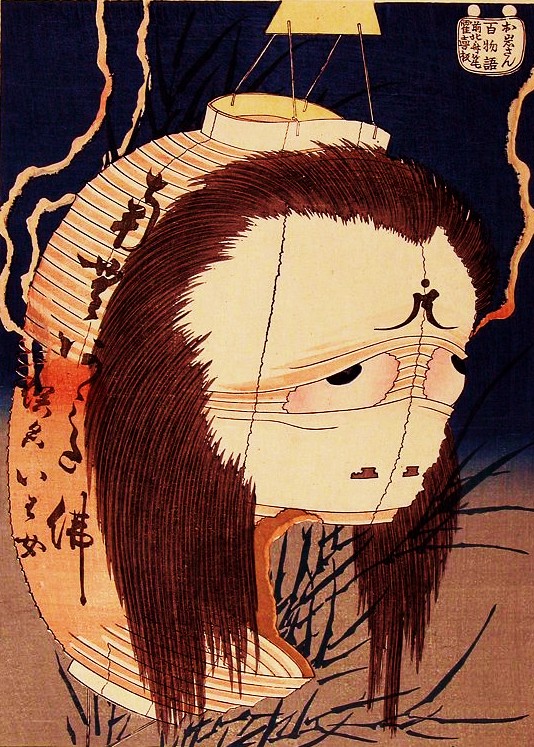
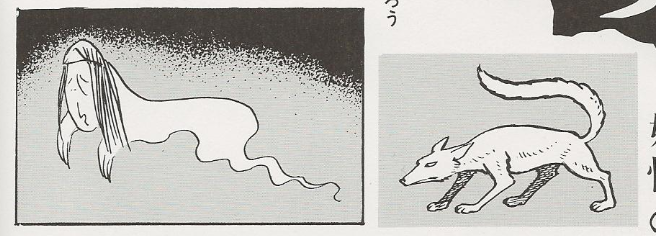
Generally speaking, yokai and obake are two words that mean the same thing.   If a distinction must be made, it could be said that obake are those creatures which somehow change from one form to another (the Japanese word bakeru which forms the root of obake means to change for the worse, or adopt a disguise).

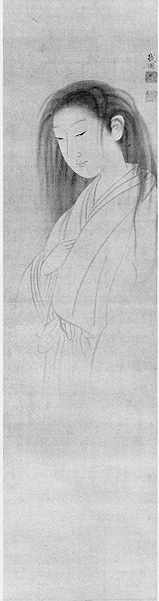
Examples are transforming kitsune (foxes) or of the dead people whose lingering grudges cause them to appear as yurei, or a myriad of other shape-changers.

What kinds of Yokai are there?

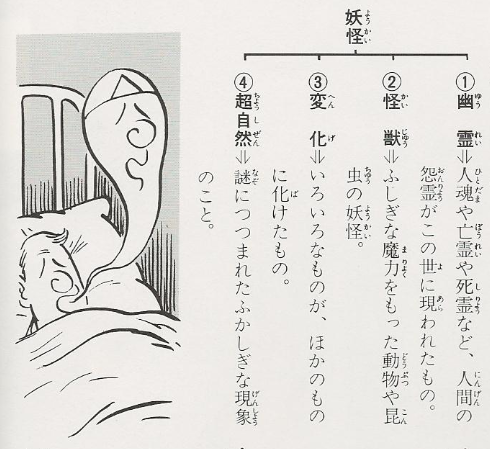
If you wanted to organize yokai by large categories,  it could be said that there are Yurei (spirits of the dead) Kaiju (monsters), Henge (shape-changers) and Choshizen (supernatural phenomena).

A chart would look like this:

 Yokai

Yurei  Kaiju  Henge  Choshizen
Examples are hitodama, borei and shiryo, and onryo.  The spirits of humans still lingering on Earth.  Animals or insects with mysterious and magical powers.  Anything that can change from one form to another. Mysterious or puzzling phenomena.


How many kinds of Yokai are there in Japan?

As a rule, it is said that there are about a thousand different species of yokai.  But if you limit it to those that have appeared in pictures or those about which we have some information, then it is really roughly four hundred different species.

But there are many yokai of other countries.  Nobody knows the number of worldwide yokai.

What is the largest Yokai of them all?

 That is the Onyudo.  The body of the Onyudo is as large as Mt. Fuji.  However, it is said that even if angered the Onyudo would never cause harm to humans.

Further Reading:

For more Types of Yokai, check out:

6 Types of Japanese Yokai From Showa

When Food Attacks – 6 Types of Food Yokai From Japan

10 Famous Japanese Ghost Stories

What’s the Difference Between Yurei and Yokai?

A Brief History of Yokai

Zashiki Warashi

Translated from Mizuki Shigeru’s Yokai Daihyakka

Zashiki warashi are a yokai from the Tohoku region of Japan.  They live in the rafters of ceilings or in old storehouses.  One of the mysteries of zashiki warashi is that they always take the appearance of small children, and never of adults.

In Iwate prefecture, zashiki warashi are said to appear in many of the local Elementary schools, and play with the children.  At nine o’ clock, dressed in a white kimono, the zashiki warashi slip through cracks in the door and play around between the desks and chairs, having a great time.  Of course, only the children can see the zashiki warashi as they romp around the classroom.

Also, about a hundred years ago in Tokyo, zashiki warashi were said to live in the storehouse of a man named Umehara Sotoku.  Whenever any human went into the storehouse they would suddenly be overcome by the need to urinate and would have to flee running from the storehouse.  It was said that this was due to the presence of the zashiki warashi.    Also, sometimes at night the sound of something striking a metal pole could be heard.

One year, there was a fire near that house and the flames rapidly spread.   The family was busy bringing the furniture out of the house when a child that no one knew was seen running out of the storehouse and helped carry the furniture into the cellar for safekeeping.   Even though they tried, no one got a good look at his face.  When all of the goods and people were safely in the cellar, the door was shut tight but the small boy was no were to be seen.

That old storehouse was nothing special, the kind that could be found anywhere.  But high up on the shelf that was used to store charcoal there was a box about 15 by 16 centimeters that no one ever touched.  Most likely that was the home of the zashiki warashi.

The old storehouse did eventually burn down in a fire in the middle of the Meiji period, and from then on the zashiki warashi was never seen or heard from again.  I wonder where it went?

Further Reading:

Read more about Zashiki Warashi on hyakumonogatari.com

On Zashiki Warashi


Previous Older Entries Next Newer Entries

Copyright notification

All translations and other writing on this website were created by Zack Davisson and are copyright to him.

Copyright notification

In accessing these web pages, you agree that any downloading of content is for personal, non-commercial reference only.

No part of this web site may be reproduced or transmitted in any form or by any means, electronic, mechanical, photocopying, recording or otherwise, without prior permission of Zack Davisson.

Copyright notification

For rights clearance please contact Zack at:

zack.davisson (at) gmail.com

Thank you.