Tōfu-kozō – The Tofu Boy

Translated and sourced from Mizuki Shigeru’s Mujara, Yokai Jiten, Japanese Wikipedia, and other sources

On a dark and stormy night Edo night, if you should happen to turn around and see a giant baby dressed in an enormous bamboo hat and carrying a wiggly block of tofu festooned with a maple leaf, don’t panic. Despite the strange appearance, it is only Tofu Kozo, one of the most harmless of all of Japan’s bizarre yokai tribe.

Who is Tofu Kozo?

One of Japan’s most popular yokai, the name Tofu Kozo is most commonly translated as “tofu boy” or “tofu kid,” although a more literal—albeit clumsy—translation would be “tofu young Buddhist priest.” But the Buddhist associations don’t run any deeper than the name, with “kozo” being a common term for young boys in Japan.

Tofu Kozo generally appears as a small boy, or even a baby, in a giant, conical bamboo rain hat and a traditional kimono. The kimono can be plain, or highly decorated with daruma figures, red rockfish, horned owls, and taiko drums, all of which were thought to be talismans against small pox during the Edo period. As the same suggests, Tofu Kozo are never seen without a plate of tofu, which is decorated with a single maple leaf impression.
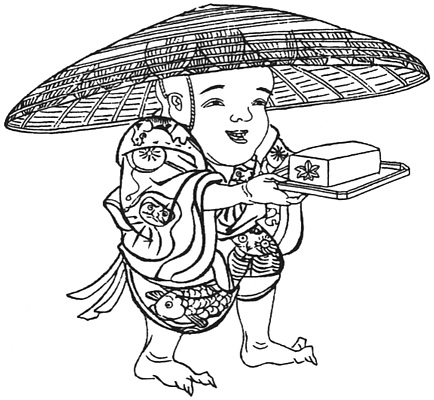
Lacking any special powers or features other than appearance, Tofu Kozo is said to wander through deserted city streets at night, or during the rain. Generally shy and timid, Tofu Kozo sometimes likes to sneak behind humans and follow them through the streets.

There is little agreement about Tofu Kozo amongst writers. Some say that there is only one Tofu Kozo, and that he is a sort of yokai prince, the son of the yokai supreme commander Mikoshi Nyudo and his wife the Rokurokubi. Some say that tofu kozo are nothing more than errand boys for the yokai, rushing back and forth on endless tasks.

From the Showa era and up, there have been accounts of Tofu Kozu as meeting people on rainy streets at night, and offering up some delicious tofu. Anyone who eats the tofu finds their body growing with mold from the inside until they die. Yokai researchers Kyougoku Natsuhiko and Yamaguchi Bintaro trace this legend as having been invented for for childrens’ books in the Showa era to give the Tofu Kozo a bit more of an edge for modern readers.

One the opposite side, in modern Japan therapists have been using Tofu Kozo as a yokai who gets bullied by other yokai, and is used in anti-bullying therapy and education.

The Origin of Tofu Kozo

Tofu Kozo has the unique status of being Japan’s first modern, city-bred yokai. Unlike other yokai that sprang from ancient and rural Japan, the Tofu Kozo has no folklore heritage, no appearances in traditional folktales or legends. He arrived fully formed suddenly during the Anei era (1772-1781), where he quickly became a popular character for picture books, kabuki performances, toys, advertisements, cookbooks, and yellow-covered kiboshi illustrated stories.

There are several theories as to the origin of Tofu Kozo. One aspect is tofu itself. The urban Edo period saw the rise of tofu as a popular food source, cheap and nutritious. One picture book of the time, Edo Meisho Zue (江戸名所図会) “Collection of Pictures of the Famous Places of Edo” by Hasegawa Settan, shows tofu dealers wearing the iconic conical bamboo hat as they travel the streets back and forth with their wares. Other illustrations from the period show yokai like tanuki and kappa carrying tofu, and it is speculated that some enterprising tofu dealer might have created Tofu Kozo as an advertising character for their shop, only to see the character’s popularity run away from them.

Mizuki Shigeru gives the location of Tofu Kozo as Satsuma province, modern day Kagoshima prefecture, although the character is seen all over Japan. During the Edo period, when the 100 candle storytelling game of Hyakumonogatari Kaidankai was popular, game players and storytellers were always on the lookout for new yokai stories to tell, and it is likely that the legend of Tofu Kozo was created and expanded upon during numerous storytelling sessions.

The first known print appearance of Tofu Kozo is in the 1777 kiboshi illustrated book “Bakemono Shiuchi Hyoban-ki” (妖怪仕内評判記; “Commentary on Notable Events of the Yokai”), written by Koikawa Harumachi. A few years later in 1782, he appeared in a popular tofu cookbook called “Tofu Hyakuchin” (豆腐百珍; “The 100 Curiosities of Tofu”) by Hitsujun Ka. The character continued to be popular through the Meiji era.

The Many Faces of Tofu Kozo

Because there is no traditional origin for Tofu Kozo, artists have depicted him in varying ways over the years. Early descriptions describe him as having an enormous head, like an overgrown baby. Koikawa Harumachi described him this way in “Bakemono Shiuchi Hyoban-ki,” and the artist Kitao Masayoshi even named him Ogashira Kozo, meaning “Big Head Boy,” in his 1787 picture book “Bakemono Chakutōchō” (夭怪着到牒). For a short time, it was popular to draw Tofu Kozo as having only one eye, but this fad soon faded and by 1853 Tofu Kozu was drawn looking like a normal young boy, as seen in the illustrated book “Kyoka Hyakumonogatari” (狂歌百物語).

An obvious relative of Tofu Kozo is Hitotsume Kozo, meaning the One-Eyed Boy. Although Hitotsume Kozo is an older, more traditional yokai, over the years the two have come to resemble each other as their stories and appearances merged. This has caused researchers to postulate that they are the same yokai. But while they have had obvious influences on each other—and are depicted as cousins in many modern yokai stories—they are generally considered to be separate characters.

Umibōzu – The Sea Monk

Translated and sourced from Mizuki Shigeru’s Mujara, Yokai Jiten, Japanese Wikipedia, and other sources

If you find yourself out sailing strange tides in an unfamiliar sea, the umibozu is not the kind of monk you should pray to for help.

The Legend of the Umibozu

Sailors in Japan’s yokai-haunted waters had many things to dread. Dark nights and stormy waters could bring funa yurei rising up from the depths demanding hishaku, a wooden ladel, that they would then use to fill a boat with water and sink it to the depths. But it was clear skies and calm waters that brought fear of the umibozu. Rising suddenly from the placid surface of the water, umibozu looked like a great ocean swell, a giant black head that would lurch upwards and upside ships, sending the sailors into murky waters. They were massive, rising as much as ten meters tall, and strong enough to snap a ship in two.


What is an Umibozu?

Umibozu (海坊主) translates literally as “sea monk.” They are known by other, similar names such as umi boshi (海法師) and umi nyudo (海入道), both of which are variations of the world “sea monk.” (“boshi “ and “nyudo” are other words for monk, meaning “teacher of the Buddhist laws” and “walker of the way” respectively). The name is entirely linked to appearance—the rounded head of an umibozu was said to resemble the shaved head of a Buddhist monk—and has no deeper connections to Buddhism. I have seen some English language sources saying that the umibozu are the spirits of drowned monks, but I haven’t found this claim supported by Japanese sources.

Traditionally, umibozu rise from calm waters. Their appearance is sometimes said to herald a coming storm, and they can be accompanied by other strange ocean phenomenon. Or even just feelings of dread. In any case, wise fishermen could read the signs that an umibozu was about, and would refuse to launch their boat until the waters were clear.

Accounts of umibozu differ wildly. They can be anything from a hairy creature resembling a sperm whale to a beautiful woman who can shape-change into a vicious monster. The classic umibozu is the one most often represented by ukiyo-e artists; that of a giant black head with two massive eyes thrusting up from the water. Umibozu can be gigantic, there have been reports of tiny umibozu, no more than a few feet or inches tall. Some say that these are children and that the massive umibozu are full grown adults. When they attack, some say that they cling to the hull of a ship to drag it down, or have great stretching arms that can pull a ship down by its mast. Some say that they try desperately to quench any lit fires on the boat. Some say they cry “Kuya kuya” as they attack, and that striking them with the oars will bring cries of pain, “Oitata!,” from the smaller species. In some legends, they can be repelled by tobacco smoke.

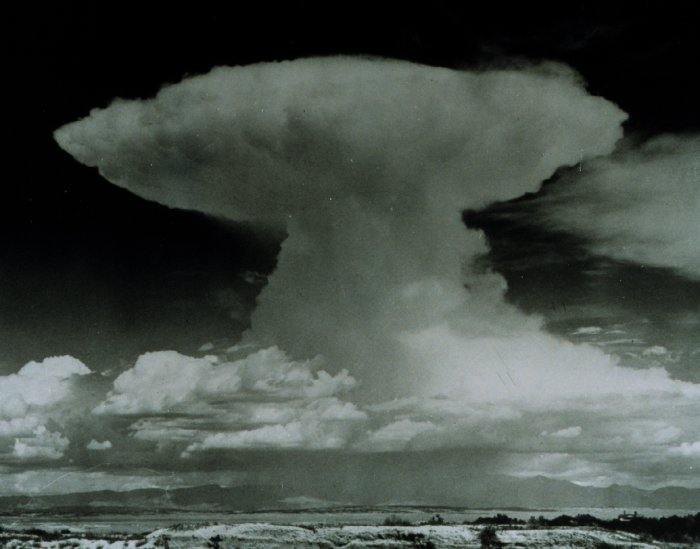
Most researchers think that umibozu are a misunderstanding of a natural occurrence. The shells of great ocean sea turtles or massive jellyfish rising suddenly from the water, or a black thunderhead of clouds rising in the distance have all been sited as the origin of umibozu legends.

A more recent candidate is a rare phenomenon called a rogue wave, which is a large and spontaneous ocean surface wave that occurs far out in the sea fitting almost exactly the traditional description of an umibozu. Rogue waves themselves were thought to be sailor’s folklore until the Draupner wave was recorded in 1995 off the coast of Norway.

Umi Bozu across Japan and Elsewhere

Unsurprisingly, as an island nation Japan has long had a deep and abiding fear of the ocean. An uncountable assortment of sea monsters live in the waters off of every coast. Each small fishing village created its own folklore, and as villages grew larger and merged into port cities mythologies mixed and blended, accounting for the massive and infinite variety.

Most Japanese yokai are regional. They were created in one particular area, and there they stayed. But the umibozu are widespread, and touch every part of Japan that is touched by the ocean. Because they are so widespread, over the centuries the story of umibozu has mixed with other sea creatures. In some accounts, the umibozu are like the funa yurei, demanding a spoon or a barrel in order to fill a boat with sea water. In some accounts, the umibozu are like the kappa, trying to suck the shirikodama from out of the human anus.

In the Tohoku region, before going out to sea for fishing the captain of fishing boats would give prayer to the Goddess of the Sea for safe passing. It is said that the umibozu are the retribution of the Goddess on any ship captain who fails to give her the proper respect.

In Okayama prefecture, the umibozu were considered to be an aspect of the yokai nurarihyon. Sailors in the Seto Inland Sea feared the rising of the nurarihyon’s large head from the water, which would flip ships over as a joke.

In Aomori prefecture, Shimokita district, Higashidori village, people who ate shark (eating shark was sometimes taboo in Japan, as sharks ate people so it was seen as cannibalistic) were said to become mojyabune (亡者船; ship of the dead), which was associated with the umibozu. People protected themselves from the mojyabune by mixing miso paste with water and pouring it into the ocean.

In Shizuoka prefecture, Kamo district, they told tales of the umi kozo, which refers to a young monk. The umi kozo was covered in a fine hair up to its eyes, and came up along people’s fishing lines, cackling hideously.

There have been stories of shape-changing umibozu as well. In Miyaki prefecture, on Ooshima island, they say that umibozu disguise themselves as a beautiful woman lost and swimming in the ocean. The same story is told in Iwate prefecture, where it is said that the woman will invite you to come into the water with her, and that anyone foolish enough to do so will be swallowed whole.

Many other countries have similar legends, or sea monsters that resemble the umibozu. In Mongolia there is the Mokuri Kokuri. In China the Kikokutan, and in Europe the Sea Monk and the Bishop fish haunt the oceans.

Reports of Umibozu

There have been several written accounts of umibozu. Many of these are eye-witness encounters appearing in newspapers or collected in the bound volumes that served as the popular literature of the time.

In the Kansei era (1789 – 1801), in a collection of writings called Kanso Jigo (閑窓自語), in Osaka prefecture, Kaitsuka city, there was a report of an umibozu that rose out of the water and stayed visible for three days before returning to the sea.

In Wakayama prefecture, in the 21rst year of Meiji (1888) the Miyako Shinbun newspaper reported an umibozu monster that was 2.4 meters long and weighed up to 263 kilograms. It was said to be light brown with orange eyes, with a mouth like a crocodile and a tail like a giant shrimp, with a voice like a cow.

In the collection Usō Kanwa (雨窓閑話), it was written that in Mie prefecture it was thought that the end of the month was the time for umibozu, and ships were prohibited from launching at that time. A sailor broke the ban and went to see at the end of the month. Sure enough, he soon encountered an umibozu who approached him and asked “Am I terrifying?” The sailor replied, “I find nothing as terrifying as trying to make my way in this world,” at which the umibozu suddenly vanished.

And the most recent account, published in the Mainichi Shinbun newspaper in 1971, told of a first-hand account by a ship that was tuna fishing near New Zealand. When they went to hoist up their catch, a giant animal came up tangled in the lines. The captain and crew panicked at what they were sure was some monster from the deep. The monster was brown colored, with deeply wrinkled skin, and eyes fifteen centimeters in diameter. They saw no nose or mouth. Only a part of the monster’s body came out of the water, with the rest hidden in the ocean water. The matter was investigated by Japan’s oceanography department, who felt that experienced fishermen were not likely to mistake a whale or a giant squid for something different. If, as the fishermen said, the visible part of the body that breached the surface was around 1.5 meters long, then the remainder of the body must be larger than any animal ever known.

Perhaps it was an umi bozu.

Translator’s Note:

This was posted by request for reader Stuart, who says he is writing a song about umi bozu.  Hope to hear that song when it is finished!  And also thanks to comic writer Brian Wood, in whose comic The Massive appearing in Dark Horse Presents I first heard about the Draupner wave and thought … that sounds like an umibozu!

Further Reading:

Read more yokai tales on hyakumonogatari.com

Funa Yurei

Nure Onago – The Soaked Woman

The Appearance of the Spirit Turtle

Nure Onago – The Soaked Woman

Translated from Mizuki Shigeru’s Mujara

In Tsushima in Nagasaki prefecture, when the rain falls at night, the bakemono known as the Nure Onago appears. The Nure Onago can appear near any body of water, from a small pond to the ocean. Her entire body is drenched, and she is soaked from the top of her head to the tips of her toes.

The Nure Onago can be found in several parts of Japan. In Nuwa in Ehime prefecture, it is said that you can see her hair stretched out and floating on the surface of the ocean, and it is from there that she appears. In the Uwa district, the Nure Onago doesn’t come from the ocean, but it is said that she appears from a soaking wet mop of hair.

The Nure Onago always has a wicked smile, and laughs hideously. If by chance you hear her and, thinking she is just a regular woman amused at something, should laugh along with her, then she will attack you swiftly and without mercy.

In Kagoshima prefecture, in the cape of Tajiri where the famous festival for the god Ebisu is held, there is a similar yokai. They call her the Iso Onna (Beach Woman), and like the Nure Onago she is soaked head to foot. The Iso Onna appears anywhere there is sand, either on the actual beach or inland if there is sand. The main different between the Nure Onna and the Isa Onna is the lower half of their bodies. The Isa Onna is said to have no lower half, but instead is formed like a snake below the waist. Both the Iso Onna and the Nure Onago are types of the yokai called Nure Onna.

Most depictions of the Nure Onago show her as being nothing different than a regular human woman, dripping wet. The Nure Onago is a relative of the Hari Onna (Needle Woman) from western Japan.

Translator’s Note

Mizuki Shigeru’s depiction of the Nure Onago is quite different than most portrayals.  Mizuki’s description is more in tune with the name Nure Onna 濡女子 which means literally “Wet Woman-child” or “Soaked Woman-child.” The related Nure Onna is traditionally drawn as a snake with the head of a woman.  She is also sometimes described as carrying a small child (odd considering the lack of arms) which then turns out to be a bundle of leaves.  This story is taken directly from the Ubume legends.

Further Reading:

Read more yokai tales on hyakumonogatari.com

Inen – The Possessing Japanese Ghost

Funa Yurei

Enju no Jashin – The Evil God in the Pagoda Tree

Kappa to Shirikodama – Kappa and the Small Anus Ball

Translated and adapted from Mizuki Shigeru’s Mujara and other sources

To learn much more about Japanese Ghosts, check out my book Yurei: The Japanese Ghost

You have a magical ball in your butt, and kappa want it.

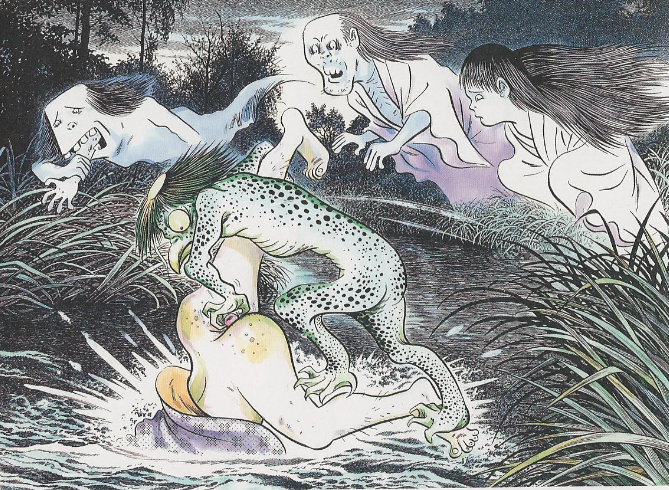
At least that is how the story goes. Although modern kappa are often portrayed as cute and mostly harmless, during the Edo period they were monsters who had a particularly vicious method of killing their victims. In probably one of the strangest bits of Japanese folklore, it is said that human beings have something in their body called a shirikodama (尻子玉), which translates literally as “small anus ball.” The ball is nestled either immediately inside the anus, or deeper inside the intestines or the stomach. The kappa have a preferred method of extraction.

Folklorist/manga artist Mizuki Shigeru wrote:

“Ever since I was a child I heard that I had to be careful in the water because the kappa would try and take my shirikodama. It was said that in the water, a kappa would come from below, extend an arm upwards and stick a hand up your anus to extract the ball.”

In some stories, the kappa don’t reach up with their hands but instead actually suck the shirikodama from the body. However it was taken, the person whose shirikodama was extracted from was almost always killed in the process. Usually the kappa would hold them underwater to drown them first, before taking the ball.

What is a Shirikodama?

No one really agrees on what the shirikodama is. Some say that it is the human soul, hardened into physical form. Some say that the shirikodama in pictures resembles the Buddhist Hojo, or wish-granting jewel. The hojo was onion-shaped, with a round body and a tapered top. The usual depiction of the shirikodama does indeed resemble this shape.

Many associate the shirikodama with the liver. Kappa were known to love human livers, and some say that the shirikodama was the liver, or that the ball was blocking access to the liver with the liver being the actual target for the kappa.

Why Do They Want It?

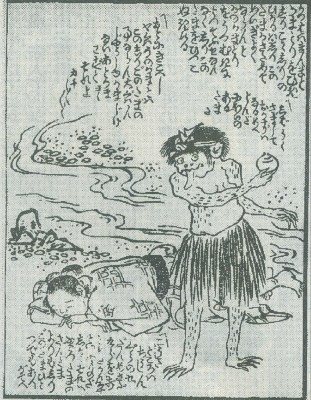
Again, no one really knows for sure. The most basic explanation is that kappa consider the shirikodama to be a delicious delicacy and that they eat it as soon as it is removed. This explanations is contradicted by some Edo era depictions such as the one by Jippensha Ikku that shows a kappa with a freshly extracted shirikodama holding it far away from his face and clearly disgusted with the item. The shirikodama was said to smell as bad as the anus it was removed from.

In one story, it was said that the kappa paid the shirikodama as a sort of tribute and tax to the Dragon King who lived under the sea and was the lord of all things under the water. What the Dragon King would want with such an item no one has dared to guess.

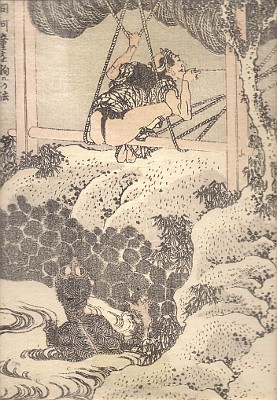
But they did want it. A humorous print by Hokusai Katsushika called “How to Fish for Kappa” (Onajiku kappa-wo tsuru no hō ; 同河童を釣るの法) shows a man using his own backside as bait to lure a kappa in to be caught with a net.

The Origin of the Shirikodama

The most commonly accepted origin is that drowning victims often have an open or extended anus, looking as if something was taken out of it. Bodies that had drowned in the river or ocean and then washed up on shore might have looked as if something had been forcibly extracted from the anus.

With kappa moving further and further way from their role as monsters in Japan, the legend of the shirikodama is on its way to being forgotten. Kappa have been recast in Japan as being friendly mascots of various companies or harmless characters on children’s cartoons. In movies like the popular “My Summer Vacation with Coo the Kappa,” the cute little kappa Coo never once sneaks up on its human friend Koichi to forcibly remove a magical ball from his anus.

Further Reading:

Check out other kappa tales from hyakumonogatari.com:

The Appearance of a Kappa

Do Kappa Really Exist?

The Kappa of Mikawa-cho

The One-Armed Kappa

Enju no Jashin – The Evil God in the Pagoda Tree

Translated from Mizuki Shigeru’s Mujyara

Long ago in Koshu (Modern day Yamanashi prefecture), on the base of Mt. Minobu, there was a dark forest where great trees lined up in a row. Inside the forest was an ancient Japanese Pagoda Tree. The tree was worshiped as a spirit, and a shrine had been built near the tree. However, anyone who passed by that tree after sundown had to leave an offering of silver and gold, or fine clothing, or anything of monetary value. Those who ignored this custom would suffer a terrifying curse. Now, I say that the tree was a spirit, but those in the town called it the mori no jyashin, the Evil God of the Forest.

At one time, a poor but hardworking farmer heard that his mother was dreadfully ill. He fled back home to see her, but the quickest path to her house took him right in front of the tree, and he had nothing to leave as an offering. There was nothing to be done, and as the famer rushed by the tree he prayed to the evil god, making a promise that he would come back later with an appeasement. But from the tree an empty suit of armor appeared and followed the man. The farmer dropped to the ground, bowing his head against the ground and begging the evil god for forgiveness. Appearing to accept the promise, the armor disappeared.

The following day, because the farmer terribly poor, he could only muster 500 mon in coins for an offering. Apparently this amount did not please the evil god, who cast the farmer into a giant pot and set him to fire preparing to make a dinner of him. The farmer prayed most solemnly for his life, and his prayers were heard. The son of the diety Fudo Myo appeared, and dispensed with the evil god. Not only that, all of the money and goods that had been paid to the evil god by the village was returned.

Although the villagers called the entity in the tree a spirit, I think it is more likely that some kind of yokai had settled down there.

Translator’s Note:

The name of this story is Enju no Jashin (槐の邪神). The enjyu tree is a species called Sophora japonica, and is known in English as either the Japanese Pagoda Tree or the Chinese Scholar.

Further Reading:

Check out other magical tree tales from hyakumonogatari.com:

Ochiba Naki Shii – The Chinkapin Tree of Unfallen Leaves

Previous Older Entries Next Newer Entries

Copyright notification

All translations and other writing on this website were created by Zack Davisson and are copyright to him.

Copyright notification

In accessing these web pages, you agree that any downloading of content is for personal, non-commercial reference only.

No part of this web site may be reproduced or transmitted in any form or by any means, electronic, mechanical, photocopying, recording or otherwise, without prior permission of Zack Davisson.

Copyright notification

For rights clearance please contact Zack at:

zack.davisson (at) gmail.com

Thank you.