Gatagata Bashi – The Rattling Bridge

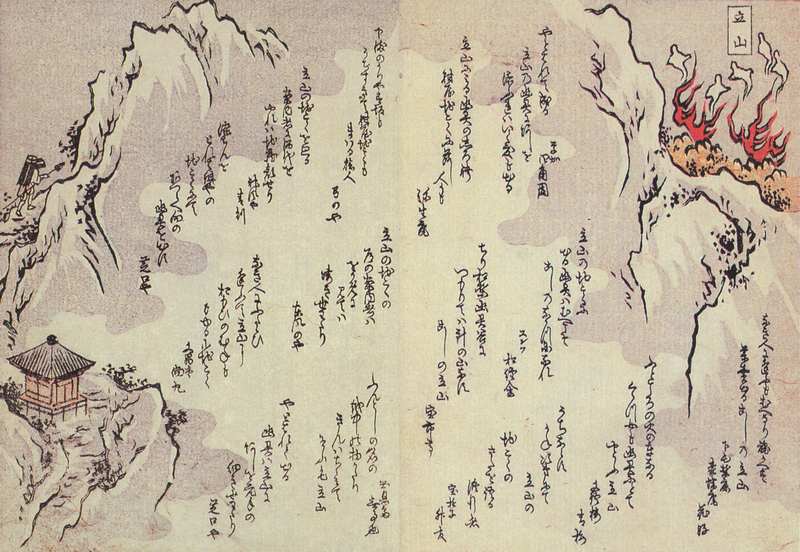
Masasumi Tateyama Gatagata Bashi

Translated and Sourced from the Kyoka Hyakumonogatari and Japanese Wikipedia

In the village of Ozaka in the province of Hida (Modern day Gifu prefecture) there lived a man named Kane’emon. In front of his house was an old wooden suspension bridge that lead across a mountain valley to the neighboring village.

One night, while Kane’emon was in his house, he heard the distinct rattling sound of someone crossing the bridge, accompanied by whispering voices. Making the crossing was far too dangerous at night, so Kane’emon rushed out of his house to warn the travelers whoever they might be. He saw nothing.

This continued for night after night, always the rattling of the bridge and the whispering. On some nights he even heard cries of sorrow and people weeping.

Unsure of what to do, Kane’emon consulted a fortune teller who told him that what he was hearing was a parade of the dead on their way to Tachiyama (Modern day Toyama prefecture). It was known that there were several entrances to Hell located in Tachiyama and that the mojya (亡者; dead people) must have recently discovered his bridge as an expedient path.

Hearing that, Kane’emon resolved to move his entire household as far away from the bridge as possible, and also arranged to have a memorial service held at the bridge, praying to ease the sentence of those poor spirits cast into Hell. He had a permanent memorial posted at the bridge, and from that time no more strange sounds were heard. However, that bridge is still known to this day by the name of Gatagata Bashi, meaning Rattling Bridge.

Translator’s Note:

Another short yurei tale for Halloween. This story of the Gatagata Bashi comes from Masasumi Ryūsaikanjin’s 1853 kaidanshu Kyoka Hyakumonogatari (狂歌百物語; 100 Tales of Kyoka Poetry), where it appeared under the much longer name of “The Sound of the Dead Traveling to Tachiyama Hell as They Crossed the Suspension Bridge.” (立山地獄へ向かう亡者たちが境に架けられた橋の上をわたる音) It has been collected in several kaidanshu and yurei books over the years. Although it refers to小坂, there are old bridges across Japan colloquially called Gatagata Bashi with “gatagata” being an onomonopia for the sound of rattling wooden boards.

Many of these Gatagata Bashi have legends attached. Bridges—being a method of spanning boundaries—are often found in yokai and yurei tales. In many of these cases the nickname of “gatagata bashi” was applied first, and then an appropriate legend dreamed up to add some romance to the name. This one with the parade of the dead making their way to Hell is one of the best.

Tachiyama as the entrance to Hell features in several yurei stories of this period. There will be more about it in my next post.

Further Reading:

For more yurei tales, check out:

Chikaramochi Yurei – The Strong Japanese Ghost

The Ghost of Oyuki

The Dead Wife Who Didn’t Leave

Two Tales of Ubume

Shorokaze – The Ghost Wind

Chikaramochi Yurei – The Strong Japanese Ghost

Chikaramochi Yurei Mizuki Shigeru

Translated and Sourced from Mizuki Shigeru’s Mujyara and Japanese Wikipedia

Long ago in the Empou period (1670 – 1683), an unusual farmer’s wife lived in a small village called Mikoharabara, which was nestled in a remote mountain valley in the province of Noshu (modern day Ishikawa prefecture).

She was unusual for several reasons. For one, she had fish scales growing under her armpits where she should have had skin. Second, her nipples were so long that she could throw them over her shoulder and feed her baby while it was still nestled on her back. Last, she was incredibly strong—it was said this farmer’s wife could do the world of 4-5 grown men, all by herself.

However, even the strongest person is not invulnerable. One winter the farmer’s wife got sick and died.

The 17th day after her death, she came back as a yurei and haunted her husband to death. No one really knew what he did to deserve her curse, but there it was. Even then, she still wasn’t satisfied. From time to time the woman’s yurei would appear in the village and frighten people and cause mischief.

Eventually, a man named Sakuzou was traveling through the mountains on business when he stopped by the village. After hearing the villagers’ stories, he wondered if there might not be a hole in her grave. This, he thought, would account for her restless spirit still haunting the village even after she had killed her husband. The villagers went to check, and sure enough there was a deep hole burrowed into her grave. Working together, the filled the hole and covered it with a large stone.

This wasn’t the solution they were hoping for though, although it did have a strange effect. The woman’s grudge transferred to Sakuzou and almost immediately she began to torment him as much as she had her husband. Under siege, Sakuzou made a pilgrimage to a nearby shrine that he knew, and borrowed a famous sword kept there. The sword was known to be a talisman against yurei with ghost-quelling powers. Sakuzou kept the sword by his side constantly, and was no longer troubled by the woman’s vengeful spirit. Satisfied that he had broken the curse, he returned the sword to the shrine

His business finished at last, Sakuzou began his journey home along the steep mountain pass. He had not walked long when he felt some strange presence coming up behind him. He had no time to react before he was lifted bodily off the grown, and thrown 10 meters over the edge of the road and into the mountain valley below. The impact rendered him unconscious, and Sakuzou lay bleeding, looking as though he had died. The farmer’s wife was apparently satisfied thinking she had killed Sakuzou, and with that her yurei vanished, never to be seen again.

Translator’s Note:

Another in my Japanese ghost series for Halloween, this story comes from the Edo-period Kaidanshu Yotsu Fugoroku (四不語録; Four Recordings of Silence). The story appeared under the generic title of Onna no Yurei (女の幽霊; Female Yurei) until Mizuki Shigeru collected it and included it in his Mujyara series, where he renamed it Chikaramochi Yurei (力持ち幽霊; The Strong Ghost).

Mizuki Shigeru also adds a note saying you should be careful of women with fish scales under their armpits. They are probably already yokai to begin with.

Further Reading:

For more Yurei tales, check out:

The Ghost of Oyuki

Shudan Borei – A Group of Ghosts

Shichinin Dogyo – The Seven Pilgrims

The Gratitude-Expressing Yurei

Hokusai’s Manga Yurei

Hidarugami – The Hunger Gods

Hidarugami Mizuki Shigeru

Translated and Sourced from Mizuki Shigeru’s Mujyara, Showa: A History of Japan, Japanese Wikipedia, Kaii Yokai Densho Database, and Other Sources

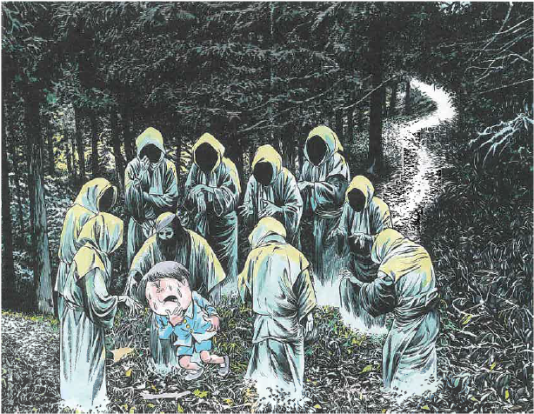
If you are walking through a mountain trail, and find yourself overcome with a sudden hunger—a soul-killing hunger that drives you to your knees like true starvation—you might need to do more than reach into your backpack for an energy bar. You might be under attack by the Hidarugami, the Hunger Gods.

What Does Hidarugami Mean?

Hidarugami is written with the katakanaヒダル (hidaru) + the kanji 神 (kami; god). Things written in katakana have no inherent meaning. However, the word “hidaru” is most likely connected with饑い (hidarui), meaning hunger. Hidarui is a colloquial term, used mainly in Gifu prefecture. Hidarugami is also sometimes writtenひだる神 using the hiragana for “hidaru,” also with no inherent meaning.

The fact that the kanji “kami” is used places the hidarugami on a higher level than most yokai, alongside such devastating deities like the Binbogami (貧乏神; God of Poverty) and Shinigami (死神; God of Death). This elevated status is due in part to arising from human spirits, from reikon.

There are other names for the Hidarutami. In Kitakyushu, it is known as the Darashi (ダラシ), in Mie and Wakayama prefectures it is sometimes called the Dari (ダリ), while in Nara and Tokushima prefectures it is called Daru (ダル). All of these use katakana for the names.

The Hunger Strike of the Hidarugami
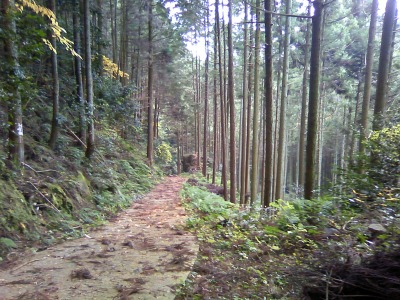
Hidarugami Road

Hidarugami are said to be the spirits of those who starved to death wandering the mountains. Because they died alone, with no marker for their grave or any ceremony, their spirits become evil and seek to share their death agonies.

They are found almost exclusively on mountain trails and passes. Hikers and travelers in the presence of the Hidarugami are suddenly overcome with acute hunger, fatigue, and numbness of the limbs. The feeling is said to be that of actual starvation. The victim is unable to move and often collapse. This attack is a form of possession. The Hidarugami enters your body. If no action is taken, the Hidarugami can cause death—actual death by starvation in a healthy body.

If you are killed, you join the Hidarugami group. In this way, Hidarugamai groups slowly enlarge to contain many souls.

Expelling the Hidarugami is easy, so long as you are prepared. Just a small mouthful of a staple food, such as rice or grain, staves off the attack and the starvation leaves as quickly as it arose. That is why—even today—hikers are advised against going into the mountains without a few riceballs or a bento to eat. Even then, they never eat the entire meal, always leaving a few grains behind in case of emergency.

Old Japanese kaidanshu and traveler’s guides are full of stories of the Hidarugami. In a story coming from 1736 a man named Senkichi was found exhausted and unconscious on a mountain trail. Unable even to speak, he was loaded into a cart and carried back to town where he was fed and recovered. Senkichi related an account of an attack by Hidarugami. Another typical story tells of a merchant crossing the Noborio Pass towards Onohara. Only a few hours after finishing his lunch he became ravenously hungry, struggling to make his way to a nearby temple. A traveler’s guide from 1861 warned of the dangers of going into the mountains without a few riceballs for protection.

Are the Hidarugami Yokai or Yurei?
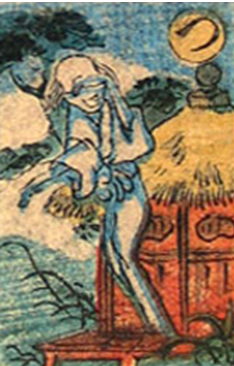
Obake_Karuta_Hidarugami

Hidarugami defy simple classification, and show the complicated nature of Japanese folklore. Are they yurei? Are they yokai? Are they Gods? Yes to all three questions. (And yes, it is a trick question as all yurei are yokai. Smart catch there!)

Because Hidarugami enter the body and possess it, they are considered a type of the Tsukimono yokai – A Possessing Thing. While most tsukimono are magical animals, anything that possess can fall into this category.

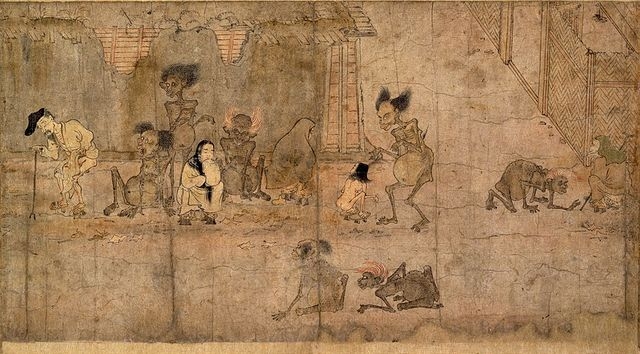
Higarugami are most definitely yurei—they are referred to as either akuryo (悪霊; Evil Spirit) or onryo (怨霊; Vengeful Spirits). But they are not typical yurei. Like Funa Yurei and oddities like the Shichinin Dōgyō – The Seven Pilgrims, the Hidarugami act as a group and actively make new members. Because they are bound to their location, they would be considered a type of jibakurei (地縛霊; Earth-bound Spirit).

Hidarugami are also muenbotoke (無縁仏). This refers to the unworshiped dead, those who die without burial or ceremony. Special rites are often held on Obon, the Festival of the Dead, specifically for muenbotoke to try and get their spirits to pass one. One passage says that the Hidarugami’s grip on the world is not particularly strong—that they are a weak god—and they should be banished by a simple muenbotoke ceremony.
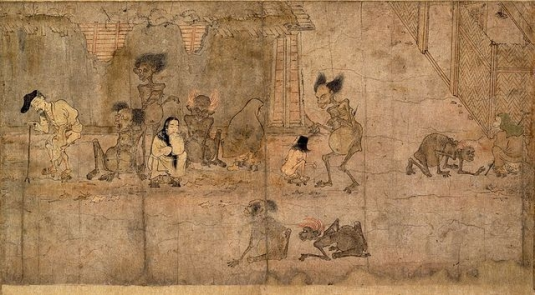
Gaki Hungry Ghosts

They are also associated with Gaki ( 餓鬼), the Preta or Hungry Ghost of Chinese and Tibetan Buddhist mythology. The association is vague and only based on the dual obsession with hunger. Gaki are those whose sins of gluttony condemn them to be reborn as foul creatures with a rapacious hunger for disgusting things such as corpses or feces. Gaki are not native to Japanese folklore, and at sometime after their importation from China a link was made between the Gaki and the Hidarugami.

Hidarugami Across Japan

Like all widespread folklore, the Hidarugami have regional variations and associations. In Wakayama prefecture, —along the ancient pilgrimage route of Kumano Kodo—there is a deep hole called the Gaki Ana, or the Gaki’s Pit. The exact location of the pit is unknown, but it is said to be someone near Mt. Okumotori and Mt. Shokumotori in Wakayama prefecture. Wherever it is, staring into the Gaki Ana is said to summon the Hidarugami.

In Shiga prefecture, possession by a Hidarugami is much more dreadful. The possessed person’s stomach suddenly swells like a starvation victim, and they begs for a bowl of rice with tea. If someone answers that they had food, but have eaten it, the possessed victim will attack with a fury, ripping open their stomachs in search of undigested bits of rice to eat.

In Mie prefecture, Hidarugami are said to attack not only humans but also cattle being moved across mountain trails.

In Kochi, Nagasaki, and Kagoshima prefectures, there are small shrines set up along mountain roads and mountain passes enshrining the kami Shibaorigami (柴折様). Making a small offering at these shrines, even something so small as laying down a few token branches of wood, is said to provide protection against the Hidarugami.

Translator’s Note:

This is the next in my series of yokai who appear in Mizuki Shigeru’s Showa: A History of Japan. A young Mizuki Shigeru encountered the Hidarugami once walking through a mountain road. He survived the attack due to finding a few stray grains of rice. It was only much later in his life while reading a book that he learned to put a name to the strange phenomenon he had encountered.

Further Reading:

To read more about Tsukimono and other sundry ghosts, check out:

Tsukimono – The Possessing Thing

Shichinin Dōgyō – The Seven Pilgrims

Funa Yurei
The Ghost of Oyuki

Maruyama_Okyo_The_Ghost_of_Oyuki

To learn much more about Japanese Ghosts, check out my book Yurei: The Japanese Ghost

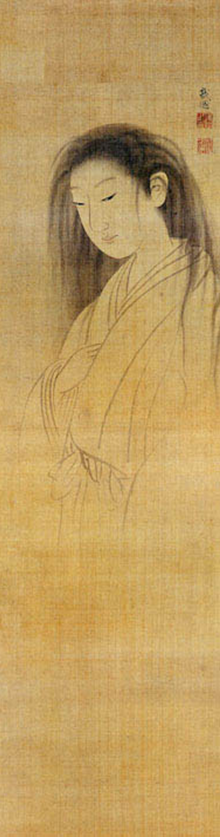
Maruyama Ōkyo opened his eyes from a fitful sleep and saw a dead woman. She was young. Beautiful. And pale. Unnaturally drained of color, her bloodless skin peeked from her loose, bone-white burial kimono. Her bleached appearance was contrasted only by the thin slits of her black eyes, and by the long, black hair that hung disheveled across her shoulders. She had no feet.

What is The Ghost of Oyuki?

The Ghost of Oyuki is without a doubt the most famous and influential Japanese ghost painting.  It is the template for the entire country’s idea of “what a ghost looks like.” The white-faced, black-haired girl in the white kimono has roots in tradition, but this image–particularly the lack of feet–comes from the brush of Maruyama Ōkyo.

Although the English title is The Ghost of Oyuki, the actual Japanese title is Yūreizu: Oyuki no Maboroshi (幽霊図(お雪の幻), which translates as Portrait of a Yurei: The Vision of Oyuki. According to a note on the scroll box, put there sometime by a former owner named Shimizu, the young artist had a mistress called Oyuki who worked as a geisha at the Tominaga geisha house in Ōtsu city in the province of Ōmi, modern-day Shiga prefecture.  Oyuki had died young, how or when the note does not say; and Ōkyo mourned her deeply.  Perhaps too deeply.

One night Maruyama awoke  and saw Oyuki hovering at the foot of his bed. She stayed there for a moment and disappeared. When she was gone, Maruyama sprang from his bed and painted Oyuki exactly has she had appeared before him.

Maruyama had a reputation as the ultimate naturalist painter—if he painted something, you could trust that he had seen it.  Because of his reputation, when Maruyama appeared with his painting and his story, the people of Japan had no doubt that this was what a yurei actually looked like. And they have been honoring that image ever since.

The Ghost of Oyuki Yomihon

The Ghost of Oyuki Chapbook

(Sorry! The Ghost of Oyuki is now sold out!!!)

The story of Maruyama Okyo and the Ghost of Oyuki is told in my yomihon chapbook from Chin Music Press. The Ghost of Oyuki is not an actual book, but a piece of “book art” commissioned from Mercuria Press in Portland, OR to support my upcoming book Yurei: The Japanese Ghost. The Ghost of Oyuki is letterpress printed and handbound in the style of an Edo period yomihon, and was produced in a limited edition of 100.

(Sorry! The Ghost of Oyuki is now sold out!!!)

Further Reading:

For more Yurei-zu, check out:

Ubume-zu – Portrait of an Ubume

Yurei-zu: A Portrait of a Yurei, a Japanese Ghost

Hokusai’s Manga Yurei

More Hokusai Manga Yurei

Shudan Borei – A Group of Ghosts


shudan borei

To learn much more about Japanese Ghosts, check out my book Yurei: The Japanese Ghost

Translated from Mizuki Shigeru’s Mujara

On July 28th, Showa 30th (1955), in a heartbreaking incident 36 junior high school girls drowned on a beach in Mie prefecture. Of the nine girls who survived the incident, five had the same story to tell.

The girls were all playing and swimming in the calm waters, enjoying the gentle lapping of the waves. Without warning, the water seemed to gather together, and a dark mass rose from the surface of the ocean. The mass took the shape of people in WWII air-raid hoods, dark in color, soaking wet and pouring water from every surface. As the mass rose, the figures become more defined, dressed in old-fashioned women’s work pants. There were hundreds of them.

The girls tried to get away, but the water seemed to be sucked up towards the dark figures, dragging the girls towards them. One of the girls who survived said she felt a hand grab her leg and try and pull her under the water. She was able to break the hands grasp and make her way to the shore, but her friends were not so lucky.

Afterwards, students who were on the beach and not in the water confirmed the story and all of its details. They saw the ghosts rising and dragging the girls under the water.

After investigating the incident, it was discovered that exactly ten years before the incident, U.S. aircraft had firebombed that area, killing around 250 people. The bodies were not cremated, but were piled without ceremony into a mass grave on that beach. In this way one tragedy became two tragedies, as the ghosts of the war dead rose up again.

Translator Note:

The kanji for this is集団 (shudan, meaning “group” or “gathering”) and亡霊 (borei, which is a somewhat Gothic term for “ghost”).

This story is based on a actual event, called the Kyohaku Junior High School Drowning Incident (橋北中学校水難事件) in Japanese. The school had gone to the beach as their annual excursion, and as swimming practice for the girls. At the time, swimming had been added to the official school curriculum, but as the school had no pool swimming practice was held in the nearby, usually calm ocean.

The school principle and teachers were arrested and charged with negligence—the school was short-handed and had not brought along the required number of adult observers, and parents claimed their children were not yet strong enough swimmers to be unsupervised in the ocean. Ultimately, they were found not-guilty and cleared of charges. The girls’ deaths were ruled a mysterious, unfortunate accident. A pool was quickly built for the school, and the students no longer practice swimming in the ocean.

Observers reported a sudden swelling of the waves and a rise in the water level that drowned the girls. Of the nine surviving girls, five reported a sensation of pulling on their legs, as if the sand was sucking down on their feet, holding them down while the water rose. Several also reported seeing the dark shape of women in air-raid hoods rising from the water.

In 1956, the Ise Newspaper reported on the story of the war dead buried on the beach, noting that most of the dead had been refugees and were thus buried without name or ceremony. In 1963, one of the girls published an article in a Joshi Jishin magazine (Women’s Own Stories) called “How I survived an Encounter with a Ghost” that further spread the supernatural origin of the drowning.

Several scientific explanations have been offered for the sudden swelling of the water based on the geographical features of the beach, along the supernatural one. It is clear Mizuki Shigeru prefers the supernatural explanation.

The beach remains off-limits for swimmers. A year after the incident, a shrine was raised on the location, and a statue called the Goddess of Protecting Swimmers in the Ocean was placed on the beach as a memorial.

Further Reading:

For more tales of haunted oceans, read:

Umi Bozu – The Sea Monk

Funa Yurei – The Boat Ghosts

Nure Onnago – The Soaked Woman

Previous Older Entries Next Newer Entries

Copyright notification

All translations and other writing on this website were created by Zack Davisson and are copyright to him.

Copyright notification

In accessing these web pages, you agree that any downloading of content is for personal, non-commercial reference only.

No part of this web site may be reproduced or transmitted in any form or by any means, electronic, mechanical, photocopying, recording or otherwise, without prior permission of Zack Davisson.

Copyright notification

For rights clearance please contact Zack at:

zack.davisson (at) gmail.com

Thank you.