The Speaking Skull

Translated from Nihon no Yurei Banashi

The Man who materialized before the Temple Gate

This is a tale that comes from about 1300 AD.   There was a temple in Nara prefecture called Kanko-ji, where lived a monk named Doutou.  Doutou had come from Koma province (modern day of northern Chosen peninsula), and was a very tender-hearted and compassionate person.  He noted one day that travelers had difficulty crossing the Uji river due to lack of a bridge, and so he supplied the funds from his personal savings to build a bridge for everyone’s use.  Acts such as this earned Doutou the respect and honor of everyone who knew him.

One day, Doutou was walking through the valley of Mt. Nara with his disciple Manryo.  Quite by accident while glancing on the wayside, he saw a skull that had tumbled down from somewhere.  The skull seemed to have had a hard time, being covered in mud and looking like it had been kicked around by travelers on the road. There was very little meat left clinging to the bone, and then only in small places.  Doutou felt very sorry for the poor skull, and turned around to talk to his disciple Manryo.

“Look at this poor skull, of nobody knows who.  People have been picking on it even when it is dead.  In order to protect it from this shameless behavior, the least we can do is place it in some tree away from trampling feet.”

As his mastered commanded, Manryo took the skull high up into a tree away from where it would be seen, and covered it with some branches to keep it hidden.

This happened on the evening of the closing of the year.

Soon after, a man appeared before the gates of Kanko-ji, asking to be shown inside.

“I have humbly come down from the mountains, with a request to see the one they call Manryo with my own eyes.  Could you please bring me before him?”

The man was infallibly polite in his greeting and manners, so the young man tending the gate guided him to Manryo.

Though Manryo had never seen the man before, his face had an odd familiarity about it.  This is what the man said:

“I am a man who is deeply indebted to you.  You have done me a tremendous service, and now I would like to return your generosity.  Although I have brought nothing with me now, I beg of you to return with me to my home so that I may properly repay you.”

For his part, Manryo did not understand at all.  However, because the petitioner had come with such heartfelt enthusiasm, he felt that the man must be telling the truth.

“How could I deny such a request from one so earnest?  I will come with you to your home.”

There was nothing for Manryo to do except for to accompany the man out of the temple gates.

A crime revealed

When he arrived at the man’s house, Manryo was presented with a dazzling feast.

“Please, please…take only your favorites, and lots of them!  Please!”

While saying this, the man began to enthusiastically gorge himself.  Manryo still wondered what he had done to deserve such rich rewards, but when he asked the man how exactly he had been of service, the man was quick to shut Manryo up by shoving delicious delicacies at him.  There seemed to be no end to the offered morsels.

Manryo, still a young man and given to worldly pleasures, was unable to resist.

“Alright, I will hear the reason later.  For now, I will simply enjoy the proffered feast!”

With that decided, Manryo dug into the food with as much enthusiasm as his mysterious companion.  Never in his life had he tasted such delicious foods, and he was eager to try them all.  Between the two of them, empty plates piled up like a mountain.

Eventually, enthusiasm gave way to physics as Manryo could stuff no more food into his eager body.  Thinking to relax, he was startled as he saw the man’s face suddenly turn a violent shade.

“Honored Manryo!  My brother who murdered me has just arrived!  There is no time to hesitate.  We must flee from here!  Come with me!”

Hearing this, Manryo was shocked out of his pleasant repose.

“What? What exactly are you saying?”

His voice trembling, the man answered.

“Many years ago my brother and I had a business together. From that business I was able to save 30 kin of gold (about 18 kilograms).  My brother himself saved nothing, and thought it easier to kill me one night and steal my 30 kin of gold.  For the longest time my body rotted in the forest, until nothing was left of me but my skull.  People walking along the road who saw me would only kick my skull out of the way like an inconvenience. It was terrible. But then, beyond all hope you came along and lifted me up from the dirt and saved me from my fate.”

“I thought about how I could possibly repay such a kindness, and so I came to your temple this evening to invite you to my house for this feast.”

To say that Manryo was surprised by this confession would be a gross understatement.  But even in his panic and confusion he realized that being caught in this house by the murderous brother was undesirable, and so he jumped to his feet.  But he was too slow in trying to escape, and he heard the door creak open and someone enter the house.

The shock was too much for him, and Manryo froze in fright.

The person at the door, however, was not the feared brother but instead the brother’s son accompanied by their mother.  She saw Manryo standing rigidly in her living room and shouted in fear.

“Ahhh!!! A monk! Why are you here inside my house!”

Manryo let the story he had just heard poor out in every detail.  He turned back to look over his shoulder and get confirmation from the man who had led him to this house, only to see nothing.

The mother listened to Manryo’s story with as much shock as Manryo had.  It was nothing like what she had heard before.   The mother was very angry towards her son who had killed his younger brother.  She looked down at the brother’s son and told him in her strictest voice.

“Your father is a terrible person!  You must pray for the spirit of your murdered uncle, and apologize for your father’s crime!”

The young boy did as he was directed, and removed his father from his heart to be replaced by honored instead his uncle who had been good and kind.

This story comes from the “Nihon Ryoiki,” Japan’s oldest collection of folktales and legends. That folktale collection was written in the 13th year of Konin (822 AD), and is mostly a collection didactic tales for teaching Buddhism.
The Yurei Child

Translated from Edo Tokyo Kaii Hyakumonogatari

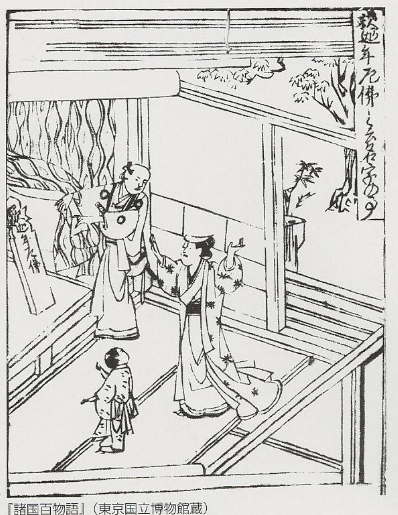
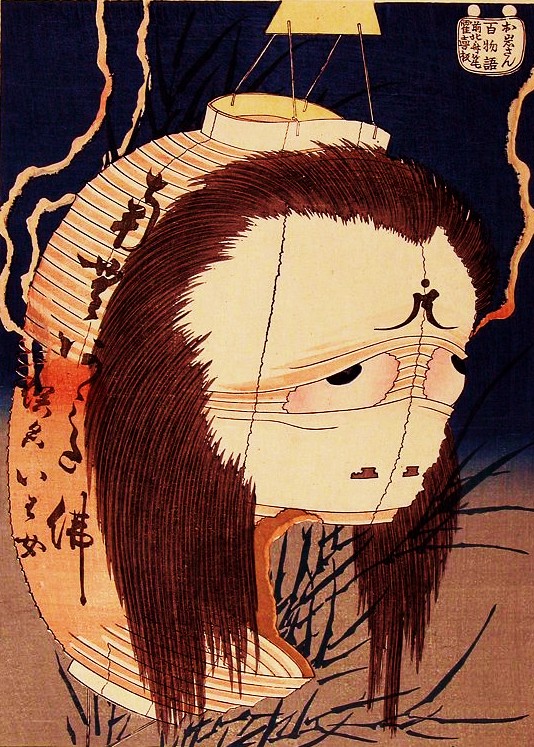
In Edo, in the vicinity of Nipponbashi (modern day Tokyo), there was an important shopkeeper named Kenhei.  Every year Kenhei would make a trip to Kyoto to buy stock for his store, always buying from the same seller, a widow women living with her daughter.  This daughter had stolen the heart of Kenhei, and she had no plans to give it back.  So, with the consent of the mother, they were pledged.

In the following days Kenhei said:

“I am a man of Edo, and so it is my wish to move our family to Edo where we can live out our days in ease.  I will return first and make the necessary preparations, then come and collect you.  What do you think?”

The daughter was pleased, and answered:

“I know that we have not yet the money to move, so we will wait for you here in Kyoto.  By the time you come again next year, we will be ready to go and live with you in Edo.”

With this pledge, Kenhei returned happily to Edo.  But on the trip back, he became terribly ill and unable to work.   The daughter was unaware of this and waited patiently for Kenhei to come and collect her and bring her to Edo to live together.  When the promised day came and went, she thought she had been betrayed and was overcome by sadness.  Such was her grief that she died.

Kenhei, still in Edo, believed that the daughter was waiting for him in Kyoto.  Just as he was wondering what she was doing now, he heard a voice:

“Is this the residence of Kenhei?”

Kenhei was overcome with happiness.

“What are you doing here in Edo?  This is fantastic!”

They both wept profusely.  But the daughter was bitter with her accusations at Kenhei for not keeping his promise.

Kenhei explained to her about his illness and why he had been unable to keep his promise.  At length he soothed her anger and brought her into his house, where she was introduced as his wife.

When the daughter said:

“And now we must bring my mother to Edo as well.”

Kenhei replied:

“Sadly, I still lack the money and she must wait another two or three years.”

During that time, the daughter, now Kenhei’s wife, became pregnant and gave birth to a boy as round as a ball.

When the boy was three years old, Kenhei went as promised to Kyoto to bring back the mother.  He went to their familiar house where the old widow was pleased to see him again.

She cried while saying:

“Well, well.  This is an unexpected reunion!  It has been three years since my daughter died while waiting for you to come and collect here.  Since she passed away I have had no one to rely on.  I have just lived an empty life here by myself, without compassion or sympathy of others, and here suddenly from Edo is that man who I thought had abandoned us long ago!”

Kenhei was shocked by this:

“What is it you are saying?  You daughter came to my house three years ago, and even now our three year old child is in our house.  Your grandson!”

With this the mother went into the back room where the family altar was kept, removed the mortuary tablet of her daughter.

“Your love for my daughter must have been so great as to call her back so she could live with you for those three years.”

Pulling it from her breast pocket, the mother showed the mortuary tablet to Kenhei.  The daughter’s name was written clearly on it in brush, along with the name of the blessed Buddha.    Kenhei broke down in tears, and after performing the proper funerary rights he brought the mother home with him to live together in Edo.

The child born to Kenhei and his ghostly bride grew up, and he became admired for his great wisdom and gentility by everyone in the province.

The Yurei of Kobata Heiji

Translated from Edo no Kimyou no Hyakumonogatari

It is said that there are no monsters or bakemono from Hakone town, but even here one can feel the mysterious touch of the yurei.

One night, Bando Hikosaburo was walking home, a kyogen play he had heard over the summer running around in his head, when he saw something frightening.  Holding a lantern casting a dim illumination on the scene that was neither dark nor light, a pale blue figure stood before him like some vision.

“I am the yurei of Kobata Heiji.  Those who look upon me and hear my story will endure neither fear, nor my wrath, nor any disturbing thoughts. 

It has been almost two ages since Itoe Shoroku took pity on my suffering spirit and performed a memorial service in my honor.  Still, it brings be pleasure to again stride the stage of this world from time to time.”

With that said, the Yurei suddenly vanished. 

This took place in the 13th year of Bunmei (1830) at the closing of summer.

The Speaking Futon

Translated from Nihon no Obake Banashi

Long ago, in the town of Totori, a shopkeeper opened a small inn.  The inn welcomed its first customer on a cold winter’s night.

 “Welcome my guest, and please spend the night comfortably.  Help yourself to our bedding and futons!”

 The proprietor thus led the guest to his room.

 The exhausted lodger fell quickly into the offered futon, and was soon asleep.  However, in the middle of the night he was awakened by someone’s voice.

 “Older brother…you must be cold.”

 “Little brother, you must be cold too…”

 The voice, little more than a whisper, was a child’s voice.

 “Huh.  There are no kids in this room…that must be coming from one of the neighboring rooms…”

 “But still…at this hour it is awfully rude for someone to be talking and keeping the other guests awake.”

 The lodger made a purposeful show of loudly clearing his throat.  The child’s voice stopped exactly at that time.

 With a sigh of satisfaction, the lodger once again began to settle into sleep.  But just as he was on the verge of sleep, the child’s voice was heard again, this time whispering directly into his ear.

 “Older brother…you must be cold.”

 “Little brother, you must be cold too…”

 It was a sad voice.  The lodger sprang from his futon and hurriedly lit the nearby paper lantern.

 There was no one in the room.  He check the adjoining room, and there was no one their either.  Leaving the paper lantern lit, the lodger lay down yet again.  And again he heard the voice, coming from the base of his pillow.

 “Older brother…you must be cold.”

 “Little brother, you must be cold too…”

 Again it was the sad child’s voice.

 A chill went down the lodger’s spine.  Yet he summoned up his courage and tried to pinpoint the source of his voice.  He could hear it coming from his futon.   The bed covering was speaking to him.

 The lodger fled terrified from the room. Waking the proprietor, he told him the whole story of the haunted futon.

 “What are you talking about?  My inn has only opened today.  And I certainly don’t have any haunted futons.  You must be very tired for your mind to be playing tricks on you.”

The proprietor would simply not believe the story.  And as for the lodger, he had already paid and there was nothing to be done about it.  The proprietor stuck out his belly and would not be budged.

 “Yah…this is a bad omen.  My first day of business and my first customer is like this…”

 However, the following day another lodger stayed in the same room, and had the same story to tell the proprietor about the haunted futon.

 “Now this is a strange thing indeed.  To have two customers report the same thing…I am going to have to look into this…”

 The proprietor was still unbelieving, but he went into the room and put his head next to the futon.  Sure enough, he could soon hear a child’s voice crying:

 Shocked as he was, the proprietor still investigated the mysterious voice and found that it was coming from only a single bed-cover futon used as a blanket.

 “So you are the offending futon?  Why do you say what you say?”

 The next day the proprietor went to the dealer in used clothing and bedding from whom he had purchased the futon.

 “Actually,  before I sold it to you I bought this futon from another used store…”

 And so the dealer in used goods told the proprietor of the inn where he had the futon.  The proprietor hurriedly went to that shop where he heard the story.

 Not so long ago, there a poverty-stricken family of four lived in the town of Totori.  Their father had died of illness, followed by their mother, leaving only the 6- and 4-year old brothers.  The brothers had no family or friends to look after them.  They sold all of their household goods for food, including their mother and father’s kimonos and their hibachi stove.  But because their house was poor, the items they could sell were soon gone, and they had nothing left but a single futon blanket.

 Before long, winter came and the snow fell.  The two brothers had nothing and stayed in a deserted house growing weaker and weaker. Wrapped together in the single futon blanket, they shivered in the cold.  At night they tried to sleep, but the bitter cold would keep them awake

 “Older brother…you must be cold.”

 The kind little brother tried to give the entire futon blanket to his older brother.

 “Little brother, you must be cold too…”

 But the older brother refused and covered his little brother with the futon instead.

 The two passed the night this way, attempting to give the entire futon to their freezing bother.  And that passed another night this way, and then another. How often could they perform this ritual?

 In time, the coldhearted landlord of the house came calling, and unable to pay the rent the brothers were thrown from the house.  The landlord even tore the futon blanket from them as payment for their debt.

 That night there was a terrible snow storm.

 Having not eaten for many days, the brothers succumbed to their hunger and the cold.  Under the stoop of a nearby house they were found dead, still clinging to each other.

 “The poor dears…the poor little dears…”

 Thinking this, the neighbors buried them in a small grave near the temple of Kannon the deity of mercy.

 The proprietor of the inn, hearing this story brought the futon blanket to the temple of Kannon where the two brothers were buried.  The Buddhist monk of the temple prayed for them and held a memorial service for them.

 From then, the futon was never heard to speak again.

This melancholy tale comes from Tottori , next to Shimane prefecture, and was included in the collection of legends known as “Inbaku Densetsu Shu.”  It was made famous by Koizumi Yakumo, also known as Lafcadio Hearn.

The Severed Heads Hanging in the Fowling Net


Translated from Nihon no Yurei Banashi

The Thrush Bird

At the Western base of Noriguchidake in the Japanese Alps there is a picturesque plateau.  All through-out this plateau are scattered small lakes filled with sky-blue water.

In the olden days, the road from Shinshu (modern day Nagano prefecture) to Hida (modern day Gifu prefecture) wound along this plateau linking lake to lake.  However, because fearsome things were known to happen along this route people referred to it as the “Road of the Dead.”

It has been two hundred years since this story was first told.  Sitting near the base of this plateau was a small village, where lived a peasant named Heitaro.  His greatest love was hunting the birds and beasts of the wild, and with the coming of winter Heitaro would venture forth with his fowling net and bow and arrow without fail.

“Today, if luck is with me, I will bring down a thrush!”

Heitaro spread out his great fowling net right in the open plains of the Road of the Dead, and waited for an unknowing thrush to fly into it.

At this time, it was still in the early hours of morning.  The white fog was thick, covering the ground and limiting visibility.  Heitaro crouched silently, hidden in the lee of a nearby tree and patiently smoked a cigarette.  After awhile, he heard a loud voice coming from the vicinity of his fowling net.

“Get that Heitaro!  Get that Heitaro!”

Heitaro could hear someone yelling this.

“Eh? What is that?”

Heitaro peered into the fog from between the branches of his hiding place.

“What the…?

Taken aback, Heitaro held his breath and began to shudder with fear.  The voice was coming from something unspeakably terrible.

Caught in his fowling net, lined up in a row, were several severed heads of dead men. And what’s more the heads were screaming:

“Get that Heitaro!  We are going to get that Heitaro!!!”

At any minute it looked liked the heads would free themselves and coming flying towards Heitaro.

Heitaro was too frightened to speak, and quickly dove into an open cavern in a nearby rock formation where he lay shivering. Because the severed heads might be able to come down the same opening that Heitaro had entered, he closed up the hole with another rock.

But he could still hear the terrible voices screaming:

“Get that Heitaro!  Get that Heitaro!”

In time, the dense fog that enveloped the scene began to dissipate, and along with the thinning of the fog Heitaro could no longer hear the voices.

The Dead among the Fog


“Now is the time to make my escape”

Heitaro made no move to gather up his fowling net.  Leaving everything behind, he started to run for his village at the base of the plateau.

As he was fleeing, however, again the thick white fog began to gather around the ground until Heitaro could longer see even those things right in front of his eyes. 

“Ahhh!  This is bad…this is bad…anything could happen in weather like this…”

Thinking this to himself, a long shiver ran along his spine. 

He found himself standing along one of the small lakes that decorated the plateau.  From the lake he could hear certain sounds:

“Slurp.  Slurp.”

It was clearly the sound of someone drinking from the water. Heitaro could also hear the sound of something moving along the ground like a worm.

Fearfully, he tried to search through the fog for the source of the sound…

“Ah!”

Heitaro screamed loudly, when he saw the ghastly blue colored things rolling around on the ground.  Drinking the water, dressed in white kimonos where the yurei of dead men.   And there were many of them!  Clinging to the banks of the lake they were pushing each other out of the way to drink from the blue water.

“O…oh no!”

Wanting desperately to flee, Heitaro turned to run but his legs where knocking together with terror and his feet wouldn’t move.  And it was here that Heitaro was seen.

“Heitaro!  We have been waiting for you!”

In a blind panic, Heitaro drug his unmoving feet finally breaking into a run.  Blindly he fled across the plateau until somehow or other he arrived at his village. But all was not well, as Heitaro could no longer go hunting and in time fell ill and succumbed to his bed.

When news of this affair reached the people of the village, they said:

“Is that so…things like really do happen?  I guess what they say about that road is true.  It really is the Road of the Dead.  A place where you go hunting for thrush and catch severed heads”

From that time forth and for a long time after, no one passed again along that route.

This legend is of the “Haunted Forest”-type, and is common amongst yurei tales. These same types of mysterious stories can be found in almost every area, with only the details changed to accommodate the local setting.

Previous Older Entries Next Newer Entries

Copyright notification

All translations and other writing on this website were created by Zack Davisson and are copyright to him.

Copyright notification

In accessing these web pages, you agree that any downloading of content is for personal, non-commercial reference only.

No part of this web site may be reproduced or transmitted in any form or by any means, electronic, mechanical, photocopying, recording or otherwise, without prior permission of Zack Davisson.

Copyright notification

For rights clearance please contact Zack at:

zack.davisson (at) gmail.com

Thank you.