Nazo no Tokkuri – The Enigmatic Sake Bottle

Translated from Edo Tokyo Kaii Hyakumonogatari

In July 28th, in the seventh year of Kaei (1854), a sake seller plied his trade between the Kamakura riverbanks and the lower valley. On that day, an old monk of about sixty years of age came to the sake dealer, bearing a small sake bottle that could hold no more than three or four swallows. “Please fill this with three masu (about three cups) of sake” the monk said. Now, there was absolutely no way three masu of sake would fit in the old monk’s bottle. The young sake seller was suspicious of some trick, but he did his job dutifuly and smoothly poured the three masu into the small bottle. Much to his surprise and wonder, the sake bottle held the volume.

The monk readily paid for three masu of sake, then went on his way. Overcome by the enigma of the sake bottle, the young sake seller silently followed the monk. He followed the monk to a temple in the Jinai area of Asakusa, and crouched by the Yadaijin statue near the front gate.

“Why have you followed me here?” the monk said in a reproachful.

“Because I have never seen such a mysterious thing in my life as your sake bottle.” the young sake seller answered.

“There is no mystery,” came the voice. “I am a servant of the goddess Kannon, and I have something to tell you. This year, at the closing of the month of July, a terrible illness will ravage the land. You will want to flee to safety, but instead you must make peony rice cakes and eat them for the rest of this month. Go home quickly and tell the people of your house!”

With that said, the monk vanished.

The young sake seller ran home as fast as he could and told his master what he had seen and heard. The people of the house did as the monk said and ate the peony cakes, and when the sickness came not one of them fell ill.

There is another example of this kind of story.

Tales are told of the tengu of Ohira mountain. This is one of them.

In Ohiru mountain, in the country of Dewa (Modern day Yamagata prefecture), an old man came into a sake dealers shop. The old man was carrying a sake bottle, but ordered only a single spoonful of sake. To the sake dealer’s surprise, the sake bottle was filled to the brim by that one spoon. He decided to follow the old man, and learn the secret behind his magical bottle.

Following him into the mountains, the old man showed his true form as the tengu of the mountain, and prophesied both a rich harvest and a terrible disease for the coming year. If the old man wanted to escape the ravages of disease, then he must take an image of the tengu to a temple and place it before for the gates and pray to it.

The old man did as he was told.

Kimodameshi – The Test of Courage

Translated and sourced from Japanese wikipedia and other sources

Are you brave enough? That is the question that will be answered by playing kimodameshi, the Japanese test of courage. You will have to walk a dark, lonely path to a haunted location and set down your token to prove that you had been there.

The Meaning of Kimodameshi

Kimodameshi (肝試し) is most often translated into English as Test of Courage, which is not literally accurate. The word kimo (肝) actually refers to the liver, while dameshi (試し) does in fact mean “test.” In Japan the liver is associated with courage—for example kimo ga suwaru, or to sit on your liver, means to be brave or self-assured. So a more literal translation of kimodameshi would be to “prove your guts.”

The History of Kimodameshi

Like most folkloric practices, the factual origin of kimodameshi is lost to legend. But there are two possible beginnings, both of which could be equally true.

In the closing years of the Heian Period, during the reign of Emperor Shirakawa (1073 to 1087), the book “O-kagami” (大鏡; “Great Mirror”) was written by an unknown author. In the book was a story of three sons of Fujiwara Kaneie. One night during the Hour of the Ox (around 3 A.M.), the sons dared each other to go to a nearby house that was known to be the home of an oni. Only the son who was the leader of the martial arts school was brave enough to take up the challenge, and as proof of his courage he used his sword to slice a chip from the lintel of the house which he brought back to show the others.

Whether the story of the sons of Fujiwara Kaneie is true or not is unknown, but it is also said that kimodameshi began as a way for those of the samurai class to condition their children against fear, and that the game served as a kind of training.

During the Edo period, the 100 candles game hyakumonogatari kaidankai—which this site is based on—was a form of storytelling kimodameshi. The earliest recording of this game comes from the kaidan-shu “Tonoigusa” (1660) where a group of samurai gather to test their courage by telling ghost stories one by one.

Modern Kimodameshi

There are no set rules to kimodameshi, and there are as many variations as there are people who play it. Kimodameshi can be played impromptu, with only a few friends egging each other on to go somewhere scary or haunted, or it can be an organized event with a preset course, often inside a prepared haunted house with actors playing the roles of spooks.

In its most pure version, a group chooses a destination, one guaranteed to inspire fear. Common examples are dark forests, grave yards, Shinto shrines, abandoned buildings, or known haunted and mysterious spaces called shinrei spots. Challengers can go alone or as a duo. They go to the chosen spot at night, to ensure maximum fear, and they either bring something back to prove that they had gone the distance, or leave some sort of token that can be recovered the next day.

Like all Japanese ghost traditions, kimodameshi traditionally takes place in the summer. In Japan, summer is when the land of the living is thought to intersect with the land of the dead, and it is the time when yokai and yurei come out to play. All organized haunted house kimodameshi will take place during the summertime. It isn’t unusual to see TV celebrities during the summer being filmed walking through a haunted house or to some famous location in a game of kimodameshi.

There are some legal issues with kimodameshi. When an abandoned building becomes a popular spot, the police have been known to set up stings to arrest trespassers. Some of the locations themselves are dangerous, such as long, dark tunnels on country roads where a car can come through at any time.

School Kimodameshi

Many Japanese people experience kimodameshi when they are young, in Elementary or Junior High School. The game is played when the children go on school camping trips, or sometimes at school during school festivals. When played with school children, the game is a set-up.

In order to keep them safe, and still provide a good scare, the location is scouted before hand and scary objects like skulls and horror-props are planted along the way. Teachers and other volunteers dress in ghost costumes and hide along the path to spring out at the children. All of the students are told a scary story about that particular location, then sent off in groups to prove their guts once the Sun has gone down.

Students can also create their own kimodameshi events at school during school festivals. They dress up in costumes and turn one of the classrooms into a haunted house for other students to enter and test their courage.

Kappa to Shirikodama – Kappa and the Small Anus Ball

Translated and adapted from Mizuki Shigeru’s Mujara and other sources

To learn much more about Japanese Ghosts, check out my book Yurei: The Japanese Ghost

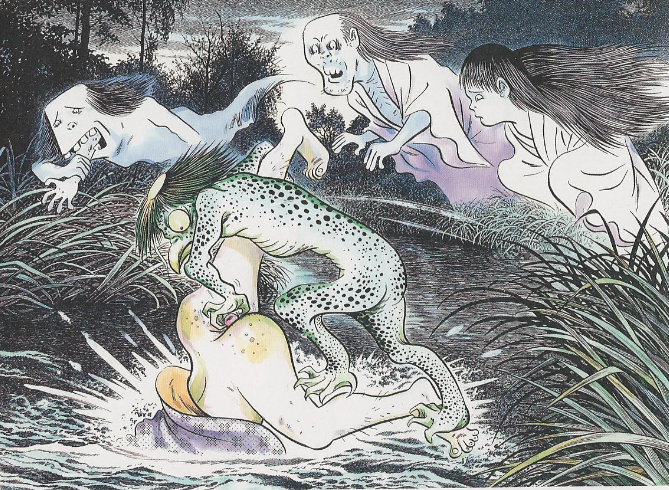
You have a magical ball in your butt, and kappa want it.

At least that is how the story goes. Although modern kappa are often portrayed as cute and mostly harmless, during the Edo period they were monsters who had a particularly vicious method of killing their victims. In probably one of the strangest bits of Japanese folklore, it is said that human beings have something in their body called a shirikodama (尻子玉), which translates literally as “small anus ball.” The ball is nestled either immediately inside the anus, or deeper inside the intestines or the stomach. The kappa have a preferred method of extraction.

Folklorist/manga artist Mizuki Shigeru wrote:

“Ever since I was a child I heard that I had to be careful in the water because the kappa would try and take my shirikodama. It was said that in the water, a kappa would come from below, extend an arm upwards and stick a hand up your anus to extract the ball.”

In some stories, the kappa don’t reach up with their hands but instead actually suck the shirikodama from the body. However it was taken, the person whose shirikodama was extracted from was almost always killed in the process. Usually the kappa would hold them underwater to drown them first, before taking the ball.

What is a Shirikodama?

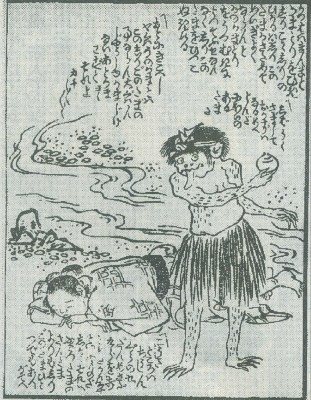
No one really agrees on what the shirikodama is. Some say that it is the human soul, hardened into physical form. Some say that the shirikodama in pictures resembles the Buddhist Hojo, or wish-granting jewel. The hojo was onion-shaped, with a round body and a tapered top. The usual depiction of the shirikodama does indeed resemble this shape.

Many associate the shirikodama with the liver. Kappa were known to love human livers, and some say that the shirikodama was the liver, or that the ball was blocking access to the liver with the liver being the actual target for the kappa.

Why Do They Want It?

Again, no one really knows for sure. The most basic explanation is that kappa consider the shirikodama to be a delicious delicacy and that they eat it as soon as it is removed. This explanations is contradicted by some Edo era depictions such as the one by Jippensha Ikku that shows a kappa with a freshly extracted shirikodama holding it far away from his face and clearly disgusted with the item. The shirikodama was said to smell as bad as the anus it was removed from.

In one story, it was said that the kappa paid the shirikodama as a sort of tribute and tax to the Dragon King who lived under the sea and was the lord of all things under the water. What the Dragon King would want with such an item no one has dared to guess.

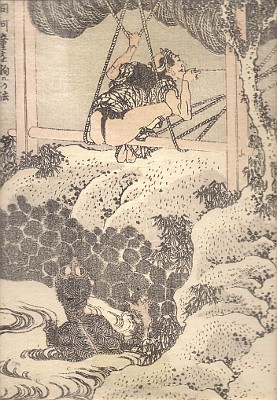
But they did want it. A humorous print by Hokusai Katsushika called “How to Fish for Kappa” (Onajiku kappa-wo tsuru no hō ; 同河童を釣るの法) shows a man using his own backside as bait to lure a kappa in to be caught with a net.

The Origin of the Shirikodama

The most commonly accepted origin is that drowning victims often have an open or extended anus, looking as if something was taken out of it. Bodies that had drowned in the river or ocean and then washed up on shore might have looked as if something had been forcibly extracted from the anus.

With kappa moving further and further way from their role as monsters in Japan, the legend of the shirikodama is on its way to being forgotten. Kappa have been recast in Japan as being friendly mascots of various companies or harmless characters on children’s cartoons. In movies like the popular “My Summer Vacation with Coo the Kappa,” the cute little kappa Coo never once sneaks up on its human friend Koichi to forcibly remove a magical ball from his anus.

Further Reading:

Check out other kappa tales from hyakumonogatari.com:

The Appearance of a Kappa

Do Kappa Really Exist?

The Kappa of Mikawa-cho

The One-Armed Kappa

Enju no Jashin – The Evil God in the Pagoda Tree

Translated from Mizuki Shigeru’s Mujyara

Long ago in Koshu (Modern day Yamanashi prefecture), on the base of Mt. Minobu, there was a dark forest where great trees lined up in a row. Inside the forest was an ancient Japanese Pagoda Tree. The tree was worshiped as a spirit, and a shrine had been built near the tree. However, anyone who passed by that tree after sundown had to leave an offering of silver and gold, or fine clothing, or anything of monetary value. Those who ignored this custom would suffer a terrifying curse. Now, I say that the tree was a spirit, but those in the town called it the mori no jyashin, the Evil God of the Forest.

At one time, a poor but hardworking farmer heard that his mother was dreadfully ill. He fled back home to see her, but the quickest path to her house took him right in front of the tree, and he had nothing to leave as an offering. There was nothing to be done, and as the famer rushed by the tree he prayed to the evil god, making a promise that he would come back later with an appeasement. But from the tree an empty suit of armor appeared and followed the man. The farmer dropped to the ground, bowing his head against the ground and begging the evil god for forgiveness. Appearing to accept the promise, the armor disappeared.

The following day, because the farmer terribly poor, he could only muster 500 mon in coins for an offering. Apparently this amount did not please the evil god, who cast the farmer into a giant pot and set him to fire preparing to make a dinner of him. The farmer prayed most solemnly for his life, and his prayers were heard. The son of the diety Fudo Myo appeared, and dispensed with the evil god. Not only that, all of the money and goods that had been paid to the evil god by the village was returned.

Although the villagers called the entity in the tree a spirit, I think it is more likely that some kind of yokai had settled down there.

Translator’s Note:

The name of this story is Enju no Jashin (槐の邪神). The enjyu tree is a species called Sophora japonica, and is known in English as either the Japanese Pagoda Tree or the Chinese Scholar.

Further Reading:

Check out other magical tree tales from hyakumonogatari.com:

Ochiba Naki Shii – The Chinkapin Tree of Unfallen Leaves

Tsugaru no Taiko – The Taiko of Tsugaru

Translated and adapted from Japanese Wikipedia and other sources

This is a story from the Edo period.

In Honjo, in Hirosagi-han fiefdom, a Daimyo of the house of Tsugaru had his mansion. Daimyo’s have two mansions, the kami-yashiki, where they live during their year of residence in Edo, and their shimo-yashiki in their native land. This mansion we are speaking of was the Daimyo’s kami-yashiki.

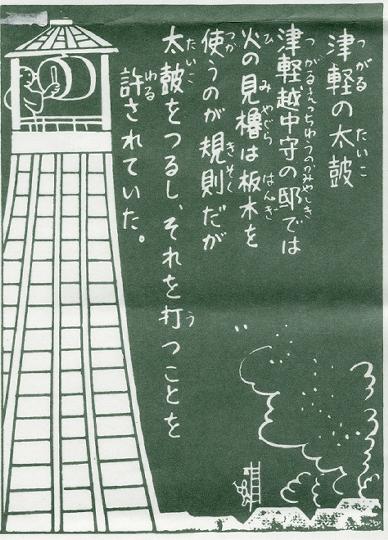
At this Daimyo’s kami-yashiki, there was a tall observation tower that was used for fire-spotting. Fire was the bitter enemy of Edo period Japan, and these towers were a common site. You are probably familiar with them from the roll of a fire tower in the tale of the 47 Ronin. Aside from being high enough to spot any sign of smoke or fire, they were equipped with a large shaped piece of wood, called a bangi, suspended by ropes from the roof. Whenever a fire was seen, the bangi would be loudly struck as an alarm to summon the fire brigade.

The mystery of the Tsugaru tower was that, when the alarm was raised, instead of the usual clack of a bangi the deep booming of a taiko drum would come from the tower.

The townsfolk’s explanation of the mystery varied. Some said that the tower had a bangi like all the others, but that when struck the bangi sounded exactly like a taiko drum. They said that the bangi had come from a tree that was used to make a taiko, or that the bangi itself had once been part of a taiko, but this was just idle talk.

There are some who say that the Taiko of Tsugaru was even less mysterious. They say that, instead of a bangi, the tower of Tsugaru simply had a large taiko drum. The reason for the drum, they said, was that because the fire tower was on a Daimyo’s kami-yashiki, the Daimyo’s didn’t want to use a bangi like everyone else. He just had to be different.

Like all of the Seven Wonders of Honjo, the Taiko of Tsugaru was incorporated into Rakugo performances. However, due to the story’s lack of true mystery, it is the wonder most often omitted.

Translator’s Note:
The Taiko of Tsugaru,  Tsugaru no Taiko (津軽の太鼓), is one of the Honjo Nana Fushigi (本所七不思議) meaning one of the Seven Wonders of Honjo.

Previous Older Entries Next Newer Entries

Copyright notification

All translations and other writing on this website were created by Zack Davisson and are copyright to him.

Copyright notification

In accessing these web pages, you agree that any downloading of content is for personal, non-commercial reference only.

No part of this web site may be reproduced or transmitted in any form or by any means, electronic, mechanical, photocopying, recording or otherwise, without prior permission of Zack Davisson.

Copyright notification

For rights clearance please contact Zack at:

zack.davisson (at) gmail.com

Thank you.