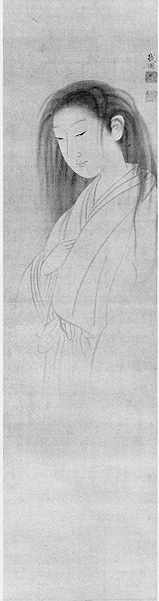
Ochiba Naki Shii – The Chinkapin Tree of Unfallen Leaves

Translated and adapted from Japanese Wikipedia and other sources

This is a story from the Edo period.

In Honjo, in the Hiradoshinden-han fiefdom, in the house of Matsura, there stood a Daimyo’s mansion. More than a simple mansion, this was the Daimyo’s kami-yashiki, where the Daimyo lived during his year in residence in Edo by edict of the Shogun. The Daimyo’s shimo-yashiki was in his native land, but the Daimyo currently resided in Edo.

This kami-yashiki was bordered by a large wall, which ran parallel along the banks of what was then called the Great River, but what we now call the Sumida River of Tokyo. Planted in the Daimyo’s garden was a prodigious chinkapin tree whose leaves hung over the wall. The leaves from this tree never fell.

Now, chinkapin trees are evergreen, not deciduous, but even then at least a few of their leaves fall with the seasons. But not the tree in the Daimyo’s kami-yashiki. No one had ever seen so much as a single leaf fall from its branches.

The Daimyo’s gardener was a diligent fellow, but not even he could clean up every leaf that ever fell. This particular chikapin tree was truly a wonder. And what was the origin of this chikapin tree’s fantastic abilities? Well that is a mystery still to this day.

The Daimyo was unsettled by the tree—perhaps fearing some unknown fox power or mysterious spirits—and used his kami-yashiki as little as possible. But the fame of the tree spread until the mansion was no longer known as the Matsura house, but was locally called the Chinkapin Tree Mansion. The tree hanging over the wall near the banks of the Great River was considered an elegant scene and was popular for strolls.

When the stories of the Seven Wonders of Honjo became popular in Rakugo storytelling, the Chinkapin Tree of Unfallen Leaves was included in the ranks.

Neither the Daimyo’s mansion nor the famous chinkapin tree survive to the modern world. During the Meiji era, the territory was purchased by the Yasuda zaibatsu financial conglomerate who created a private garden called Yasuda Park. In the fifteenth year of Taisho, the Yasuda zaibatsu donated the garden as a public park. The park is now located in the Sumida ward, in the Honjo district. Like all of the Seven Wonders of Honjo, the old location of the Chinkapin Tree of Unfallen Leaves is marked with a sign and stone monument.

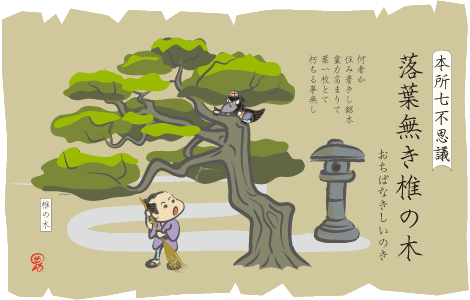
Translator’s Note:
The print is by Kobayashi Kiyochika and shows the Ochiba Naki Shii (落葉なき椎), one of the Honjo Nana Fushigi (本所七不思議) meaning one of the Seven Wonders of Honjo.
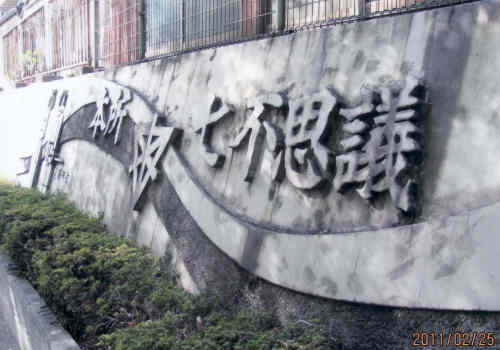
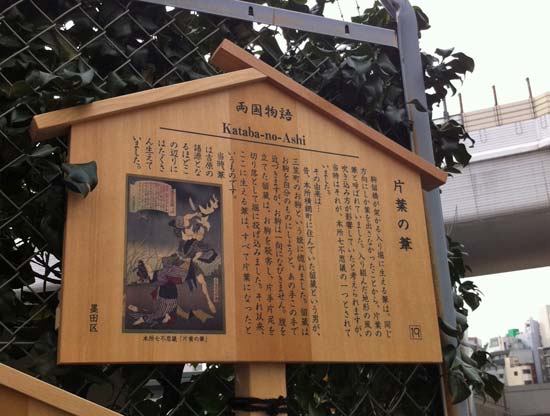
The Seven Wonders of Honjo

During the Edo period, the area known as Honjo (modern day Sumida ward in Tokyo) was a meloncholy and shadow-haunted place that drew legends about it like a cloak. Vast fields spread about Honjo, with only a few houses scattered here and there, and many a night-traveler would walk far to avoid a trip though those fields at night.

Several of the ghost legends of Honjo were collected together and called the Honjo Nanafushigi (本所七不思議), the Seven Wonders of Honjo. The number seven is purely nominal; as in many places in the world, the number seven carries mystical significance and when you are telling ghost stories the “seven wonders” sounds scarier than the “nine wonders” or “eight wonders.”
Many local places had their own collection of “seven wonders.” They form a typical model of urban legend, passed down through word of mouth, told and retold over kitchen fireplaces, then transitioning from local legend to stage performance.

The Seven Wonders of Honjo moved from the streets of Edo into the halls of Rakugo performers, who took the seven wonders on tour. In the late 1880s Utagawa Kuniteru (歌川国輝) made a series of prints called the “Honjo Nanafushigi.” In 1937, Shinko Kimura filmed “Honjo Nanafushigi” (本所七不思議), which was remade in 1957, as “Ghost Stories of Wanderer at Honjo” (怪談本所七不思議; Kaidan Honjo Nanafushigi) by Katano Goro. The films featured yokai stories and did not really focus on the authentic Seven Wonders.

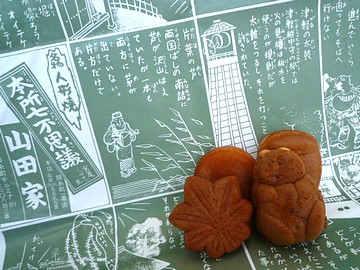
Today of course, the Seven Wonders of Honjo are largely remembered as tourist attractions.  You can buy special sweets in the shape of the seven wonders, and take walking tours of Sumida where you read all about the seven wonders on helpful tourist maps and plaques.

The Seven Wonders are:

• The “Leave it Behind” Straggler–  置行堀(Oite Kebori)
The Sending-Off Lantern 送り提灯(Okuri Chochin)
The “Following Wooden Clappers” 送り拍子木(Okuri Hyoshigi)
The Unlit Soba Shop  燈無蕎麦 (Akarinashi Soba)
The Foot Washing Mansion 足洗邸 (Ashiarai Yashiki)
The One-sided Reed 片葉の葦 (Kataba no Ashi)
The Chinkapin of Unfallen Leaves 落葉なき椎 (Ochiba Naki Shii)
The Procession of the Tanuki 狸囃子(Tanuki Bayashi)
The Taiko of Tsugaru 津軽の太鼓 (Tsugaru no Taiko)

What are Teruteru Bōzu?

teruterubouzu

Translated and sourced from Yokai Jiten and other sources.

To learn more about Japanese Ghosts, check out my book Yurei: The Japanese Ghost

Teruteru Bozu, the small tissue-paper men, are a not unusual site on overcast days in Japan. Looking exactly like the tissue-paper ghosts American children make on Halloween, they hang from the eaves of houses, each one a wish for sunny weather from a child who wants to go outside and play.

But what the children don’t know—and most likely the parents don’t know either—is that what looks like a simple folk-custom is actually a prayer to ancient Chinese gods and to one of Japan’s monster clan, the yokai called Hiyoribo.

Hiyoribo (日和坊)– The Weather Monk

SekienHiyori-bo

Hiyoribo is a legend that has been passed down for many years in Japan. He is said to come from the mountains of Hitachi-no-kuni—modern day Chiba prefecture—and his season is the summertime. Hiyoribo is said to be a yokai who brings sunny weather, and who cannot be seen on rainy days.

Toriyama Seiken illustrated the Hiyoribo in his picture-scroll “Supplement to the Hundred Demons of the Past,” and explained that this yokai was the origin of teruteru bozu. He said that when children hang up teruteru bozu and pray to them to bring sunshine into the rain, it is actually the spirit of the Hiyoribo that they are praying to.

Teruteru bozu (てるてる坊主) – The Sunshine Monk

Teruteru bozu are made from white cloth or tissue bound together with a bit of string. They are usually hung upright from the eaves of a house, and are used as talisman in the hopes that tomorrow will bring good weather.

In some areas of Japan the dolls are used by farmers on days when they hope for rain instead of sun. The dolls are are hung head-downwards and called furefure bozu or ameame bozu (both meaning roughly The Rain Monk) or ruterute bozu which is simply teruteru bozu said backwards.

And although teruteru bozu is the most common name, they are also known as teretere bozu and sometimes hiyori bozu. Researcher Miyata Noboru has found that in certain places in West Japan they are still called Hiyoribo and remembered as yokai.

Teruteru bozu appeared around the middle of the Edo period in Japan. In the book “Kiyu Shoran” (Inspection of Diversions) the author writes of the custom that if the teruteru bozu is successful, and the following day is clear, then its head is washed with sacred sake and the doll is sent into a river to be washed away. In Edo period Japan, rivers were thought to connect to the afterlife and the realm of the gods, so sending the teruteru bozu down the river was returning it home in the same way that candles and lanterns were floated down the river during Obon, the Festival of the Dead. There was also a custom where—as with Daruma dolls—a face was only drawn on the teruteru bozu if it had been successful in bringing fair weather.

The origins of the custom are vague. Some say that it comes from China, where untou ningyo (cloud-clearing dolls) and ameku musume (rain banishing girls) are just a few of the similar customs that can be found. Folklorist Fujizawa Morihiko sees the origin of both the yokai Hiyoribo and the teruteru bozu in a Chinese drought-god with similar properties.

The Teruteru bozu Song

Like many Japanese customs, there is a warabe uta—a folksong. The lyrics are allegedly about a story of a monk who promised farmers to stop rain and bring clear weather during a prolonged period of rain which was ruining crops. When the monk failed to bring sunshine, he was executed.

Japanese:
てるてるぼうず、てるぼうず
明日天気にしてをくれ
いつかの夢の空のよに
晴れたら金の鈴あげよてるてるぼうず、てるぼうず
明日天気にしてをくれ
私の願いを聞いたなら
甘いお酒をたんと飲ましょてるてるぼうず、てるぼうず
明日天気にしてをくれ
それでも曇って泣いてたら
そなたの首をちょんと切るぞ
Romaji:

Teru-teru-bōzu, teru bōzu
Ashita tenki ni shite o-kure
Itsuka no yume no sora no yo ni
Haretara kin no suzu ageyo

Teru-teru-bōzu, teru bōzu
Ashita tenki ni shite o-kure
Watashi no negai wo kiita nara
Amai o-sake wo tanto nomasho

Teru-teru-bōzu, teru bōzu
Ashita tenki ni shite o-kure
Sore de mo kumotte naitetara
Sonata no kubi wo chon to kiru zo

Translation:
Teru-teru-bozu, teru bozu
Do make tomorrow a sunny day
Like the sky in a dream sometime
If it’s sunny I’ll give you a golden bellTeru-teru-bozu, teru bozu
Do make tomorrow a sunny day
If you make my wish come true
We’ll drink lots of sweet sakeTeru-teru-bozu, teru bozu
Do make tomorrow a sunny day
but if it’s cloudy and I find you crying (i.e. it’s raining)
Then I shall snip your head off

Translator’s Note

This is one of those ubiquitous pieces of folk magic in Japan that people have long forgotten the origins. They look exactly the same as the tissue ghost puppets I made as a child, but with very different intent!

When I lived there, I saw teruteru bozu all over the place but no one could really explain what they were or why they made them. All they knew is that little kids made them to pray for the rain to stop when they wanted to go outside and play.

I went digging and found the yokai origins of the little cotton charms.

Kyōkotsu – The Crazy Bones Yōkai

Kyokotsu Mizuki Shigeru
Translated and adapted from Hyakiyako Kaitai Shisho and other sources

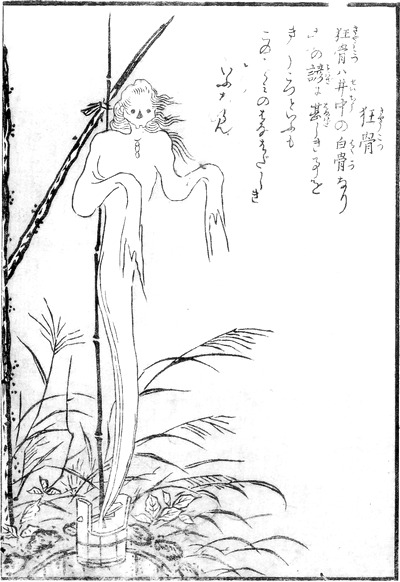
Be careful when you pull up a bucket of water from an ancient, abandoned well. You might get more than you bargained for if a kyokotsu 狂骨—which translates literally as “crazy bones”—springs up from the bucket like a Jack-in-the-Box to deliver its curse.

Clad in a white burial kimono, kyokotsu almost look like a classical yurei but they lack the black/white contrast due to shocks of white hair that spring from its bleached-white skull. Kyokotsu appear as little more than bones wrapped in a shroud, springing from a well.

The yokai is best-known from Toriyama Sekien’s Edo-period yokai print-book “Konjyaku Hyaku Kishui” or  “Supplement to the Hundred Demons of the Past.” Author Kyogoku Natsuhiko also recent featured a kyokotsu in his book “Dream of the Kyokotsu.”

Sekien’s original woodblock print was accompanied by this text:

“Kyokotsu rise from the bones in the well. It is said that whosoever commits the horrendous act of abandoning august bones will find it impossible to abandon the horrendous wrath that follows.”

Sekien’s text seems to explain that kyokotsu appear from a well in response to some wrongdoing and bearing a terrible grudge. Seiken also claimed that the regional-dialect term “kyokotsu,” meaning “violent” or “furious,” is an allusion to this yokai. However, while such a term does exist, specifically in Tsuki-gun in Kanagawa prefecture, there is no concrete evidence linking either the term or Seiken’s picture to an older folktale.

It is much more likely that the opposite occurred, that Seiken heard the term “kyokotsu” and decided to invent a yurei to match—much like if an English-language author decided to create a monster called “Lazy Bones” after the pre-existing term. To get the image for his yokai, Seiken was probably just playing on works, combining the local term “kyokotsu” (crazy bones) with “gyokotsu,” which means bones from which all of the meat has fallen off. He might also have been influenced by the words “keikotsu” or “sokotsu” which can mean drifter or wander, but also can be phrased as “someone from the bottom.” It seems likely that Seiken was influenced both by these words and by the old belief of an inexhaustible grudge that can come from the bottom of wells.

There are several Japanese folklore stories—involving both yokai and yurei—that involve the bottom of a well. In Japanese folklore, water was a channel to the world of the dead, and the bottoms of wells were directly connected. Wells also served as a convenient hiding place for murders committed in the dark of the night, and the superstitious believed that any such-disposed of corpse was capable of a powerful curse. Those who died from falling in wells, by accident, suicide, or murder, were thought to transform into shiryo and haunt the well. The spirit connects to the well itself, rather than where they were murdered, and their curse is likely to fall on anyone who used the well and not specifically targeted to the murderer.

A cursed set of bones is another typical trope in Japanese folklore and does not need to be connected to a well. In her book “Nozarashi Monogatari,” the literary scholar Sawada Mizuho wrote a similar story of a weather-beaten, abandoned skull that gets its revenge.

The biggest difference between the kyokotsu and typical Japanese folklore tales of skeletal ghosts is the element of disparity between the spirit form and the physical remains. In most stories, the spirit resembles a typical Japanese yurei—with a physical, full human body—even while the discovered remains are nothing more than a pile of rotting bones. The kyokotsu is rare in that Sekien drew the spirit in skeletal form as well. Because of this, kyokotsu is most often identified as a type of yokai, being a possessed skeleton, rather than a type of yurei, a Japanese ghost.

Translator’s Note:  The manga series “Bleach” has a character called Katen Kyōkotsu that uses the same kanji as this yokai, but seems to have no other relationship.

The Bodhidharma Button

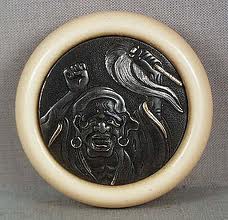
I recently got a request from a reader to help her identify what she called an “old Japanese button.”  She had suspected that the image was an onryo, a Japanese vengeance ghost.

The Image

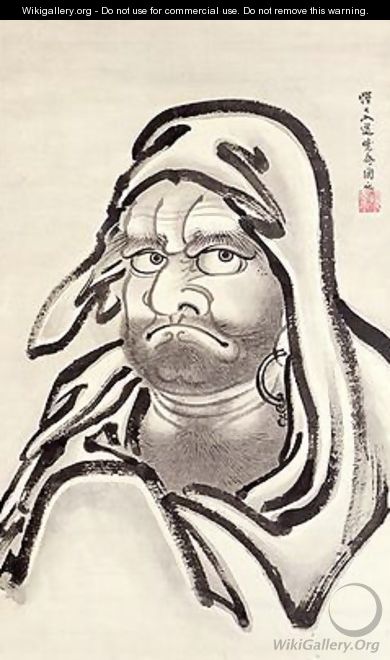
The image on the button—not really a button but I will call it that for the time being—was easy to identify. That is not an onryo, but the Buddhist monk Bodhidharma, known more popularly as Daruma.

Daruma is one of the most popular figures in Japanese folklore art and in contemporary Japan. From whisky bottles to women’s underwear, you can find Daruma’s scowling face on almost every product-type in Japan. Daruma is a super-figure in Japanese folklore, credited with inventing everything from tea to Shaolin martial arts. He is most commonly found as the wish-granting, roly-poly Daruma dolls. Sold eyeless, you paint in one eye while making a wish, then paint in the other eye in thanks when the wish comes true.

The historic Daruma comes from 5th or 6th century AD. Most of his life is so completely wrapped in legend it would be impossible to sort fact from fancy, but he is often considered to have come from South India, or “from Persia.” Whatever his origin, he is the divine transmitter of Ch’an Buddhism, known in Japanese—and English—as Zen Buddhism. In art, he is depicted as being grumpy, ill-tempered, scowling, with a beard and deep-set eyes.

The image on this button, with the emaciated, skeletal form, is very different from the portly and robust figure found in most depictions of Daruma.  The scene is most likely taken from Daruma’s “nine years of wall gazing.”In this legend, Daruma was denied entrance into a Shaolin Monostary, so he went to a nearby cave and stared at a wall for nine years.  There are several variations on the legend, including one where he fell asleep after seven years and—disgusted with himself—tore off his own eyelids so they couldn’t betray him.  Casting his eyelids on the ground, they sprouted up into the first tea bushes which Daruma brewed and drank to keep himself awake for the final two years.

The Artist

 The rest of the request—who made this button and what is it?—went out of my area of expertise.  Even reading the kanji on the button was difficult, as it is in archaic form and written in a calligraphic style.  Neither I nor my wife, who is Japanese, could read the signature. So I called on my friend Aaron Rio, with his big brains and phd in Japanese Art to help in the identification.  And help he did!

First off, what is the object exactly?  All we know for sure is that it is not a button.  Without seeing the reverse side and depth it is difficult to make a determination—Is it a medallion or a container? A lid? And why are there cords attached?  The best guess is that it is a netsuke 根付, possibly of the kagamibuta 鑑蓋 variety missing it’s ivory surround. Or it is possibly the lid of a small netsuke container.

As to the writing, the three characters at left are 民乗, the artist/carver’s name, and then his cipher (花押, kaō), i.e., a handwritten (carved) signature. 民乗,whose actual name was 海野珉乗 (Unno Minjō, 1873-1910; note the different character used for ‘min’) is a known netsuke carver. He was a professor at 東京芸大 when he died, as was his far more famous father Unno Shomin (海野勝珉), who was also a metalworker. The Museum of Fine Art (MFA) in Boston has at least one netsuke, a kagamibuta, by this artist, and they date it to the late 19th century.

Just because it is signed doesn’t mean it is real, of course. There are lots of netsuke fakes. However, Minjō wasn’t exactly a celebrity carver, and he did die rather young, so I’m not sure why anyone would fake his signature. And the signature resembles (though isn’t identical) to the signature on the MFA piece, The MFA has an extensive online catalogue, and you may very well find this other Minjō netsuke there as well.

Previous Older Entries Next Newer Entries

Copyright notification

All translations and other writing on this website were created by Zack Davisson and are copyright to him.

Copyright notification

In accessing these web pages, you agree that any downloading of content is for personal, non-commercial reference only.

No part of this web site may be reproduced or transmitted in any form or by any means, electronic, mechanical, photocopying, recording or otherwise, without prior permission of Zack Davisson.

Copyright notification

For rights clearance please contact Zack at:

zack.davisson (at) gmail.com

Thank you.