Secrets of the Yokai II

Translated from Mizuki Shigeru’s Yokai Daihyakka

How are Yokai born?

It is said that the vast majority of Yokai are born from the emotions of human, especially the powerful emotions of fear, yearning or hate.

But there are other ways for a Yokai to come into being:

1. From the violence of natural disasters such as floods, earthquakes, windstorms or volcanic eruptions.

2.  From the fear of dying accompanying disease and dire poverty.

3. From fear of animals, especially the terror humans feel at the prospect of being eaten by some beast.

4. From plants with lifespans that outstrip humans, like cedar and pine trees.  It was thought that these trees would live forever, and there was a desire of humans to believe in something that had power over death, something indestructible.

5. From human belief in superstitions and stories, or the teachings of religions.  There are things that scientific knowledge cannot explain, and it is there that Yokai are born.

Further Reading:

For more information about yokai and their meaning, check out:

What Does Yokai Mean in English?

A Brief History of Yokai

Secrets of the Yokai – Types of Yokai

Secrets of the Yokai – Types of Yokai

Translated from Mizuki Shigeru’s Yokai Daihyakka

What is the difference between Yokai and Obake?

Generally speaking, yokai and obake are two words that mean the same thing.   If a distinction must be made, it could be said that obake are those creatures which somehow change from one form to another (the Japanese word bakeru which forms the root of obake means to change for the worse, or adopt a disguise).

Examples are transforming kitsune (foxes) or of the dead people whose lingering grudges cause them to appear as yurei, or a myriad of other shape-changers.

What kinds of Yokai are there?

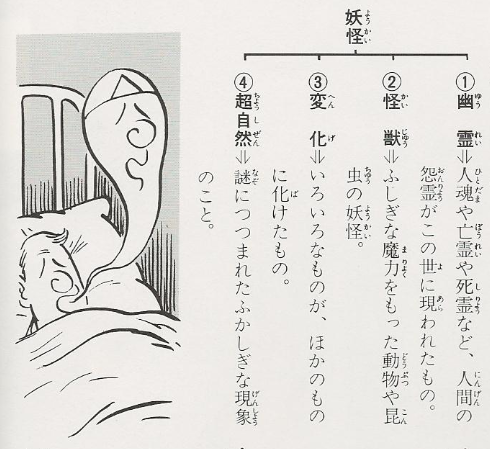
If you wanted to organize yokai by large categories,  it could be said that there are Yurei (spirits of the dead) Kaiju (monsters), Henge (shape-changers) and Choshizen (supernatural phenomena).

A chart would look like this:

 Yokai

Yurei  Kaiju  Henge  Choshizen
Examples are hitodama, borei and shiryo, and onryo.  The spirits of humans still lingering on Earth.  Animals or insects with mysterious and magical powers.  Anything that can change from one form to another. Mysterious or puzzling phenomena.


How many kinds of Yokai are there in Japan?

As a rule, it is said that there are about a thousand different species of yokai.  But if you limit it to those that have appeared in pictures or those about which we have some information, then it is really roughly four hundred different species.

But there are many yokai of other countries.  Nobody knows the number of worldwide yokai.

What is the largest Yokai of them all?

 That is the Onyudo.  The body of the Onyudo is as large as Mt. Fuji.  However, it is said that even if angered the Onyudo would never cause harm to humans.

Further Reading:

For more Types of Yokai, check out:

6 Types of Japanese Yokai From Showa

When Food Attacks – 6 Types of Food Yokai From Japan

10 Famous Japanese Ghost Stories

What’s the Difference Between Yurei and Yokai?

A Brief History of Yokai

Zashiki Warashi

Translated from Mizuki Shigeru’s Yokai Daihyakka

Zashiki warashi are a yokai from the Tohoku region of Japan.  They live in the rafters of ceilings or in old storehouses.  One of the mysteries of zashiki warashi is that they always take the appearance of small children, and never of adults.

In Iwate prefecture, zashiki warashi are said to appear in many of the local Elementary schools, and play with the children.  At nine o’ clock, dressed in a white kimono, the zashiki warashi slip through cracks in the door and play around between the desks and chairs, having a great time.  Of course, only the children can see the zashiki warashi as they romp around the classroom.

Also, about a hundred years ago in Tokyo, zashiki warashi were said to live in the storehouse of a man named Umehara Sotoku.  Whenever any human went into the storehouse they would suddenly be overcome by the need to urinate and would have to flee running from the storehouse.  It was said that this was due to the presence of the zashiki warashi.    Also, sometimes at night the sound of something striking a metal pole could be heard.

One year, there was a fire near that house and the flames rapidly spread.   The family was busy bringing the furniture out of the house when a child that no one knew was seen running out of the storehouse and helped carry the furniture into the cellar for safekeeping.   Even though they tried, no one got a good look at his face.  When all of the goods and people were safely in the cellar, the door was shut tight but the small boy was no were to be seen.

That old storehouse was nothing special, the kind that could be found anywhere.  But high up on the shelf that was used to store charcoal there was a box about 15 by 16 centimeters that no one ever touched.  Most likely that was the home of the zashiki warashi.

The old storehouse did eventually burn down in a fire in the middle of the Meiji period, and from then on the zashiki warashi was never seen or heard from again.  I wonder where it went?

Further Reading:

Read more about Zashiki Warashi on hyakumonogatari.com

On Zashiki Warashi


Yokai of the House

Translated from Mizuki Shigeru’s Yokai Daihyakka

 Shiryo – The Dead Spirit

Shiryo are the spirits of those who died and did not receive the proper respect after death.  From this, they change to become a form of yokai.

In the forty-nine days following death, if a family does not visit the grave, or set tea in remembrance before the family Buddhist altar,  instead of moving on to become a protective ancestor spirit the dead soul will return as a grudge-bearing Shiryo

 Amamehagi

Long ago in Kashima district in Noto (Modern day Ishikawa prefecture), when the bells sounded on New Year’s Eve to ring in the coming of the new year, the Amamehagi came creeping dowm from the mountains.

If they found any children out after dark, the Amamehagi would strip the skin from the children’s feet and wear them as shoes.

Needless to say, in those olden times all the children of Noto went to bed early on New Year’s Eve.

Funa Yurei

Translated from Nihon no Obake Banashi

Long ago, it was said that when a boat put out to sea on New Year’s Eve it was sure to catch the eyes of funa yurei.

Funa yurei are said to be the souls of drowning victims.  Bitter and wrathful towards the living, they rise up from the bottom of the sea to attack boats.

One time, at Mizushimanada in the Seto Inland Sea (West of modern day Okayama prefecture) a lone boat crossed the water heavy with goods for the New Year’s festival.  Due to the nature of its cargo, the boat had no choice but to cross on New Year’s Eve and was now being tossed about by the white-capped waves.

“What, do you fear to go sailing on New Year’s Eve?  Are we boatmen to have our livelihoods ended out of fear of the funa yurei?  The sky may be black as ink without a star in sight, but the wind is favorable and if we hold our course steady we will at be back home before we even left!”

Cheering themselves up in this manner, the boatsmen continued along the pitch-black sea.  For a time, everything was good. Their sales were full of wind, and they were traveling so fast it was as if they were flying over the water.  But suddenly the skies opened up, and a hammering rain began to fall.

“Damn!  This is some pretty bad stuff coming down on us…”

The boatsmen didn’t stop their work for evne a moment, and kept the boat steady on as the violence of the rain increased.  Suddenly, the boat ground to a halt as if something had moved up behind it and grabbed itl  The wind fell to a dead calm.

“What just happened?  Where is our wind?”

Then, just as suddenly, they were blasted by a fierce breeze that seemed to have come straight from the heart of winter.

“Everyone!  Push us ahead!  Heave to those oars!”

To the shock of the boatsmen, the boat held its ground, frozen to the spot as if it had set down roots.

“Wha…what is that?”

From deep under the water, something was drifting up towards the boat.  It looked almost like floating balls of cotton.

“No!…it can’t be!”

The white shapes moved relentlessly upwards, increasing in size as they approached.  The boatsmen could see them now; wrapped in kimonos as white as snow, their hair floated wildly in the water.   From below there was a ghastly light illuminating their faces.  There was no doubt these were the dreaded funa yurei.

“Lend us a hishaku…lend us a spoon…”

Their ghostly hands stretched up from the waves, and their voices carried their bitter grudge toward the living.

It is known that, if you should find yourself in such a situation and overcome by fear you actually had over the hishaku spoon they are requesting, then you are as good as dead.  Before your eyes, the single hishaku spoon will split into multiple spoons, and arms beyond you ability to count will stretch out from the ocean.

“Ei ya!  Ei ya! Ei ya!”

Singing their loathsome song with voices filled with hate, the funa yurei will ladle water from their infinite spoons until you boat is swamped.  And if this is not enough to sink your boat, they will reach up and drag it to the bottom of the ocean.  How many hundred of ships have been sunk in this manner?

“No no no…not to you…we will never lend you a spoon!”

But these boatsmen, shivering so badly they could barely hold their oars, refused absolutely and pulled the water with all their strength. This did not discourage the funa yurei.   Slowly the boat moved slowly forward in the water, followed closely by the funa yurei.

“Go away!  Just go away!”

The boatmen took their oars and began to beat with all their might on the heads of the funa yurei.

“Lend us a hishaku…lend us a spoon…”

A funa yurei grabbed hold of one of the oars and pulled with such strength that one of the boatmen was dragged into the ocean.

“No!”

Letting go of the oar, he clambered up the side of the boat upsetting the lantern they had used to guide their way through the black night.   Sparks flew off of the lantern, and the funa yurei fled before the power of the flame.    With that, the boat that had been held almost still in the water suddenly broke free and sped along smoothly.

“Ahhh….thanks to that lantern…”

The boatmen pulled with all of their remaining strength for the shore.

The funa yurei are found not only in the Seto Inland Sea, but anywhere in the waters surrounding Japan.   Always they ask for the hishaku spoon.

Because of this, some boats carry a specially prepared hishaku spoon with holes drilled in it.  This way, when the pass over the spoon the funa yurei are unable to fill the boat with water and they can make their escape.

This legend comes from Okayama prefecture, from an Edo period book called “Kasshi Yawa.”   A fishing villiage in this area still sells specially made hishaku spoons with holes that are said to ward off the funa yurei.
Previous Older Entries Next Newer Entries

Copyright notification

All translations and other writing on this website were created by Zack Davisson and are copyright to him.

Copyright notification

In accessing these web pages, you agree that any downloading of content is for personal, non-commercial reference only.

No part of this web site may be reproduced or transmitted in any form or by any means, electronic, mechanical, photocopying, recording or otherwise, without prior permission of Zack Davisson.

Copyright notification

For rights clearance please contact Zack at:

zack.davisson (at) gmail.com

Thank you.