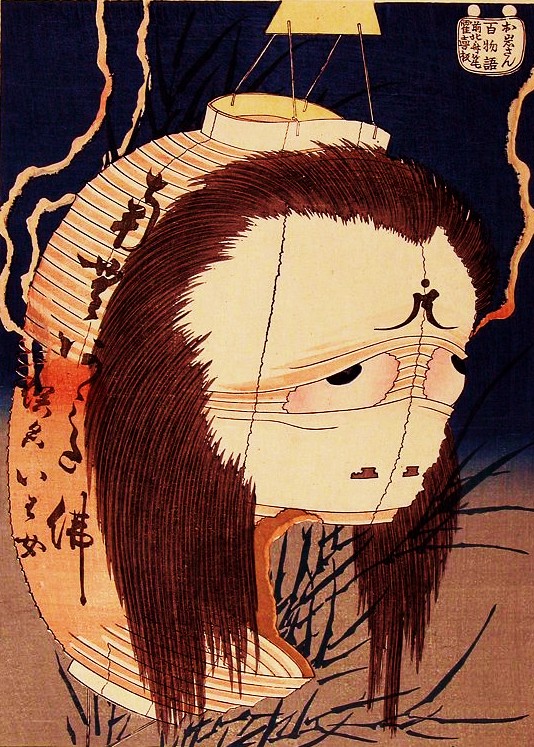
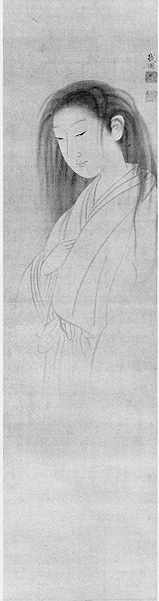
Okuri Hyoshigi – The “Following Wooden Clappers”

Translated from Edo Tokyo Kaii Hyakumonogatari

On the 20th day on the month of the sign of the bear, when the moon grows white and even the paper street lanterns that shine in every direction fail to brighten the gloominess of the street, rain will come with a rushing downpour.  On that day, the temple bells resound with the tones of the afterlife.

At first the cries of the nighthawks and street walkers, the sellers of soba noodles and bottled beer, of tea noodles and red-bean bread, will harmonize with the resounding bells, but these sounds will fade out and die away as the night stretches on and the people grown thin.

While trying to make your way home in the dark and the rain, covering your paper lantern with the sleeve of your raincoat to prevent it from soaking and going out, you will hear the sound of a pair of wooden clappers banging together behind you.  As you walk on, the bang of the clappers will synchronize with your footsteps and the faster you run the faster and closer the sound of the clappers will come.  This is the spirit known as the “Following Wood Clappers”.

Translator’s Note:

This print, by Utagawa Kuniteru, is called Okuri Hyoshigi (送り拍子木), and depicts one of the Honjyo Nana Fushigi (本所七不思議) meaning one of the Seven
Wonders  of Honjo
.

Oite Kebori – The “Leave it Behind” Straggler

Translated from Edo no Kimyo no Hyakumonogatari

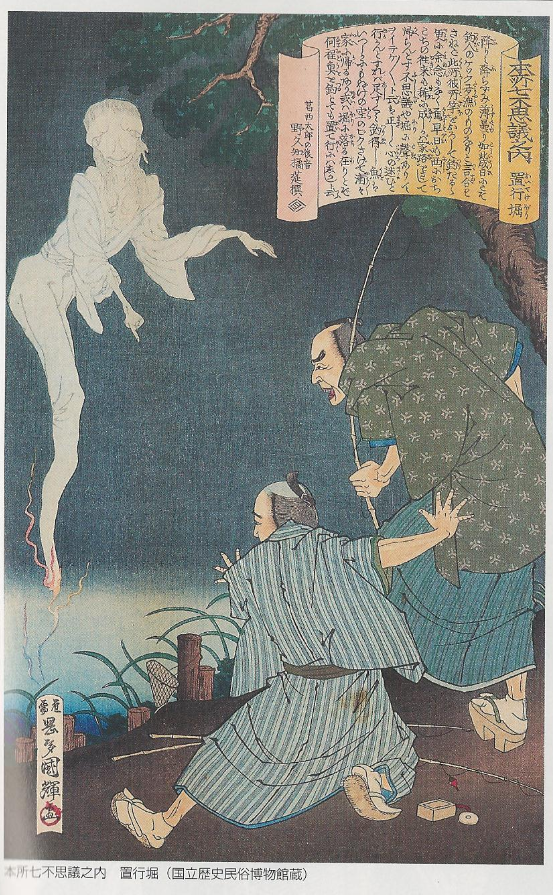
There are days when the clouds are too thin to carry rain, but pour down anyways.   On such a day fish can be pulled from the water with abundance.    A fisherman need only cast his rod about without care, lazily chatting with his friends without any other care, and the fish will come.   When a day like this pulls to a close, those stragglers remaining behind may be witness to a mysterious phenomenon when they finally make for the road home.

From the moat in which they have been fishing, a voice comes telling them to “leave it behind…” This may cause them to only shudder in their hearts, but as they try to leave their feet become heavy and drag on the road. Their big sacks which had been filled with fish become suddenly empty.

It doesn’t matter if they listen to the voice and empty their sacks, or if they ignore it and  struggle to make their way home.  It doesn’t matter if they put only a little back in the moat, and still try to make off with a mere remnant of their catch.

Either way, they will find themselves with nothing to show for their day’s labor.

Translator’s Note:

This print, by Utagawa Kuniteru, is called Oite Kebori (置行堀), and depicts one of the Honjo Nana Fushigi (本所七不思議) meaning one of the Seven Wonders  of Honjo.
Next Newer Entries

Copyright notification

All translations and other writing on this website were created by Zack Davisson and are copyright to him.

Copyright notification

In accessing these web pages, you agree that any downloading of content is for personal, non-commercial reference only.

No part of this web site may be reproduced or transmitted in any form or by any means, electronic, mechanical, photocopying, recording or otherwise, without prior permission of Zack Davisson.

Copyright notification

For rights clearance please contact Zack at:

zack.davisson (at) gmail.com

Thank you.