The Scared Yurei

Translated from Nihon no Yurei

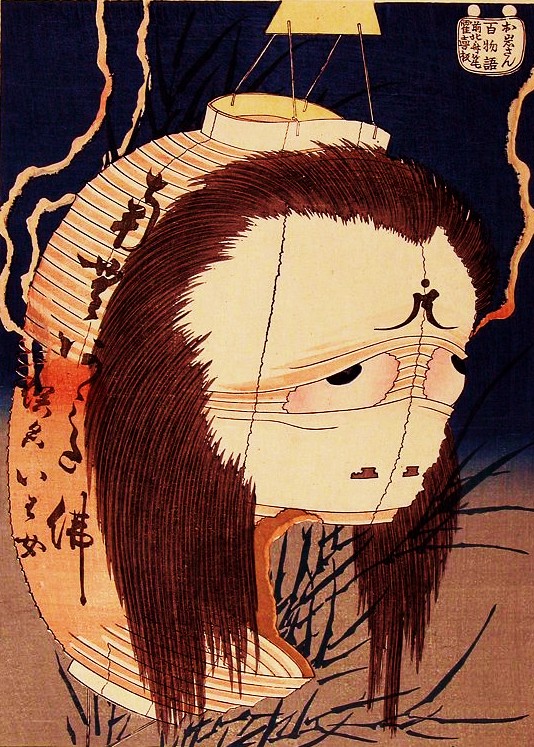
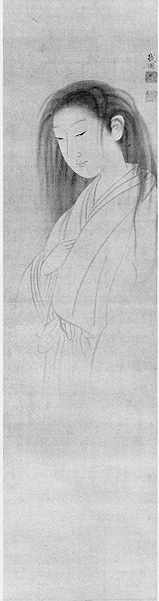
In a certain house an old woman lived alone. One night, as she was sitting down to her dinner, she spied a young woman’s downhearted face peering out at her from the darkness of a corner.   Looking closer, she could see that the face was that of a young  girl of the next-door geisha house who had recently passed away.

This young girl had been the protégé of the madam of that house, calling her “older sister” in the style of the geisha.  However, their relationship was not good and it had been the talk of the town that the madam had badly mistreated this girl when she had been alive.  The madam devised such mischief as waiting until the young girl was just about to bring her chopsticks to her lips, before letting loose a torrent of chastisment to which the she must endure, thus leaving her with barely a morsel eaten.  The madam also covered the girl’s body with bruises to such an extent that the color of her beatings never faded. Finally, it was said, she killed the girl. 

Before the abused girl had died, this old woman of the next-door house had pitied her. Sometimes, the old woman would stealthily enter the geisha house in order to slip the young woman candies and bites to eat.  Because of this, when that girl’s lost spirit appeared at the old woman’s house, that old woman was quite vexed.  Always stout-hearted in nature, the old woman scolded the yurei who had mistakenly appeared in her home.

 “Hey you!  You have absolutely no reason to hold a grudge against me!  If you are going to haunt someone, go next door to your older sister!  You are here by mistake!”

The old woman had no doubt that the yurei, who had mistakenly appeared in the wrong house, would soon leave and so she lightly pummeled the spirit with her fists.

 Now if the yurei had replied something along the lines of how she had meant to go straight to her older sister’s house but felt she couldn’t do the job properly because she was too hungry and so she had dropped by the house of the kind old woman who had fed her when she was alive, the story would have more of a comedic feel to it.  But instead the yurei sadly replied with her downcast face:

“I am too scared to go to my older sister’s house.”

This answer is what marks this story as unusual for the yurei genre. In the normal way of things, a person who has transformed into a yurei is usually an object of terror to the person who harassed them in life.  But even though she has died, the young girl still fears her older sister, and this twist ending  is what lends the story its interest.

What the old woman said in reply, and how the story continued after that moment, has never been told, and in fact if the story had continued with all the loose ends properly tied up it would have given the story the stink of a literary creation. 

Instead, the story remains how it was told by the old woman, who lived in that area until around the start of the war.  She would often tell the tale of the young girl yurei, forever adding at the end “Say it is stupid if you want, but it just goes to show you can’t be thoughtlessly kind to people. “ 

I heard this story from my father, who had spent his whole life in Ginza until he died after the war.

Kataba no Ashi – The One-sided Reed

Translated from Edo no Kimyo no Hyakumonogatari

There was a villain named Tomedo whose heart was wicked.   He attempted to seduce a young widow named Oyoshi, who held an amulet in the shape of a shogi chess piece that he desired.  When she refused him, he became enraged and killed her, pruning off her left leg and arm as if she were a bonsai tree and throwing them into a ditch.

From that time, the ditch grew nothing but a weed called kataba no ashi, which means “one-sided reed” and has leaves that grow on only on the right side.

Even now, they say that this reed is the spirit of Oyoshi.

Translator’s Note:

This print, by Utagawa Kuniteru, is called Kataba no Ashi  (片葉の葦), and depicts one of the Honjyo Nana Fushigi (本所七不思議) meaning one of the Seven Wonders  of Honjo.

Akarinashi Soba – The Unlit Soba Shop

Translated from Edo Tokyo Kaii Hyakumonogatari

Above the bridge that spanned the flowing canal, a soba shop stood whose paper lantern had the words “28” written on it in thick, bold characters.  Even when all the fires were put out, and the street was in darkness, this lantern would continue to shine, without candle or oil.

Those who tried in vain to douse the lantern would meet with no success, and misfortune would fall upon their household.

Translator’s Note:

This print, by Utagawa Kuniteru, is called Akarinashi Soba (燈無蕎麦), and depicts one of the Honjo Nana Fushigi (本所七不思議) meaning one of the Seven Wonders  of Honjo.

Ashiaraiyashiki – The Foot Washing Mansion

TheWashingFoot

Translated from Edo Tokyo Kaii Hyakumonogatari

To learn much more about Japanese Ghosts, check out my book Yurei: The Japanese Ghost

On the 3rd street in the Honsho district there lived a woman named Hanamoku.  At her house, a mysterious thing was known to occur.

At the time when the flowers were sleeping and the ushimitsu plant was blooming, a horrible, rotten stench would invade the house, and a giant foot bristling with hair would descend from the ceiling accompanied by an enormous sound. If you washed the foot, it would soon disappear back into the ceiling.   But if you didn’t, the giant foot would rampage though the house until satisfied.

Translator’s Note:

This print, by Utagawa Kuniteru, is called Ashiarai Yashiki  (足洗邸), and depicts one of the Honjyo Nana Fushigi (本所七不思議) meaning one of the Seven Wonders  of Honjo.

Further Reading:

For more bizarre tales of Japaneses Folklore, check out:

6 Types of Japanese Yokai From Showa

10 Famous Japanese Ghost Stories

When Food Attacks – 6 Types of Food Yokai From Japan

Tanuki no Kintama – Tanuki’s Giant Balls

Kappa to Shirikodama – Kappa and the Small Anus Ball

Nebutori – The Sleeping Fatty

Tanuki Bayashi – The Procession of the Tanuki

Translated from Edo Tokyo Kaii Hyakumonogatari

Almost every night would come the sound of the taiko drums.   At times they would sound very near, at times they would sound very far away, and a local fisherman, overwhelmed with a desire to see the interesting site, became exhausted almost to the point of death while trying to find the players.  After a night of hard searching, it was all he could to make his way back home where he quickly lay down and fell soundly asleep.

The first thing he noticed was the song of a bird, so close it was like it was being sung into his ear, and his eyes sprang open at the mysterious sound.  While he thought he was comfortably at home, the dew was still clinging to his raincoat that still covered his body and the sounds of the forest were rumbling with his loud snoring.

“My wife will be angry at me”, he thought, and he was a man filled with deep regret.  Even here in this world there are such things as a procession of magical beasts.

Translator’s Note:

This print, by Utagawa Kuniteru, is called Tanuki Bayashi  (狸囃子), and depicts one of the Honjyo Nana Fushigi (本所七不思議) meaning one of the Seven Wonders  of Honjo.

Previous Older Entries Next Newer Entries

Copyright notification

All translations and other writing on this website were created by Zack Davisson and are copyright to him.

Copyright notification

In accessing these web pages, you agree that any downloading of content is for personal, non-commercial reference only.

No part of this web site may be reproduced or transmitted in any form or by any means, electronic, mechanical, photocopying, recording or otherwise, without prior permission of Zack Davisson.

Copyright notification

For rights clearance please contact Zack at:

zack.davisson (at) gmail.com

Thank you.