
Translated from Mizuki Shigeru’s Mujara
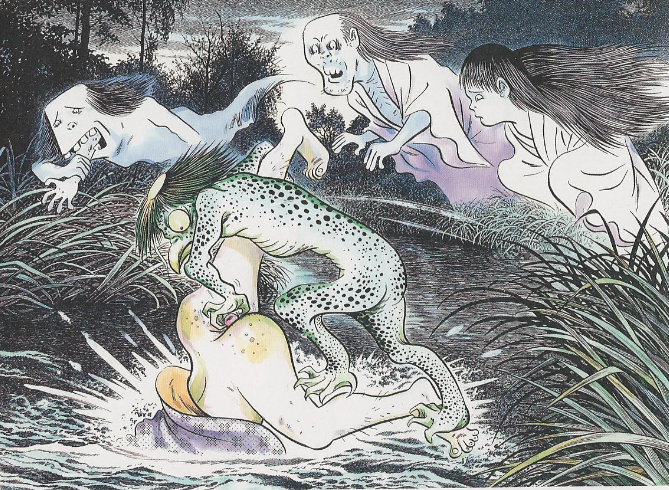
In Tsushima in Nagasaki prefecture, when the rain falls at night, the bakemono known as the Nure Onago appears. The Nure Onago can appear near any body of water, from a small pond to the ocean. Her entire body is drenched, and she is soaked from the top of her head to the tips of her toes.
The Nure Onago can be found in several parts of Japan. In Nuwa in Ehime prefecture, it is said that you can see her hair stretched out and floating on the surface of the ocean, and it is from there that she appears. In the Uwa district, the Nure Onago doesn’t come from the ocean, but it is said that she appears from a soaking wet mop of hair.
The Nure Onago always has a wicked smile, and laughs hideously. If by chance you hear her and, thinking she is just a regular woman amused at something, should laugh along with her, then she will attack you swiftly and without mercy.
In Kagoshima prefecture, in the cape of Tajiri where the famous festival for the god Ebisu is held, there is a similar yokai. They call her the Iso Onna (Beach Woman), and like the Nure Onago she is soaked head to foot. The Iso Onna appears anywhere there is sand, either on the actual beach or inland if there is sand. The main different between the Nure Onna and the Isa Onna is the lower half of their bodies. The Isa Onna is said to have no lower half, but instead is formed like a snake below the waist. Both the Iso Onna and the Nure Onago are types of the yokai called Nure Onna.
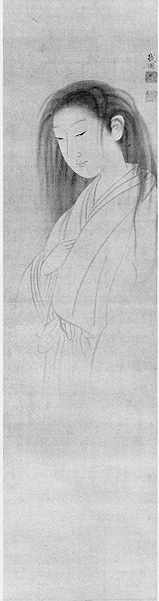
Most depictions of the Nure Onago show her as being nothing different than a regular human woman, dripping wet. The Nure Onago is a relative of the Hari Onna (Needle Woman) from western Japan.
Translator’s Note
Mizuki Shigeru’s depiction of the Nure Onago is quite different than most portrayals. Mizuki’s description is more in tune with the name Nure Onna 濡女子 which means literally “Wet Woman-child” or “Soaked Woman-child.” The related Nure Onna is traditionally drawn as a snake with the head of a woman. She is also sometimes described as carrying a small child (odd considering the lack of arms) which then turns out to be a bundle of leaves. This story is taken directly from the Ubume legends.

Further Reading:
Read more yokai tales on hyakumonogatari.com


 百物語怪談会 Hyakumonogatari Kaidankai
Recent Comments