The Yurei Child

Translated from Edo Tokyo Kaii Hyakumonogatari

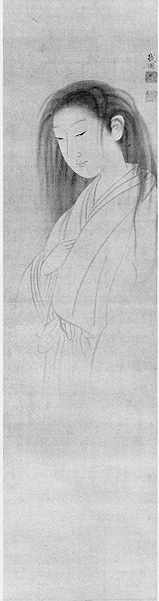
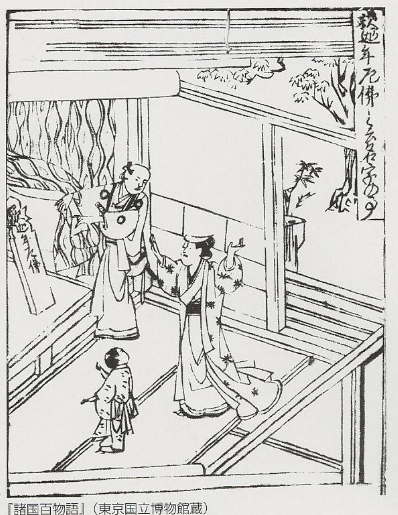
In Edo, in the vicinity of Nipponbashi (modern day Tokyo), there was an important shopkeeper named Kenhei.  Every year Kenhei would make a trip to Kyoto to buy stock for his store, always buying from the same seller, a widow women living with her daughter.  This daughter had stolen the heart of Kenhei, and she had no plans to give it back.  So, with the consent of the mother, they were pledged.

In the following days Kenhei said:

“I am a man of Edo, and so it is my wish to move our family to Edo where we can live out our days in ease.  I will return first and make the necessary preparations, then come and collect you.  What do you think?”

The daughter was pleased, and answered:

“I know that we have not yet the money to move, so we will wait for you here in Kyoto.  By the time you come again next year, we will be ready to go and live with you in Edo.”

With this pledge, Kenhei returned happily to Edo.  But on the trip back, he became terribly ill and unable to work.   The daughter was unaware of this and waited patiently for Kenhei to come and collect her and bring her to Edo to live together.  When the promised day came and went, she thought she had been betrayed and was overcome by sadness.  Such was her grief that she died.

Kenhei, still in Edo, believed that the daughter was waiting for him in Kyoto.  Just as he was wondering what she was doing now, he heard a voice:

“Is this the residence of Kenhei?”

Kenhei was overcome with happiness.

“What are you doing here in Edo?  This is fantastic!”

They both wept profusely.  But the daughter was bitter with her accusations at Kenhei for not keeping his promise.

Kenhei explained to her about his illness and why he had been unable to keep his promise.  At length he soothed her anger and brought her into his house, where she was introduced as his wife.

When the daughter said:

“And now we must bring my mother to Edo as well.”

Kenhei replied:

“Sadly, I still lack the money and she must wait another two or three years.”

During that time, the daughter, now Kenhei’s wife, became pregnant and gave birth to a boy as round as a ball.

When the boy was three years old, Kenhei went as promised to Kyoto to bring back the mother.  He went to their familiar house where the old widow was pleased to see him again.

She cried while saying:

“Well, well.  This is an unexpected reunion!  It has been three years since my daughter died while waiting for you to come and collect here.  Since she passed away I have had no one to rely on.  I have just lived an empty life here by myself, without compassion or sympathy of others, and here suddenly from Edo is that man who I thought had abandoned us long ago!”

Kenhei was shocked by this:

“What is it you are saying?  You daughter came to my house three years ago, and even now our three year old child is in our house.  Your grandson!”

With this the mother went into the back room where the family altar was kept, removed the mortuary tablet of her daughter.

“Your love for my daughter must have been so great as to call her back so she could live with you for those three years.”

Pulling it from her breast pocket, the mother showed the mortuary tablet to Kenhei.  The daughter’s name was written clearly on it in brush, along with the name of the blessed Buddha.    Kenhei broke down in tears, and after performing the proper funerary rights he brought the mother home with him to live together in Edo.

The child born to Kenhei and his ghostly bride grew up, and he became admired for his great wisdom and gentility by everyone in the province.

The Yurei of Kobata Heiji

Translated from Edo no Kimyou no Hyakumonogatari

It is said that there are no monsters or bakemono from Hakone town, but even here one can feel the mysterious touch of the yurei.

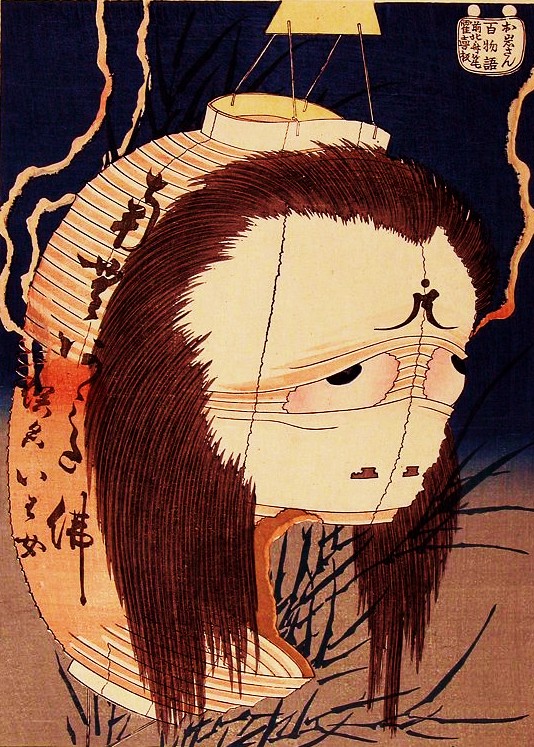
One night, Bando Hikosaburo was walking home, a kyogen play he had heard over the summer running around in his head, when he saw something frightening.  Holding a lantern casting a dim illumination on the scene that was neither dark nor light, a pale blue figure stood before him like some vision.

“I am the yurei of Kobata Heiji.  Those who look upon me and hear my story will endure neither fear, nor my wrath, nor any disturbing thoughts. 

It has been almost two ages since Itoe Shoroku took pity on my suffering spirit and performed a memorial service in my honor.  Still, it brings be pleasure to again stride the stage of this world from time to time.”

With that said, the Yurei suddenly vanished. 

This took place in the 13th year of Bunmei (1830) at the closing of summer.

The Obake Cart

Translated from Nihon no Obake Banashi

Long ago, in the town of Kouka in the province of Oumi (modern day Shiga prefecture) ,when night did fall a mysterious cart was said to appear without fail. 

“Kiiii….kiiiii….”

The sound of the cart could be heard, although where it was coming from or where it was going to no one could say.

“That cart is an obake cart.  Anyone who lays eyes on it will feel the cart’s curse!”

Everyone said this, and when the night fell there was not a soul in the town who was not safely inside with their doors and windows sealed shut to the smallest crack.

In this town there was also a very steadfast and sensible proprietress.

“If this cart really exists, then there must be something especially terrible riding in it.  More likely its nothing more than a rumor spread on purpose to keep us indoors at night.  Either way, I would like to see for myself what the truth is!”

Even though she was thinking this, the proprietress was careful not to tell anyone in the town.  For it was said that if you spoke badly about the obake cart to anyone, or even spoke of it at all, then the cart was sure to come visiting in the night.

“No one speaks about the cart twice.  Anyone who speaks about it even once feels the cart’s curse!”

This the townsfolk would say, and even then at night they would shudder with their eyes held shut but their ears open for the sound of the obake cart.

The proprietress waited until everyone was sleeping and secretly crept from bed.  She silently padded her way to the door where she crept out of sight.  Through a knothole in the door she peered into the night.  Although all was quiet, after a time she began to discern the sound of a cart’s squeaking wheels.

The proprietress watched intently from her knothole.  Suddenly, justas the moon emerged from behind the clouds and shone in the sky, the street became as bright as noon

“Kiiii….kiiiii….”

The sound of the obake cart got louder and louder, coming closer.

What was it?  Was someone riding in the obake cart?  The proprietress held her body perfectly still and stopped her breath, staring with all her life into the light.

The cart came increasingly closer.   The body of the proprietress began to tremble uncontrollably.

“Ah!”

Without thinking, she let out a cry.

Somehow, a cart with only one wheel, with nothing pulling it at all came moving into her view.  Riding on top was a solitary beautiful young woman. 

Now the proprietress had been expecting some sort of terrible oni, not a beautiful young woman, and the proprietress’ gaze was held as if in a trance.  The obake cart stopped right in front of the home from where the proprietress was watching.   She tried to crouch even smaller to hide her body.

“Here.  It would have been better if you had been looking after your precious child than spying on me.  But now it is too late for you to do anything but mourn.”

The proprietress heard this in the young woman’s voice, and with that the single-wheeled cart sped away.

The proprietress released the breath she had been holding in with relief, and didn’t give any worries to what she had just heard.  Instead she crept back to her bed.   And what did she do there?  Why, she crawled into her futon where her baby should be sleeping, only to find that he was not there.

“Husband…husband…”

The proprietress woke up her husband and others of the house.   Everyone began to search for the baby but he was nowhere to be found.

“Ahhh!  I did something terrible!!!”

The curse of the obake cart had fallen not on the proprietress, but instead on her small baby who had been adducted.  But the proprietress would not give up her child so easily.

“This is wrong.  I was the one who looked on the obake cart!  Why should my innocent child pay the price for my misdeeds? It is too terrible. Put your curse on me and give me back my child!!!”

Crying this over and over again it became like a song of sadness for the proprietress.

And so, the following night the proprietress stood at the door of her hour and loudly sang this sad song.  Somehow this penetrated the cold heart of the mistress of the obake cart, and although she had planned only to take the child and be done with it, she found herself thinking.

“This is the home of a woman who truly loves her child.  I had not intended to give back the baby, but perhaps this once I can make an exception.”

The young woman of the obake cart heard the sad song of the proprietress once more, then listened again a third time.  Finally, the sadness was too much even for her and she returned the child. Silently, the obake cart sped away from the town.

“Thank you!!! Thank you!!!!!”

The proprietress fell to her knees on the dirt floor of her house, tears pouring from her face like rain yet never stopping the torrent of thanks that poured from her mouth.  Finally, carrying the baby she had so desperately searched for, she went back to her bed where they were both soon fast asleep.

From that night, the obake cart never came again.  Having revealed her true form to a human without punishment, it was said that she could no longer appear in the town of Kouka.

This legend has been handed down from the Edo period in Shiga prefecture, and the obake cart appears in images of the Night Parade of a Hundred Demons popular at the time.  It is of the style of legends concerning ghostly vehicles.

The Speaking Futon

Translated from Nihon no Obake Banashi

Long ago, in the town of Totori, a shopkeeper opened a small inn.  The inn welcomed its first customer on a cold winter’s night.

 “Welcome my guest, and please spend the night comfortably.  Help yourself to our bedding and futons!”

 The proprietor thus led the guest to his room.

 The exhausted lodger fell quickly into the offered futon, and was soon asleep.  However, in the middle of the night he was awakened by someone’s voice.

 “Older brother…you must be cold.”

 “Little brother, you must be cold too…”

 The voice, little more than a whisper, was a child’s voice.

 “Huh.  There are no kids in this room…that must be coming from one of the neighboring rooms…”

 “But still…at this hour it is awfully rude for someone to be talking and keeping the other guests awake.”

 The lodger made a purposeful show of loudly clearing his throat.  The child’s voice stopped exactly at that time.

 With a sigh of satisfaction, the lodger once again began to settle into sleep.  But just as he was on the verge of sleep, the child’s voice was heard again, this time whispering directly into his ear.

 “Older brother…you must be cold.”

 “Little brother, you must be cold too…”

 It was a sad voice.  The lodger sprang from his futon and hurriedly lit the nearby paper lantern.

 There was no one in the room.  He check the adjoining room, and there was no one their either.  Leaving the paper lantern lit, the lodger lay down yet again.  And again he heard the voice, coming from the base of his pillow.

 “Older brother…you must be cold.”

 “Little brother, you must be cold too…”

 Again it was the sad child’s voice.

 A chill went down the lodger’s spine.  Yet he summoned up his courage and tried to pinpoint the source of his voice.  He could hear it coming from his futon.   The bed covering was speaking to him.

 The lodger fled terrified from the room. Waking the proprietor, he told him the whole story of the haunted futon.

 “What are you talking about?  My inn has only opened today.  And I certainly don’t have any haunted futons.  You must be very tired for your mind to be playing tricks on you.”

The proprietor would simply not believe the story.  And as for the lodger, he had already paid and there was nothing to be done about it.  The proprietor stuck out his belly and would not be budged.

 “Yah…this is a bad omen.  My first day of business and my first customer is like this…”

 However, the following day another lodger stayed in the same room, and had the same story to tell the proprietor about the haunted futon.

 “Now this is a strange thing indeed.  To have two customers report the same thing…I am going to have to look into this…”

 The proprietor was still unbelieving, but he went into the room and put his head next to the futon.  Sure enough, he could soon hear a child’s voice crying:

 Shocked as he was, the proprietor still investigated the mysterious voice and found that it was coming from only a single bed-cover futon used as a blanket.

 “So you are the offending futon?  Why do you say what you say?”

 The next day the proprietor went to the dealer in used clothing and bedding from whom he had purchased the futon.

 “Actually,  before I sold it to you I bought this futon from another used store…”

 And so the dealer in used goods told the proprietor of the inn where he had the futon.  The proprietor hurriedly went to that shop where he heard the story.

 Not so long ago, there a poverty-stricken family of four lived in the town of Totori.  Their father had died of illness, followed by their mother, leaving only the 6- and 4-year old brothers.  The brothers had no family or friends to look after them.  They sold all of their household goods for food, including their mother and father’s kimonos and their hibachi stove.  But because their house was poor, the items they could sell were soon gone, and they had nothing left but a single futon blanket.

 Before long, winter came and the snow fell.  The two brothers had nothing and stayed in a deserted house growing weaker and weaker. Wrapped together in the single futon blanket, they shivered in the cold.  At night they tried to sleep, but the bitter cold would keep them awake

 “Older brother…you must be cold.”

 The kind little brother tried to give the entire futon blanket to his older brother.

 “Little brother, you must be cold too…”

 But the older brother refused and covered his little brother with the futon instead.

 The two passed the night this way, attempting to give the entire futon to their freezing bother.  And that passed another night this way, and then another. How often could they perform this ritual?

 In time, the coldhearted landlord of the house came calling, and unable to pay the rent the brothers were thrown from the house.  The landlord even tore the futon blanket from them as payment for their debt.

 That night there was a terrible snow storm.

 Having not eaten for many days, the brothers succumbed to their hunger and the cold.  Under the stoop of a nearby house they were found dead, still clinging to each other.

 “The poor dears…the poor little dears…”

 Thinking this, the neighbors buried them in a small grave near the temple of Kannon the deity of mercy.

 The proprietor of the inn, hearing this story brought the futon blanket to the temple of Kannon where the two brothers were buried.  The Buddhist monk of the temple prayed for them and held a memorial service for them.

 From then, the futon was never heard to speak again.

This melancholy tale comes from Tottori , next to Shimane prefecture, and was included in the collection of legends known as “Inbaku Densetsu Shu.”  It was made famous by Koizumi Yakumo, also known as Lafcadio Hearn.

Okuri Chochin – The Sending-off Lantern

Translated from Edo Tokyo Kaii Hyakumonogatari

Even though it is called spring,   the weather is bitter cold and the rain is falling.  The coming and going traffic dies down in the face of a wind that pierces the body, and the bell of the temple of Houan-ji can only be distantly heard.

On tall wooden geta a warrior stumbles drunkenly helped along with his tottering steps by a companion.  While suppressing a shudder, the companion says:

“My lord, this is a desolate area…”

The lord laughs and replies:

“There are foxes and tanuki and other mysterious beings here.”

Looking ahead of them, they saw the light of a lit lantern which they attempted to follow.  However, when they got closer to the light, it suddenly blinked out leaving them in pitch blackness.

This was the Sending-off Lantern.

Translator’s Note:

This print, by Utagawa Kuniteru, is called Okuri Chochin (送り提灯), and depicts one of the Honjo Nana Fushigi (本所七不思議) meaning one of the Seven Wonders  of Honjo.

Previous Older Entries Next Newer Entries

Copyright notification

All translations and other writing on this website were created by Zack Davisson and are copyright to him.

Copyright notification

In accessing these web pages, you agree that any downloading of content is for personal, non-commercial reference only.

No part of this web site may be reproduced or transmitted in any form or by any means, electronic, mechanical, photocopying, recording or otherwise, without prior permission of Zack Davisson.

Copyright notification

For rights clearance please contact Zack at:

zack.davisson (at) gmail.com

Thank you.