Bakekujira and Japan’s Whale Cults

Mizuki_Shigeru_Bakekujira

Translated and Sourced from Mizuki Shigeru’s Mujyara, Kaii Yokai Densho Database, Japanese Wikipedia, and Other Sources

Legends of a Great White Whale usually bring to mind Moby Dick, but the white of this whale is the color of its bones. For bones are all you can see of the Bakekujira—a massive, skeletal baleen whale that appeared and disappeared under mysterious circumstances once of the coast of Japan. Is it a monster? Is it a ghost? Is it a god? No one really knows for sure.

What Does Bakekujira (化鯨) Mean?

Bakekujira’s name is the same as many magical animals in Japanese folklore, with a difference of nuance. For most bake- creatures (bakeneko, bakenezumi, etc … ) the kanji 化 (bake; change) refers to a transformation, the ability to shift from one form to another. In Bakekujira—化 (bake; change) +鯨 (kujira; whale)—bake does not refer to a transformation. It just sounds scary and bizarre. This is one instance where translating bakekujira as “ghost whale” or “goblin whale” instead of “transforming whale” would be perfectly appropriate.

Inland Whaling2 Ukiyoe

The Tale of the Bakekujira

One rainy night, something massive and white appeared off the coast of Okino Island, Shimane prefecture. Fishermen from the village watched it get closer and closer, and finally decided to take a rowboat out and see what it was. From its size, they knew it must be some sort of whale, but no one had seen a whale like that before. As they rowed out their boat, they saw the waters of the ocean glimmer with thousands upon thousands of fish, the likes of which they had never seen.

As they neared the white whale, one of the fisherman threw his harpoon and it passed through the mass of white unnoticed. Their vision obscured by the pounding rain, the fishermen finally got a good look at the monster—it was the skeleton of a great baleen whale, without an ounce of skin nor meat on it. But it was moving and alive.

The men were terrified, even more so because the ocean was writhing with unknown fish, and the skies were filled with strange birds. In the distance they saw an island that hadn’t been there before, as if they had rowed into some mysterious country. Then suddenly the vision ended, and the massive bakekujira—for that is what they called it—retreated back to the open sea as quickly as it had come.

When the fishermen went back to shore, they speculated that it might have been the ghost of a whale killed in a hunt or some strange god. Whatever it was, the bakekujira was never seen again.

The History of the Bakekujira

That’s it. There is that one story of the one appearance of the bakekujira, and that is the sum total of knowledge on the boney beastie. Anything else you read about the bakekujira is pretty much just made up to try and fill in the gaps.

In fact, for being so well-known in the modern world, the bakekujira is a limited and obscure yokai. It wasn’t important enough to be added to Toriyama Sekien’s numerous Edo-period yokai collections; there aren’t any ukiyo-e prints or kaidan collections including the bakekujira—at least not that I could find when I was researching for this article. In fact, the first mention I could find of the bakekujira was from Mizuki Shigeru, whose cool character design seems largely (solely?) responsible for the bakekujira being known today.

But Japan does have a long history of whale gods and venerated bones, to which the bakekujira fits in nicely. So allow me to segue to another aspect of Japanese folklore—the Whale Cults of Japan.

Hyochakushin – The Drifting Ashore God
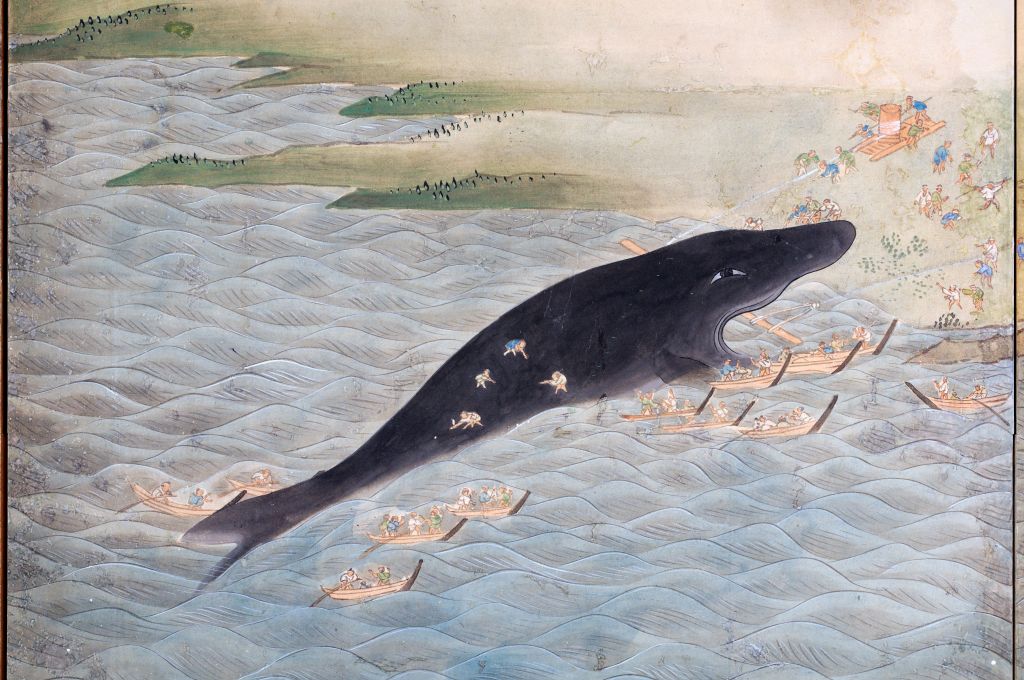
Whale God Ukiyoe

In pre-seafaring Japan—before Samurai William brought the secret of keels and ocean-going vessels—fishermen were limited to the coastal waters their small ships could take them too. They eked out a subsistence living harvesting what was in reach. But every now and then, the oceans would deliver a bounty beyond imagination.

Whales would sometimes come inland, or beach themselves on the shore. Fishermen hunted these whales in a practice called Passive Whaling, using harpoons to kill the whale that was trapped in the shallows. This was a rare and auspicious event—a single whale provided vast amounts of meat and resources for the village, and seemed like a gift from the gods. And the whale itself was only a piece of the bounty. Whales often came in following larges schools of fish, so their arrival meant an abundance of sea life beyond the leviathan itself. The arrival of a whale could save a village teetering on the edge of starvation and ruin. It was mana from the oceans.

Passive Whaling Ukiyoe

Like modern Cargo Cults, the villagers could not understand from where or why the whale came in to shore. They only knew that a whale meant wealth and rare full stomachs. Whales were considered to be embodied deities (神体; shintai), and whale religions sprang up in coastal villages, called Hyochakushin (漂着神; Drifting Ashore God) or Yorikami Shinkyo (寄り神信仰; The Religion of the Visiting Kami).

The Whale and Ebisu

These original whale cults were primitive. The people praying generally had one request—send more whales. But in time they evolved. Like many religions, the Whale Cults in Japan were built on a portion of respect and gratitude and a portion of fear. Because whaling—even Passive Whaling—was a dangerous operation, some whale religions also saw in whales the ability to be malevolent gods, and prayed to appease their spirits and assuage their wrath. Bad storms of poor catches could mean an angry whale god, and nobody wanted that.

In time, these whale religions merged with another, more popular deity, the god of abundance Ebisu. Whales were first thought to be emissaries of Ebisu, and then became considered to be an incarnation of Ebisu himself. Because whales were thought to have the power to control fish, fishermen began carrying images of the god Ebisu as a whale to give them the same fish-controlling powers.

Kujira Jinjya – Whale Shrines

120713_1102

When you have feasted on the body of a god, it only makes sense to give the leftovers a proper burial. After stripping the body of everything useful, villagers buried the whale carcass in mounds called Kujira Tsuga (鯨塚; whale mounds). Kujira Tsuga were capped with monuments of some sort, varying from carved stone tablets to pagodas to small wooden or rock shrines. Often these Kujira Tsuga were created in memory of some particularly bountiful harvest, and annual festivals where held like the Daihyo Tsuifuku (大漁追福; Big Catch Memorial Service). Or people prayed to the Kujira Tsuga for Kaijyo Anzen Kito (海上安全祈祷; Prayers to Ensure Safety at Sea).

Places where passive whaling was more prevalent also had Kujira Haka (鯨墓; whale graveyards) and Kujira Ishibumi (鯨碑; whale stone monuments). There are about 100 known whale graveyards throughout Japan.

Many Kujira Tsuga have their own legends and myths. In Miyagi prefecture, Kesenmema city, Karakuwa town, a legend is told of a ship foundering in the storm that was approached by two massive, white whales. The two whales swam to either side of the ship and steadied it, guiding it into port before sailing away. From that day forward, the citizens of Karakuwa down abandoned their ancient custom of whale eating.

The legend is attached to the MIsaki Shrine in Karakuwa, but the connection is not exactly accurate. Misaki Shrine is an old Kujira Tsuga, raised over a whale corpse and topped with a stone monument expressing gratitude for the whale’s death.

In Ehime prefecture, Seiyo city, Akehama town there are three known Kujira Tsuga, one of which is high up in the mountains. The shrine is ancient, and overlooks the ocean. It now sits along the national highway route making it much more accessible. Hauling up that carcass must have been quite the event.

On June 21st, 1837 (Tenpo 8th), a massive whale came to shore directly underneath this shrine. This was during the Great Tenpo Famine, and the whale saved the entire area from starvation. The villagers gave the whale a posthumous Buddhist name, meaning roughly “The Great Whale Scholar of the Universe who Brings Health.” That was extremely rare at the time, as posthumous Buddhist names was an honor reserved for great lords. The shrine is still honored by the villagers today

Whalebone Tori Gates

Whalebone Tori Japan

By the Edo period, Japan had become a seafaring nation and created a whaling industry and culture. Whaling Associations established and maintained official Whale Shrines in coastal areas, many of which still exist today. Whale shrines were also built in Taiwan when it was under Japanese rule, usually dedicated to Ebisu.

The most dramatic of these have Whalebone Tori gates—the picturesque post-and-lintel design that signifies the presence of a kami spirit.. The oldest Whalebone Tori is in Wakayama prefecture, Taijicho town, called the Arch of Ebisu. Ihara Saikaku mentions this Tori in his book Nippon Eitaigura (日本永代蔵; Japan’s Warehouse of Eternity; 1688). The tori is probably much older, however. The newest whalebone tori is in Nagasaki, Shinkamigostocho town at the Kaido Jinjya (Shrine of the Sea). Dedicated in 1973, it was built by the Japan Whaling Association.

Nirai Kanai

In an odd and unrelated Okinawan legend, a whale dressed in a kimono was said to have brought the secrets of rice cultivation to Japan. You can read more about this in my article on Nirai Kanai.

The Curse of the Bakekujira

Island Whale Ukiyoe

There are two odd footnotes to the story of the bakekujira, that don’t really fit in anywhere else so I am sticking them on here at the end.

In the 1950s, manga artist Mizuki Shigeru was working on a kamishibai story about the bakekujira, and also eating a lot of whale meat. He suddenly came down with a terrible fever, that only stopped when he quit working on the story. He calls this the “Curse of the Bakekujira.”

In 1983, an intact whale skeleton was spotted floating off the shores of Anamizu, Ishikawa prefecture. The press jumped on the story naming it a “real-life bakekujira.”

Translator’s Note:

This article was done at the request of comic book writer Brandon Seifert, who does the incredibly cool folklore/horror comic Witch Doctor, as well as other things. If you are a folklore fan, I highly recommend his work. And look for the bakekujira to possibly pop up his boney head in one of Seifert’s upcoming comics!

Further Reading:

For more tales of ocean-going yokai, check out:

Umibozu – The Sea Monk

Funa Yurei

Nirai Kanai

The Appearance of the Spirit Turtle

The Tale of the Hashihime of Uji

Toriyama Sekien Hashihime of Uji

Translated from the Heike Monogatari

During the Imperial reign of the Emperor Saga, there lived a courtly lady consumed by jealousy. So powerfully was she in jealousy’s grip that she made a pilgrimage to the shrine at Kifune and cloistered in prayer. For seven days, she devoted herself to a single-minded wish: “Oh great and powerful Kami of Kifune, grant me the powers of a devil while I am still living. Make me a fierce being, terrible to behold. Let my outer form match the flame of jealousy that burns so brightly within. Let me kill.”

That great miracle-working Kami of Kifune understood the depths of her desire, and heeded her call. “I am moved by pity and by the sincerity of your prayer. If you wish to become a living oni, to change into a monstrous form, get thee to the Kawase river in Uji. Perform the ceremony I shall now teach you, and then return to submerge yourself in the waters of the river. Do this for 21 days.” This courtly lady saw and heard the manifestation of this celestial being, and was in rapture.

The woman returned to the capitol city and made her preparations. She found a secluded spot where she could work her magic. First, she twisted the long strands of her hair into five horns. Then she ground cinnabar for her face and vermillion for her body until she was as bright red as an oni of legend. Finally, she crowned her head with a three-pronged trivet, and set in it three torches of burning pine. In her teeth she clenched two further torches.

Her preparations complete, she ran south down Yamato-oojidori, torches blazing in the deep night, skin bright red and with an iron crown resting on her eyebrows. Her every aspect was that of an oni, and all who saw her collapsed, dying of terror at the manifested horror they had seen. At the end of her path was the Kawase river, where the lady dutifully sank beneath its waters. As promised by the Kami of Kifune, after 21 days she transformed in living body into an oni, the dread Bridge Princess called Hashihime.

In this way the Hashihime took her revenge on the man who was the target of her jealousy, and all of his relatives above and below. Her wrath knew no boundaries. When she slew men, she appeared as a woman. When she slew women, she appeared as a man. All in the town were a’ feared of her, and during the Hour of the Monkey none dared leave their dwelling.

Utagawa_Kuniyoshi_Watanabe_no_Tsuna_and_the_Hashihime_of_Uji

At that time, the lord Minamoto no Yorimitsu had four brave fighters and protectors. Known as the Four Heavenly Kings, they were Watanabe no Tsuna, Kimitoki, Sadamichi, and Suetake. Of these Tsuna was the greatest.

Yorimitsu had business in the town of Ichijo Omiya and dispatched Tsuna as a messenger. Tsuna arrived on horseback in the dead of night, the famous sword Higekiri (Beard Cutter) tucked into his obi. He planned a short trip, and to soon return with a message for his master. Yet when he crossed the Modari Bridge over the Hori river, on the Eastern side he saw a beautiful woman of a bit more than 20 years of age. Her skin was as white as new-fallen snow, so much that she had the visage of a yurei. Yet he saw the flair of her under-kimono peeking out—red as the red-blossomed plum tree. She bore a sash across her chest, and a sutra in the folds of her sleeves.

She stood on the bridge, facing South. She was quite alone. Tsuna mounted the bridge from the West, and the sound of his horse cracking the silence of the night.

The woman called out, “What business is yours? I am making a pilgrimage to Gojo. It is dangerous to travel alone at night. You gave me a scare!” Her tone was overly familiar for such a meeting. Tsuna answered “Come upon my horse. It would be my pleasure to help you on your errand.”

Tsuna brought his horse near and dismounted, then lifted the woman into the saddle. She held the warrior tight, as he spun his horse around and headed West. The woman directed him towards Shogimachi, saying “Great sir, in truth I am not on a pilgrimage to Gojo. My home lies a little bit outside of the capital. If you would do me the honor of taking me as far as the gates, I would be in your debt.”

Tsuna complied, saying it would be his pleasure to see the lady home. With that, the woman changed into the form of an oni, saying “It is I who shall be taking you to Mt. Atago!” She grabbed Tsuna’s topknot and flew into the air taking Tsuna with her. Tsuna was caught off guard for only a moment, before drawing Higekiri and slicing off her arm mid-air. He looked into the sky and saw the North Star as he plummeted to earth. Tsuna flees, the hand of the severed arm still holding his topknot. Where the hand held tight his hair had turned white as snow.

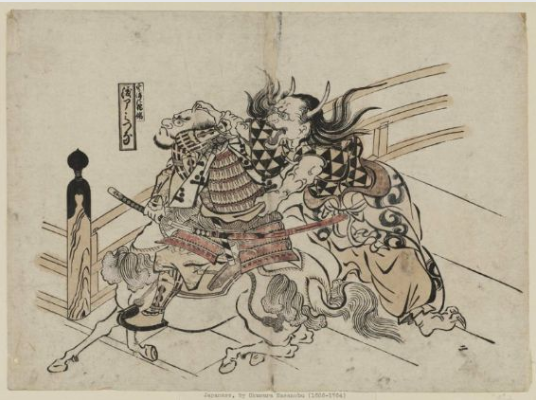
Okumura_Masanobu_Watanabe_no_Tsuna_and_the_Hashihime_of_Uji

Tsuna gave Lord Yoshimoto quite a shock when he returned, severed arm still firmly in place. The sorcerer Abe no Seimei was summoned, who advised Tsuna to be given seven days leave, during which time he must pray to the two Deva kings for release from the arm.

Translator’s Note:

Part one of the long-requested Hashihime. I will do a standard entry next with the history and different versions of the yokai, but I thought it might be fun to translate the actual Heiki Monogatari passage on Hashihime instead of just referencing it. Apparently I have a strange idea of fun … Heian period Japanese is hard!

This is only one version of the tale of the Hashihime of Uji. Because the Heiki Monogatari comes from an oral tradition, there are multiple versions of every tale. The second tale, of Tsuna and the sword Higekiri cutting off the arm of an oni, is only sometimes connected to the Hashihime (and even then only marginally). Other times he meets the oni at the Rashomon gate and cuts off its arm there. The tale follows with the oni coming back to Tsuna in some hidden form and stealing back its arm.

Further Reading:

For more tales of dangerous women on hyakumonogatari.com, check out:

Ushi no Koku Mairi – Shrine Visit at the Hour of the Ox

Nure Onago – The Soaked Woman

Takaonna – The Tall Woman

Takaonna – The Tall Woman

Translated from Mizuki Shigeru’s Mujyara and Japanese Wikipedia

The takaonna (tall woman) is a yokai with an interesting hobby. If she is walking along, and sees a two-story brothel, she stretches the bottom half of her body so she can peek in on men enjoying the delights inside. It’s said that the takaonna was a homely woman who could never attract male companionship, changed into a yokai by her own desire.

Takaonna were first illustrated by Toriyama Seiken in his The Illustrated Night Parade of a Hundred Demons (Gazu Hyakki Yagyo ). He drew a picture and a name, but with no story or explanation for the stretching yokai.

Folklorist Fujisawa Morihiko first recorded the story of the ugly woman peeking into brothel windows in his book Complete Discussions of Yokai (Yokai Gadan Zenshu), although he speculates that the local legends of the takaonna probably came from people seeing Toriyama’s illustration, then imagining a story to go along with it. Novelist Yamada Norio furthered the legend of the takaonna in his book Travels in the Weird Tales of Tohoku (Tohoku Kaidan no Tabi). Yamada tells of a woman consumed by jealousy and lust but too ugly to get a man, who then transforms into the takaonna and menaces anyone enjoying the pleasures of the flesh that she was denied.

There is a possible (but obscure) connection to a more horrible creature from Wakayama prefecture, a female demon called the takanyobo (tall wife).

It is said that the takanyobo was once the wife of Kijishi, a woodcutter of Kizaku village. She was a strong woman who would go and cut wood with him in the forest. He thought he was a lucky man to have such a wife, but she was actually a yokai. Kijishi was a successful woodcutter, and he always kept a servant. But the servant wouldn’t stay long. Over a year, Kijishi went through 30 servants. It was only when his own baby also disappeared that Kijishi discovered the truth at last—his yokai wife had eaten them all.

Kijishi confronted his wife and threw her into a well. He thought to let her die down there, but to Kijishi’s surprise she stretched the bottom half of her body right to the top of the well, then clambered out and made her escape into the night.

Translator’s Note:

The kanji for the tall woman is exactly what it says 高 (taka; tall) + 女(onna; woman). She is most likely an original creation of Toriyama Seiken, who apparently wasn’t feeling very creative because he didn’t give her a story. Fortunately the people of the Edo period filled in for him, and came up with a nice little urban legend based on his image.

I think the connections are obvious between the takaonna and the later kuchisake onna (split-mouth woman). Both yokai are urban legends more than folklore, both are hideously ugly women, and both have a grudge against the beautiful people they can never be, and the love (or sex) they can never share.

Further Reading

For more female yokai stories, you should read:

Bakeneko Yujo – The Bakeneko Prostitutes of Edo
Nure Onago – The Soaked Woman
The Long-Tongued Old Woman

What Does Yokai Mean in English?

To learn much more about Japanese Ghosts, check out my book Yurei: The Japanese Ghost

You probably think you already know what yokai means. And, you are probably wrong. Or at least, you are only partially correct. There is more to yokai than you think.

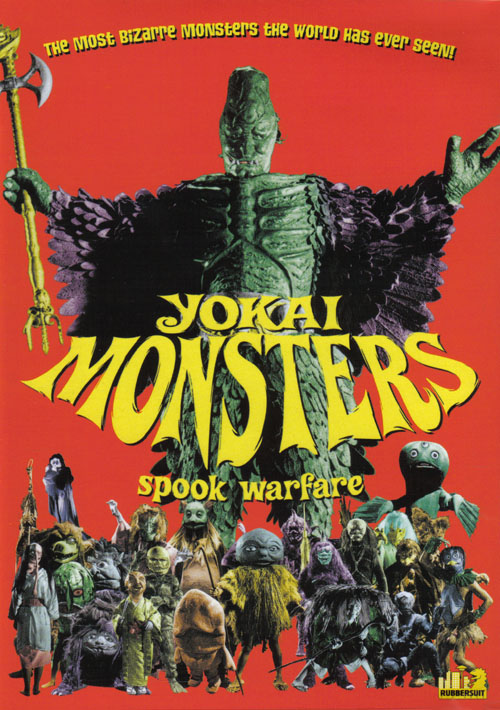
Thanks to movies like “The Great Yokai War,” and comics and books like “Nura: Rise of the Yokai Clanand “Yokai Attack!,” yokai as a word is slowly making its way into the English language. People are becoming aware of Japan’s legacy of magic and mystery. But, “yokai” is entering English with a meaning almost-but-not-quite the same as the Japanese meaning.

It is kind of like the word “manga”—in English, manga has come to mean “Japanese comics.” Exclusively. But in Japanese, manga just means … comics. All comics. Regardless of national origin. Iron Man? Manga. Mickey Mouse? Manga. Rex Morgan, M.D.? Manga. Tin Tin? Manga. And it doesn’t even specifically mean books (That would be “manga no hon.”) “Manga” can mean toys, movies, games … anything comic-related. It has a vast meaning beyond the limited scope of usage that we have given the word in English. I digress.

Of course, yokai can refer to Japan’s menagerie of monsters. All of the beasties and spirits—the baku, the kodama, the yuki onna, the kappa—all of these are yokai. I am as guilty as the next person for using yokai as a generic term for “Japanese monster.” It works. It fits. But that’s not the whole story.

Many other things are also yokai, things that are not creatures of any sort. Like the word manga, the Japanese usage of yokai has a much larger scope. It covers much more than just monsters.

(It is worth noting that “Nura: Rise of the Yokai Clan” isn’t called that in Japanese. The original title is “Nurarihyon no Mago” meaning “Nurarihyon’s Grandson.” The term “Yokai Clan” was tagged on to appeal to English readers.)

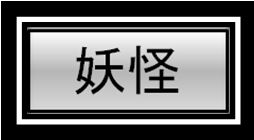
Breaking Down the Kanji – 妖怪

Like most Japanese words, the key to the meaning is in the kanji. So let’s start there.

Yokai uses two kanji;

  • (yo) which means “mysterious, bewitching, unearthly, weird.” It doesn’t really have a scary nuance to it, but more of the attraction to something beyond the normal. It can be used in words like yoka (妖花) meaning an ethereally beautiful flower, or ayashii (妖しい) meaning bewitching or charming.
  • (kai) which means “mystery, wonder, strange.” Kai has more of a sense of horror, or the bizarre. It is the same kanji used in kaidan (怪談) meaning “weird tales” and kaiki (怪奇) meaning “bizarre, strange, outrageous.”

Put those two together and you get yokai妖怪, with a direct translation along the lines of “something that is otherworldly and strange yet captivating and appealing.” But direct translation of kanji almost never gives the full picture.

So, What Does Yokai Really Mean?

I think a better translation would be “mysterious phenomena”—or even “Fortean phenomena” if that means anything to you. “Mysterious phenomena” is probably better.

Along with folkloric creatures, yokai can refer to things like strange weather, mysterious illnesses, optical illusions, weird fruit, etc … And yokai is not limited to Japan. In his Yokai Encyclopedias, comic artist/folklorist/genius Mizuki Shigeru covers things like the Moai statues on Easter Island, or bigfoot and the yeti, or vampires and ghouls, or rains of frogs. Yokai is a broad, sweeping term that can cover pretty much everything weird on Earth.

Here’s what Japanese Wikipedia has to say:

“Yokai as a term encompasses oni, obake, strange phenomenon, monsters, evil spirits of rivers and mountains, demons, goblins, apparitions, shape-changers, magic, ghosts, and mysterious occurrences. Yokai can either be legendary figures from Japanese folklore, or purely fictional creations with little or no history. There are many yokai that come from outside Japan, including strange creatures and phenomena from outer space. Anything that can not readily be understood or explained, anything mysterious and unconfirmed, can be a yokai.”

That great arbitrator of all things yokai, Mizuki Shigeru, further breaks down the word yokai into four separate categories:

  • Kaiju – 怪 (kai, mysterious) + 獣 (ju; beast), meaning “monster.” Most of Japan’s famous yokai are kaiju. Godzilla is a dai-kaiju, or “great monster.”
  • Choshizen – 超 (cho; super) + 自然 (shizen; natural), meaning the supernatural, including mysterious natural phenomena.
  • Henge – 変 (hen; strange) + 化(ge; to change, transform) , meaning shape-shifters like tanuki, foxes, and old cats.
  • Yurei -幽 (yu; dim) + 霊 (rei; spirit), meaning ghosts, and spirits of the dead.

So if you think in the classic biological classification model, then you would have something like this:

  • Bakeneko is a yokai > henge
  • Oiwa is a yokai > yurei
  • Bigfoot is a yokai > kaiju
  • Bermuda Triangle > yokai > choshizen

(Very) Brief History of the Word Yokai

Yokai is a pretty old world, pre-dating most of Japanese folkloric vocabulary. The oldest known use of “yokai” is from the 1st century text “Junshiden” (循史伝) where the author writes “The yokai was in the Imperial Court for a long time.” The term is used to describe a sense of unnatural anxiety and foreboding. It shows up again in 772, in “Shoku Nihongi” (続日本紀) where a ritual cleansing of the palace is recommended to “clear away the yokai.” It isn’t used in the sense of any particular bad creature, but just accumulated “bad juju” that might be clinging to the palace.

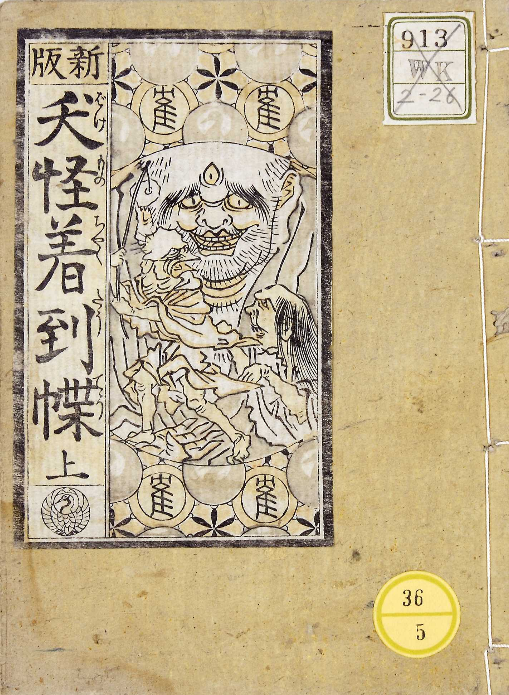
Yokai as a term for Japan’s folkloric beasts didn’t really appear until the Edo period, with the publication of “Yokai Chakutocho” (夭怪着到牒 ), a yokai bestiary of the kind still familiar today. Sharp-eyed readers ( or those who know Japanese) will see that a different set of kanji was used; 夭 (yo, calamity, disaster ) + 怪 (kai). That kanji has a much more distinct menacing feel to it.

Texts from the Edo period also distinguish between types of yokai, such as “strange natural phenomenon” or “strange living things.”  Also during the Edo period, when Japan began to have contact with other cultures, books began to be published of accounts of “Yokai of the West.”

Now you Know What Yokai Means!

Of course, this is the quick and dirty version.  Whole books can and have been written on yokai, on the history of yokai, on the evolution and social meaning, etc … At least now when you want to start diving into things like that, you will have a clearer understanding of what the word yokai actually means!

Further Reading:

Secrets of the Yokai  – Types of Yokai

Secrets of the Yokai II

How Do You Say Ghost in Japanese?

Translator’s Note:

I wrote this article mainly to clear up some misapprehensions.  More and more I see people refer to yokai as if it meant some sort of tribe of Japanese monsters.   And while that isn’t exactly incorrect, it is a simplification. So here is a little deeper dive for yokai fans.

Yūrei-zu – A Portrait of a Yūrei, a Japanese Ghost

Translated from Mikzuki Shigeru’s Yokai Zukan

To learn much more about Japanese Ghosts, check out my book Yurei: The Japanese Ghost

The moon hangs in the sky like the blade of a sickle, giving off a dim glow. A ghostly air permeates the scene, and from a thicket of bamboo emerges the form of a single yurei.

An emaciated body wrapped in a kyokatabira, the traditional white burial kimono, this figure is the very epitome of a yurei. Our eyes are instantly drawn to the clenched teeth from which dangles a pale, severed head. Held tightly by the hair, the yurei shows no sign of allowing its precious bounty to drop, and its expression challenges anyone to make it try. And while the eyes of the dead, severed head are closed, the eyes of the yurei look as if they could pop out of their eye sockets at any moment. An unearthly light surrounds the yurei and its head. The scene is blood curdling.

The head is painted in vivid colors, but we do not know its story. There must have been some terrible curse, some tragic event, to produce such a terrifying circumstance.

Although there are other paintings along similar themes, in this work the artist Kawanabe Kyosai has emphasized the horror, the eerie nature of the image. Kyosai is known as a master of yurei paintings, and surely this is one of his masterpieces.

Translator’s Note

This is Mizuki Shigeru’s commentary on a famous painting by Meiji-era artist Kawanabe Kyosai (河鍋暁斎; 1831-1889). Known as the last great painter in the Japanese style, Kyosai was said to be the inheritor of Hokusai and the other great ukiyo-e masters, although he did not study under Hokusai.

This painting, titled simply Yurei-zu (幽霊図), meaning “Picture of a Yurei,” is india ink on silk and was painted in 1870 – The 3rd year of the Meiji period. The painting is currently housed in the Fukuoka City Museum.

The story of this particular painting is not known, and indeed there may be no story. Kyosai painted a few portraits of yurei carrying severed heads. The reason for this is usually related to a story from Kyosai’s youth. As a nine-year old boy, he found a severed head by the side of a river, and brought it home to study and play with it like some discovered toy. When his parents found the head and ordered Kyosai to throw it back in the river, he did so only after he drew the head from every angle, fully studying his gruesome find.

Further Reading:

Check out other yurei art from hyakumonogatari.com:

Hokusai’s Manga Yurei

More Hokusai Manga Yurei

Previous Older Entries Next Newer Entries

Copyright notification

All translations and other writing on this website were created by Zack Davisson and are copyright to him.

Copyright notification

In accessing these web pages, you agree that any downloading of content is for personal, non-commercial reference only.

No part of this web site may be reproduced or transmitted in any form or by any means, electronic, mechanical, photocopying, recording or otherwise, without prior permission of Zack Davisson.

Copyright notification

For rights clearance please contact Zack at:

zack.davisson (at) gmail.com

Thank you.