Nezumi Otoko – Rat Man

Nezumi Otoko

Translated and sourced from Kitaro’s Daihyaka, Mizuki Shigeru’s Mujyara, Japanese Wikipedia, and various Gegege no Kitaro comics

Half yokai. Half human. All scoundrel. Nezumi Otoko is the trickster character in Mizuki Shigeru’s seminal yokai comic Gegege no Kitaro. Filthy, greedy, and conniving, Nezumi Otoko sides with whoever looks like they will come out on top, and yet he always manages to be back with Kitaro for the next adventure. Even though his constant schemes and betrayals earn the ire of everyone around him, Mizuki Shigeru has long said that Nezumi Otoko is his favorite character and that without Nezumi Otoko Gegege no Kitaro could not exist.

What Does Nezumi Otoko Mean?

Almost all sources (including this article) give Nezumi Otoko’s name as “Rat Man” in English, but this is not technically correct. This translation is based on a pun in Japanese and his appearance rather than his actual name. The truth is more complicated.

Written in Japanese, his name is ねずみ男 (Nezumi Otoko). Sharp-eyed readers will notice that while he uses the kanji for “man” (男; otoko), he doesn’t use the kanji for “rat” (鼠; nezumi). Because “nezumi” is written in hiragana, there is no inherent meaning. One those rare occasions where kanji is used, Nezumi Otoko’s name is given as 根頭見 (根; ne – root,) + (頭; zu – head) + (見; mi – look). So, a transliteration of would be “Guy With the Root-Shaped Head.” If you look at him, that fits pretty well. But it’s more of a mouthful than “Rat Man.”

Nezumi Otoko Kitaro Mizuki Shigeru

Even then, Nezumi Otoko is only a nickname. In one adventure where the Kitaro gang journeyed to Nezumi Otoko’s homeland, his true name was revealed as Nezumi Pekepeke (根頭見ペケペケ). This was an inside joke Mizuki Shigeru made to himself, as “pekepeke” is the word for “shit” in the language of the Tolai people of New Guinea where Mizuki once lived. Nezumi Pekepeke is one of those “secret facts” that show up on yokai quizzes. For all intents and purposes, his name is Nezumi Otoko.

Nezumi Otoko has one more nickname, Bibibi no Nezumi Otoko (ビビビのねずみ男). This is a play-off of Kitaro’s own nickname Gegege no Kitaro, and refers to the onomonopiac sound of slapping someone in the face (which Nezumi Otoko does often). He is also known to use the pseudonym Nagai Futen in his schemes, and has a passport and documentation in that name.

The Origin of Nezumi Otoko

Nezumi Otoko is a half-yokai, what Mizuki Shigeru calls a hanyokai and what Takashi Rumiko calls a hanyo. But even though he is half-yokai / half-human, the accounts of his birth vary and the human half is never explained.

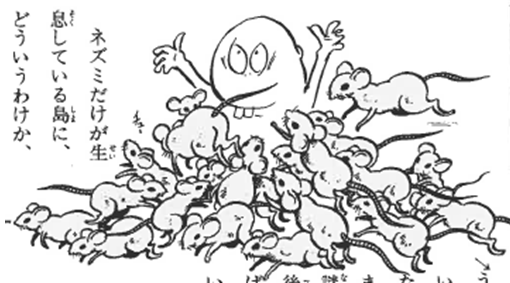
In the most official version, the one used for his profile in Kitaro’s Daihyaka (鬼太郎大百科), Nezumi Otoko was mysteriously born as a human baby on an island populated only by rats. That’s it. End of story.
Baby_Nezumi_Otoko_Large

In another story, Kitaro’s Hell Compilation (鬼太郎地獄編), Nezumi Otoko comes from a land on the boarder of the world of the living and the world of the dead. This world is populated by people like himself, and “Nezumi Otoko” is a general term for the species. Nezumi Otoko’s mother appears in this story, looking like female version of the rat man himself. But she is later revealed to be Sasori Onna in disguise as part of a revenge plot by Nurarihyon. However, Nezumi Otoko’s world and people are never referenced again outside of Kitaro’s Hell Compilation.

About Nezumi Otoko

sssssssssssssssssssssssssss

Whatever his origins, Nezumi Otoko is a true yokai. He is over 360 years old, and likes to claim that he has never taken a bath in all that time (which is untrue, like almost everything Nezumi Otoko claims). His body is repulsive, covered in ringworm and scabies, and is home to unique diseases that evolved to live only in Nezumi Otoko. He can eat anything, no matter how rotten or unpalatable.

Nezumi_Otoko_Ringworm_Large

His most powerful weapon is his own filth. Nezumi Otoko’s breath is so foul it can knock people out cold, and he can fart with the power of a rocket blast. In some stories, he is even able to fly by spreading out his cloak and farting, using the hot air to take off. His cloak is as dirty as he is, and can also be used as a weapon based on its stink alone.

He has other random weapons in his arsenal—his rat-like teeth are sharp enough to bite through things, and his long whiskers have been shown to be as strong as iron. He is quick with a slap, earning his nickname Bibibi no Nezumi Otoko. Mizuki Shigeru has a tendency to make things up as he goes along, so Nezumi Otoko might unveil some special power for one story, never to be mentioned again.

Even though he isn’t officially “Rat Man,” his rat-like nature is enough to excite the appetite of the cat girl Neko Musume and other cat yokai. Cats are Nezumi Otoko’s natural enemies, and he is terrified of them.

Nezumi_Otoko_Neko_Musume_Attack

Nezumi Otoko – For Love or Money

Money is Nezumi Otoko’s main motivation, and he is constantly scheming to acquire it even though it always slips through his fingers.

Whenever possible, he secretly charges people for Kitaro’s help or even sells humans to monsters if the price is right. As part of his schemes, Nezumi Otoko claims to be a degreed professor from the prestigious Yokai University and deeply knowledgeable about all things yokai. This isn’t a complete lie, and it is often speculated that Kitaro and Nezumi Otoko met as co-students at Yokai University. (Although Nezumi Otoko’s graduation is dubious).
Nezumi_Otoko_in_Love

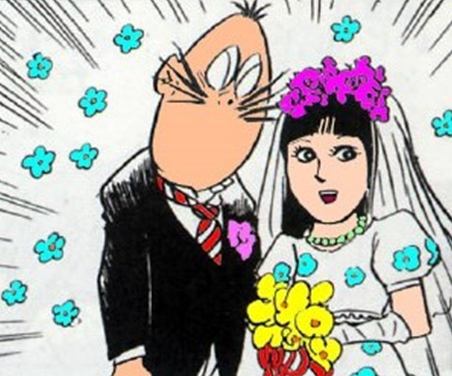
The other thing that drives Nezumi Otoko is his quest for love. In many stories, he has attempted to romance some unsuspecting woman, usually though devious schemes and hiding his true nature. But, as is the case with all of his plans, the truth eventually outs and all ends in tears.

Brief Publication History of Nezumi Otoko

Like Medama Oyaji and Neko Musume, Nezumi Otoko is an original yokai creation from Mizuki Shigeru. He first appeared in the story “The Lodging House” (下宿屋) in the rental manga Hakuba no Kitaro (墓場の鬼太郎; Graveyard Kitaro). In that story, Nezumi Otoko was an unnamed servant of Dracula the 4th, and was in charge of securing lodgings and victims for his master. He disappeared halfway through the story when Kitaro and Medama Oyaji met the true menace.

Nezumi_Otoko_First_Appearance_Large

He appeared again, this time officially as Nezumi Otoko, in the story “The Strange Fellow” (おかしな奴) . He presented himself to Kitaro and Medama Oyaji as a famous Yokai Professor, offering his services to them—for a modest fee, of course. Another introduction happened in the Gegege no Kitaro novel from Kodansha. Nezumi Otoko shows up out of nowhere and steals a fish dinner out from under Neko Musume. Hijinks ensue, and Nezumi Otoko is soon part of the regular group.

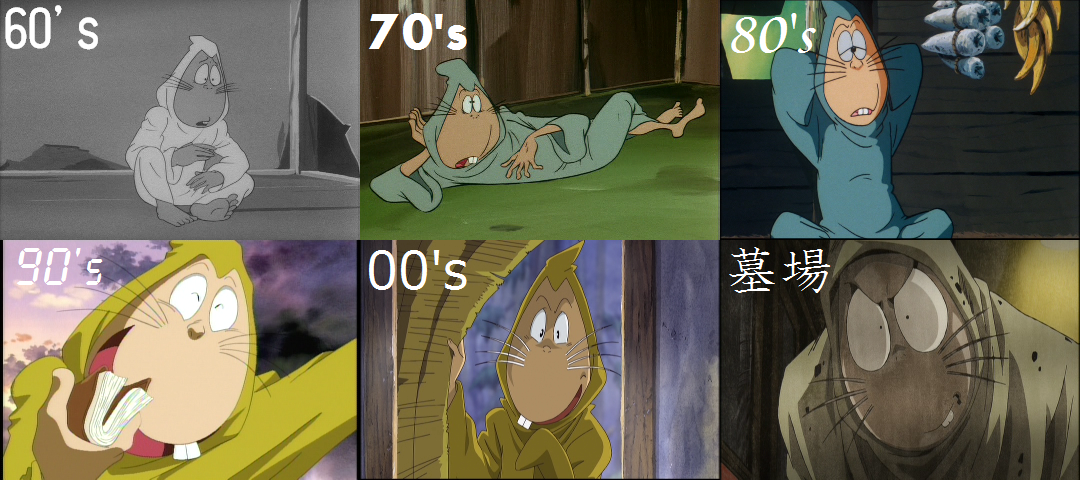
Nezumi Otoko’s first animated appearance was in “Yasha” (夜叉), the second episode of the first season of the animated Gegege no Kitaro. He has appeared in every series of the cartoon ever since, as well as several live-action TV shows and movies.
Nezumi Otoko Anime History

Nezumi Otoko has appeared in every possible medium, and on every possible product. He even has his own train. You would be hard-pressed to find anyone in Japan who didn’t know Nezumi Otoko, and he is one of the most well-known and popular characters in Japan.

Nezumi Otoko Statue

Mizuki Shigeru on Nezumi Otoko

In any interview, whenever he is asked about his favorite yokai, Mizuki Shigeru is quick to answer “Nezumi Otoko.” He likes the rest of the Kitaro family about the same, but Nezumi Otoko is his favorite child. Mizuki explains “Kitaro is actually kind of dumb. He’s like Superman, giving everything he has to random strangers without hope of reward or happiness. That’s boring. If I don’t put Nezumi Otoko in there to mess things up a bit, I don’t have a story. “

Mizuki further says that his original goal with Kitaro was social commentary and satire. It was at the publisher’s request that he change his stories to focus on Kitaro as a Hero, using his supernatural powers to defeat monsters. Nezumi Otoko is the only character that embodies Mizuki’s original intentions for the comic.

Nezumi Otoko Kitaro Comic

Mizuki says his own life philosophy is much closer to Nezumi Otoko’s—he values money, luxury, and happiness and would never give it away for free like Kitaro does. Sometimes he uses Nezumi Otoko to voice his own opinions in a way he can’t with Kitaro. Life was exceptionally hard for Mizuki until he found his success as a comic artist, and those feelings of hunger, of failure, of grasping for success that continually eludes you, are embodied in Nezumi Otoko.

When Mizuki Shigeru wrote his own autobiography and history comic, Showa: A History of Japan, he used Nezumi Otoko as his narrator and mouthpiece.

Nezumi Otoko Showa

Nezumi Otoko’s Model

Along with himself, Mizuki Shigeru based Nezumi Otoko on his friend Umeda Etaro (梅田栄太郎). Umeda worked in the rental manga market along with Mizuki Shigeru, and he was always thinking up get-rich-quick schemes to try and squeeze a little bit more money out of kids. And like Nezumi Otoko, his schemes always failed.

In the 2010 drama Gegege no Nyobo, Uragi Yoshino (浦木克夫), was also named as an influence on Nezumi Otoko.

Translator’s Note

This is my first piece in a series on yokai who appear in my translation of Showa 1926-1939: A History of Japan from Drawn & Quarterly.

In doing my translation on Showa 1926-1939: A History of Japan and my work on Kitaro (also from Drawn & Quarterly) I gained a new appreciation of Nezumi Otoko. Just like Donald Duck and Wimpy from Popeye, Nezumi Otoko plays an important role in Gegege no Kitaro, and it is easy to see why he is Mizuki Shigeru’s favorite.

Just like Walt Disney soon learned that Mickey Mouse—while popular—was too bland of a character to carry on a story by himself, Mizuki needs Nezumi Otoko to be greedy, to betray, to do the wrong thing; all of which pushes the story forward.

Further Reading:

For more on Mizuki Shigeru and his yokai, check out:

Mizuki Shigeru in Rabaul

What are Hanyo?

Mizuki Shigeru’s Showa 1926-1939: A History of Japan

Ijuu – The Strange Beast

Mizuki Shigeru Ijuu Strange Beast

Translated and Sourced from Mizuki Shigeru’s Mujyara, Kaii Yokai Densho Database, Japanese Wikipedia, and Other Sources

If you are wandering through the forests of Japan and happen across a beast that looks like a strange blend of monkey and bear, don’t be scared. Just offer to split your lunch with it and the creature will most likely repay you by carrying your heavy load. At least that’s the story of the Ijuu, the strange beast.

What Does Ijuu Mean?

Whoever named the Ijuu wasn’t feeling particularly imaginative. Ijuu has two kanji making up its name, 異 (I; strange, mysterious) + 獣 (Juu; beast, creature). The name translates literally as “strange beast.”

The Tale of the Ijuu

There is only one story of the Ijuu, and it comes from Suzuki Bokushi’s Edo period book Hokuetsuseppu (北越雪譜; Snow Stories of North Etsu Province, 1837).

Suzuki Bokushi Iju Strange Beast

Long ago, in Echigo province (modern day Niigata prefecture), a porter named Takesuke was engaged in hauling a heavy load over a mountain pass to a faraway town. He had gone about 7 shaku (28 kilometers), when he became exhausted and hungry. Takesuke leaned his backpack against a tree, then sat down and rested against that same tree, unpacking his lunch and preparing to tuck in.

Before Takesuke could get a bite into his mouth, the thick bamboo of the forest was pushed aside, and an incredible monster stepped into sight. It was larger than a human, and looked like some mix between a monkey and a bear. It had long tufts of hair on its head, and fur covering its entire body.

Instead of panicking, the porter calmly looked at the strange beast. It looked hungry, Takesuke decided. He then casually split his lunch, offering the animal half. The creature was delighted, and accepted the food and ate it with vigor.

With the meal done, the strange beast leapt to its feel and shouldered Takesuke’s burden as if it weighted nothing at all. The porter walked ahead down the mountain trail, while the creature happily ambled along behind. When they got within sight of the porter’s definition, the creature took off the heavy backpack, set it down carefully, and scampered back into the forest.

It was never seen again.

Sakaiminato_Mizuki_Shigeru_Road_Ijyu_Statue_1

Translator’s Note:

Ijyuu is another one-shot yokai with only one appearance, and another translation for reader Michael Goldstein of Yokai Composed.

For as obscure and limited the Ijyuu is, it still got one of the coveted spots as a bronze statue on Mizuki Shigeru Road in Sakaiminato, Tottori prefecture.

Further Reading:

For more mysterious monsters, check out:

Shirime – Eyeball Butt

Onikuma – The Demon Bear

The Kappa of Mikawa-cho

Onikuma – Demon Bear

Onikuma Mizuki Shigeru

Translated and Sourced from Mizuki Shigeru’s Mujyara, Kaii Yokai Densho Database, Japanese Wikipedia, and Other Sources

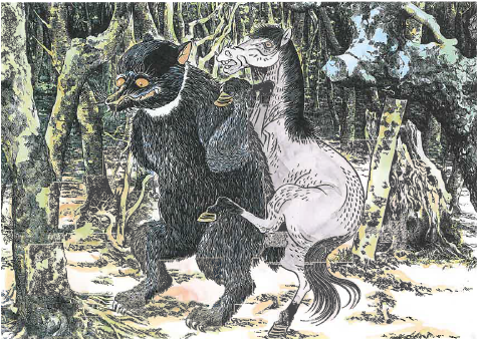
What walks on its hind legs like a human, is covered in fur, and hauls off horses in the middle of the night to eat? If you answered Onikuma, the Demon Bear, then you are definitely up on your Japanese yokai.

What Does Onikuma mean?

The name onikuma is broken down into two kanji 鬼(oni; demon, ogre) + 熊(kuma; bear). It’s an unusual name for a yokai of this type—the vast majority of magical animal yokai use some variation of bake-, like the bakekujira, or bakeneko. I have no idea why this isn’t called a bakeguma, but it just goes to show that folklore doesn’t follow any rules. A monster bear comes tromping through your town, you get to name it whatever you please.

In this case the word “oni” doesn’t mean that this is a half-oni bear. It’s just used as a descriptive term, meaning this is one big, tough bear.

The Legend of the Onikuma

Shunsen Oniguma Ehon Monogatari

Onikuma come from Kiso province (modern day Nagano prefecture). They are a fairly obscure yokai, and one of the few known depictions of them is from the Ehon Hyakumonogatari (1841). Like almost all magical animal yokai, the onikuma is a bear that has lived an exceptionally long life and has transformed into a yokai.

Onikuma have no special powers other than walking on their hind legs like humans, and being exceptionally strong. Legends say an onikuma can move rocks that 10 men together can’t push. There are still some rocks in odd places around Nagano prefecture that are rumored to have been put there by onikuma, since they are far too large for a group of men to manage.

Their favorite food is horse. They are rarely seen, but sometimes sneak into villages at night to carry off horses by their forelegs, which they then devour in their caves.

Hunting the Onikuma

A legend says that a group of villagers once hunted and killed an onikuma. They were sick of their horses being carried off, and tracked the onikuma back to its cave lair. In preparation, they carved long spears from massive trees, and placed fresh meat as bait in front of the onikuma’s cave. When it came out for its supper, the villagers attacked with their long spears, killing it. They took the carcass back to their village where they stretched and tanned the hide. It was said to be big enough to cover the floor of an entire large room.

Henge or Kaiju?

In Hokkaido, instead of transformed animals the term “onikuma” is used for giant bears who have killed and eaten humans. In his book Mujyara, Mizuki Shigeru makes the case that perhaps the onikuma is not a henge-type transforming animal like bakeneko, but just a monstrous bear and should be considered a kaiju (monster) –type yokai.

Translator’s Note:

Onikuma comes by request for reader Michael Goldstein who runs the blog Yokai Composed. It’s one of those yokai where there really isn’t too much to tell—it’s a giant, horse-eating bear. There are quite a few yokai like that, where there is only one story and not much other folklore. Still, demon bears are always cool.

Further Reading:

For more magical animal tales, check out:

Bakeneko – The Changing Cat

Bakekujira and Japan’s Whale Cults

Iriomote Oyamaneko – The Iriomote Great Mountain Cat

Bakekujira and Japan’s Whale Cults

Mizuki_Shigeru_Bakekujira

Translated and Sourced from Mizuki Shigeru’s Mujyara, Kaii Yokai Densho Database, Japanese Wikipedia, and Other Sources

Legends of a Great White Whale usually bring to mind Moby Dick, but the white of this whale is the color of its bones. For bones are all you can see of the Bakekujira—a massive, skeletal baleen whale that appeared and disappeared under mysterious circumstances once of the coast of Japan. Is it a monster? Is it a ghost? Is it a god? No one really knows for sure.

What Does Bakekujira (化鯨) Mean?

Bakekujira’s name is the same as many magical animals in Japanese folklore, with a difference of nuance. For most bake- creatures (bakeneko, bakenezumi, etc … ) the kanji 化 (bake; change) refers to a transformation, the ability to shift from one form to another. In Bakekujira—化 (bake; change) +鯨 (kujira; whale)—bake does not refer to a transformation. It just sounds scary and bizarre. This is one instance where translating bakekujira as “ghost whale” or “goblin whale” instead of “transforming whale” would be perfectly appropriate.

Inland Whaling2 Ukiyoe

The Tale of the Bakekujira

One rainy night, something massive and white appeared off the coast of Okino Island, Shimane prefecture. Fishermen from the village watched it get closer and closer, and finally decided to take a rowboat out and see what it was. From its size, they knew it must be some sort of whale, but no one had seen a whale like that before. As they rowed out their boat, they saw the waters of the ocean glimmer with thousands upon thousands of fish, the likes of which they had never seen.

As they neared the white whale, one of the fisherman threw his harpoon and it passed through the mass of white unnoticed. Their vision obscured by the pounding rain, the fishermen finally got a good look at the monster—it was the skeleton of a great baleen whale, without an ounce of skin nor meat on it. But it was moving and alive.

The men were terrified, even more so because the ocean was writhing with unknown fish, and the skies were filled with strange birds. In the distance they saw an island that hadn’t been there before, as if they had rowed into some mysterious country. Then suddenly the vision ended, and the massive bakekujira—for that is what they called it—retreated back to the open sea as quickly as it had come.

When the fishermen went back to shore, they speculated that it might have been the ghost of a whale killed in a hunt or some strange god. Whatever it was, the bakekujira was never seen again.

The History of the Bakekujira

That’s it. There is that one story of the one appearance of the bakekujira, and that is the sum total of knowledge on the boney beastie. Anything else you read about the bakekujira is pretty much just made up to try and fill in the gaps.

In fact, for being so well-known in the modern world, the bakekujira is a limited and obscure yokai. It wasn’t important enough to be added to Toriyama Sekien’s numerous Edo-period yokai collections; there aren’t any ukiyo-e prints or kaidan collections including the bakekujira—at least not that I could find when I was researching for this article. In fact, the first mention I could find of the bakekujira was from Mizuki Shigeru, whose cool character design seems largely (solely?) responsible for the bakekujira being known today.

But Japan does have a long history of whale gods and venerated bones, to which the bakekujira fits in nicely. So allow me to segue to another aspect of Japanese folklore—the Whale Cults of Japan.

Hyochakushin – The Drifting Ashore God

Whale God Ukiyoe

In pre-seafaring Japan—before Samurai William brought the secret of keels and ocean-going vessels—fishermen were limited to the coastal waters their small ships could take them too. They eked out a subsistence living harvesting what was in reach. But every now and then, the oceans would deliver a bounty beyond imagination.

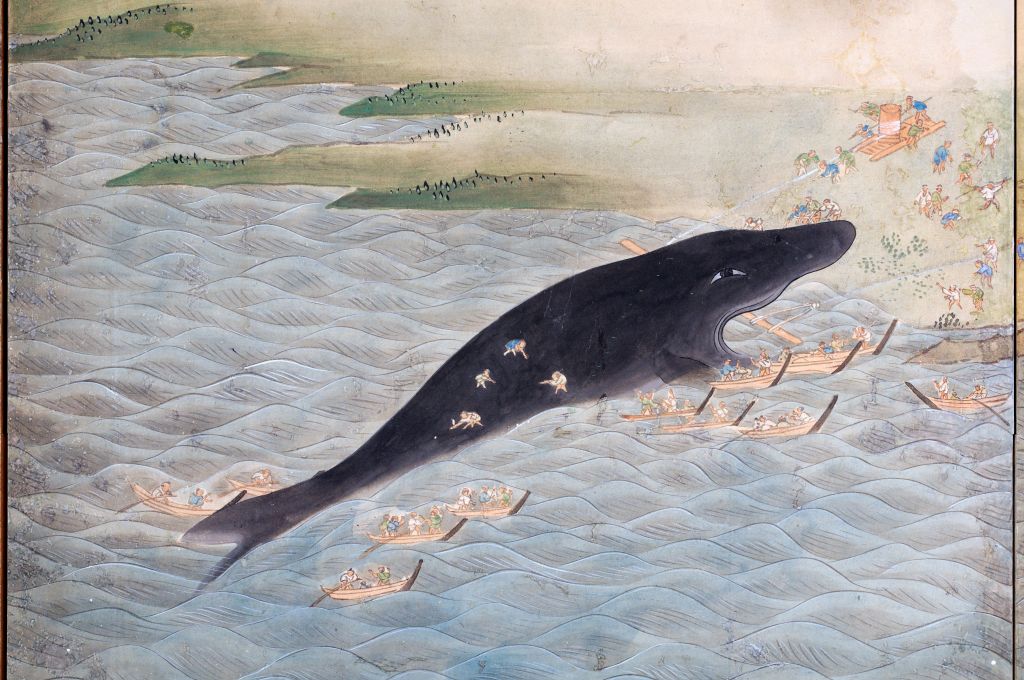
Whales would sometimes come inland, or beach themselves on the shore. Fishermen hunted these whales in a practice called Passive Whaling, using harpoons to kill the whale that was trapped in the shallows. This was a rare and auspicious event—a single whale provided vast amounts of meat and resources for the village, and seemed like a gift from the gods. And the whale itself was only a piece of the bounty. Whales often came in following larges schools of fish, so their arrival meant an abundance of sea life beyond the leviathan itself. The arrival of a whale could save a village teetering on the edge of starvation and ruin. It was mana from the oceans.

Passive Whaling Ukiyoe

Like modern Cargo Cults, the villagers could not understand from where or why the whale came in to shore. They only knew that a whale meant wealth and rare full stomachs. Whales were considered to be embodied deities (神体; shintai), and whale religions sprang up in coastal villages, called Hyochakushin (漂着神; Drifting Ashore God) or Yorikami Shinkyo (寄り神信仰; The Religion of the Visiting Kami).

The Whale and Ebisu

These original whale cults were primitive. The people praying generally had one request—send more whales. But in time they evolved. Like many religions, the Whale Cults in Japan were built on a portion of respect and gratitude and a portion of fear. Because whaling—even Passive Whaling—was a dangerous operation, some whale religions also saw in whales the ability to be malevolent gods, and prayed to appease their spirits and assuage their wrath. Bad storms of poor catches could mean an angry whale god, and nobody wanted that.

In time, these whale religions merged with another, more popular deity, the god of abundance Ebisu. Whales were first thought to be emissaries of Ebisu, and then became considered to be an incarnation of Ebisu himself. Because whales were thought to have the power to control fish, fishermen began carrying images of the god Ebisu as a whale to give them the same fish-controlling powers.

Kujira Jinjya – Whale Shrines

120713_1102

When you have feasted on the body of a god, it only makes sense to give the leftovers a proper burial. After stripping the body of everything useful, villagers buried the whale carcass in mounds called Kujira Tsuga (鯨塚; whale mounds). Kujira Tsuga were capped with monuments of some sort, varying from carved stone tablets to pagodas to small wooden or rock shrines. Often these Kujira Tsuga were created in memory of some particularly bountiful harvest, and annual festivals where held like the Daihyo Tsuifuku (大漁追福; Big Catch Memorial Service). Or people prayed to the Kujira Tsuga for Kaijyo Anzen Kito (海上安全祈祷; Prayers to Ensure Safety at Sea).

Places where passive whaling was more prevalent also had Kujira Haka (鯨墓; whale graveyards) and Kujira Ishibumi (鯨碑; whale stone monuments). There are about 100 known whale graveyards throughout Japan.

Many Kujira Tsuga have their own legends and myths. In Miyagi prefecture, Kesenmema city, Karakuwa town, a legend is told of a ship foundering in the storm that was approached by two massive, white whales. The two whales swam to either side of the ship and steadied it, guiding it into port before sailing away. From that day forward, the citizens of Karakuwa down abandoned their ancient custom of whale eating.

The legend is attached to the MIsaki Shrine in Karakuwa, but the connection is not exactly accurate. Misaki Shrine is an old Kujira Tsuga, raised over a whale corpse and topped with a stone monument expressing gratitude for the whale’s death.

In Ehime prefecture, Seiyo city, Akehama town there are three known Kujira Tsuga, one of which is high up in the mountains. The shrine is ancient, and overlooks the ocean. It now sits along the national highway route making it much more accessible. Hauling up that carcass must have been quite the event.

On June 21st, 1837 (Tenpo 8th), a massive whale came to shore directly underneath this shrine. This was during the Great Tenpo Famine, and the whale saved the entire area from starvation. The villagers gave the whale a posthumous Buddhist name, meaning roughly “The Great Whale Scholar of the Universe who Brings Health.” That was extremely rare at the time, as posthumous Buddhist names was an honor reserved for great lords. The shrine is still honored by the villagers today

Whalebone Tori Gates

Whalebone Tori Japan

By the Edo period, Japan had become a seafaring nation and created a whaling industry and culture. Whaling Associations established and maintained official Whale Shrines in coastal areas, many of which still exist today. Whale shrines were also built in Taiwan when it was under Japanese rule, usually dedicated to Ebisu.

The most dramatic of these have Whalebone Tori gates—the picturesque post-and-lintel design that signifies the presence of a kami spirit.. The oldest Whalebone Tori is in Wakayama prefecture, Taijicho town, called the Arch of Ebisu. Ihara Saikaku mentions this Tori in his book Nippon Eitaigura (日本永代蔵; Japan’s Warehouse of Eternity; 1688). The tori is probably much older, however. The newest whalebone tori is in Nagasaki, Shinkamigostocho town at the Kaido Jinjya (Shrine of the Sea). Dedicated in 1973, it was built by the Japan Whaling Association.

Nirai Kanai

In an odd and unrelated Okinawan legend, a whale dressed in a kimono was said to have brought the secrets of rice cultivation to Japan. You can read more about this in my article on Nirai Kanai.

The Curse of the Bakekujira

Island Whale Ukiyoe

There are two odd footnotes to the story of the bakekujira, that don’t really fit in anywhere else so I am sticking them on here at the end.

In the 1950s, manga artist Mizuki Shigeru was working on a kamishibai story about the bakekujira, and also eating a lot of whale meat. He suddenly came down with a terrible fever, that only stopped when he quit working on the story. He calls this the “Curse of the Bakekujira.”

In 1983, an intact whale skeleton was spotted floating off the shores of Anamizu, Ishikawa prefecture. The press jumped on the story naming it a “real-life bakekujira.”

Translator’s Note:

This article was done at the request of comic book writer Brandon Seifert, who does the incredibly cool folklore/horror comic Witch Doctor, as well as other things. If you are a folklore fan, I highly recommend his work. And look for the bakekujira to possibly pop up his boney head in one of Seifert’s upcoming comics!

Further Reading:

For more tales of ocean-going yokai, check out:
Umibozu – The Sea Monk

Funa Yurei

Nirai Kanai

The Appearance of the Spirit Turtle

Hashihime – The Bridge Princess

Mizuki Shigeru Hashihime

Translated and Sourced from Mizuki Shigeru’s Mujyara, Kaii Yokai Densho Database, Japanese Wikipedia, and Other Sources

Nothing quite embodies the saying “Hell hath no fury like a woman scorned” like the Hashihime. A human woman consumed by jealousy and hatred, she transformed herself through sheer willpower—and the assistance of a helpful deity who taught her a complicated ritual—into a living demon of rage and death. A yokai from the Heian period, she is one of the most powerful and fierce creatures in Japan’s menagerie.

What Does Hashihime Mean?

With only two kanji, her name is straight-forward: 橋 (hashi; bridge) 姫 (hime; princess). But there is a secret meaning hidden inside. In ancient Japanese, the word airashi (愛らしい; pretty; charming; lovely; adorable) could be pronounced “hashi.” So “Hashihime the Bridge Princess” was also a homophone for (愛姫) “Hashihime the Pretty Princess.”

Segawa kikunojō no hashihime

The only real question is why does such a horrible demon have such a lovely, delicate name? This is because the name predates the monster. There have been Bridge Princesses—benign deities of the water—for far longer than there have been jealous women with crowns of iron and burning torches clenched between their teeth.

Hashihime as Water Goddess

Masasumi_Hashihime

Going back into ancient, pre-literate Japan, there has long been a mythology built around bridges. Japan was—and still is—an animistic culture where nature is embodied by spirits of good and ill. The wonders of nature, like particularly large and twisted trees or odd and out of place rocks, had their own guardian deities called kami. Rivers too, especially large rivers, were the abodes of gods.

Bridges across these rivers were the proverbial double-edged sword. They allowed you to cross for commerce and trade, but they also allowed enemies in. Any bridge of significant size was believed to have guardian deities that acted as gatekeepers, letting allies in and keeping enemies out.

The guardian deities of bridges were thought to be a matched set—you had both a male and female river deity, a Bridge Prince and a Bridge Princess. Shrines dedicated along these bridges were dedicated to both equally.

Overtime, the female deity became the more popular of the pair—she was thought to be luminously beautiful and sometimes appeared in human form.

In the year 905 CE, we get one of the oldest known written mentions of the Hashihime, in a poem from the 14th scroll of the Kokin Wakashū (古今和歌集; Collection of Poems of Ancient and Modern Times). This is especially notable because it mentions not just any Hashihime, but the Hashihime of Uji—a legend that would come to dominate all images of this fantastic creature.

“Upon a narrow grass mat
laying down her robe only
tonight, again –
she must be waiting for me,
Hashihime of Uji”

Hashihime as Female Demon

How the transformation happened—from benign, sexy river goddess to avatar of female rage—is unknown. Most likely it happened like all folklore, organically and over time. The shrines to the Hashihime existed near bridges, and as people forgot their original purpose they began to make up new stories. Most of these stories tended to include some legend of the Hashihime as “woman done wrong.” There are old legends of a woman whose husband went off to war and never came back, and she wept by the river bank in sorrow until she was transformed into the Hashihime. Others are stories of jealousy and revenge.

“Hashihime” is the title of one of the chapters of Japan’s first work of literature, Genji Monogatari (源氏物語; The Tale of Genji) and she is mentioned several times throughout. While the Hashihime is used mostly as a metaphor, Genji Monogatari tells the story of Lady Rokujo, a woman consumed and transformed by jealousy into a monster. Lady Rokujo becomes an ikiryo, a rare creature in Japanese folklore able to release their soul—their reikon—and all of its powers while they are still alive.

Kikugawa Eizan Hashihime Twelve Seasons of Genji

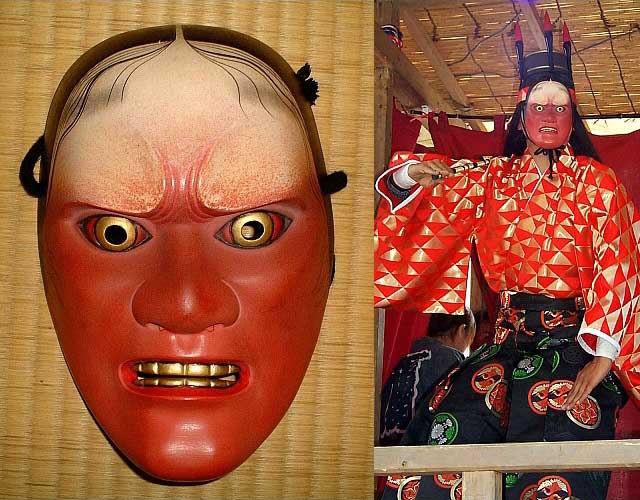
While Lady Rokujo is not the Hashihime, this story of the power of a woman’s jealousy caught the Japanese imagination, and more and more similar characters started to appear in theater and song. Noh Theater in particular loved the Hashihime, and the face of the Hashihime is one of the official masks of Noh.

The Heike Monogatari and the Hashihime of Uji

The story of the Hashihime was solidified in the Heike Monogatari (平家物語; The Tale of the Heike), an epic poem handed down by oral tradition not unlike The Odyssey. Because the Heike Monogatari was told by so many storytellers over so many generations, when written language was discovered multiple, conflicting versions of the poem made it onto the printed page.

Many of these versions told a story of the Hashihime of Uji. She was a noble woman who—by conflicting accounts—either had a husband who cheated on her, or who took a second wife and paid more attention to her. The unnamed woman prayed to the Kami of Kifune for revenge, and was given a complicated ritual that would turn her into a still-living oni.

For more details and a translation of the Heike Monogatari, see The Tale of the Hashihime of Uji.

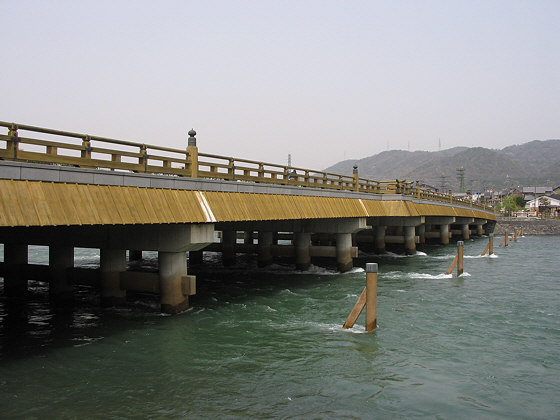
uji_bridge

The Heike Monogatari emphasizes repeatedly than the Hashihime is a “still-living” oni. This is different from other versions of the tale, where the woman dies in the river and rises again as the Hashihime (although not as a yurei. The Hashihime is never a ghost). In Japanese folklore, death has a powerful transformative effect—many stories follow the pattern of post-death revenge. So the Hashihime of Uji being a “still-living” oni adds and extra layer of unnatural terror.

The Hashihime of Uji influenced all following interpretations of the Hashihime, and remains definitive. When Toriyama Sekien put the Hashihime in his Konjyaku Gazu Zokuhyakki (今昔画図続百鬼; The Illustrated One Hundred Demons from the Present and the Past) he specifically referred to her as the Hashihime of Uji.

Toriyama Sekien Hashihime of Uji

Toriyama’s Text:

“The Goddess Hashihime lives in the under the Uji Bridge in Yamashiro province (Modern day Southern Kyoto). That is the explanation for this drawing of the Hashihime of Uji.”

Kanawa – The Iron Crown

hashihime Noh

The Noh play Kanawa (鉄輪; The Iron Crown) comes from one of the versions of the Hashihime story from the Heike Monogatari. In this version, the courtly woman has a husband who takes a second wife, as was the custom at that time. The woman is overcome with jealousy about the second wife, and tries to curse and kill her. But her husband has consulted with the great yin/yang sorcerer Abe no Seimei, who arrives at the last moment to break her curse.

Abe no Seimei then constructs a katashiro, a paper amulet in the form of a human, that reflects the curse back on the first wife, transforming her into a demon. (At this part of the play the lead actor changes into the Hashihime mask). Ashamed of her appearance, the woman (now the Hashihime) flees back to the river, jealousy and revenge burning in her heart.

The Hashihime again attacks the second wife, but is beaten off my Abe no Seimei with the assistance of 30 kami spirits. The Hashihime claims she will return, and disappears.

Other Hashihime

Although she is by far the most famous, the Hashihime of Uji is not the only Hashihime. Nagarabashi bridge over the Yodogawa river in Osaka and the Setanokarabashi bridge over the Setagawa river in Sega prefecture also lay claim to their own Hashihimes.

The Hashihime Shrine

hashihime_shrine

A little off the beaten path, near Uji Bridge, you can find the Hashihime Shrine. It isn’t a big place, and people might not be so eager to guide you there because of the shrines’ reputation—and what it is for.

Shrine records claim the Hashihime Shrine dates back to 646 CE, making it older than most known legends of the Hashihime of Uji. Most likely it was originally dedicated to the water goddess under the bridge, and the kami of the shrine evolved along with the legends.

The shrine is unusual in that it is essentially a divorce shrine. People come—mostly women, to be honest—to pray for freedom from difficult or unwanted attachments. This can be anything or anyone you want to be free of, but in practice most women come to pray for divorce or miscarriage.

The shrine even sells you something to help you on your way. Most Shinto shrines sell some sort of amulet, something to protect you from bad spirits. The Hashihime Shrine does too—it sells magical scissors that you can use to metaphorically cut yourself from entanglements, all without needing to transform yourself into a still-living oni bent on revenge.

Further Reading:

The Hashihime is the last in my series on trivet-wearing yokai. For the rest of the trivet-wearing yokai, check out:

The Tale of the Hashihime of Uji

Ushi no Koku Mairi – The Shrine Visit at the Hour of the Ox

Gotokoneko – The Trivet Cat

Translator’s Note:

This is part 2 of the long-requested Hashihime. I translated the text from the Heike Monogatari for the first part, and this entry gives more of the history and context. The Hashihime is a favorite of mine because I have spent quite a bit of time in Uji. Uji is one of my favorite places in all of Japan. You really should go there if you are ever in Japan. It is stunningly beautiful, with century-old teashops and the magnificent Byoudoin temple. Of course, you must also visit the Uji Bridge where the Hashihime dwells and the Hashihime Shrine to pay your respects.

Previous Older Entries Next Newer Entries

Copyright notification

All translations and other writing on this website were created by Zack Davisson and are copyright to him.

Copyright notification

In accessing these web pages, you agree that any downloading of content is for personal, non-commercial reference only.

No part of this web site may be reproduced or transmitted in any form or by any means, electronic, mechanical, photocopying, recording or otherwise, without prior permission of Zack Davisson.

Copyright notification

For rights clearance please contact Zack at:

zack.davisson (at) gmail.com

Thank you.